
Could your clinical outcomes be suffering because your technology roadmap is stuck in the past? With 80% of healthcare providers planning to increase digital health investments through 2026, the gap between organizations that innovate and those that merely maintain is widening. You likely feel the daily friction caused by outdated systems and the persistent anxiety of a looming HIPAA audit. It’s a common struggle to watch your IT budget disappear into a black hole without seeing a clear return on investment or a path toward strategic modernization.
Our specialized virtual cio services provide the executive-level leadership your organization requires without the excessive overhead of a full-time hire. We’ll show you how to align your technology with clinical outcomes to drive growth and ensure ironclad compliance. This guide explores the May 2026 HIPAA Security Rule updates, the shift toward FHIR-based interoperability under the HTI-5 rule, and how a three-year roadmap can reduce operational costs through intelligent automation. By the end of this article, you’ll understand how to transform your infrastructure into a stable foundation for long-term clinical success.
Key Takeaways
- Understand the transition from a reactive “break-fix” mentality to a proactive technology leadership model that prioritizes clinical outcomes and organizational stability.
- Learn how specialized virtual cio services align IT expenditures with strategic financial goals while maintaining a rigorous HIPAA compliance posture.
- Identify the critical distinctions between the operational support of a Managed Service Provider and the strategic, executive-level guidance of a fractional CIO.
- Discover the methodology for creating a multi-year technology roadmap that begins with clinical workflow audits and infrastructure stabilization.
- Explore why specialized expertise is essential for navigating the complex interoperability standards and regulatory shifts expected in 2026.
What Are Virtual CIO Services for Healthcare?
Understanding What Are Virtual CIO Services for Healthcare? requires looking beyond basic technical support. A vCIO is a high-level executive partner who provides strategic direction on a fractional basis. Unlike traditional IT support that reacts only when systems fail, virtual cio services focus on the long-term health of your digital infrastructure. This role bridges the gap between technical operations and clinical outcomes, ensuring that every technology investment supports patient safety and practice growth. This transition represents a fundamental shift from a “break-fix” mentality to a proactive technology leadership model.
For many medical groups, technical oversight often focuses solely on uptime. While keeping servers running is vital, it doesn’t address the complex demands of modern medicine. A vCIO evaluates how technology integrates into the provider’s workflow. They look at clinical efficiency, data security, and financial ROI. For geographically dispersed healthcare organizations, the virtual nature of this service is a significant asset. It allows leadership to unify disparate clinics under a single, cohesive technology strategy without the logistical burden of an on-site executive at every location.
The Evolution of the Healthcare CIO Role
The responsibilities of the modern CIO have shifted significantly from managing physical hardware to orchestrating data interoperability and patient experience. With the Department of Health and Human Services (HHS) finalizing a major overhaul of the HIPAA Security Rule in May 2026, the demand for executive IT oversight has never been higher. These updates mandate rigorous security measures, such as annual formal audits and mandatory multi-factor authentication. Generalist models no longer suffice in this high-stakes environment. Many organizations now rely on specialized healthcare IT consulting services to ensure their systems meet the specific interoperability standards required by the ONC’s HTI-5 rule.
Fractional Leadership vs. Full-Time Executives
Hiring a full-time CIO in 2026 often requires a salary exceeding $250,000, not including benefits and bonuses. This financial commitment is often prohibitive for mid-sized practices or growing clinics. Fractional virtual cio services offer a cost-effective alternative by providing the same level of expertise at a fraction of the cost. Rather than relying on the knowledge set of a single individual, you gain access to a collective brain-trust of specialists. This model allows you to scale your IT leadership as your practice expands, ensuring you have a steady hand at the wheel during every phase of growth.
Core Responsibilities of a Specialized Healthcare vCIO
A specialized healthcare vCIO operates at the intersection of technology and patient care. While general virtual cio services might focus on uptime and hardware lifecycles, a healthcare-specific lead prioritizes clinical workflows and regulatory integrity. They manage the complex relationship between your technical infrastructure and your ability to deliver care. This role isn’t merely about oversight; it’s about ensuring every digital asset contributes to the financial and clinical health of the organization.
The core responsibilities of this role include several critical functions:
- Strategic Budgeting: Transforming IT from a perceived “black hole” of expenses into a driver of ROI by aligning spending with clinical objectives and billing accuracy.
- Vendor Management: Acting as the primary point of contact for EMR/EHR providers and billing software vendors to ensure service level agreements are met.
- Interoperability: Facilitating the seamless flow of patient data between disparate medical systems, which is essential for meeting the ONC’s HTI-5 rule requirements.
- Risk Mitigation: Maintaining a proactive cybersecurity posture that anticipates threats rather than just reacting to breaches.
Strategic IT Roadmap Development
Developing a roadmap begins with a thorough audit of existing technical debt and legacy systems. This process identifies vulnerabilities that could impede clinical efficiency or lead to compliance failures. By prioritizing projects based on clinical impact and upcoming regulatory deadlines, the vCIO ensures that every dollar spent moves the needle. Building a Multi-Year Strategic IT Roadmap is essential for long-term stability in a rapidly evolving market. This roadmap serves as a living document that evolves alongside clinical needs and technological advancements.
Governance, Risk, and Compliance (GRC)
In a landscape where the HIPAA Security Rule is undergoing significant overhaul in May 2026, proactive risk management is non-negotiable. A healthcare vCIO oversees regular risk assessments to maintain HIPAA and HITECH standards. They establish disaster recovery protocols specifically designed for life-critical patient data, ensuring that your practice remains operational even during a system failure. Security isn’t just about software; it’s about people. Managing the human element through continuous staff training and clear policy enforcement is a cornerstone of effective virtual cio services. Organizations that want to go deeper on protecting patient data should explore dedicated healthcare cybersecurity services to build a zero-trust framework that addresses both technical vulnerabilities and human risk factors. If you’re concerned about how these responsibilities fit into your current structure, exploring specialized IT leadership can provide the clarity and security your organization requires.
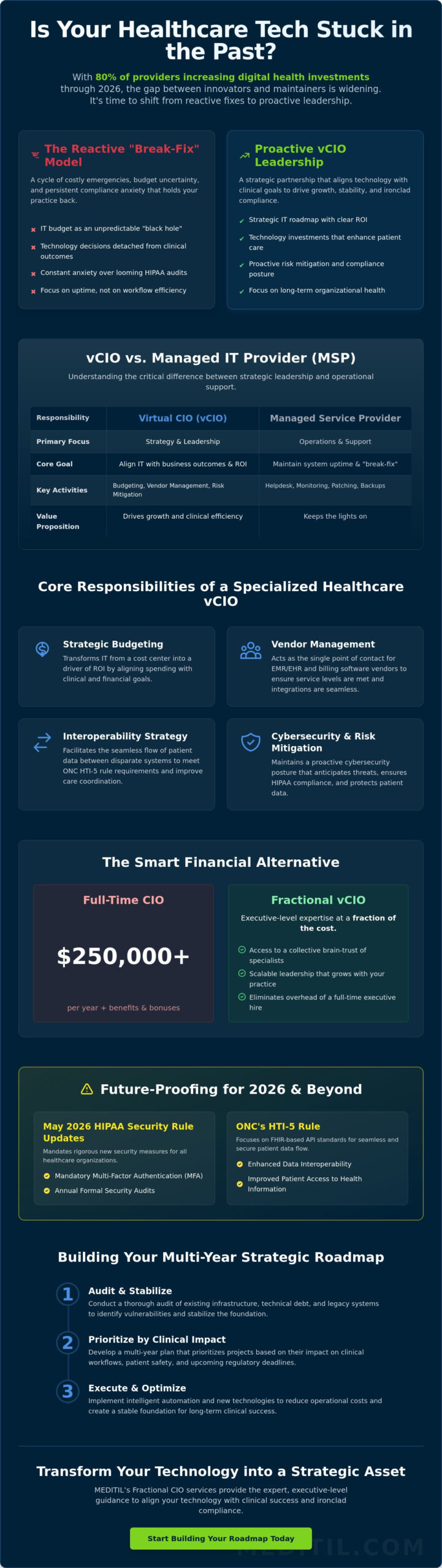
Virtual CIO vs. Managed IT Provider: Which Does Your Practice Need?
Many healthcare organizations conflate the roles of a Managed Service Provider (MSP) and a vCIO. While both are essential for a stable environment, they serve distinct purposes. Think of your MSP as the “Engine Room.” They focus on uptime, patching, help desk tickets, and general maintenance. In contrast, virtual cio services provide the “Captain” for your ship. The vCIO isn’t looking at the individual server today; they’re looking at the horizon to ensure your technology investments align with long-term clinical viability and financial ROI. Relying on an MSP for high-level strategy often leads to a conflict of interest where technology is implemented for its own sake rather than to solve a specific clinical friction point.
A vCIO acts as a critical check-and-balance for your technical teams. Whether you have an internal IT department or an external provider, the vCIO ensures that their daily tasks support the broader mission. They translate complex technical data into actionable business intelligence for your board or executive committee. This distinction is especially vital when navigating challenges in rural healthcare IT leadership, where resources are often limited and every strategic decision carries significant weight. Without this executive layer, practices often find themselves with “perfectly functioning” systems that don’t actually support the physicians’ workflows.
Evaluating Your Current IT Support Model
It’s easy to tell when your MSP has reached its strategic ceiling. If your leadership meetings consist of discussing why the Wi-Fi is slow rather than how to leverage data for better patient outcomes, you’re missing a strategic layer. The “Fire Drill” indicator is another clear sign. Are you constantly reacting to technology issues, or are you following a roadmap that prevents them? Understanding how managed it services for healthcare integrate with vCIO leadership is the first step toward moving from a reactive to a proactive posture. A standard MSP keeps the lights on; a vCIO decides which rooms need lighting and why.
The Synergy of Combined Services
The most successful healthcare groups utilize both roles in tandem. Virtual cio services optimize the performance of your existing IT staff by providing them with clear priorities and a structured roadmap. This reduces the operational friction that often exists between clinical staff and technical support. When the IT team understands the clinical “why” behind a project, implementation is smoother and adoption rates among providers increase. This unified management approach has been shown to improve clinical outcomes by ensuring that technology serves as a tool for care rather than a barrier to it.
Building a Multi-Year Strategic IT Roadmap
A multi-year strategic roadmap is not a static document; it is a phased evolution that ensures your technology supports clinical expansion rather than hindering it. Without a structured plan, healthcare organizations often fall into a cycle of reactive spending. Specialized virtual cio services break this cycle by providing a clear, four-phase approach to modernization. This methodical progression allows leadership to manage technical debt while preparing for the regulatory and operational demands of 2026 and beyond.
- Phase 1: Discovery and Clinical Workflow Audit. This initial stage identifies technical debt and “clicks-to-care” bottlenecks that frustrate providers. It establishes a baseline for performance and security.
- Phase 2: Stabilizing the Foundation. Efforts focus on infrastructure upgrades and ironclad security. This phase is essential for meeting the mandatory encryption and multi-factor authentication requirements finalized in the May 2026 HIPAA Security Rule updates. Implementing robust healthcare cybersecurity services during this phase ensures that your organization can defend against AI-driven threats while maintaining the seamless clinical workflows your providers depend on.
- Phase 3: Optimization. Here, the focus shifts to efficiency, specifically through healthcare revenue cycle management it solutions. This phase targets billing accuracy and administrative automation to recover lost revenue. Deploying medical billing automation solutions during this stage is critical for achieving the 2026 industry benchmark of a 98% clean claim rate and eliminating the systemic risks posed by manual entry and fragmented financial data.
- Phase 4: Innovation. Once the foundation is stable, the organization can safely implement telehealth, AI-driven decision support, and remote patient monitoring to scale patient care.
Aligning Technology with Clinical Workflows
Technology must serve the provider, not the other way around. By identifying bottlenecks in EMR systems, a vCIO can streamline the user experience to prioritize patient interaction over screen time. Implementing automated billing integrations further reduces the administrative burden on clinical staff. Seamless interoperability reduces physician burnout by eliminating manual data entry and ensuring patient records are instantly accessible across the care continuum. This alignment turns your IT environment into a tool for retention and provider satisfaction.
Budgeting for Predictable Growth
Effective financial management requires moving from unpredictable capital expenditure (CapEx) to a more stable operational expenditure (OpEx) model. This shift allows practices to replace large, sudden hardware costs with predictable monthly investments. Virtual cio services provide the expertise needed to forecast hardware refresh cycles and cloud migration costs with precision. This ensures that IT spend remains a consistent, manageable percentage of total revenue. If you are ready to transition from reactive patches to a structured future, you can consult with our strategic IT leaders to begin your roadmap today.
MEDITIL’s Fractional CIO Services: Expert Strategy for Healthcare
Successfully managing a medical organization in 2026 requires more than technical proficiency. It demands a deep understanding of the regulatory and clinical pressures unique to the healthcare sector. MEDITIL’s virtual cio services are built specifically for this high-stakes environment. We don’t just manage hardware; we provide the strategic oversight necessary to bridge the gap between the boardroom’s financial objectives and the exam room’s clinical realities. In an era marked by the May 2026 HIPAA Security Rule overhaul and evolving interoperability standards, having a seasoned expert to guide your technology decisions is a requirement for operational survival. We serve as a steady hand at the wheel, offering a proactive approach to systems management and data connectivity.
Our methodology focuses on long-term stability and measurable improvement. We understand that clinical friction caused by outdated systems leads to provider burnout and reduced patient satisfaction. By aligning your digital infrastructure with clinical workflows, we transform technology from a source of frustration into a tool for growth. Our expertise ensures that your organization remains ahead of regulatory deadlines, such as the February 2026 HIPAA Notice of Privacy Practices update, while maintaining a robust cybersecurity posture that protects sensitive patient data.
A Partner, Not Just a Provider
MEDITIL operates as a strategic partner invested in your long-term success. We provide access to a nationwide network of healthcare IT specialists, offering a depth of knowledge that far exceeds the capabilities of a single internal hire. Our focus is on transparency and accountability. We deliver regular, comprehensive reports that demonstrate a clear ROI on your technology investments. This commitment to operational stability means you can focus on patient outcomes, knowing that every detail of your IT infrastructure is being handled with precision and expert care.
Next Steps for Your Strategic Evolution
The transition to a more strategic IT model begins with a thorough understanding of your current environment. When you engage with MEDITIL, we work to integrate seamlessly with your existing structure, whether you utilize an internal IT team or an external MSP. We act as the strategic layer that coordinates these resources to meet your multi-year goals. During an initial strategic consultation, we identify immediate vulnerabilities and outline a path toward stabilization and growth. This process ensures that your technology roadmap is both realistic and results-oriented. To take the first step toward a secure and clinical-first technology environment, Schedule a Strategic IT Consultation with MEDITIL today.
Securing the Future of Your Healthcare IT Strategy
The healthcare landscape in 2026 demands a departure from reactive technical support. Success now hinges on your ability to align complex infrastructure with clinical outcomes and evolving regulatory standards. By implementing a multi-year roadmap, organizations can move from unpredictable technical debt to a stable, scalable operational model. This strategic shift ensures that technology serves as a primary asset for patient care rather than a source of administrative friction.
Specialized virtual cio services provide the executive-level guidance needed to navigate the May 2026 HIPAA Security Rule updates and the technical requirements of the HTI-5 interoperability rule. MEDITIL offers deep healthcare sector specialization and national US coverage to support your growth. Our expertise in EMR interoperability and HIPAA GRC ensures that your systems remain compliant and efficient. You don’t have to manage these high-stakes complexities alone.
Secure Your Strategic Roadmap with MEDITIL’s Virtual CIO Services
With a steady hand at the wheel, your organization can confidently embrace the innovations of the future while maintaining a secure and stable foundation today.
Frequently Asked Questions
What is the difference between a vCIO and a vCISO?
A vCIO focuses on broad technology strategy and business alignment, while a vCISO specializes exclusively in security posture and risk management. The vCIO ensures that technology investments support clinical goals and organizational growth. In contrast, the vCISO focuses on protecting data from breaches and ensuring that technical security controls meet specific regulatory standards.
Does a virtual CIO replace my current IT company?
No, a vCIO typically complements your existing IT team or Managed Service Provider by providing executive leadership and strategic direction. While your MSP handles daily technical tasks like help desk support and server maintenance, the vCIO acts as a strategic guide for those teams. They provide a necessary check-and-balance to ensure technical work aligns with clinical needs.
How much do virtual CIO services typically cost for a medical practice?
The cost of virtual cio services varies based on the level of engagement and the complexity of the healthcare organization. Advisory-level support is generally structured as a predictable monthly retainer, while more intensive, embedded leadership roles involve different investment levels. Practices should evaluate these services based on the significant salary savings of avoiding a full-time executive hire.
Can a vCIO help with EMR/EHR selection and implementation?
Yes, a vCIO provides essential guidance during the selection and implementation of clinical systems to ensure they meet your specific workflow requirements. They manage vendor relationships and oversee the technical integration process to prevent bottlenecks. By focusing on interoperability, they ensure that new software communicates effectively with your existing billing and laboratory systems.
How many hours a month does a fractional CIO typically work?
A fractional CIO typically works between 5 and 20 hours per month, depending on the current phase of your technology roadmap. During a major system implementation or a complex infrastructure stabilization project, hours may increase to provide more intensive oversight. In a standard maintenance phase, the engagement often shifts to monthly strategy reviews and quarterly executive reporting.
Is a vCIO responsible for HIPAA compliance audits?
A vCIO oversees the governance and strategy required to pass a HIPAA audit, though they often work alongside specialized compliance officers. They ensure that technical safeguards, such as the mandatory MFA and encryption required by the May 2026 HIPAA Security Rule updates, are correctly implemented. Their role is to verify that your infrastructure and policies remain regulator-ready at all times.
What qualifications should I look for in a healthcare virtual CIO?
You should look for a professional with deep experience in healthcare-specific technology and a thorough understanding of regulatory standards like HIPAA and HITECH. Effective candidates possess a blend of technical expertise and business acumen. This allows them to communicate with both IT staff and board members. Look for a proven track record in managing EMR interoperability and multi-year strategic budgeting.
How does a vCIO improve patient care outcomes?
A vCIO improves outcomes by optimizing clinical workflows and ensuring that technology never acts as a barrier between the provider and the patient. By streamlining access to data and reducing technical friction, they allow physicians to focus on diagnosis and treatment rather than troubleshooting software. Robust virtual cio services ensure that life-critical patient data is always available and secure when it is needed most.
31 Responses