With the average cost of a healthcare data breach reaching $7.42 million in 2025, the margin for error in technical leadership has effectively vanished. You likely feel the weight of this reality every day. It’s a constant challenge to balance the pressure of HIPAA audits against a growing disconnect between technical priorities and clinical workflows. It’s frustrating to watch specialized talent leave for other sectors while your remaining staff struggles to maintain legacy systems alongside mandatory AI innovations. Managing healthcare it teams in this environment requires more than just technical oversight; it demands a steady hand that can align infrastructure with patient care.
This article provides a strategic framework to help you master these complexities and secure your organization’s digital future. You’ll learn how to build a stable, high-performing department that achieves 100% compliance audit readiness while directly reducing physician burnout. We will examine the essential steps for bridging the gap between IT and the clinic, preparing for 2026 regulatory shifts like the 72-hour system restoration requirement, and ensuring a clear ROI on every technology investment. By the end of this guide, you will have the tools to transform your IT department into a proactive partner in clinical excellence.
Key Takeaways
- Learn how to transition from reactive troubleshooting to a proactive strategic partnership that aligns your technical roadmap with clinical goals.
- Discover methods for establishing a high-security culture that ensures 100% compliance readiness without creating unnecessary barriers for medical staff.
- Identify the optimal staffing balance for managing healthcare it teams by evaluating the cost-efficiency of in-house specialists versus fractional CIO leadership.
- Implement specific strategies to reduce clinical friction, including shadowing programs that help IT staff optimize digital workflows for providers.
- Gain a framework for prioritizing interoperability and FHIR-based APIs to eliminate data silos and streamline complex prior authorization processes.
The 2026 Landscape of Managing Healthcare IT Teams
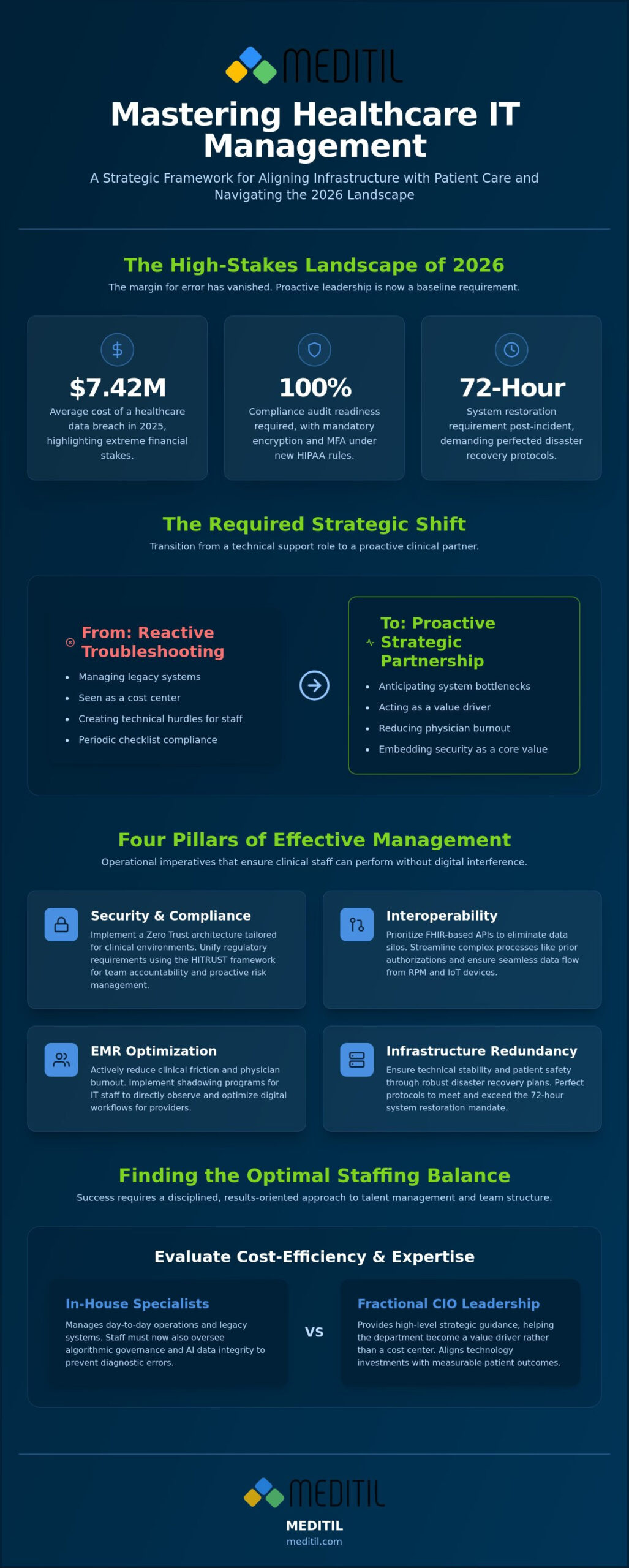
By 2026, the era of digital transformation has moved from an aspirational goal to a baseline requirement for survival. Managing healthcare IT teams no longer involves simple hardware maintenance or routine software patches. Instead, it requires a sophisticated understanding of how technical infrastructure supports life-critical decisions. Leadership must transition from reactive troubleshooting to a proactive strategic partnership. This means anticipating system bottlenecks before they impact a physician’s workflow and ensuring every technology investment translates into measurable patient outcomes. It’s about being a steady hand at the wheel while the industry undergoes rapid technical evolution.
The dual mandate of modern IT leadership is clear: you must maintain ironclad security while ensuring clinical accessibility. If a security protocol adds significant time to a nurse’s documentation process, it’s a failure of leadership, not just a technical hurdle. Leaders act as a strategic guide, helping their departments become value drivers rather than mere cost centers. This shift is essential because the volume and sensitivity of healthcare data in 2026 demand a specialized management approach that general IT frameworks cannot provide. Success requires a focus on infrastructure that is both resilient and invisible to the end user.
The Rise of Clinical Data Complexity
Your team isn’t just managing servers; they’re managing a continuous stream of clinical intelligence. The influx of data from Remote Patient Monitoring (RPM) and medical IoT devices has created a telemetry tidal wave. General IT management often fails here because it lacks the nuance required for Health information management and the strict requirements of medical-grade data. The integration of AI has shifted the skill requirements for your staff. It’s no longer enough to understand database administration. Teams must now oversee algorithmic governance and ensure data integrity across interconnected systems to prevent diagnostic errors. This complexity requires a disciplined, results-oriented approach to talent management.
Regulatory Pressure and the Cost of Failure
The regulatory environment in 2026 has reached a new level of stringency. Recent updates to the HIPAA Security Rule have made encryption and multi-factor authentication mandatory, removing the flexibility of “addressable” standards. The 72-hour system restoration requirement following an incident puts immense pressure on IT leadership to have perfected disaster recovery protocols. Compliance must be treated as a core cultural value rather than a periodic checklist. By investing in comprehensive healthcare cybersecurity services, management protects more than just data; they protect the patient trust that sustains the organization. With the average cost of a healthcare data breach reaching $7.42 million in 2025, the financial and reputational stakes are absolute.
Core Pillars of Effective Healthcare IT Management
Effective management relies on a foundation that prioritizes patient safety through technical stability. Managing healthcare it teams requires a shift in focus toward four central pillars: security, interoperability, EMR optimization, and infrastructure redundancy. These aren’t just technical goals; they’re operational imperatives that ensure clinical staff can perform their duties without digital interference. When these pillars are managed correctly, the IT department stops being a source of friction and becomes a steady hand that supports every clinical outcome.
Security and Compliance as a Foundation
In 2026, the traditional perimeter-based security model is obsolete. Leaders must implement a Zero Trust architecture specifically tailored for clinical environments, where access is verified at every step without slowing down the provider. This involves regular security audits and proactive risk management protocols that identify vulnerabilities before they can be exploited. According to research on Organizational Leadership in Healthcare, the success of these technical measures depends heavily on how leadership trains and incentivizes the team to prioritize security as a shared responsibility. HITRUST compliance serves as the definitive framework for team accountability by unifying various regulatory requirements into a single, verifiable standard of data protection.
Interoperability and Data Management
Data silos are the primary enemy of clinical efficiency and patient safety. When managing healthcare it teams, the priority must be the adoption of FHIR standards to ensure seamless data exchange across different platforms. This interoperability isn’t just about moving data; it’s about making it actionable at the point of care. Reducing clinical friction often starts with the administrative burden. By implementing medical billing automation solutions, organizations can free up significant IT resources that would otherwise be spent on manual data entry or troubleshooting fragmented billing systems. This allows the team to focus on higher-value projects like EHR optimization and AI governance.
Finally, 24/7 clinical availability requires robust infrastructure redundancy. Clinical teams cannot afford downtime, so the IT management strategy must include geographically dispersed backups and automated failover systems. This technical foundation must be paired with continuous staff training. As EMR/EHR systems evolve, the IT team must act as a bridge, providing ongoing education to clinicians to ensure they’re using the tools to their full potential. If your organization is struggling to maintain this level of specialized oversight, considering strategic IT consulting can help bridge the gap in your operational planning.
Staffing Models: In-House vs. Managed vs. Fractional CIO
Selecting the right staffing model is a high-stakes decision that dictates your organization’s technical resilience. When managing healthcare it teams, the choice between internal staff and external partners often comes down to a balance of cost, specialized expertise, and operational continuity. In 2026, the fiscal reality of recruitment is stark. The average cost to hire in the healthcare sector is $4,770, but this figure often climbs above $6,464 for specialized IT and professional services roles. Organizations looking to optimize their broader workforce, including support and hospitality roles, can discover LetME as a modern solution for quality-assured personnel. With senior software engineers in healthcare now commanding average salaries of $126,002, building a full-scale in-house department can quickly strain a mid-sized organization’s budget. Beyond the salary, the “single point of failure” risk remains a critical concern for small departments where the departure of one key specialist can jeopardize clinical operations.
The ROI of Fractional IT Leadership
A fractional leadership model provides enterprise-level strategy without the burden of an executive-level salary. This approach is particularly effective for organizations that need a steady hand to guide long-term technical roadmaps but don’t require a full-time C-suite presence. By utilizing virtual CIO services, practices gain access to seasoned experts who bridge the gap between the boardroom and the server room. These leaders ensure that technology investments aren’t just technical upgrades but strategic advancements that improve patient care. They provide the disciplined oversight needed to manage complex vendor relationships and regulatory audits, ensuring your infrastructure remains compliant and performant.
Augmented Teams and Managed Operations
Scalability is the primary advantage of moving toward a managed or augmented staffing model. Managed operations allow you to outsource the day-to-day management of your infrastructure to a specialized partner, ensuring 24/7 clinical availability and help desk support. This model is essential for maintaining continuity of care during staff transitions or large-scale system migrations. According to the Harvard T.H. Chan School of Public Health, successful Modern Healthcare Team Management requires a focus on cohesion and clear operational “norms” which can be difficult to maintain with a high-turnover internal team.
When you compare internal management overhead against managed it services for healthcare, the benefits of partnership become clear. You eliminate the burden of specialized recruitment and the hidden costs of training and retention. An augmented team provides a proactive guide through the complexities of a regulated environment, allowing your internal leadership to focus on clinical excellence rather than troubleshooting. It’s a methodical transition from a reactive posture to a stable, high-performing IT ecosystem. Is your current staffing model prepared for the regulatory shifts of 2026?
Best Practices for Reducing Clinical Friction
Clinical friction occurs when technology becomes a barrier rather than a tool. Managing healthcare it teams in 2026 requires a disciplined focus on the provider experience to prevent burnout and ensure patient safety. It’s not enough for systems to be functional; they must be intuitive. Leaders must prioritize IT projects based on their direct impact on clinical outcomes and the ease of use for medical staff. This involves moving beyond simple tickets and help desk metrics to measure the actual time saved at the bedside. When IT teams understand the high-stakes nature of clinical work, they can transition from being perceived as a hurdle to being seen as a strategic partner.
One of the most effective ways to build this understanding is through “Shadowing” programs. By requiring IT staff to observe clinical workflows in real-time, they gain a firsthand look at how technical delays translate into delayed care and the physical strain on staff who are constantly on their feet. For organizations seeking to support the physical stability of their clinical teams, you can learn more about Zero Give. This practice builds empathy and allows the team to identify “invisible” bottlenecks that clinicians might not think to report. Establishing a feedback loop that respects the schedule of a busy physician is also critical. Short, mobile-friendly surveys or brief, monthly check-ins are more effective than long meetings that take providers away from their patients. This methodical approach ensures that technology serves the mission of the organization.
Bridging the IT-Clinical Divide
A Clinical IT Advisory Committee is an essential management structure for any modern healthcare organization. This group acts as a bridge, ensuring that technical decisions are guided by clinical necessity. It’s vital to train your technical staff to speak the language of the clinic. When an IT professional understands the difference between an urgent lab result and a routine documentation update, they can prioritize their tasks with greater precision. Management should also utilize it budgeting for medical practices to specifically fund improvements requested by physicians, demonstrating a clear commitment to their operational needs.
Workflow Optimization and Training
Optimization must extend beyond the primary EHR system to include the peripheral tools that often cause daily frustration. Scanners, label printers, and mobile communication devices are frequently the source of significant clinical friction if they aren’t managed with the same rigor as the core database. Instead of traditional classroom sessions, implement “just-in-time” training that provides short, targeted instructions exactly when a clinician needs them. Generic IT management strategies often fail in specialized clinics because they don’t account for the unique data requirements and high-precision workflows specific to those medical disciplines. If you’re struggling to balance technical requirements with provider satisfaction, partnering with a specialized IT management firm can provide the expertise needed to streamline your operations.
Partnering with MEDITIL for Healthcare IT Excellence
The transition toward a proactive, strategic IT department requires more than just new software; it requires a fundamental shift in how your technical resources are directed. MEDITIL serves as the strategic management layer that bridges the gap between complex infrastructure and clinical performance. We provide the disciplined oversight necessary to ensure your technology supports your mission rather than detracting from it. By managing healthcare it teams with a focus on stability and precision, we help organizations navigate the high-stakes regulatory environment of 2026 with confidence. We don’t just offer technical support; we act as a proactive guide for your entire digital ecosystem.
Our approach is built on the philosophy of a “steady hand at the wheel.” Whether you’re dealing with the pressure of a HIPAA audit or the complexities of AI integration, our team provides the seasoned expertise required to maintain operational continuity. We understand that every medical practice has unique workflows, which is why we reject generic solutions in favor of customized roadmaps. This methodical process ensures that your technical advancement is always aligned with your clinical objectives and financial goals. Managing healthcare it teams effectively means ensuring that every server, application, and security protocol is verified and optimized for life-critical service.
Comprehensive Managed IT and Strategy
MEDITIL provides a full suite of infrastructure and network services designed specifically for the healthcare sector. Our management goes beyond basic maintenance to include proactive monitoring and advanced cybersecurity protocols. We maintain a security-first mindset that prioritizes data protection without hindering care delivery. This includes managing cloud services, telehealth platforms, and remote monitoring systems with a focus on seamless connectivity. Getting started is a structured process that begins with a comprehensive strategic IT assessment. This evaluation identifies vulnerabilities in your current systems and provides a clear path toward 100% compliance readiness and technical stability.
The MEDITIL Difference: Healthcare-Only Focus
The primary advantage of partnering with MEDITIL is our exclusive focus on the medical industry. We possess deep expertise in EMR/EHR implementation, interoperability, and billing automation integration. This specialized knowledge allows us to resolve clinical friction more efficiently than generalist IT firms. We understand the nuances of medical-grade data and the specific requirements of health information management. When you utilize our augmented IT teams or fractional CIO leadership, you gain a partner invested in your long-term success. It’s time to move away from reactive troubleshooting and toward a stable, high-performing IT department. Schedule a consultation with a MEDITIL Fractional CIO today.
Securing Your Strategic Technical Future
The landscape of 2026 demands a departure from traditional, reactive IT oversight. Success now hinges on your ability to align technical infrastructure with clinical workflows while maintaining absolute regulatory compliance. This is about stability. By prioritizing interoperability and fostering a culture of security, you transform your department from a cost center into a strategic asset. Whether you choose an augmented team or a fractional leadership model, the goal remains the same: a high-performing environment that supports patient care without friction.
Managing healthcare it teams requires a partner who understands the unique pressures of the medical sector. MEDITIL provides the specialized healthcare-only focus needed to navigate these complexities. Our experienced fractional CIOs and comprehensive HIPAA compliance management ensure your organization is prepared for any audit or innovation. It’s time to move toward a more resilient operational model. Optimize your healthcare IT management with MEDITIL today and gain the peace of mind that comes with expert oversight. Your clinical success starts with a disciplined strategy.
Frequently Asked Questions
What are the biggest challenges in managing healthcare IT teams today?
High staff turnover, escalating regulatory pressure from HIPAA, and a persistent disconnect between technical priorities and clinical workflows are the primary obstacles. Leaders must also navigate the complexity of integrating AI innovations while maintaining aging legacy systems. With the average cost of a healthcare data breach reaching $7.42 million in 2025, security has become a high-stakes management challenge that requires constant, disciplined oversight.
How does a Fractional CIO differ from a full-time IT Manager?
A Fractional CIO provides high-level strategic guidance and board-level representation, whereas an IT Manager typically focuses on daily operational tasks and department supervision. Fractional leaders act as a proactive guide for long-term roadmap development and executive decision-making. This model allows mid-sized organizations to access seasoned expertise for managing healthcare it teams without the financial burden of a full-time C-suite salary.
Why is clinical friction a management problem rather than a software problem?
Clinical friction usually stems from a failure to align technical configurations with the actual physical movements and documentation needs of medical providers. Managing healthcare it teams effectively requires leaders to bridge the gap between technical specifications and clinical reality. When IT projects are prioritized without direct clinician input, even the most advanced software becomes a barrier to efficient patient care.
How can I reduce IT staff turnover in my medical practice?
Reducing turnover requires a focus on professional development, competitive compensation, and a mission-driven culture that connects technical tasks to patient outcomes. With the cost per hire for specialized IT roles often exceeding $6,464, retention is a significant financial imperative. Offering clear career paths, such as clinical awareness or medical emergency training from First Medical Training Ltd, and reducing individual burnout through augmented staffing models can help stabilize your internal department and preserve institutional knowledge.
What security certifications should I look for in a managed IT partner?
You should prioritize partners with HITRUST CSF certification and SOC 2 Type II compliance to ensure they meet the rigorous standards of the healthcare industry. These certifications verify that the partner has established disciplined, audited controls for data protection. A partner should also demonstrate a deep understanding of the 2026 HIPAA Security Rule updates regarding mandatory encryption and multi-factor authentication.
How do I align my IT budget with clinical goals?
Alignment begins with establishing a Clinical IT Advisory Committee that identifies which technical investments will most effectively reduce provider burnout or improve patient safety. Budgeting must move away from reactive repair costs toward proactive investments in interoperability and billing automation. This ensures that every dollar spent on managing healthcare it teams translates into a measurable clinical improvement or a clear operational ROI.
What is the role of an augmented IT team in a mid-sized clinic?
An augmented team provides specialized expertise and additional labor to support your existing staff during system migrations, regulatory audits, or periods of rapid growth. This model effectively eliminates the “single point of failure” risk common in smaller departments. It allows your internal leadership to focus on high-level strategy while the partner handles infrastructure maintenance, network security, and 24/7 help desk support.
How often should a healthcare IT team undergo compliance training?
Compliance training should occur at least annually, with supplemental sessions whenever regulatory standards like HIPAA or CMS interoperability rules are updated. Continuous education ensures that security remains a core cultural value rather than a periodic checklist. Regular drills for the mandatory 72-hour system restoration requirement are also essential for maintaining 100% audit readiness and operational resilience in 2026.