
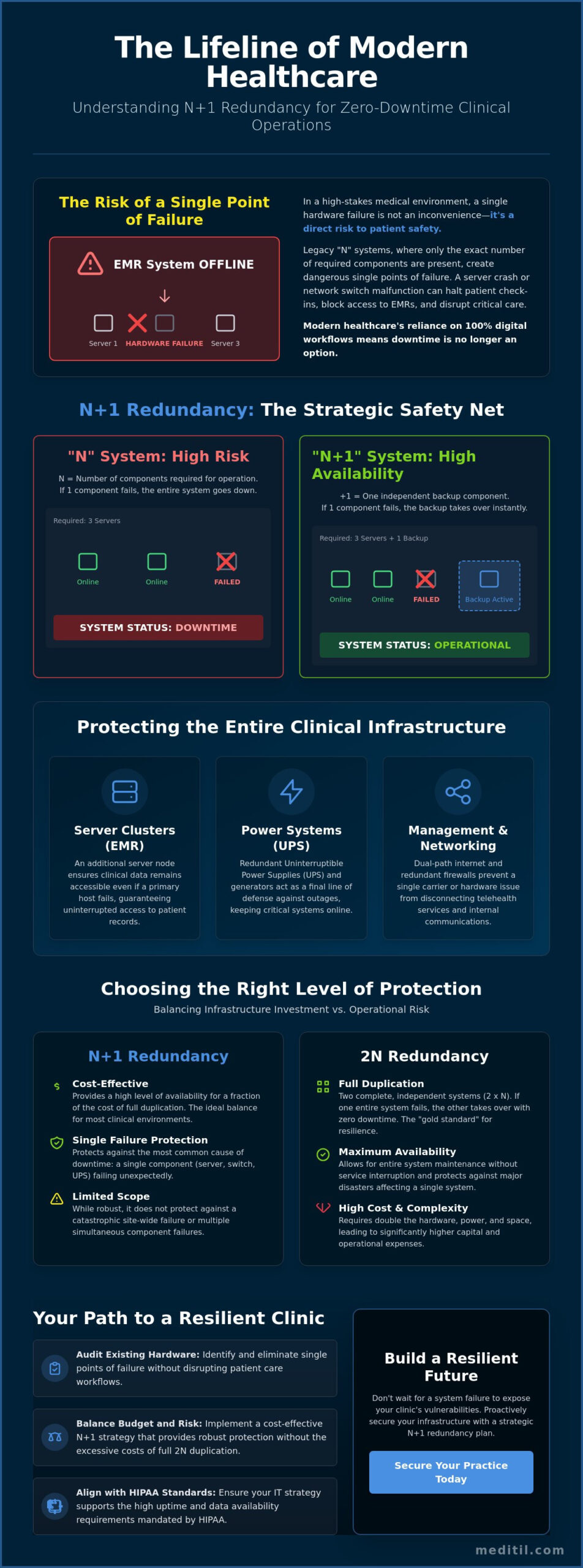
Imagine a clinician in the middle of a critical patient evaluation when the EMR suddenly goes dark because of a hardware failure. In a high-stakes medical environment, a single point of failure is more than an IT inconvenience. It’s a direct risk to patient safety. This reality leads many healthcare leaders to ask: what is n 1 redundancy and how does it secure our clinical environment? At its core, this configuration ensures that for every “N” number of components required to run a system, there’s at least one “+1” independent backup ready to take over immediately.
It’s understandable to feel overwhelmed by technical jargon while trying to balance infrastructure upgrades with tight departmental budgets. You need a reliable system that guarantees zero-downtime clinical operations without the excessive costs of full duplication. This guide explains how N+1 redundancy protects healthcare organizations from critical system failures and ensures continuous patient care. We will break down the framework for IT budgeting and show you how to maintain compliance with HIPAA availability standards through strategic infrastructure planning.
Key Takeaways
- Understand what is n 1 redundancy and how this configuration provides a cost-effective safeguard against single component failures in clinical environments.
- Identify critical vulnerabilities in server clusters and network switching to ensure that electronic medical records remain accessible during hardware malfunctions.
- Evaluate the performance differences between N+1 and 2N redundancy models to determine the most appropriate balance between infrastructure investment and operational risk.
- Learn a structured approach for auditing existing hardware to eliminate single points of failure without disrupting active patient care workflows.
- Align your IT strategy with HIPAA availability standards by implementing redundant systems that support the high uptime requirements of modern healthcare data centers.
What is N+1 Redundancy? The Basic Definition for Healthcare
Maintaining continuous access to patient data requires a shift from reactive repairs to proactive architecture. Central to this strategy is understanding N+1 redundancy, a standard that ensures critical systems remain operational even when hardware fails. When administrators ask what is n 1 redundancy, they are essentially looking for a guarantee of High Availability (HA). This configuration provides a safety margin that protects clinical workflows from the unpredictable nature of hardware lifecycles.
In technical terms, “N” represents the base capacity required to support your current clinical workload. If your facility requires four servers to process EMR requests without lag, then N equals four. The “+1” is the independent backup component. It isn’t just an extra piece of hardware; it’s a strategic safety net. This extra module can either sit on standby or share the load during normal operations. This load-sharing approach, often called active-active redundancy, reduces wear on individual components while providing a seamless transition if one unit goes offline. The core promise of this setup is simple: if any single component fails, the system continues to function without interruption.
The N+1 Formula in Simple Terms
Think of it as a logical insurance policy. If your network requires three switches to maintain connectivity across the clinic floor, an N+1 configuration provides four. In an “N” system, a single failure leads to immediate downtime, halting patient check-ins and script orders. N+1 redundancy serves as the baseline for medical-grade IT resilience by ensuring that no single hardware fault can cripple clinical workflows. This structure allows for routine maintenance or unexpected repairs without forcing the clinic into an offline state.
Why Healthcare Can No Longer Rely on “N” Systems
The transition to 100% digital workflows has changed the stakes for infrastructure. Ten years ago, a server failure meant a temporary switch to paper charts; today, it means a total cessation of services. Many clinics still operate on legacy “N” systems, creating dangerous single points of failure that go unnoticed until a crisis occurs. This technical debt often results from budget constraints or a lack of strategic oversight. However, the financial loss of a “dark” clinic during business hours often exceeds the cost of the initial upgrade. Beyond the balance sheet, the emotional strain on clinical staff and the potential risk to patient safety make “N” systems a liability. Modern healthcare requires a steady hand at the wheel, ensuring that connectivity remains a constant, not a variable.
How N+1 Redundancy Protects Clinical Infrastructure
Protecting a healthcare facility’s digital backbone requires more than just high-quality hardware. It demands a architecture where components work in concert to eliminate single points of failure. When analyzing what is n 1 redundancy in a practical setting, we look at the server clusters hosting Electronic Medical Records (EMR). By deploying an additional server node beyond the minimum required capacity, clinical data remains accessible even if a primary host experiences a critical hardware fault. This ensures that the flow of patient information never stops, allowing clinicians to focus on care rather than troubleshooting connectivity.
Infrastructure resilience extends to the power systems that keep these servers running. Between 2019 and 2023, U.S. hospitals and clinics experienced an annual average of nearly 3,200 fires, highlighting the volatility of physical environments. N+1 redundancy in Uninterruptible Power Supply (UPS) systems and backup generators serves as the final line of defense. If one UPS module fails during a power surge or outage, the secondary module immediately sustains the load. This level of protection is often compared to other models, such as N+1 vs. 2N Redundancy, to determine which architecture best fits a facility’s risk profile and budget.
Redundancy in Management and Networking
The clinic floor relies on constant connectivity to function. Implementing dual-path internet connections prevents telehealth disruptions, ensuring that a single carrier outage doesn’t disconnect providers from their patients. This approach to management and networking also involves redundant firewalls. If a primary security appliance fails, a secondary unit takes over to maintain the cybersecurity perimeter. If you are concerned about your current network stability, consulting with an infrastructure specialist can help identify hidden vulnerabilities in your switching fabric.
HIPAA and the Requirement for Data Availability
Regulatory compliance is a significant driver for redundant architecture. HIPAA standards require organizations to maintain “Emergency Mode Operation Plan” procedures, which mandate that electronic protected health information (ePHI) remains available during emergencies. There’s a vital distinction between a simple backup and a real-time redundant system. While a cold standby system might take hours to activate, a “Hot Standby” N+1 configuration provides near-instantaneous failover. This ensures that data availability is not just a theoretical goal but a functional reality during a system crisis.
N+1 vs. 2N Redundancy: Choosing the Right Level of Risk
Determining the appropriate level of investment for clinical infrastructure requires a clear understanding of risk tolerance. While exploring what is n 1 redundancy, many administrators encounter the more robust 2N model. The distinction lies in the scope of protection. N+1 redundancy, often called parallel redundancy, focuses on having at least one independent backup for a specific system component. Conversely, 2N redundancy involves a complete duplication of the entire system architecture. For a mid-sized medical practice, N+1 typically provides the necessary resilience to achieve high uptime standards without the prohibitive costs of a 2N setup.
Choosing between these models involves a calculation of the “Cost of Downtime” versus the “Cost of Infrastructure.” In a 2N environment, every server, switch, and power supply is doubled. This creates two entirely independent paths for data and power. While this offers maximum safety, it often exceeds the operational needs of most outpatient facilities. N+1 redundancy hits the “sweet spot” by ensuring that if a single component fails, the backup is already in place to maintain clinical operations. It’s a disciplined approach to risk management that prioritizes stability while respecting budget constraints.
The Law of Diminishing Returns in IT Infrastructure
For a private medical practice, 2N redundancy is often overkill. Implementing a fully duplicated system doubles not only the initial hardware cost but also the ongoing maintenance and energy requirements. A more strategic approach involves identifying “critical” versus “non-critical” systems. Tiered redundancy allows you to apply N+1 protection to essential EMR servers while using standard configurations for less vital administrative tools. N+1 is the industry standard for balancing cost and clinical safety, providing a reliable environment for patient care without unnecessary expenditure.
Addressing the Cost Objection
Infrastructure upgrades are frequently viewed through the lens of immediate expense rather than long-term protection. However, comparing a $5,000 hardware upgrade to the potential of $50,000 in lost daily revenue quickly clarifies the value proposition. Beyond preventing immediate outages, redundancy reduces emergency “break-fix” labor costs over time. Systems that fail gracefully don’t require midnight service calls or rushed shipping for replacement parts. Additionally, a resilient network offers significant insurance and liability benefits by demonstrating a proactive commitment to HIPAA availability standards. If you’re unsure where your current budget will have the most impact, consulting with a strategic IT partner can help you prioritize your infrastructure roadmap.
Strategic Planning: Implementing N+1 Without Clinical Friction
Moving from a theoretical understanding of what is n 1 redundancy to a functional deployment requires a methodical, low-impact approach. The goal is to harden the environment without disrupting active patient care. This process begins with a comprehensive audit of existing hardware to identify hidden “Single Points of Failure” (SPOFs). In many clinics, these vulnerabilities exist in aging network closets or unmonitored power modules. By mapping every critical data path, administrators can see exactly where a single hardware fault would halt clinical operations. This visibility is the first step toward a more resilient architecture.
- Audit and Inventory: Catalog all servers, switches, and power modules to find components lacking a redundant partner.
- Phased Upgrades: Prioritize systems that directly impact patient safety and revenue, such as the core EMR server cluster, before addressing peripheral systems.
- Failover Testing: Schedule regular verification cycles to ensure the “+1” component activates as expected. A backup that isn’t tested is merely a theoretical asset.
- Vendor Alignment: Review Service Level Agreements (SLAs) with ISPs and cloud providers to ensure their infrastructure meets your facility’s requirements for uptime and data availability.
The Role of a Virtual CIO in Infrastructure Design
Strategic leadership is essential for aligning IT expenditures with long-term clinical growth. Our virtual cio services provide the expertise needed to create a resilient infrastructure roadmap. This involves moving beyond reactive “break-fix” cycles to a proactive three-year plan. By anticipating hardware lifecycles and regulatory shifts, a vCIO ensures that your redundancy strategy evolves alongside your practice’s needs. This disciplined planning prevents budget spikes and ensures that every dollar spent contributes to operational stability.
Managed IT: Monitoring the Health of Redundant Systems
Redundancy loses its value if a component fails and no one is alerted. Proactive monitoring is the only way to ensure that a failed module is replaced before the secondary unit is also compromised. Integrating these protocols into a broader managed it services for healthcare strategy allows for automated alerts. These systems notify technicians the moment a redundant component goes offline, often allowing for a repair before the clinical staff even notices a problem. This steady hand at the wheel ensures that your “+1” is always ready to perform. If you’re ready to eliminate downtime and secure your facility, contact our team for a comprehensive infrastructure audit.
Building a Resilient Future with MEDITIL
Transitioning from a vulnerable IT state to a resilient one requires more than a simple hardware replacement. It demands a partnership with experts who understand that healthcare uptime is a life-critical metric. At MEDITIL, we specialize in healthcare-grade infrastructure and network services. We move beyond the basic definition of what is n 1 redundancy to deliver verified, high-availability systems tailored to the unique demands of medical environments. Our approach provides a steady hand at the wheel, ensuring that your technical foundation remains invisible so your clinical staff can focus entirely on patient care.
Our process begins with a deep clinical audit. We don’t just look at server specifications; we analyze how data flows through your specific workflow. From systems integration to interoperability, we identify every point where a failure could disrupt a patient visit. Once these gaps are mapped, we implement a phased hardening of your network. This ensures that every critical component, from EMR hosts to security firewalls, adheres to a strict N+1 standard. This methodical transition minimizes clinical friction while maximizing operational stability.
Expertise in Healthcare Infrastructure
Managing IT for a medical practice is fundamentally different from supporting a general office. We bring years of experience managing EMR uptime and complex interoperability for national clients. Our commitment to HIPAA compliance is woven into every infrastructure design we produce. A healthcare-specific partner understands the nuances of billing automation and telehealth stability in ways a general provider cannot. We prioritize system stability because we recognize that in a clinical setting, a network outage is a patient care crisis. Our sophisticated vocabulary and industry-specific knowledge ensure that your systems meet the highest regulatory standards.
Start Your Resilience Audit Today
If you’re concerned about your current uptime or feel overwhelmed by the technical requirements of modern infrastructure, the first step is a professional evaluation. MEDITIL offers project-based IT consulting and augmented IT teams to support your existing staff during these critical transitions. We provide the strategic leadership necessary to turn a list of hardware into a resilient clinical asset. It’s time to move toward a framework that guarantees zero-downtime clinical operations. Don’t wait for a system failure to reveal your vulnerabilities. Contact our team today to schedule a strategic consultation and begin the journey toward a more secure and resilient future.
Securing the Foundation of Modern Patient Care
Establishing a resilient clinical environment requires a shift from reactive maintenance to strategic infrastructure design. By defining what is n 1 redundancy for your specific facility, you move beyond basic hardware counts to a verified safety protocol. This architecture ensures that EMR access and network connectivity remain constant, even when individual components fail. Balancing cost-effective N+1 models with proactive monitoring allows your team to maintain high uptime standards without the excessive expenditure of full system duplication.
True operational stability comes from combining high-performing hardware with specialized expertise. MEDITIL provides a steady hand at the wheel through our healthcare-exclusive IT focus and strategic Fractional CIO leadership. Our proven HIPAA-compliant network designs are built to withstand the unique pressures of life-critical environments, ensuring that your data is always reachable when patients need it most. Secure your clinical uptime with MEDITIL’s infrastructure experts. We are ready to help you build a more predictable and resilient future for your practice.
Frequently Asked Questions
Is N+1 redundancy the same as having a backup?
No, these are distinct concepts within a clinical IT strategy. A backup is a copy of your data used for recovery after a loss, whereas redundancy is the live duplication of hardware to prevent an outage from occurring in the first place. While a backup might take hours to restore, a redundant setup ensures that operations continue without a noticeable break.
How much does it cost to implement N+1 redundancy in a clinic?
Implementation costs vary based on the scale of your clinical operations and your existing infrastructure. Instead of focusing only on the initial hardware investment, administrators should evaluate the potential loss of revenue and patient trust during a total system outage. A strategic partner can help you identify a cost-effective path to resilience by prioritizing your most critical systems first.
Can N+1 redundancy prevent cyberattacks or ransomware?
Redundancy is primarily designed for hardware and system availability rather than active security defense. However, having redundant firewalls helps maintain your perimeter integrity if one security appliance fails. It doesn’t replace the need for robust cybersecurity and compliance protocols to defend against ransomware or sophisticated data breaches.
What happens if the “+1” component in an N+1 system fails?
If the redundant component fails, your system remains operational but loses its protective safety net. In this state, any further hardware failure will lead to immediate downtime for your clinical staff. This is why proactive monitoring is essential; it alerts your IT team to replace the failed module before a second failure occurs.
Do I need N+1 redundancy if my EMR is already in the cloud?
Yes, local redundancy remains vital even for cloud-based applications. While the EMR is hosted elsewhere, your clinic still relies on local switches, routers, and internet service providers to access those records. Implementing N+1 redundancy for your on-site networking ensures that a single hardware fault doesn’t disconnect your clinicians from the cloud.
How often should we test our redundant systems for failover?
You should test your failover systems at least twice a year to verify they perform as expected under stress. These tests ensure that the logic governing the switch between the primary and the backup component is still functional. Regular verification prevents the “silent failure” of redundant parts that might otherwise go unnoticed until a crisis hits.
Does N+1 redundancy require more physical space in my server room?
The physical footprint of an N+1 configuration is usually minimal. It typically requires only one additional rack unit or module for each critical system group, such as your server cluster or power supply. For most clinics, this slight increase in space is a small trade-off for the significant gain in operational stability and patient safety.
Is N+1 redundancy required for HIPAA compliance?
While HIPAA doesn’t explicitly use the term, it mandates that covered entities have an Emergency Mode Operation Plan. This requires ensuring that electronic protected health information (ePHI) remains available during and after an emergency. Understanding what is n 1 redundancy is a recognized best practice for fulfilling these availability and contingency planning standards effectively.