
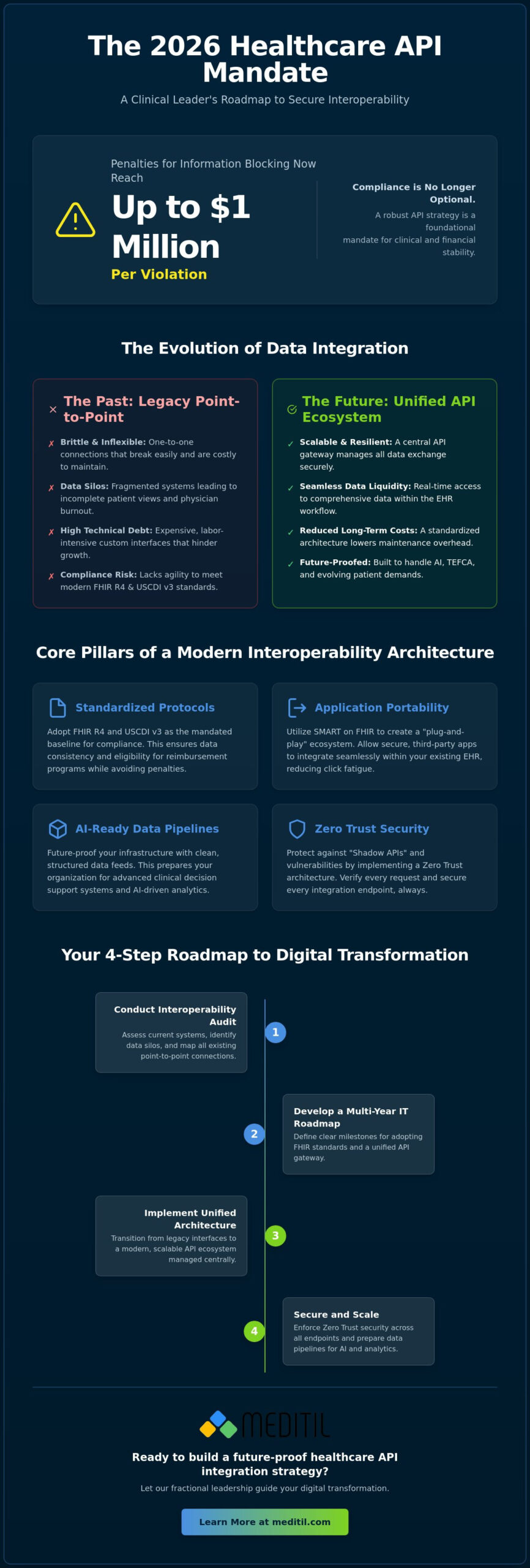
With penalties for information blocking now reaching up to $1 million per violation, the days of treating data connectivity as a secondary IT project are over. In 2026, a robust healthcare api integration strategy isn’t just a technical requirement; it’s a foundational clinical leadership mandate. You’ve likely felt the strain of fragmented systems where physician burnout is exacerbated by data silos and the mounting costs of maintaining brittle, legacy point-to-point connections. It’s a high-stakes environment where the pressure to meet evolving FHIR R4 and USCDI v3 standards can feel overwhelming.
We understand that achieving true interoperability requires more than just checking a compliance box. You need a system that facilitates seamless data liquidity while protecting patient privacy with absolute precision. This guide provides a strategic roadmap to help you transition from fragmented data to a secure, interoperable ecosystem that drives clinical excellence. We’ll explore how a standardized API architecture reduces technical debt, automates prior authorizations, and positions your organization as a leader in the era of TEFCA and intelligent, event-driven workflows.
Key Takeaways
- Transition from outdated point-to-point models to a unified healthcare api integration strategy that ensures scalability and clinical excellence across your organization.
- Adopt FHIR and SMART on FHIR as non-negotiable standards to enable seamless third-party application integration and secure data exchange within your existing EHR.
- Future-proof your infrastructure by developing AI-ready data pipelines that feed clinical decision support systems and meet patient demands for real-time medical record access.
- Protect your digital ecosystem against the risks of “Shadow APIs” by implementing a Zero Trust architecture for every integration endpoint.
- Accelerate your digital transformation through structured interoperability audits and multi-year IT roadmaps guided by seasoned fractional leadership.
The Evolution of Healthcare API Integration Strategy in 2026
In 2026, the definition of success in medical data management has fundamentally shifted. A modern healthcare api integration strategy is no longer a localized IT project; it’s a comprehensive framework for organizational stability. For decades, point-to-point integrations served as the industry standard, but these brittle, one-to-one connections can’t support the high-volume, real-time requirements of a modern practice. As regulatory pressures from the 21st Century Cures Act intensify, 2026 marks the definitive end of point-to-point models as a viable clinical option. They simply lack the agility to handle the complex data classes required by current standards.
Transitioning from isolated data silos to true data liquidity represents a core administrative objective for high-performing organizations. This shift isn’t just about accessibility; it’s about financial sustainability. By moving away from fragmented systems, your organization can significantly reduce technical debt. Maintaining dozens of individual, custom-coded interfaces is expensive, labor-intensive, and prone to failure. A unified strategy replaces these legacy “band-aids” with a scalable architecture that lowers long-term maintenance costs and provides a predictable roadmap for future growth.
From Legacy Interfacing to Modern API Ecosystems
Traditional HL7 v2 messaging relied on push-based, asynchronous communication that often lacked the flexibility needed for modern mobile applications and real-time analytics. Today, REST-based architectures utilizing Fast Healthcare Interoperability Resources (FHIR) provide the granular access that providers demand. A central API Gateway now serves as the command post for all data exchange. It manages high-volume clinical traffic while ensuring that security protocols are enforced consistently across every endpoint. For mid-sized practices that lack massive internal dev teams, “Integration-as-a-Service” has become the standard. This model allows clinical leaders to leverage sophisticated infrastructure and expert management without the overhead of building proprietary systems from scratch.
Strategic Alignment with Clinical Outcomes
Interoperability is a clinical metric as much as a technical one. When external data surfaces directly within the EHR workflow, we see a measurable reduction in “click fatigue.” Physicians don’t have to toggle between multiple screens or log into separate portals to find lab results, imaging reports, or medication histories. This seamless connectivity correlates directly to improved patient safety. Accurate, real-time data access reduces medical errors and ensures that clinical decisions are based on the most current information available. A sophisticated healthcare api integration strategy serves as the essential bridge between technical infrastructure and clinical efficiency.
Core Pillars of a Modern Interoperability Architecture
Building a resilient infrastructure requires a departure from reactive IT fixes. A truly sophisticated healthcare api integration strategy relies on a foundation where data isn’t just moved, but is actively managed and understood across every touchpoint. In 2026, this architecture is defined by four non-negotiable pillars: standardized protocols, application portability, semantic clarity, and rigorous identity management. Without these components, an organization risks creating a digital “house of cards” that fails under the weight of increasing regulatory scrutiny and clinical demand.
FHIR R4 has transitioned from an industry recommendation to a mandated baseline for compliance. Aligning your internal systems with US national interoperability goals ensures that your practice remains eligible for reimbursement programs and avoids the steep penalties associated with information blocking. Furthermore, SMART on FHIR technology allows third-party applications to run seamlessly within your existing EHR environment. This creates a “plug-and-play” ecosystem where clinicians can access specialized tools without leaving their primary clinical screen. It’s the technical realization of a unified workflow that prioritizes the provider’s focus on the patient.
Standardization via FHIR and HL7
Meeting 2026 compliance standards requires a deep commitment to the latest FHIR iterations and the United States Core Data for Interoperability (USCDI) v3. Utilizing professional healthcare data integration services is often the most efficient way to normalize disparate data sets from legacy systems into these modern formats. Versioning management is critical here; your architecture must maintain backward compatibility in a multi-vendor environment to ensure that older systems don’t break when a primary EHR updates its API endpoints. Organizations often find that a strategic IT advisor can clarify these governance requirements before implementation begins.
Centralized API Management and Governance
Transparency is the cornerstone of effective governance. A centralized API catalog provides your IT team with a clear view of every active connection, reducing the risk of redundant or unauthorized integrations. To protect your core systems, you must implement rate limiting and throttling. These measures prevent “noisy neighbor” issues where one high-volume integration consumes excessive resources and degrades the performance of the entire EHR. Finally, establishing clear “API Contracts” with your vendors is essential. These agreements hold partners accountable for data uptime and response times, ensuring that your interoperability roadmap remains stable and predictable regardless of external system changes.
2026 Trends: From Data Liquidity to AI-Ready APIs
The year 2026 represents a turning point where data liquidity is no longer the final goal but the baseline for more advanced capabilities. Organizations are now focusing on the development of AI-ready data pipelines. This transition requires a healthcare api integration strategy that looks beyond the mere movement of packets. It demands an architecture capable of feeding structured, high-quality data into Large Language Models (LLMs) to enhance clinical decision support. If your infrastructure isn’t prepared to deliver clean, standardized data, your investments in artificial intelligence will likely fail to yield a clinical return.
Preparing for the AI Revolution in Healthcare
Standardized APIs are the essential prerequisite for any meaningful AI implementation. Without a consistent way to query and retrieve information, AI tools remain isolated and unable to provide the holistic insights clinicians need. Ensuring data quality and “cleanliness” at the API layer is critical because inaccurate data leads to flawed analysis. AI is only as effective as the API-driven data it consumes. By prioritizing semantic interoperability today, you’re building the necessary foundation for the predictive analytics of tomorrow.
The Consumerization of Healthcare Data
The demand for patient-facing APIs has reached a critical mass in 2026. Patients now expect secure, real-time access to their medical records through mobile applications of their choice. This isn’t just a consumer preference; it’s a regulatory mandate driven by CMS and ONC requirements for patient data portability. EHR interoperability solutions serve as the vital bridge between these external patient apps and your internal clinical EHR. This connectivity allows for a more engaged patient population and a more complete longitudinal record.
Beyond patient access, we’re seeing a rise in “low-code” integration platforms. These tools allow IT teams to deploy clinical applications rapidly, responding to operational needs in weeks rather than months. Additionally, real-time telemetry from remote patient monitoring (RPM) is finally being integrated directly into the primary care record. This constant stream of data provides a more accurate picture of patient health between visits, allowing for proactive interventions. Managing this high-volume telemetry requires a robust API gateway that can handle the load without compromising system stability. By adopting a proactive healthcare api integration strategy, you ensure that these diverse data streams converge into a single, actionable clinical view.
Overcoming Strategic Friction: Security and Compliance Gaps
As your ecosystem becomes more interconnected, security risks inevitably multiply. A successful healthcare api integration strategy must account for the reality that every new endpoint is a potential entry point for malicious actors. In a post-breach healthcare climate, simply securing the perimeter is insufficient. You must adopt a posture that assumes the network is already compromised. This shift requires a move away from traditional trust-based models toward a more disciplined, verification-heavy approach that prioritizes clinical stability and patient privacy.
The danger of “Shadow APIs” represents one of the most significant threats to clinical stability in 2026. These are unauthorized or undocumented integrations often created by departments to solve immediate operational bottlenecks without IT oversight. Because they exist outside your central API catalog, they often lack essential security patches and fail to meet HIPAA standards. Identifying and securing these hidden connections is a critical step in managing the distributed risk inherent in a modern medical practice. You can’t protect what you haven’t cataloged.
The Zero Trust API Framework
Adopting a Zero Trust architecture means that every API request must be authenticated, authorized, and continuously validated. It’s no longer enough to trust a request just because it originated from an internal server. Utilizing specialized healthcare cybersecurity services allows you to perform deep-dive audits of your API vulnerabilities before they are exploited. Encryption in transit and at rest are non-negotiable requirements for 2026 medical data exchange. These protocols ensure that even if data is intercepted, it remains unreadable and useless to unauthorized parties.
Automating Compliance and Audit Trails
Forensic readiness is a pillar of regulatory compliance. You must log every data exchange to create a comprehensive audit trail for regulatory reporting and internal analysis. This transparency is especially vital for financial workflows. For instance, medical billing automation solutions rely on secure, highly-regulated APIs to move sensitive claims data without risking financial leaks. In a distributed environment, the question of risk ownership becomes complex. When data moves between your EHR and third-party services, a breach at any point can trigger a HIPAA investigation. You can’t outsource your ultimate responsibility for patient privacy. If you’re concerned about the resilience of your current infrastructure, engaging a Managed IT partner can provide the continuous monitoring and SIEM integration needed for real-time threat detection.
Implementing a Future-Proof Roadmap with Fractional CIO Leadership
Executing a comprehensive healthcare api integration strategy requires a shift from technical execution to long-term strategic governance. Many organizations fail not because they lack the right tools, but because they lack a structured roadmap that aligns their technical infrastructure with their clinical and business objectives. In 2026, the complexity of maintaining FHIR-compliant ecosystems demands a disciplined, multi-step approach to implementation that prioritizes stability over rapid, uncoordinated growth.
- Step 1: Conduct an Interoperability Audit. Begin by identifying legacy bottlenecks and fragile point-to-point connections. This audit provides a clear baseline of your current data liquidity and highlights hidden security vulnerabilities within your existing interfaces.
- Step 2: Define a Multi-Year IT Roadmap. Interoperability isn’t achieved overnight. You need a phased plan that prioritizes high-impact clinical workflows while gradually decommissioning technical debt and legacy systems.
- Step 3: Establish a Vendor-Neutral Governance Model. Ensure that your integration architecture doesn’t lock you into a single vendor’s proprietary ecosystem. A neutral model allows for greater flexibility as new clinical technologies and standards emerge.
- Step 4: Leverage Strategic Oversight. Utilize specialized virtual CIO services to bridge the gap between executive vision and technical implementation. This leadership ensures that every integration serves a specific clinical or operational purpose.
- Step 5: Measure ROI Through Efficiency. Track the success of your strategy by monitoring clinical efficiency gains, such as reduced documentation time, improved patient data access, and lower administrative overhead.
The vCIO Advantage in Interoperability
Small to mid-sized practices often face the same regulatory pressures as large health systems but with fewer internal resources. Fractional leadership allows these organizations to access high-level expertise without the overhead of a full-time executive. A vCIO acts as a steady hand at the wheel, ensuring that your managed it services for healthcare are fully optimized for API stability and security. This proactive guidance is essential for translating the C-suite’s clinical goals into actionable IT tasks that your technical team can execute with precision.
Measuring the Success of Your API Strategy
A successful healthcare api integration strategy must be quantifiable to justify the investment. We recommend tracking Key Performance Indicators (KPIs) such as integration uptime, data latency, and clinician adoption rates. Over time, a robust strategy should reduce the “cost per integration” by creating repeatable, standardized patterns for data exchange. This efficiency allows your practice to scale without a linear increase in IT spending or technical complexity. If you’re ready to transform your fragmented systems into a unified, secure ecosystem, contact MEDITIL for a strategic consultation on your 2026 integration roadmap.
Positioning Your Practice for Interoperability Excellence
The landscape of medical data exchange has reached a critical inflection point. Moving away from legacy point-to-point systems isn’t just a technical upgrade; it’s a necessity for regulatory survival and clinical efficiency. By anchoring your infrastructure in FHIR standards and a Zero Trust security framework, you transform fragmented data into a strategic asset. A resilient healthcare api integration strategy ensures that your practice isn’t just keeping pace with 2026 mandates but is actively building a foundation for AI-driven decision support and improved patient outcomes.
Achieving this level of interoperability requires a steady hand and deep industry expertise. MEDITIL provides the fractional CIO leadership and technical proficiency needed to guide mid-sized practices through complex EHR interoperability solutions and HIPAA-compliant infrastructure transitions. Our proven track record in EMR implementation ensures that your technical roadmap aligns perfectly with your clinical goals. Secure your 2026 interoperability roadmap with MEDITIL’s strategic IT consulting.
Your journey toward a fully interoperable future is a significant undertaking, but it’s one that promises immense rewards for your staff and patients alike. We’re ready to help you turn these strategic objectives into a stable, high-performing reality.
Frequently Asked Questions
What is the difference between an HL7 interface and a healthcare API?
Traditional HL7 v2 interfaces rely on asynchronous messaging to push data between specific systems, often requiring custom point-to-point tunnels or VPNs. Healthcare APIs use modern web standards to allow real-time, granular data retrieval on demand. This shift enables a more flexible healthcare api integration strategy where data is accessible when needed rather than waiting for a batch transfer. It’s the difference between a one-way broadcast and a dynamic, two-way conversation.
Why is FHIR considered the gold standard for healthcare interoperability in 2026?
FHIR is the gold standard because it’s mandated by the 21st Century Cures Act and supported by all major EHR vendors. It uses a resource-based approach that makes data exchange predictable and developer-friendly. In 2026, compliance with USCDI v3 standards requires the granular data classes that only FHIR can efficiently provide. It’s the essential framework for achieving the data liquidity necessary for modern clinical workflows and automated regulatory reporting.
How do healthcare APIs improve the patient experience?
APIs empower patients by providing real-time access to their medical records through secure, third-party mobile applications. This transparency reduces the need for redundant paperwork and allows patients to track their health metrics between visits. When your systems are interconnected, patients experience smoother transitions of care and faster access to lab results. This seamless connectivity builds trust and encourages patients to take a more active role in their own treatment plans.
What are the biggest security risks associated with healthcare API integration?
The most significant risks include “Shadow APIs” that bypass IT oversight and improper authentication protocols that expose sensitive patient data. Without a Zero Trust architecture, every new integration endpoint becomes a potential entry point for unauthorized access. Continuous monitoring and rigorous encryption are required to prevent data leaks. Managing these risks is a foundational part of any mature healthcare api integration strategy aimed at maintaining HIPAA compliance in a distributed environment.
Do I need a full-time CIO to manage my practice’s API strategy?
You don’t necessarily need a full-time executive to manage these technical complexities. Many mid-sized practices utilize fractional or virtual CIO (vCIO) services to provide strategic oversight without the overhead of a permanent hire. A vCIO ensures that your IT roadmap aligns with your clinical objectives while managing vendor relationships and security protocols. This model offers high-level expertise and a steady hand at the wheel during critical digital transitions.
How does an API integration strategy help with HIPAA compliance?
A structured API strategy enhances HIPAA compliance by centralizing data access and creating detailed audit trails for every exchange. Standardized protocols ensure that security measures like end-to-end encryption are applied consistently across all endpoints. Instead of broad, insecure data dumps, APIs allow for granular access control, ensuring that only the “minimum necessary” information is shared. This level of precision is essential for protecting patient privacy in an increasingly interconnected ecosystem.
Can legacy EHR systems be integrated with modern APIs?
Most legacy EHR systems can be integrated with modern APIs through the use of middleware or API wrappers. These tools act as translators, converting older HL7 messages into FHIR-compliant resources. While these systems weren’t originally designed for modern interoperability, specialized integration services can bridge the gap. This approach allows you to extend the life of your existing infrastructure while still meeting current regulatory requirements and clinical demands.
What is an API Gateway and do I need one for my medical practice?
An API Gateway acts as a centralized command post that manages, secures, and monitors all incoming and outgoing API traffic. It handles essential tasks like rate limiting, authentication, and threat detection to protect your core systems from being overwhelmed. While smaller practices might start with basic connections, any organization looking to scale its interoperability needs a gateway. It provides the visibility and control required to maintain system stability and security.