
Could your organization’s clinical infrastructure withstand a regulatory scrutiny that now carries an annual penalty cap of $2,190,294 for willful neglect? As of 2026, the Department of Health and Human Services has significantly increased the financial stakes for data protection. This makes a rigorous healthcare IT compliance audit more than just a checkbox exercise; it is a critical stress test for your entire operational framework. We recognize that the pressure to maintain multi-system EHR interoperability while managing sophisticated cybersecurity threats can feel overwhelming for administrative teams lacking high-level strategic IT leadership.
You deserve a steady partner to guide you through these evolving mandates. We promise to help you master these complexities and secure your clinical environment with a precise, professional roadmap. This guide offers a methodical framework to verify your security posture and align your infrastructure with 2026 regulatory standards. We will move from broad strategic objectives to specific operational capabilities, ensuring your organization remains both compliant and resilient in this high-stakes environment.
Key Takeaways
- Define the 2026 regulatory landscape and the necessity of systematic evaluations for technical, physical, and administrative safeguards.
- Identify core technical domains, such as identity management and data encryption, required to secure Protected Health Information across complex clinical networks.
- Establish a balance between internal self-assessments for continuous monitoring and the strategic necessity of external, third-party audits.
- Execute a structured five-step roadmap for a comprehensive healthcare IT compliance audit, covering everything from system scoping to rigorous technical testing.
- Leverage fractional CIO leadership to bridge the gap between existing technical infrastructure and high-level regulatory alignment.
What is a Healthcare IT Compliance Audit and Why is it Critical in 2026?
A healthcare IT compliance audit is a methodical and comprehensive evaluation of an organization’s technical, physical, and administrative safeguards. This process ensures that patient data remains protected and that all digital workflows align with federal mandates. In 2026, this audit is no longer a periodic administrative burden; it’s a vital strategic stress test. The regulatory environment has grown more rigorous, driven by heightened oversight from the Office for Civil Rights (OCR) and updated HITECH requirements that demand greater transparency in how data moves through clinical networks. A thorough Information security audit provides the necessary verification that your infrastructure can withstand both external threats and internal process failures.
The transition toward advanced telehealth platforms and remote patient monitoring has fundamentally changed the clinical landscape. As these systems expand, the surface area for potential vulnerabilities grows. Relying on reactive compliance strategies is no longer viable for modern providers. Instead, organizations must adopt a proactive stance, using the audit as a tool for clinical stability rather than just a means of legal avoidance. When your systems are compliant, they’re inherently more stable, reducing the risk of downtime that could compromise patient care. It’s about building a resilient foundation that supports long-term growth and operational excellence.
The Legal and Financial Stakes of Non-Compliance
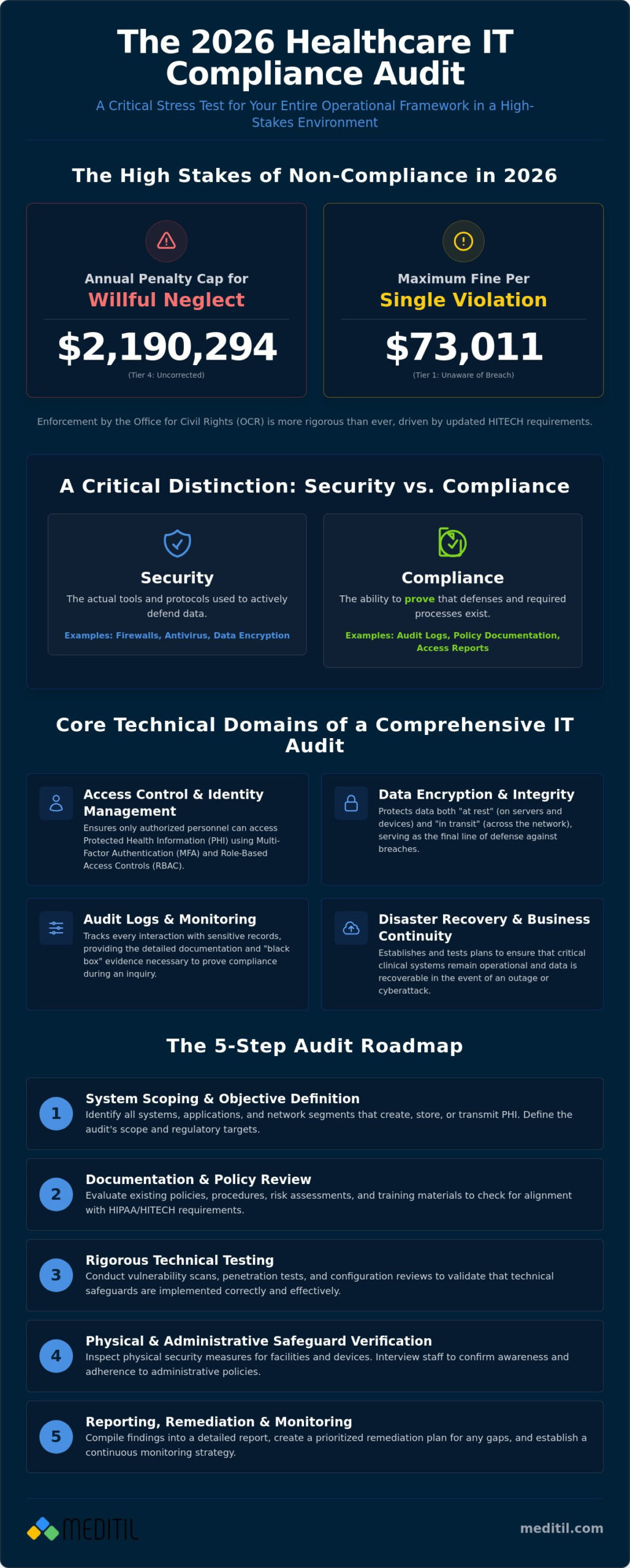
The financial risks associated with regulatory failures reached new heights in early 2026. Following the inflation adjustments on January 28, 2026, the tiered penalty structure for HIPAA violations is more punishing than ever. Tier 1 violations, where the entity was unaware of the breach, now carry a maximum per-violation fine of $73,011. However, the stakes escalate dramatically for Tier 4 violations involving willful neglect that remains uncorrected, which now face an annual cap of $2,190,294. Beyond these immediate fines, the cost of inaction includes devastating data breaches and the permanent loss of patient trust. The Office for Civil Rights (OCR) serves as the primary investigative and enforcement body for HIPAA privacy and security rule violations in 2026.
The Difference Between Security and Compliance
It’s a common misconception that a secure network is automatically a compliant one. Security involves the actual tools and protocols used to defend data, such as firewalls and encryption. Compliance, however, is the ability to prove those defenses exist through rigorous documentation and audit trails. You might have the most advanced encryption in the industry, but if you can’t produce a log showing who accessed that data and when, you’ll fail a healthcare IT compliance audit. Establishing robust healthcare cybersecurity services forms the essential foundation for this process. These services ensure that technical protections are not just active, but are also mapped to specific regulatory requirements, providing the “steady hand” needed to maintain a continuous state of audit readiness.
Core Technical Domains of a Comprehensive IT Audit
A thorough healthcare IT compliance audit must dissect the technical layers that support clinical operations. It’s not enough to have policies on paper; the infrastructure itself must enforce these standards. We begin with Access Control and Identity Management. This domain ensures that only authorized personnel can touch Protected Health Information (PHI). By utilizing multi-factor authentication (MFA) and role-based access controls (RBAC), organizations can significantly reduce the risk of internal data misuse or accidental exposure. Every digital identity within your network must be accounted for and restricted to the minimum access necessary for their specific role.
Data Encryption and Integrity represent the next critical domain. Protecting data at rest and in transit across the network is non-negotiable in 2026. If a device is lost or a packet is intercepted, encryption serves as the final line of defense. Simultaneously, Audit Logs and Monitoring act as the “black box” of healthcare IT. These systems track every interaction with sensitive records, providing the detailed documentation necessary to prove compliance during a federal inquiry. Finally, Disaster Recovery and Business Continuity plans must be tested against real-world scenarios. For life-critical systems, technical resilience is a fundamental matter of patient safety.
Network Infrastructure and Cloud Security
Auditing wireless networks and VPNs is essential for securing remote access, especially as hybrid work models persist in clinical administration. Organizations must also rigorously evaluate cloud service provider (CSP) agreements and Business Associate Agreements (BAAs) to ensure shared responsibility models are clearly defined. Effective Risk Assessment and Mitigation strategies are required to identify vulnerabilities within these complex connections. Many facilities find that partnering for managed IT services for healthcare provides the continuous infrastructure maintenance needed to stay ahead of these technical requirements.
EHR Interoperability and Billing Automation
The flow of data between EHRs and third-party applications often creates hidden security gaps. During a healthcare IT compliance audit, it’s vital to identify these points of friction, particularly where system integrations might inadvertently create “backdoors” for unauthorized access. Auditing medical billing automation solutions is equally critical to prevent data leaks during financial processing. Ensuring seamless connectivity doesn’t mean sacrificing protection. If you’re concerned about how your current integrations might affect your audit readiness, our consulting experts can provide a preliminary infrastructure review to identify potential vulnerabilities before they become liabilities.
Achieving a state of audit readiness requires a dual-track approach that balances internal vigilance with external objectivity. Internal self-assessments function as the organization’s early warning system. These evaluations maintain a “continuous compliance” state by identifying minor deviations in access logs or encryption protocols before they evolve into systemic failures. By contrast, an external healthcare IT compliance audit is often mandatory following significant infrastructure changes or as part of annual regulatory requirements. Strategically, these third-party reviews provide the objective verification needed to satisfy federal investigators and build long-term stakeholder confidence.
Relying solely on internal teams for these assessments presents significant risks. General IT staff, while technically proficient, often lack the specialized regulatory training required to interpret evolving HITECH mandates. There is also a fundamental conflict of interest when the same team responsible for managing the infrastructure is tasked with auditing its own performance. A successful healthcare IT compliance audit requires a “steady hand” that can navigate the intersection of technical requirements and clinical necessity without bias. It’s about ensuring that every safeguard is both active and accurately documented for review.
Why General Managed IT Often Fails the Audit Test
General managed IT providers often treat healthcare facilities like standard professional offices. This approach fails because it ignores the specific nuance of healthcare regulations and the high-stakes nature of PHI. An audit must account for clinical friction and the reality of physician workflows. If an IT team prioritizes security at the expense of immediate patient record access during an emergency, the system has failed its primary mission. You need a partner who understands that compliance must support, not hinder, the delivery of care. Without this specialized perspective, an organization risks failing an audit despite having standard security measures in place.
The Strategic Role of the Virtual CIO
This is where virtual cio services become indispensable. A fractional leader provides the high-level oversight necessary to manage the complexities of an external audit without the financial burden of a full-time executive. They align the IT roadmap with compliance objectives, ensuring that every technical upgrade is a step toward greater stability. By leveraging fractional leadership, organizations can manage the entire audit lifecycle with the precision of a seasoned specialist. This proactive management effectively eliminates the technical debt that often leads to increased regulatory scrutiny and potential fines.
The 5-Step Roadmap to a Successful IT Compliance Audit
Executing a healthcare IT compliance audit requires a disciplined, multi-phase approach. It’s a strategic project that demands precision at every turn. The first phase is Preparation and Scoping. During this stage, you must identify every system, device, and vendor that touches Protected Health Information (PHI). This includes EHR platforms, billing software, and even remote patient monitoring devices. Without a clear boundary, the audit will fail to provide a complete picture of your organization’s risk profile.
The second phase is Discovery and Technical Testing. This involves running automated vulnerability scans and manually reviewing access logs to identify active threats. Once the data is gathered, the third phase, Gap Analysis and Risk Assessment, begins. This is where you prioritize vulnerabilities based on their potential clinical impact. The fourth phase is Remediation and Implementation. This is the active “fixing” stage, where technical upgrades or policy changes are deployed. Finally, the process concludes with Documentation and Final Reporting. This creates the essential evidentiary trail necessary to prove your organization’s diligence to federal regulators.
Identifying and Prioritizing Security Gaps
Not all vulnerabilities carry the same weight. We recommend utilizing a Risk Rating Matrix to focus your resources on high-impact gaps that pose the greatest threat to patient data or system availability. This ensures that critical infrastructure is secured first. Many organizations struggle with the speed of this phase, which is where an Augmented IT Team can provide the necessary technical bandwidth to accelerate remediation. These specialists work alongside your existing staff to deploy patches and reconfigure networks without disrupting daily patient care or clinical efficiency.
Creating a Culture of Continuous Compliance
The ultimate goal is to move away from “once-a-year” panic and toward a state of real-time monitoring. This involves setting up automated alerts for unauthorized access attempts and conducting regular staff training on the IT policies identified during the healthcare IT compliance audit. Compliance should also be a foundational element of your financial planning. Integrating these requirements into the IT budgeting for medical practices process ensures that you have the capital necessary for ongoing infrastructure stability. If your current team lacks the capacity to manage this roadmap, our compliance consultants can step in to oversee the entire lifecycle of your next audit.
Leveraging MEDITIL for Audit Readiness and Infrastructure Stability
Effective management of a healthcare IT compliance audit requires more than just technical skill; it demands a partner who understands the high-stakes environment of modern medicine. MEDITIL operates as a proactive extension of your organization, managing the entire IT department and compliance lifecycle with precision. We recognize that clinical leaders must prioritize patient outcomes above all else. By assuming the responsibility for technical safeguards and regulatory alignment, we provide the stability necessary for your practice to thrive without the constant fear of federal oversight or data vulnerabilities. It’s our mission to serve as the steady hand at the wheel, ensuring every detail is handled with the professional rigor your facility requires.
Strategic leadership is often the missing component in failed audits. Our Fractional CIO services bridge this gap by providing the executive-level guidance required to navigate complex regulatory frameworks. We don’t just fix technical issues; we align your entire IT roadmap with the 2026 standards discussed throughout this guide. Whether it’s securing your cloud infrastructure or refining the security of your billing automation, our team ensures that every component of your clinical network is verified and protected. This disciplined approach transforms compliance from a source of stress into a predictable, managed process that supports your long-term objectives.
Customized Managed IT Solutions
We provide infrastructure management that is compliant-by-design, ensuring that every server, workstation, and wireless access point meets rigorous standards from the moment of deployment. Our team offers proactive monitoring to identify and resolve potential issues before they impact your staff. We also specialize in the seamless integration of EMR/EHR systems with existing clinical workflows, ensuring that interoperability doesn’t create new security risks. This comprehensive support allows your medical staff to work efficiently, backed by a help desk that understands the specific needs of a healthcare environment.
Getting Started: Your Initial Compliance Assessment
The journey toward long-term stability begins with a clear understanding of your current posture. We invite you to an initial consultation to evaluate your organization’s readiness for a healthcare IT compliance audit. This assessment serves as a foundation for transitioning from reactive, project-based fixes to a sustainable model of ongoing managed services. We’ll help you identify immediate gaps and develop a strategic plan for remediation that fits your budget and operational goals. Take the first step toward securing your clinical infrastructure and protecting your organization’s future. You can schedule a strategic IT compliance consultation with MEDITIL today to begin this vital process.
Securing Your Clinical Future Through Strategic Alignment
The 2026 regulatory environment demands a shift from periodic checks to a state of continuous verification. By implementing the five-step roadmap outlined in this guide, your organization can transform the healthcare IT compliance audit from a source of anxiety into a powerful tool for infrastructure stability. This process ensures that your technical safeguards are not just active, but are also documented with the precision required to withstand federal scrutiny. Relying on specialized expertise is the most effective way to manage these complexities without diverting focus from patient care.
MEDITIL serves as your strategic partner, offering national US support and the fractional CIO leadership necessary to oversee high-stakes transitions. We handle the technical intricacies of network security and EHR interoperability so your team can operate with confidence. It’s time to move beyond reactive fixes and build a resilient foundation for your practice. Secure your clinical infrastructure with MEDITIL’s expert compliance services. We’re ready to help you navigate this landscape with a steady hand and professional discipline.
Frequently Asked Questions
How often should a healthcare organization conduct an IT compliance audit?
Organizations should conduct a comprehensive healthcare IT compliance audit at least once every twelve months. This frequency ensures that any new vulnerabilities introduced by infrastructure updates or software patches are identified. In 2026, many facilities are moving toward real-time monitoring to maintain a state of continuous readiness. Significant changes to your EHR system or network architecture should also trigger an immediate interim assessment.
What is the most common IT gap found during a HIPAA audit?
The most frequent deficiency identified is the failure to perform a thorough, organization-wide risk analysis. Audits often reveal that facilities haven’t accounted for every mobile device or third-party application that touches PHI. Inadequate access logs and a lack of encryption for data in transit are also common technical failures. These gaps often stem from a lack of high-level strategic oversight within the IT department.
Can a general IT provider handle a healthcare-specific compliance audit?
General IT providers often lack the specialized knowledge of clinical workflows and HITECH mandates required for these evaluations. A generalist might secure a network but fail to document the administrative safeguards required by federal law. Effective audits require a partner who understands the nuance of EHR interoperability and medical billing security. Without this healthcare-specific expertise, an organization risks failing its healthcare IT compliance audit despite having standard security measures.
How long does a typical healthcare IT compliance audit take to complete?
A standard audit typically takes between four and twelve weeks to complete. The initial scoping and discovery phases usually require two to three weeks of focused data collection and system identification. The remaining time is dedicated to technical testing, gap analysis, and the final production of evidentiary reports. Larger organizations with complex multi-site infrastructures may require additional time for thorough testing.
What is the difference between a HIPAA audit and a NIST security assessment?
HIPAA is a legal mandate focused on protecting patient privacy, while a NIST assessment is a technical framework used to measure security maturity. Many organizations use the NIST Cybersecurity Framework as the technical foundation to prove they meet HIPAA’s security rule requirements. While NIST provides the “how” for technical controls, a HIPAA audit verifies the “what” regarding regulatory adherence and administrative documentation.
What happens if we fail an IT compliance audit?
Failing an audit can lead to significant financial penalties from the OCR and mandatory corrective action plans. In 2026, the annual cap for willful neglect violations has reached $2,190,294. Beyond fines, a failure often results in a loss of patient trust and increased scrutiny during future evaluations. Correcting identified issues within 30 days can sometimes mitigate the severity of these penalties.
How much does a healthcare IT compliance audit cost?
The investment required for an audit depends on the size of the medical practice and the complexity of its digital infrastructure. While costs vary based on the number of users and integrated systems, the financial risk of a data breach is almost always higher. It’s best to view the audit as a strategic investment in clinical stability and risk mitigation rather than a simple administrative expense.
Does my medical practice need a Virtual CIO for audit preparation?
A Virtual CIO is highly recommended for practices that lack high-level IT leadership to oversee complex regulatory requirements. This role provides the strategic guidance needed to manage the audit lifecycle and align your technology roadmap with 2026 standards. It ensures that technical decisions support both compliance and patient care. A vCIO acts as a steady hand to guide your team through the remediation of identified gaps.