
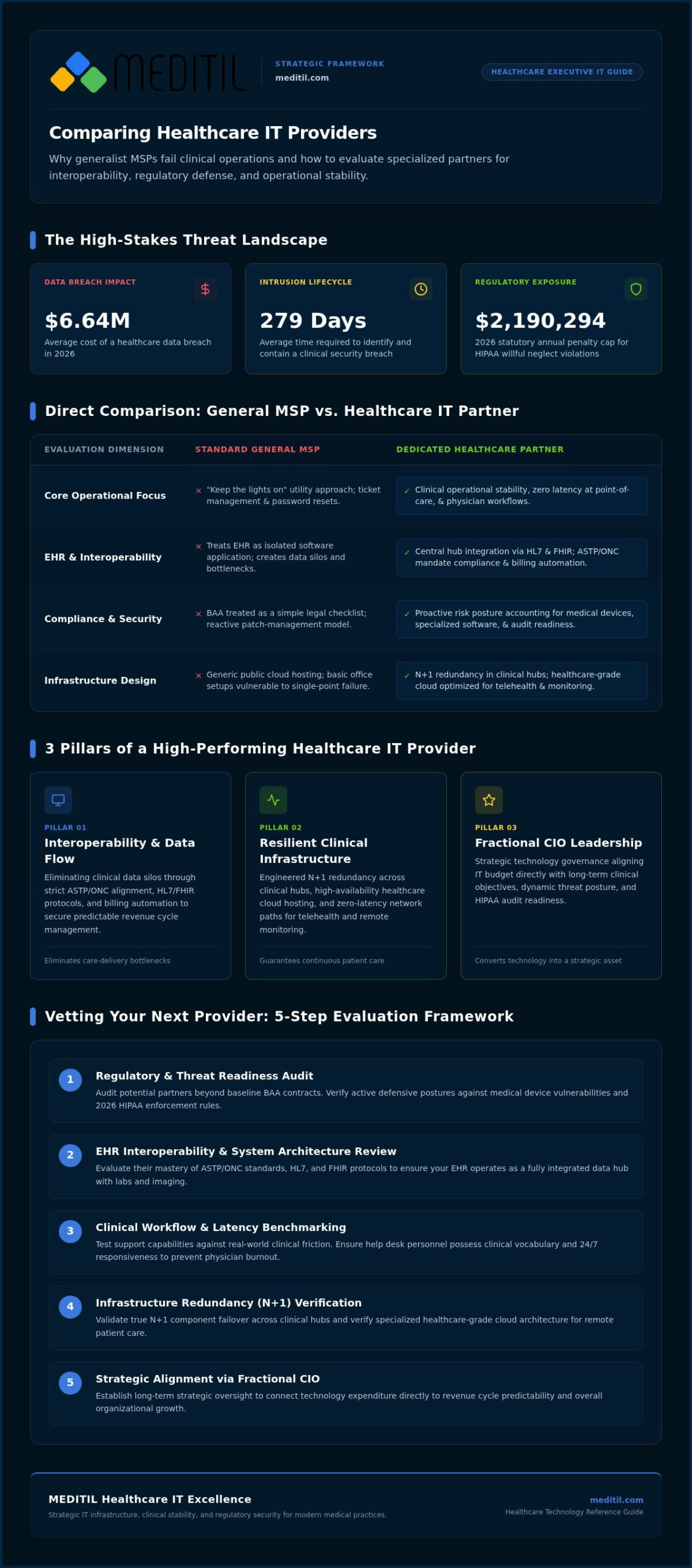
Did you know that the average healthcare data breach in 2026 costs $6.64 million, and it takes an average of 279 days to identify and contain the intrusion? For clinical leaders, these aren’t just abstract figures; they represent a fundamental threat to patient trust and operational survival. When you’re comparing healthcare IT providers, the stakes extend far beyond basic technical support. You need a partner that understands that a server failure isn’t just a help desk ticket; it’s a disruption to patient care and a potential regulatory catastrophe under the latest HHS inflation-adjusted penalties.
You likely feel the pressure of maintaining clinical stability while facing the constant fear of HIPAA audits and stagnant systems that don’t support EHR interoperability. It’s frustrating when your technology feels like a hurdle rather than a strategic asset. This article provides a framework to master the criteria for evaluating healthcare-specific IT partners to ensure long-term growth. We’ll examine how to secure a stable, interoperable environment that aligns your IT spend with clinical goals and delivers predictable revenue cycle management through better system integration.
Key Takeaways
- Understand why generic IT services lack the clinical depth required for modern healthcare interoperability and operational stability.
- Master a strategic framework for comparing healthcare IT providers by assessing their ability to balance technical performance with strict regulatory compliance.
- Identify the core pillars of a high-performing partnership, including managed infrastructure that reduces clinical friction and downtime.
- Implement a structured five-step evaluation process to audit potential partners for security readiness and healthcare-specific technical mastery.
- Align your technology spend with long-term clinical objectives through strategic guidance and fractional CIO leadership.
The Stakes of Selection: Why General IT Fails Healthcare
The choice of an IT partner is often framed as a procurement decision, but for medical practices, it’s a clinical one. When you’re comparing healthcare IT providers, the fundamental question isn’t whether they can keep your servers running. It’s whether they understand that a five-minute outage in a clinic is fundamentally different from a five-minute outage in a retail office. Generalist providers often focus on “keeping the lights on,” a utility-based approach that ignores the nuances of clinical operational stability.
General IT firms frequently underestimate the technical requirements of modern health information technology standards. They may struggle with ASTP/ONC interoperability mandates or fail to realize how technical debt, such as unpatched legacy systems and poor integration, creates bottlenecks in patient throughput. This friction doesn’t just affect the bottom line; it directly contributes to physician burnout and compromises patient safety when critical data isn’t available at the point of care.
Regulatory Compliance vs. True Security
A signed Business Associate Agreement (BAA) is a legal requirement, yet it’s merely the baseline for partnership. Generalist providers often treat HIPAA compliance as a checklist rather than a dynamic security posture. With 2026 HIPAA penalties for willful neglect now reaching a statutory annual cap of $2,190,294, the cost of a provider missing healthcare-specific threat vectors is catastrophic. True security requires moving beyond reactive patching to proactive risk management that accounts for the unique vulnerabilities of medical devices and specialized software configurations. Comparing healthcare IT providers requires looking past generic security claims to evaluate how a partner addresses these high-stakes regulatory demands.
Clinical Friction and the User Experience
Network latency is more than a technical metric; it’s a barrier to care. When an EHR lags, patient throughput drops and medical staff frustration rises. A generic help desk lacks the vocabulary to assist a nurse struggling with a billing automation error or an interoperability failure. Effective support requires 24/7 availability from technicians who understand clinical workflows and the high-stakes environment of a busy practice. By choosing a partner that prioritizes the user experience, organizations can reduce administrative friction and allow clinicians to focus on their primary mission: patient care.
General MSP vs. Healthcare IT Partner: A Direct Comparison
A standard Managed Service Provider (MSP) typically views technology through the lens of general business productivity. While they excel at password resets and hardware procurement, their scope rarely extends to the strategic alignment required for clinical operations. When comparing healthcare IT providers, the distinction lies in the transition from a reactive help desk model to a proactive, strategic infrastructure partnership. A dedicated partner doesn’t just manage tickets; they ensure that your technical ecosystem supports the high-stakes demands of patient care and regulatory compliance.
The Interoperability Gap
Generalist MSPs often treat Electronic Health Records (EHR) as isolated software applications. In contrast, a specialized partner views the EHR as a central data hub that must communicate seamlessly with billing systems, labs, and imaging software. Achieving this requires a deep understanding of selecting or upgrading health IT standards like HL7 and FHIR. By 2026, the ability to eliminate data silos through advanced systems integration and billing automation is essential for maintaining predictable revenue cycles. If your provider lacks the expertise to manage these complex connections, your practice risks operational bottlenecks and fragmented patient data.
Infrastructure and Redundancy
Clinical environments require a level of reliability that standard office setups do not. High-volume clinical hubs must implement N+1 redundancy to ensure that a single component failure does not halt patient care. While a general MSP might suggest generic public cloud hosting, a healthcare partner prioritizes healthcare-grade cloud services designed for high availability and strict data protection. This robust infrastructure is vital for supporting telehealth and remote monitoring, where network stability is a prerequisite for clinical safety. Organizations seeking this level of strategic oversight often benefit from a fractional CIO to guide their long-term technology roadmapping.
The protocols for responding to system failures also differ significantly. A healthcare IT partner treats a network outage in a surgical suite with the urgency of a life-critical event, following specialized response protocols that generalists simply do not possess. When comparing healthcare IT providers, evaluate their history with clinical workflows and their capacity to provide augmented IT support that mirrors the 24/7 nature of healthcare delivery. This specialized approach ensures that technology remains a steady hand in the management of your practice.
The 3 Pillars of a High-Performing Healthcare IT Provider
When comparing healthcare IT providers, it’s easy to get lost in technical jargon. However, a truly effective partnership rests on three distinct pillars: infrastructure, security, and strategic leadership. These elements work in tandem to ensure that technology serves as a foundation for clinical excellence rather than a source of administrative friction. Selecting a partner that excels in all three areas is the difference between a system that merely functions and one that actively supports growth.
Managed Infrastructure and Network Services
The foundation of any medical practice is its network stability. Moving away from reactive break-fix models is essential for maintaining patient throughput and avoiding costly clinical downtime. Implementing managed IT services for healthcare allows for the management of the entire IT lifecycle, from initial implementation to continuous optimization. This includes Infrastructure as a Service (IaaS) tailored specifically for medical data management. This approach ensures that high-volume clinical hubs have the scalability they need without the burden of maintaining aging physical hardware.
Cybersecurity Beyond the Firewall
In a post-ransomware environment, basic firewalls are no longer sufficient to protect sensitive patient records. Modern healthcare cybersecurity services must include proactive monitoring and Security Information and Event Management (SIEM) to detect threats before they compromise the network. This level of vigilance is critical when you consider that the average healthcare breach cost has reached $6.64 million in 2026. Beyond technical controls, a partner must help you navigate HIPAA business associate requirements and address the human element through rigorous staff training. Protecting data integrity requires a steady hand that understands both regulatory standards and clinical workflows.
The Strategic Value of a Fractional CIO
Technology shouldn’t be a stagnant expense. It should be a strategic asset. Utilizing virtual CIO services helps align IT budgets with clinical outcomes, ensuring that every dollar spent supports the practice’s long-term goals. While some providers only offer basic support, a true partner provides project-based consulting for EMR/EHR implementation and training. This leadership ensures that business intelligence and analytics are used to drive practice efficiency, turning complex data into actionable insights for the clinical team. Comparing healthcare IT providers requires looking for this level of seasoned expertise that goes beyond simple maintenance to provide a roadmap for future success.
Vetting Your Next Provider: A 5-Step Evaluation Process
Vetting a potential partner requires a methodical approach that prioritizes verification over promises. When comparing healthcare IT providers, your evaluation should follow a rigorous five-step sequence to ensure clinical and operational alignment. First, review healthcare-specific case studies that demonstrate success in environments similar to your own. Second, audit the provider’s internal security and compliance protocols to ensure they practice the same vigilance they preach. Third, test help desk responsiveness and clinical knowledge through simulated support requests. Fourth, evaluate their roadmap for it budgeting for medical practices to ensure long-term financial stability. Finally, assess their ability to manage or augment your existing internal IT teams without disrupting established workflows.
This structured vetting prevents the common mistake of selecting a provider based on cost alone. A partner that understands the nuances of a regulated environment will provide a steady hand during technical transitions. They should act as a proactive guide rather than a reactive service vendor. This distinction is vital for maintaining the integrity of your patient data and the efficiency of your medical staff.
The RFP Process for Healthcare IT
The Request for Proposal (RFP) is your primary tool for filtering out generic service providers. Ask specific questions about EHR interoperability and data migration strategies to see if they understand clinical data flow. It’s critical to verify the provider’s experience with medical billing automation solutions, as poor integration here leads to immediate revenue cycle disruption. Be wary of “healthcare-washing,” where generic firms use industry keywords without having the depth of experience to support them. A true partner will provide detailed responses that reflect technical mastery and regulatory awareness.
Service Level Agreements (SLAs) That Matter
Standard SLAs often define downtime in hours, but in a clinical context, we measure impact in minutes. Your agreement must reflect the urgency of patient care. A high-performing partner should offer performance metrics for end-user support and help desk resolution that reflect the fast-paced nature of medical workflows. Security incident response guarantees must include reporting transparency and clear communication channels. These metrics ensure that the provider is held accountable for the stability of your infrastructure. If you are ready to secure a partner that treats your clinical uptime as a mission-critical priority, consult with our strategic IT experts today to begin your evaluation.
MEDITIL: Your Strategic Partner in Healthcare IT Excellence
MEDITIL offers tailored IT solutions designed exclusively for the healthcare sector, moving beyond the limitations of generic managed services. When comparing healthcare IT providers, the value of a specialized partner becomes clear through the depth of their operational capabilities. We provide comprehensive management of IT operations, covering everything from complex networking infrastructure to daily end-user support. Our team understands that technical precision is a prerequisite for clinical safety and patient trust. We don’t just maintain systems; we optimize them to ensure they support the unique demands of a medical environment.
Our strategic advisory services, led by our fractional CIOs and healthcare IT consultants, ensure that your technology spend remains aligned with clinical objectives. We take a proactive approach to cybersecurity, compliance, and interoperability, addressing the systemic risks that generalists often overlook. By integrating billing automation and ensuring seamless EHR connectivity, we help practices achieve predictable revenue cycles and reduced administrative friction. This disciplined focus on the healthcare vertical allows us to act as a steady guide for organizations navigating a complex regulatory landscape.
Why a Seasoned Expert Beats a Bold Innovator
In a regulated industry, stability is more valuable than experimental innovation. MEDITIL prioritizes a “steady hand at the wheel” approach, focusing on proven methodologies for EHR implementation and staff training. We recognize that medical staff need reliable tools that work without interruption. Rather than chasing short-term technical fixes that create technical debt, we focus on long-term outcomes. This disciplined methodology ensures that your infrastructure remains resilient against evolving threats while supporting the daily needs of your clinicians and patients.
Getting Started with a Strategic IT Audit
The first step toward achieving operational excellence is identifying immediate gaps in your current infrastructure and compliance posture. A strategic IT audit provides a clear baseline, highlighting vulnerabilities in security and bottlenecks in clinical workflow. We use these insights to help you build a 2026 roadmap for clinical efficiency and growth, ensuring your practice is prepared for the latest ASTP/ONC mandates. This proactive planning turns IT from a source of stress into a strategic asset for your organization. To begin this process, schedule a consultation with MEDITIL to evaluate your practice’s IT health and secure your clinical future.
Securing Your Clinical Future Through Strategic Alignment
The transition from a reactive IT model to a proactive, clinical-first strategy is no longer optional. When you’re comparing healthcare IT providers, the focus must shift from simple ticket resolution to long-term operational stability and regulatory resilience. A true partner understands that network performance directly impacts patient throughput and that a single compliance oversight can lead to significant financial penalties. By prioritizing managed infrastructure, specialized cybersecurity, and strategic leadership, you ensure your technology acts as a foundation for growth rather than a source of friction.
MEDITIL serves as the steady hand at the wheel for healthcare leaders, providing tailored solutions for healthcare infrastructure and expert Fractional CIO advisory. Our specialized approach to cybersecurity and HIPAA compliance ensures your practice remains secure in an increasingly complex threat landscape. It’s time to align your IT spend with your clinical goals to achieve a more efficient, interoperable future. Partner with MEDITIL for Strategic Healthcare IT Management and take the first step toward a more stable and secure environment. We’re ready to help you navigate the complexities of modern medicine with precision and confidence.
Frequently Asked Questions
What is the difference between an MSP and a healthcare IT partner?
A general Managed Service Provider (MSP) focuses on standard business productivity tools like email and hardware maintenance. In contrast, a healthcare IT partner specializes in clinical operational stability and the complex regulatory requirements of a medical environment. This includes deep expertise in interoperability, ASTP/ONC mandates, and clinical workflows. When comparing healthcare IT providers, look for a partner that treats technical infrastructure as a life-critical asset rather than a back-office utility.
Do I need a healthcare-specific IT provider if I already have a HIPAA-compliant EHR?
Yes, because a HIPAA-compliant EHR is only one component of your digital ecosystem. While the software itself may meet standards, your local network, workstations, and third-party integrations must also be secured and optimized. A specialized provider ensures that your entire infrastructure, including cloud services and mobile devices, adheres to strict security protocols. This holistic approach prevents data leaks that occur outside of the EHR software during transmission or storage.
How does a Fractional CIO benefit a mid-sized medical practice?
A Fractional CIO provides executive-level leadership and strategic roadmapping without the expense of a full-time hire. For mid-sized practices, this means having a steady hand to align IT spending with clinical goals and long-term growth. They manage complex projects like systems integration and provide business intelligence analytics to drive efficiency. This strategic oversight ensures that your technology remains a high-performing asset that supports both financial health and patient care.
Can a healthcare IT provider help with billing automation and RCM?
Yes, a specialized partner optimizes the technical infrastructure that supports Revenue Cycle Management (RCM). While they don’t sell the billing software itself, they provide essential billing automation and integration services. This ensures that your EHR communicates effectively with your financial systems, reducing manual data entry and minimizing claim denials. Proper systems integration leads to more predictable revenue cycles and allows your administrative staff to focus on higher-value tasks.
What should be included in a healthcare IT service agreement (SLA)?
A clinical-grade SLA must prioritize uptime and define response protocols in minutes rather than hours. It should include specific performance metrics for help desk resolution and end-user support tailored to medical workflows. Transparency in security incident reporting and guaranteed compliance with current HIPAA standards are also essential. When comparing healthcare IT providers, ensure the agreement reflects the high-stakes nature of your practice and includes clear accountability for infrastructure stability.
How do IT providers handle EHR/EMR implementation and staff training?
Specialized providers manage the entire implementation lifecycle, from initial configuration to post-go-live optimization. They focus on EMR/EHR implementation and training that aligns with your specific clinical workflows rather than just technical setup. This includes hands-on staff education to ensure high adoption rates and minimal disruption to patient throughput. By optimizing how the system is used, they help your practice realize the full value of your software investment without requiring you to manage the technical transition alone.
What are the most common cybersecurity threats facing healthcare in 2026?
In 2026, healthcare organizations face sophisticated threats including AI-driven social engineering and targeted ransomware attacks. The industry also sees a rise in breaches originating from third-party business associates and unsecured medical IoT devices. Proactive risk management requires advanced cybersecurity services like continuous SIEM monitoring and rigorous staff training. These measures are necessary to mitigate the risk of catastrophic data loss and the escalating civil monetary penalties associated with HIPAA violations.
Is it better to have an in-house IT team or a managed healthcare IT provider?
Many practices find that an augmented IT team model offers the best balance of local presence and specialized depth. While in-house teams understand internal culture, a managed healthcare IT provider brings a broader range of technical certifications and 24/7 monitoring capabilities. For organizations seeking this balance, ZANGAARD provides ‘Managed Dual Shoring’ solutions that offer deep technical expertise and scalable support. This partnership allows your internal staff to focus on daily tasks while the provider manages high-level infrastructure and security. It provides a more scalable solution that adapts to your practice’s growth.