
In 2026, the U.S. Department of Health and Human Services will enforce mandatory 72-hour data restoration requirements and universal encryption for all health information. If your current infrastructure still relies on reactive troubleshooting, you aren’t just facing technical debt; you’re facing a significant compliance risk. Selecting a specialized managed service provider healthcare partner is no longer about finding a basic help desk. It’s about securing a strategic ally that understands the high stakes of clinical operations and the precision required for modern regulatory standards.
You likely recognize that physician burnout and EMR friction are reaching a breaking point, often exacerbated by data silos that prevent true interoperability. It’s exhausting to manage the high costs of an in-house team while simultaneously worrying about the next ransomware threat or a looming HIPAA audit. This guide details how a specialized MSP moves your practice from a state of constant anxiety to one of operational excellence. We will examine the transition to zero-trust architecture, the mandates of the USCDI standards, and how a strategic IT roadmap led by a fractional CIO ensures your revenue cycle remains stable through automated billing and seamless system integration.
Key Takeaways
- Distinguish between workforce staffing and technical infrastructure to ensure your organization selects the correct managed service provider healthcare partner for technical stability.
- Identify the critical infrastructure pillars required to maintain 100% uptime and meet the rigorous security standards mandated for 2026.
- Learn how a Fractional CIO provides the strategic leadership necessary to align technology investments with clinical efficiency and long-term growth.
- Explore strategies for EMR optimization and interoperability that eliminate data silos and directly address the root causes of physician burnout.
- Gain insight into a methodical onboarding process that transitions your clinical environment from reactive maintenance to a stable, optimized state.
What is a Managed Service Provider in Healthcare? IT vs. Staffing
In the medical sector, the acronym MSP often creates a point of confusion. For human resources departments, it typically refers to workforce management and contingent talent acquisition. However, for administrative and clinical leadership, a managed service provider healthcare specialist is a technical architect responsible for the digital backbone of the organization. While staffing agencies focus on people, an IT-focused Managed Service Provider manages the servers, networks, and security protocols that allow those people to deliver care without interruption. Staffing agencies manage people. We manage the systems that empower them.
The transition from reactive “break-fix” support to proactive infrastructure management is the hallmark of a mature clinical environment. Instead of waiting for a network outage to halt patient intake, a specialized provider implements continuous monitoring to identify and resolve vulnerabilities before they impact operations. This model provides predictable costs and stability through a suite of core deliverables:
- Infrastructure & Network Services: Ensuring high-speed, redundant connectivity across all clinical sites.
- Cybersecurity & Compliance: Implementing mandatory MFA and encryption standards required by the 2026 HIPAA updates.
- End-User Support & Help Desk: Providing immediate technical assistance to clinicians to minimize workflow disruptions.
- Cloud Services: Managing secure, scalable environments for data storage and application hosting.
The Limitations of Generalist Managed Service Providers
Generalist providers often lack the clinical context required to navigate complex medical workflows. They might understand basic networking, but they frequently fail to grasp the nuances of HIPAA and HITECH requirements or the critical nature of EMR performance. Treating a high-resolution imaging workstation like a standard office peripheral can lead to significant downtime. Without a deep understanding of the regulatory landscape, a generalist may overlook the mandatory 72-hour data restoration requirements that are now a standard for contingency planning.
Defining the MEDITIL Standard for Healthcare IT
The MEDITIL approach moves beyond basic technical support to offer comprehensive management of IT teams and fractional CIO leadership. This standard ensures that technology is a strategic asset rather than a utility. Whether managing a specialized surgical center or a large-scale health system, the focus remains on customization. By utilizing an augmented IT team, organizations can scale their technical capabilities without the overhead of an expanded in-house department. This ensures that every managed service provider healthcare protocol is verified and every system is seamlessly connected to improve patient outcomes.
The 4 Pillars of a High-Performance Healthcare IT Infrastructure
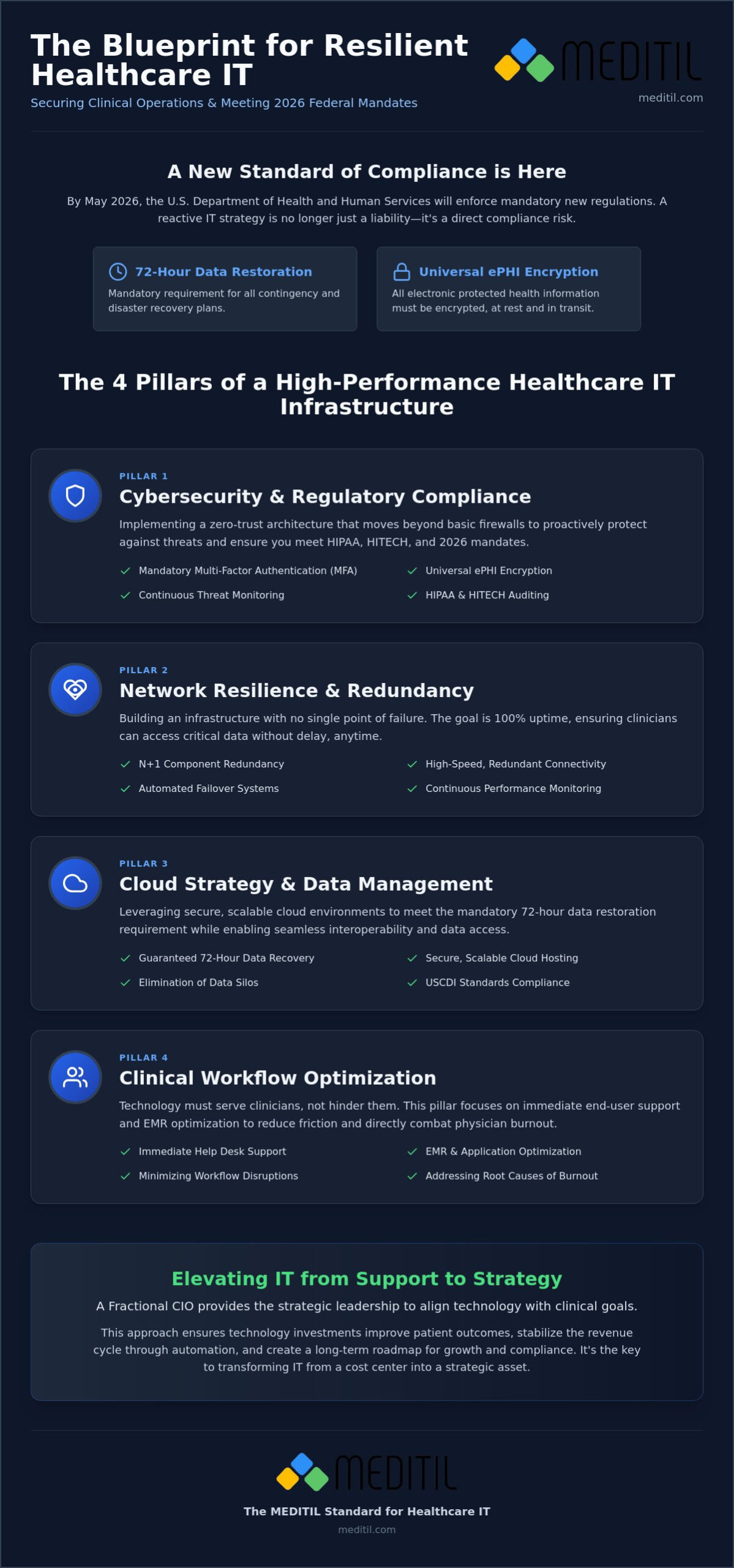
High-performance infrastructure in a clinical setting is measured by more than just speed. It’s defined by the invisible resilience that allows a surgeon to access imaging without delay or a nurse to update an EHR without system lag. A managed service provider healthcare specialist constructs this environment upon four critical pillars. These foundational elements ensure that technology serves as a silent partner in patient care rather than a source of friction.
- Pillar 1: Cybersecurity & Regulatory Compliance. This involves more than just firewalls. It requires the mandatory implementation of multi-factor authentication (MFA) and encryption for all ePHI, as dictated by the 2026 HIPAA Security Rule updates.
- Pillar 2: Network Resilience and N+1 Redundancy. To achieve 100% uptime, every critical component must have a functional backup. N+1 redundancy ensures that if a primary server or switch fails, a secondary unit assumes the load immediately.
- Pillar 3: Cloud Strategy and Secure Data Management. Modern healthcare relies on secure, scalable cloud environments that facilitate the mandatory 72-hour data restoration requirement for contingency planning.
- Pillar 4: End-User Support and Application Expertise. Technical support must be deeply familiar with healthcare-specific applications, providing specialized assistance for EMR and EHR platforms to maintain clinical momentum.
Cybersecurity as a Clinical Necessity
In 2026, cybersecurity is no longer a back-office concern; it’s a fundamental requirement for patient safety. Proactive monitoring identifies unusual patterns before ransomware can encrypt critical files or halt patient intake. By implementing a zero-trust architecture, access is verified at every point, which is essential in high-traffic medical environments where multiple providers access the same terminals. You can explore these defenses in greater detail through our specialized healthcare cybersecurity services.
Network Stability: The Foundation of Telehealth
Network latency isn’t just a technical annoyance. In a telehealth or remote monitoring context, it’s a safety issue. Infrastructure must be designed to support high-bandwidth imaging and real-time data exchange without jitter. Entering a strategic partnership with a managed service provider allows healthcare leaders to deploy these robust systems while maintaining focus on clinical outcomes. Redundant paths for internet and internal traffic ensure that even during a localized outage, the flow of patient data remains uninterrupted.
Assessing these pillars within your own organization is the first step toward long-term stability. If you’re uncertain about your current compliance posture or network resilience, a professional infrastructure consultation can provide the clarity needed to secure your managed service provider healthcare strategy for the years ahead.
Fractional CIO: Elevating Managed Services from Support to Strategy
Technical support focuses on resolving immediate failures, such as a localized network outage or an EMR login error. While essential, this reactive approach doesn’t address the long-term viability of your clinical operations. A specialized managed service provider healthcare partner integrates strategic leadership through a Fractional CIO. This role elevates IT from a cost center to a strategic asset. It ensures that every technical decision aligns with both clinical workflows and the organization’s financial objectives.
Strategic leadership is particularly vital when addressing technical debt. Legacy medical systems that haven’t been modernized often harbor vulnerabilities that conflict with the 2026 HIPAA Security Rule updates. A Fractional CIO conducts comprehensive audits to identify these risks. They create a structured roadmap for modernizing infrastructure, ensuring that facility expansions or new technology adoptions don’t compromise system stability or regulatory compliance.
Why Healthcare Leaders Need a ‘Steady Hand’ at the Wheel
Executive boards and clinical directors require a proactive guide to navigate the complexities of a regulated digital environment. A virtual CIO (vCIO) provides high-level risk mitigation and expert consultation during board-level decision-making processes. This model allows smaller and mid-sized organizations to access enterprise-level expertise without the prohibitive cost of a full-time executive salary. By utilizing virtual cio services, your leadership team gains a consultant invested in long-term outcomes rather than just ticket resolution.
IT Budgeting and Financial Stewardship
One of the most significant advantages of strategic IT leadership is the transition from unpredictable capital expenses (CapEx) to stable, predictable operating expenses (OpEx). Instead of facing sudden, large costs for server replacements, a Fractional CIO implements a lifecycle management plan. This methodical approach ensures that budgets are utilized efficiently, focusing on investments that yield a clear return. You can find more details on this transition in our guide to it budgeting for medical practices.
- Verified ROI: Identifying clinical gains from investments like billing automation and revenue cycle stability.
- Predictable Forecasting: Aligning IT spending with the facility’s three-to-five-year growth plan.
- Vendor Management: Consolidating contracts to reduce redundant spending and ensure service level agreements are met.
Ultimately, strategic leadership ensures that the four pillars of your infrastructure are not just built, but continuously refined. This steady hand at the wheel allows clinicians to focus on patient care while the Fractional CIO manages the technical complexities of the modern medical landscape.
Solving Clinical Friction: Interoperability and EMR Optimization
Technology should facilitate care, not hinder it. For many practices, clinical friction arises when data remains locked in silos or when EHR workflows aren’t aligned with actual patient encounters. A managed service provider healthcare specialist addresses these bottlenecks by prioritizing interoperability and system optimization. It’s about ensuring that the right data reaches the right provider at the right moment, without technical delays or manual workarounds. When systems communicate fluently, the administrative burden on clinicians decreases, directly addressing the primary drivers of physician burnout.
The role of a specialized MSP extends into the financial health of the organization through billing automation. By integrating financial workflows with clinical data, practices can achieve revenue cycle stability. This integration reduces manual entry errors and accelerates the reimbursement process. Managing the growing complexity of telehealth and remote patient monitoring (RPM) also requires a unified technical approach. This ensures that data from home-based devices flows securely into the patient’s primary record, maintaining a single source of truth for clinical decision-making. To see how this infrastructure enables specialized clinical services, you can check out My NuEra Rx for direct access to compounded weight loss medications.
Interoperability as a Service
Interoperability remains the most significant challenge for modern healthcare IT. It’s a fundamental operational requirement enforced by the Office of the National Coordinator for Health IT (ONC) through evolving USCDI standards. We manage system integration to ensure data flows securely between disparate platforms using standards like FHIR. This seamless exchange doesn’t just benefit the provider; it transforms the patient experience. Patients no longer need to repeat their history at every touchpoint because their data follows them through every stage of the care journey.
EMR Implementation and Staff Training
Software alone isn’t the solution. Even the most advanced EHR can become a source of frustration if the implementation is flawed or the staff is under-trained. Professional implementation involves mapping the software to your specific clinical workflows rather than forcing your staff to adapt to the software’s defaults. Training is equally critical. We focus on teaching staff to utilize IT systems for maximum efficiency, turning a complex tool into a streamlined asset. For those looking to further refine their operational efficiency, exploring medical billing automation solutions is a logical next step in the optimization journey.
If your current systems don’t communicate effectively, it’s time to explore a systems integration audit to restore clinical efficiency and protect your organization’s revenue cycle.
Partnering for Resilience: The MEDITIL Managed Service Approach
Resilience in a clinical environment is not achieved through a single software installation or a one-time security patch. It’s the result of a disciplined, ongoing partnership that prioritizes technical stability and regulatory precision. Our approach as a managed service provider healthcare specialist is built on the “Steady Hand” philosophy. This means we don’t just react to problems; we provide a composed, expert presence that ensures every technical detail is handled with precision. Whether you are transitioning from an in-house team or a generalist provider, our methodology is designed to minimize disruption while maximizing long-term security.
Every organization has unique operational requirements, which is why we reject the “one-size-fits-all” model. We customize every managed service agreement to align with your specific clinical objectives and patient care standards. By integrating continuous monitoring with a proactive management style, we eliminate the volatility often associated with medical IT. This methodical approach allows your leadership to move away from day-to-day technical troubleshooting and focus on strategic advancement and facility growth.
For healthcare administrators coordinating regional site visits or executive travel to the Minneapolis–Saint Paul area, partnering with a professional MSP Chauffeur Service ensures that transportation logistics are as reliable and seamless as your managed IT infrastructure.
The 5 Steps to a Successful MSP Transition
Transitioning your infrastructure to a specialized managed service provider healthcare partner requires a structured and logical progression. We utilize a five-step process to ensure a seamless handover and immediate operational improvement:
- Step 1: Infrastructure Audit. We conduct a comprehensive assessment of your current network and a deep-dive security risk assessment to identify hidden vulnerabilities.
- Step 2: System Stabilization. Our team works to eliminate immediate threats and stabilize mission-critical systems, ensuring your clinical workflows remain uninterrupted.
- Step 3: Monitoring Integration. We implement 24/7 infrastructure monitoring and integrate our specialized help desk to provide immediate support for your staff.
- Step 4: Strategic Alignment. We introduce Fractional CIO consultation to align your technology roadmap with your business and clinical outcomes.
- Step 5: Continuous Optimization. Through proactive lifecycle management, we ensure your systems are constantly refined to meet evolving 2026 regulatory standards.
The Long-Term Value of a Healthcare-First Partnership
A partnership with MEDITIL is an investment in the financial and operational health of your practice. By optimizing your infrastructure, we reduce the total cost of ownership (TCO) for your clinical technology. You’ll no longer face the high, unpredictable costs of emergency repairs or the financial fallout of a data breach. Instead, your organization remains audit-ready and compliant at all times, protected by a team that understands the high-stakes nature of the medical industry.
True partnership is about more than just fixing computers; it’s about building a foundation for sustainable care. If you’re ready to move beyond reactive support and secure a strategic ally for your digital future, it’s time to take the next step. Partner with MEDITIL for Strategic Healthcare IT and experience the stability of a specialized managed service approach.
Securing the Future of Clinical Operations
The transition from technical troubleshooting to strategic clinical excellence requires a partner that understands the specific demands of a regulated medical environment. By establishing the four pillars of high-performance infrastructure and integrating a Fractional CIO, your organization can move beyond the friction of legacy systems. Selecting a dedicated managed service provider healthcare specialist ensures that your infrastructure remains a silent, reliable partner in patient care rather than a source of burnout.
MEDITIL maintains a 100% focus on the healthcare sector, providing comprehensive HIPAA and HITECH compliance management through continuous verification. Our Fractional CIO expertise is available to every client, aligning technical budgets with clinical outcomes to ensure long-term stability. Technical resilience isn’t a static achievement. It’s time to achieve seamless connectivity and protect your revenue cycle through a partnership built on technical precision and a mission-driven focus on improvement.
Secure Your Clinical Future with MEDITIL’s Strategic Managed IT Services
Your path to a stabilized, high-performing IT environment begins with a single strategic decision. We look forward to helping you build a more resilient and secure digital foundation for your practice.
Frequently Asked Questions
What is the difference between a general MSP and a healthcare MSP?
A healthcare MSP focuses on clinical context and regulatory compliance rather than just general IT maintenance. While a generalist manages standard office networks, a specialist manages the security protocols and interoperability standards required for ePHI and medical workflows. This specialized managed service provider healthcare approach ensures that technology supports patient safety and meets specific industry mandates.
How does a healthcare managed service provider ensure HIPAA compliance?
We ensure compliance through continuous monitoring and the implementation of mandatory 2026 Security Rule updates. This includes enforcing multi-factor authentication (MFA), encrypting data at rest and in transit, and conducting annual penetration tests to verify the integrity of the clinical environment. Our goal is to maintain an audit-ready posture at all times through rigorous verification and documentation.
Can an MSP manage our existing EMR/EHR systems without replacing them?
Yes, we specialize in optimizing and supporting your existing EMR/EHR systems rather than requiring a replacement. Our role involves improving application performance, ensuring seamless data integration with other clinical tools, and providing end-user training to reduce staff friction. We focus on making your current software work more efficiently within your established workflows.
What is a Fractional CIO and does my medical practice need one?
A Fractional CIO is a strategic leader who provides executive-level IT guidance on a part-time basis. Your practice needs one if you require board-level risk mitigation, long-term technology roadmapping, or a methodical approach to aligning your IT budget with clinical growth. This role provides the strategic leadership of a full-time executive without the associated overhead costs.
How much does it cost to hire a managed service provider for healthcare?
Pricing for these services is typically structured as a predictable monthly fee based on the complexity of your infrastructure and the level of security required. While costs vary across the industry, a specialized managed service provider healthcare partner focuses on reducing the total cost of ownership. We achieve this through proactive stabilization and by eliminating the unpredictable expenses of emergency repairs.
Will switching to an MSP cause downtime for our clinical operations?
Our onboarding process is designed to minimize clinical disruption through a methodical, phased transition. We perform comprehensive audits and system stabilization in parallel with your current operations; this ensures that the final handover is seamless. Our team prioritizes maintaining patient intake and care delivery throughout the entire implementation period.
What is N+1 redundancy and why is it important for medical clinics?
N+1 redundancy is a configuration where an extra component is added to a system to ensure continuous availability in the event of a failure. For medical clinics, this means that if a primary network switch or server fails, a secondary unit assumes the workload immediately. This architecture is essential for maintaining 100% uptime in life-critical environments where data access is paramount.
Does MEDITIL provide on-site support or is it all remote?
MEDITIL provides a hybrid support model that combines 24/7 remote monitoring with on-site assistance for hardware deployments and critical infrastructure needs. While most technical issues are resolved instantly via our remote help desk, we remain available for physical intervention when the situation demands it. This ensures a steady hand is always available, whether through digital connectivity or in-person expertise.