
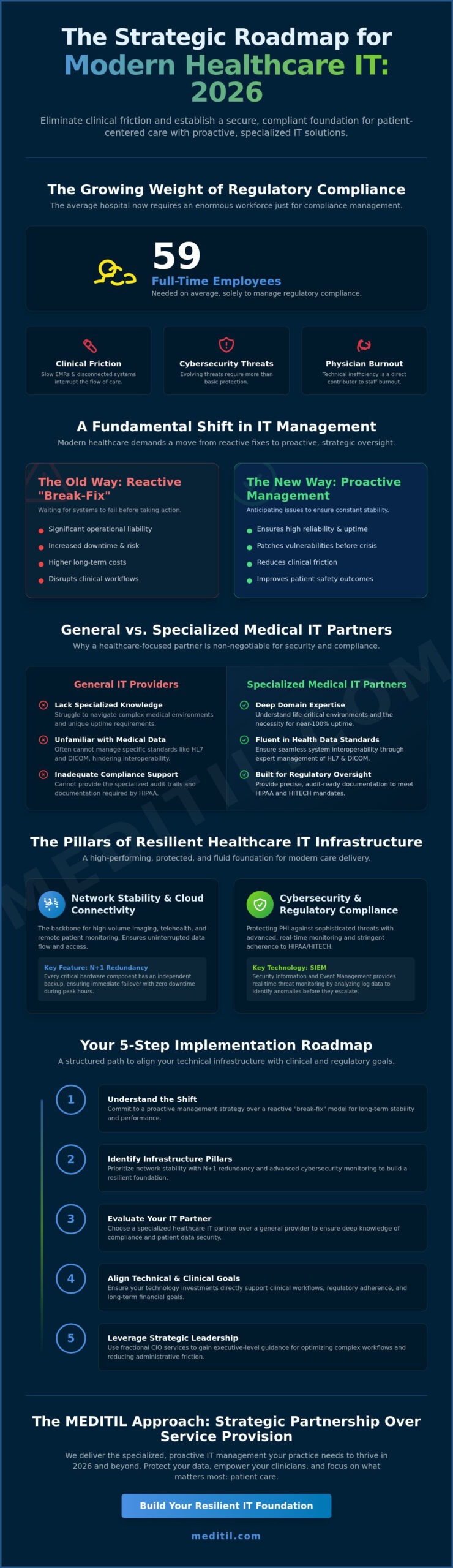
Did you know that the average hospital now requires 59 full-time employees just to manage the weight of regulatory compliance? As a healthcare leader, you likely feel this administrative pressure every day. It’s exhausting when slow systems and disconnected workflows create friction between your clinicians and their patients. You’ve likely felt the anxiety of evolving cybersecurity threats or the frustration of working with general IT providers who simply don’t understand the nuances of a medical workflow.
We recognize that your technology must do more than just function; it must protect. By implementing specialized medical it solutions, you can eliminate clinical friction and establish a secure, compliant foundation for patient-centered care. This article provides a strategic roadmap for 2026. You’ll discover how to navigate the latest HIPAA Security Rule changes and CMS mandates while building a high-performing network. We’ll examine how to improve interoperability, support telehealth growth, and ultimately reduce the physician burnout that stems from technical inefficiency.
Key Takeaways
- Understand why modern medical it solutions require a shift from reactive repairs to proactive management for long-term stability.
- Identify the essential infrastructure pillars for 2026, including N+1 redundancy and advanced cybersecurity monitoring.
- Evaluate the critical differences between general IT providers and specialized healthcare partners to ensure patient data security.
- Follow a structured 5-step implementation roadmap that aligns your technical infrastructure with clinical and regulatory goals.
- Learn how fractional CIO services deliver executive-level leadership to optimize complex workflows and reduce administrative friction.
Defining Modern Medical IT Solutions in a Regulated Environment
Modern Health information technology (HIT) is no longer a peripheral utility. It represents an integrated network of physical hardware, cloud-based software, and high-level strategic management. In 2026, the definition of medical it solutions has evolved from simple technical support to a mission-critical infrastructure that dictates the quality of patient care. It’s the nervous system of your practice, connecting every diagnostic tool to the providers who need that data to make life-saving decisions.
Of course, a network is only as effective as the hardware it supports. Many healthcare organizations ensure their clinical capabilities remain top-tier by sourcing reliable equipment and supplies from a global wholesaler like IMT Medical Devices.
The industry has moved decisively past the era of reactive “break-fix” models. Waiting for a server to fail or a network to crash before calling for help is now considered a significant operational liability. Proactive managed healthcare IT ensures that vulnerabilities are patched and hardware is optimized before a crisis occurs. This steady approach provides the reliability that healthcare leaders require to maintain a stable environment.
A primary focus for 2026 is the reduction of clinical friction. This term describes the technical hurdles, such as slow EMR logins or disconnected imaging data, that interrupt the flow of care. When systems are fragmented, providers experience higher rates of burnout. Technical stability directly correlates with patient safety outcomes. A three-second delay in accessing a patient’s allergy list or a failed imaging sync can have immediate clinical consequences. By prioritizing seamless connectivity, organizations protect both their staff and their patients.
The Core Components of a Healthcare IT Ecosystem
- Managed infrastructure: This is the physical and cloud foundation of the practice. It includes the servers, switches, and wireless access points that keep a practice operational.
- Cybersecurity and compliance: This focuses on the rigorous protection of Protected Health Information (PHI) through encryption, multi-factor authentication, and strict access controls.
- Strategic leadership: The role of a fractional CIO is essential for roadmap planning. They ensure that technology investments align with long-term clinical and financial goals.
Why ‘General’ IT Solutions Are No Longer Sufficient
General IT providers often lack the specialized knowledge required to navigate a medical environment. Medical systems have unique uptime requirements that standard businesses don’t share. While a typical office might tolerate an hour of downtime, life-critical environments cannot. Furthermore, generalists often struggle with medical-specific data standards like HL7 and DICOM, which are essential for system interoperability. Regulatory oversight in 2026 also demands specialized audit trails and documentation that only a healthcare-focused partner can provide with precision. Understanding the full scope of what to look for when evaluating a provider is essential, and our managed it support for healthcare buying guide offers a comprehensive framework for making that critical selection.
The Three Pillars of Resilient Healthcare IT Infrastructure
Building a resilient medical practice requires a fundamental shift in how leaders view their technical environment. It’s not enough to simply purchase the latest software; you must manage the entire ecosystem that supports it. In 2026, effective medical it solutions rest on three foundational pillars. These pillars ensure that your infrastructure remains high-performing, protected, and fluid enough to support modern care delivery models like telehealth and remote patient monitoring.
Network Stability and Cloud Connectivity
High-volume imaging and telehealth demand low-latency networks that can handle massive data transfers without interruption. A single connection failure during a remote consultation disrupts the clinical flow and erodes patient trust. To mitigate this risk, we implement N+1 redundancy. This architecture ensures that every critical hardware component has at least one independent backup ready to engage. If a primary gateway fails during peak hours, the system transitions to the redundant path immediately. Managed cloud services complement this by providing scalable storage for medical data, ensuring records are accessible even if a physical site experiences a local outage.
Cybersecurity and Regulatory Compliance (HIPAA/HITECH)
Basic firewalls are insufficient against the sophisticated threats targeting healthcare today. Modern protection requires Security Information and Event Management (SIEM). This technology provides real-time threat monitoring by analyzing log data across your entire network to identify anomalies before they escalate into breaches. Every IT touchpoint must meet stringent HIPAA and SOC2 compliance standards to protect patient privacy. Regular risk assessments and ongoing staff training are now essential components of a secure operation. If you’re uncertain about your current defensive posture, our team offers specialized cybersecurity and compliance services to identify and remediate hidden vulnerabilities.
Interoperability: Breaking Down Medical Data Silos
Data silos are often the root cause of clinical friction. When billing systems don’t communicate with clinical platforms, staff are forced into repetitive, manual data entry. This doesn’t just waste time; it significantly increases the risk of human error in patient records. Strategic interoperability allows for a seamless flow of information between disparate systems. By optimizing workflows through billing automation and EHR implementation, practices can focus on patient outcomes rather than administrative hurdles. This alignment reflects the goals found in any robust state-level strategic plan for health IT, emphasizing unified data standards as a requirement for modern care. When these systems talk to one another, the “steady hand at the wheel” becomes a reality for your practice management.
General MSP vs. Specialized Medical IT: A Strategic Comparison
Selecting an IT partner is a decision that extends far beyond technical support; it’s a choice that impacts the safety and efficiency of your clinical operations. Many healthcare leaders mistakenly assume that a general Managed Service Provider (MSP) can handle their needs as effectively as a specialized firm. However, the gap between general technical support and specialized medical it solutions is significant. This distinction is best measured across five critical metrics: regulatory alignment, workflow integration, data interoperability, cybersecurity depth, and audit readiness. While a general MSP focuses on “keeping the lights on,” a medical partner focuses on keeping the clinic moving.
General providers often fail because they treat medical data like any other business asset. They might secure a server, but they don’t understand the “life-critical” nature of the data on it. A common failure point occurs when a general MSP updates a system without verifying compatibility with medical imaging software or EMR plugins, leading to unexpected downtime. They also frequently overlook the “Clinical Friction” metric. This is the measurable delay a provider experiences when interacting with technology. General providers can’t measure this because they lack the context of the exam room; they see a functioning network, while the physician sees a system that takes 45 seconds to load a patient chart. This gap in understanding is precisely why organizations increasingly turn to healthcare it help desk services staffed by specialists who understand the urgency of a frozen EHR during rounds and speak the language of HL7 and MIPS.
The cost objection is the most frequent hurdle for leaders considering specialized IT. It’s vital to recognize that specialized medical it solutions are nearly always cheaper than a single HIPAA fine. With the Department of Health and Human Services intensifying enforcement in 2026, the financial risk of non-compliance is at an all-time high. Investing in a partner who guarantees compliance is a strategic act of risk mitigation, not just an operational expense. To evaluate what truly separates a qualified healthcare IT partner from a general provider, review our detailed guide on managed it support for healthcare, which outlines the key criteria for making a confident, informed decision.
Regulatory Knowledge and Audit Readiness
- General MSPs often lack the documentation rigor required for healthcare audits. They may provide basic logs, but they don’t maintain the granular, timestamped records required by OCR investigators.
- Specialized partners provide ongoing compliance as a core service. This includes maintaining a signed Business Associate Agreement (BAA) and ensuring every technician is trained on PHI handling.
- In the event of an audit, a specialized partner acts as your primary witness, providing the “ready-to-go” documentation that proves your organization has met all “required” and “addressable” specifications.
Understanding Clinical Workflows and EHR Nuance
An IT technician must understand the clinical impact of a system lag. If a system stutters during a patient exam, it doesn’t just frustrate the doctor; it disrupts the patient-provider relationship. Specialized partners follow best practices for implementing health IT to ensure that every update is vetted for clinical stability. This expertise is especially critical during EMR implementation and staff training, where technical hurdles can lead to immediate drops in provider productivity. Our research into managed it services for healthcare shows that organizations using specialized partners report a significant reduction in technical debt, as systems are built correctly the first time rather than being patched together by generalists.
A 5-Step Roadmap for Implementing Medical IT Solutions
Modernizing a healthcare practice requires more than just a series of hardware upgrades. It demands a methodical approach that aligns technical capabilities with clinical objectives. By following a structured roadmap, healthcare leaders can ensure their medical it solutions are not just functional but future-proof. This transition from fragmented systems to a unified ecosystem happens in five distinct stages, each designed to build upon the stability of the previous one.
- Step 1: Conduct a Comprehensive Infrastructure and Compliance Audit. Every successful implementation begins with a clear understanding of the baseline. This involves a deep dive into your current network health, security vulnerabilities, and compliance gaps.
- Step 2: Define Strategic Objectives with a Fractional CIO. Technology should serve your business goals. In this phase, you define what success looks like, whether it’s reducing patient wait times or increasing telehealth capacity.
- Step 3: Remediate Security Gaps and Implement N+1 Redundancy. Before adding new features, you must secure the perimeter. This includes patching vulnerabilities and ensuring that critical systems have the redundant hardware necessary to prevent downtime.
- Step 4: Integrate Systems and Automate Billing Workflows. True efficiency comes from interoperability. Here, you connect disparate platforms to ensure data flows seamlessly between clinical and administrative departments.
- Step 5: Establish Ongoing Managed Support and Proactive Monitoring. The final step is moving into a “steady state” where systems are monitored 24/7 to identify and resolve issues before they impact care. A critical component of this stage is deploying specialized healthcare it help desk services that can respond to clinical workflow disruptions with the urgency and domain expertise they demand.
Assessing Your Current Technical Debt
Technical debt is the hidden cost of maintaining legacy systems. Many practices rely on “end-of-life” hardware that no longer receives security updates, creating a significant risk for a breach. When software silos prevent efficient patient data sharing, the resulting clinical friction costs your staff hours of productive time every week. To move forward, you must quantify the financial impact of your current downtime. Identifying these bottlenecks allows you to prioritize investments that offer the highest return on clinical efficiency.
Setting a 3-Year Strategic IT Roadmap
Successful healthcare organizations don’t plan year-to-year; they look toward a three-year horizon. This long-term perspective allows you to align IT budgets with anticipated clinical growth and regulatory shifts. Using virtual cio services provides the executive-level guidance needed to navigate complex technology choices without the overhead of a full-time hire. This strategic partner helps you plan for future scalability, ensuring your infrastructure can support the increasing demands of telehealth and remote patient monitoring. If you’re ready to transition from reactive fixes to a proactive strategy, schedule a strategic infrastructure audit with our team to begin your roadmap development.
The MEDITIL Approach: Strategic Partnership Over Service Provision
At MEDITIL, our philosophy centers on being the “steady hand at the wheel” for your organization’s technical infrastructure. We believe that technology should be invisible to the provider but indispensable to the practice. In an era where technical debt can paralyze operations, we provide comprehensive medical it solutions that prioritize long-term stability over temporary fixes. Our role is not that of a simple vendor; we act as a strategic partner invested in your clinical success. Whether we are augmenting an existing IT team or serving as your primary technical department, our focus remains on ensuring your systems support the high-stakes nature of healthcare delivery.
Our commitment to zero clinical friction means we design systems that respect the provider’s time and the patient’s experience. We understand that in a medical environment, uptime is life-critical. A network failure isn’t just an inconvenience; it’s a disruption to care that can have serious clinical consequences. By maintaining a disciplined and results-oriented approach, we ensure that your infrastructure remains a high-performing asset rather than a source of administrative frustration.
Fractional CIO and Strategic Advisory
Many healthcare leaders struggle to bridge the gap between medical administration and technical execution. Our fractional CIO services provide the executive leadership needed to navigate this divide without the burden of a full-time salary. We provide the business intelligence and analytics required for data-driven decisions, helping you identify areas where technology can improve operational efficiency. This advisory role ensures that your technology serves the mission of patient care, rather than the care being forced to adapt to the technology. We help you build a roadmap that accounts for regulatory shifts, ensuring you remain compliant and competitive through 2026 and beyond.
Comprehensive Managed Operations
MEDITIL handles the end-to-end management of your technical ecosystem, from cloud infrastructure and networking to end-user help desk support. We offer dedicated healthcare application support for EMR and EHR systems, ensuring that the software your team relies on most is always optimized. Our proactive cybersecurity monitoring is specifically tailored to the unique threats facing the medical industry. We don’t just react to breaches; we build verified, secure environments that protect patient data through every touchpoint. By integrating these medical it solutions into a single managed framework, we provide the seamless connectivity and protection your practice requires to thrive in a regulated environment.
Securing the Future of Clinical Excellence
As we look toward the technical and regulatory demands of 2026, it’s clear that your infrastructure must be as resilient as the care you provide. The transition from reactive technical support to a proactive, managed ecosystem is essential for reducing clinical friction and protecting patient data. By prioritizing specialized medical it solutions over general services, you ensure that your systems are designed with the unique nuances of clinical workflows and life-critical uptime in mind.
MEDITIL provides the expert guidance necessary to navigate this complex environment. Our specialized healthcare-only focus, combined with fractional CIO strategic leadership and comprehensive HIPAA compliance management, offers the stability your practice requires to thrive. We understand that technology should empower your mission, not hinder it. You don’t have to manage these high-stakes transitions alone. Schedule a Strategic IT Consultation with MEDITIL to begin building a more secure and efficient foundation for your organization. We’re ready to provide the steady hand at the wheel that your team and your patients deserve.
Frequently Asked Questions
What are the most common medical IT solutions for small to mid-sized practices?
Small to mid-sized practices typically prioritize managed infrastructure, secure cloud storage, and automated backup systems. These organizations require help desk support that understands specific EMR workflows and specialized cybersecurity to protect patient data from ransomware. By focusing on these core areas, smaller practices can maintain the same level of technical stability and security as larger health systems.
How do medical IT solutions differ from standard business IT services?
Medical IT is built for “life-critical” uptime and rigorous regulatory compliance rather than general office productivity. Standard business IT services often lack the specialized knowledge of medical data standards like HL7 or DICOM. They also rarely provide the granular audit trails and documentation required to survive a HIPAA investigation, which makes them a liability in a clinical environment.
What is a fractional CIO, and does my medical organization need one?
A fractional CIO is an executive-level consultant who provides strategic technical leadership and long-term roadmap planning on a part-time basis. Your organization needs one if you’re struggling to align your IT budget with clinical goals or if you lack a dedicated expert to navigate complex vendor selections. They provide high-level guidance without the financial burden of a full-time executive salary.
How can medical IT solutions help our practice stay HIPAA compliant?
Specialized medical it solutions ensure compliance through end-to-end encryption, multi-factor authentication, and proactive SIEM monitoring. These systems are designed to meet every “required” and “addressable” specification under the HIPAA Security Rule. They generate the necessary logs and reports that prove your organization has maintained a secure environment during a regulatory audit.
What is interoperability in healthcare IT, and why is it important?
Interoperability is the ability of disparate healthcare systems to exchange and interpret data seamlessly across different platforms. It’s important because it eliminates the need for repetitive manual data entry and reduces the risk of human error in patient records. When your billing and clinical systems talk to each other, your staff can focus on patient care instead of administrative hurdles.
How much should a medical practice budget for IT services in 2026?
Practices should budget based on their specific infrastructure complexity and the volume of protected health information they manage. In 2026, it’s essential to prioritize allocations for cybersecurity, cloud scalability, and strategic advisory services. While costs vary, investing in a proactive managed model is consistently more cost-effective than the fines and lost revenue associated with a data breach or prolonged downtime.
Can medical IT solutions help reduce physician and staff burnout?
Yes, by eliminating the clinical friction and system lag that disrupts the flow of patient care. Stable, high-performing medical it solutions allow providers to spend less time troubleshooting technology and more time focused on their patients. Reducing these technical frustrations is a direct way to improve professional satisfaction and retain high-quality clinical staff.
What happens if our medical IT infrastructure fails during patient hours?
Without a resilient design, an infrastructure failure leads to immediate clinical downtime, lost revenue, and compromised patient trust. A properly managed environment uses N+1 redundancy to ensure that if a primary component fails, a secondary system takes over immediately. This proactive architecture minimizes the impact on care delivery, ensuring that your clinic remains operational even during a technical fault.
2 Responses