
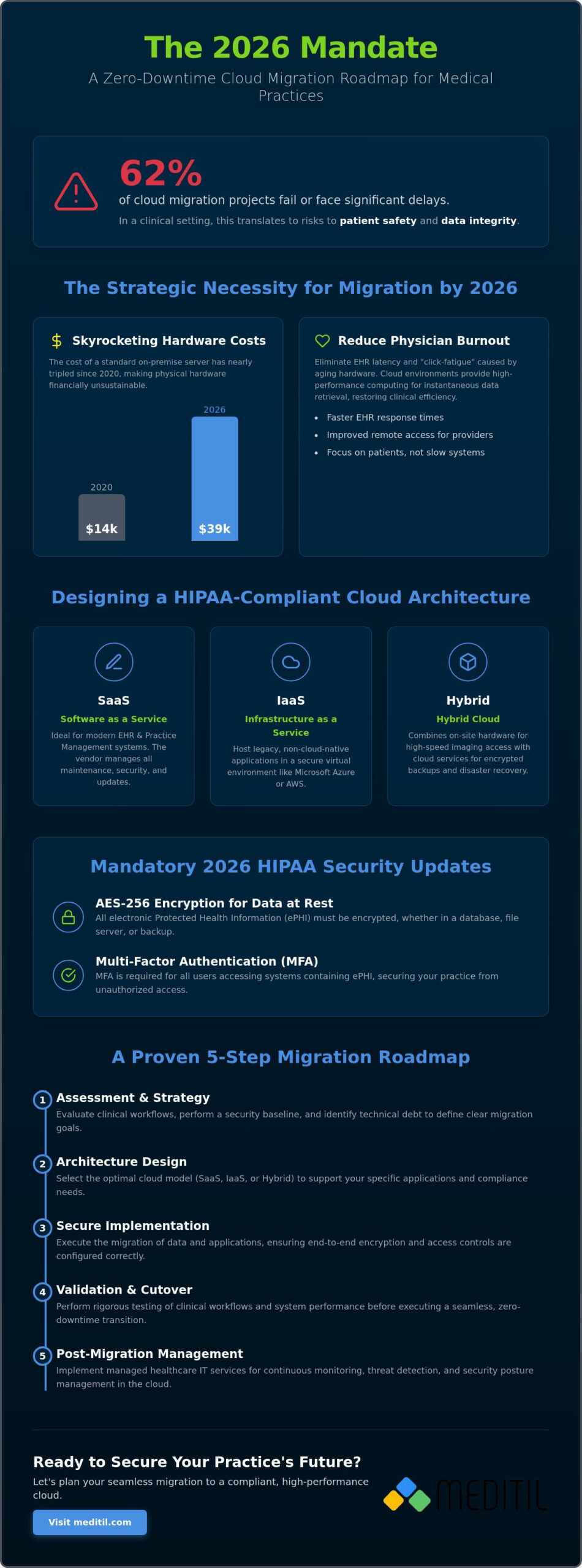
Did you know that 62% of cloud migration projects either fail or face significant difficulties? In a clinical setting, these failures translate to more than just technical lag; they represent potential risks to patient safety and data integrity. Transitioning your infrastructure is a complex undertaking that often triggers concerns about hidden costs, legacy EHR data integrity, and the clinical friction caused by system latency. You need a partner who understands that a medical practice cloud migration is a strategic clinical upgrade, not just a simple server move.
We’ve designed this framework to help you master these complexities and achieve a zero-downtime transition. You’ll learn how to align your practice with the 2026 HIPAA Security Rule updates, including mandatory AES-256 encryption for ePHI at rest and multi-factor authentication for all users. By following this roadmap, you can improve remote access for your providers and establish a predictable IT budget that avoids the volatile pricing of physical hardware. We will explore the critical role of vCIO oversight, the shift toward integrated platforms, and the steps required to ensure your cybersecurity posture remains ironclad.
Key Takeaways
- Identify the strategic necessity of retiring legacy on-premise hardware in 2026 to eliminate technical debt and rising maintenance costs.
- Evaluate the structural differences between SaaS, IaaS, and Hybrid models to build a cloud architecture that supports end-to-end encryption for ePHI.
- Discover why vCIO oversight is the primary factor in a successful medical practice cloud migration, ensuring technology remains a clinical asset rather than a liability.
- Follow a proven 5-step roadmap that prioritizes clinical workflow assessments and security baselines to prevent downtime during your transition.
- Learn how to maintain an ironclad security posture after the cutover through managed healthcare IT services designed for a perimeter-less environment.
The Strategic Necessity of Medical Practice Cloud Migration in 2026
A medical practice cloud migration is the deliberate process of transitioning clinical data, administrative applications, and IT infrastructure from physical on-site servers to a secure, HIPAA-compliant cloud environment. It’s an evolution of cloud computing tailored for the stringent demands of healthcare. By 2026, this shift has become a strategic necessity rather than an optional upgrade. Legacy hardware is no longer just an IT burden; it’s a liability that creates technical debt and operational risk.
The economic argument for this transition is undeniable. Data from 2026 indicates that the cost of on-premise server hardware has nearly tripled since 2020. For example, a standard server configuration that was quoted at approximately $14,000 four years ago now approaches $39,000. When you add the expenses of specialized climate control, physical security, and the rising cost of local technical labor, the financial case for on-site hosting collapses. Retiring this hardware allows practices to redirect capital toward clinical growth.
Beyond the balance sheet, a medical practice cloud migration addresses the growing crisis of physician burnout. On-premise systems often suffer from latency and “click-fatigue” as aging hardware struggles with modern, data-heavy EHR updates. Cloud-native environments provide the high-performance compute power needed for instantaneous data retrieval. This reduces clinical friction, allowing providers to focus on patients instead of waiting for screens to load. It’s a fundamental step in restoring efficiency to the provider workflow.
Retiring the “Server in the Closet” Mentality
Maintaining a server room requires more than just space. It demands redundant power, precision cooling, and strict access controls to meet HIPAA standards. Localized hardware failures or the limitations of traditional tape backups can lead to catastrophic data loss. Transitioning to the cloud enables centralized identity management. It replaces fragmented logins with secure, verifiable access protocols that protect your practice from internal and external threats while simplifying the user experience for your staff.
Cloud Migration as a Catalyst for Patient Safety
Patient safety relies on high-availability systems. Cloud infrastructure ensures that critical clinical data is accessible 24/7, regardless of local power outages or hardware issues. This stability is essential for the integration of remote patient monitoring (RPM) and telehealth tools that are now permanent fixtures in care delivery. When systems are reliable and interoperable, medical errors decrease. Providers can make informed decisions based on real-time data, leading to better long-term outcomes for the patient population.
Designing a HIPAA-Compliant Cloud Architecture
Constructing a cloud environment for a clinical practice requires a deliberate architectural design that balances accessibility with the rigid standards of 2026 healthcare regulations. A successful medical practice cloud migration relies on a structured approach to infrastructure, ensuring that every data point is protected. This architecture is typically built upon three primary pillars: Software as a Service (SaaS), Infrastructure as a Service (IaaS), and Hybrid models. Each serves a distinct operational purpose based on your practice’s specific technical debt and growth objectives.
SaaS vs. IaaS: Choosing the Right Path for Your Clinic
Software as a Service (SaaS) is the most common choice for modern EHR and Practice Management systems. It offloads the burden of software maintenance and security patching to the vendor, allowing your staff to focus on clinical tasks. However, many established practices still rely on legacy applications that aren’t yet cloud-native. In these instances, Infrastructure as a Service (IaaS) allows you to host those specific applications in a secure virtual environment like Microsoft Azure or AWS. A Hybrid Cloud approach remains a resilient choice for clinics that require high-speed on-site access to imaging files while utilizing the cloud for encrypted backups and disaster recovery.
Security within this architecture must be ironclad. By 2026, mandatory HIPAA updates require AES-256 encryption for all electronic Protected Health Information (ePHI) at rest, whether it’s in a database or a backup file. Additionally, all data in transit must utilize Transport Layer Security (TLS) 1.2 or higher. These technical safeguards ensure that intercepted data remains unreadable. Compliance is officially established when you execute a HIPAA-compliant business associate agreement (BAA) with every cloud service provider. This document defines the shared responsibility model, ensuring the provider is legally accountable for the security of their underlying infrastructure.
Interoperability and Data Management
The cloud serves as the essential bridge between historically siloed systems. Interoperability is the seamless exchange of data across clinical systems. By leveraging cloud-based APIs and FHIR (Fast Healthcare Interoperability Resources) standards, your practice can synchronize data flow between EHRs, billing platforms, and laboratory systems. This connectivity eliminates manual data entry and reduces the risk of transcription errors. If you’re navigating these technical choices, our team offers managed IT services for healthcare to ensure your systems remain integrated and secure.
Advanced data management also includes the use of cloud-based business intelligence tools. These platforms aggregate clinical and financial data to provide real-time practice analytics. It allows practice managers to monitor patient outcomes and revenue cycle performance through a single, unified dashboard. This level of insight is only possible when data is freed from local servers and organized within a scalable cloud framework. It’s about turning raw information into actionable clinical intelligence.
Why vCIO Oversight is Critical for Migration Success
A successful medical practice cloud migration requires more than a simple data transfer. Many organizations treat the move as a purely technical event, yet it’s actually a fundamental clinical transformation. A technical “lift and shift” often ignores the nuances of provider workflows, leading to frustration and downtime. Strategic oversight ensures that every technical decision supports the overarching mission of patient care. This is why a roadmap designed by an expert is superior to a standard data migration.
Strategic leadership helps healthcare organizations modernize their IT infrastructure without sacrificing stability. The primary goal of virtual CIO services is to align IT budgets with clinical objectives. This ensures that the migration isn’t just an expense but a catalyst for better outcomes. It also mitigates the risk of vendor finger-pointing. When complex system integrations face challenges, a vCIO acts as the authoritative liaison between EHR vendors and cloud providers, ensuring that issues are resolved quickly without disrupting the clinic.
The Fractional CIO as a Strategic Guide
Before moving any data, a fractional CIO conducts a thorough risk assessment. This process identifies potential bottlenecks in the clinical workflow and documents legacy dependencies. They develop a multi-year IT roadmap that treats migration as a foundation, not a finish line. Effective it budgeting for medical practices must account for the long-term ROI of the cloud. This includes factoring in reduced hardware replacement costs and the financial benefits of improved system uptime. By viewing technology through a financial lens, the vCIO prevents “cloud sprawl” and manages monthly consumption fees.
Managing Vendor and Stakeholder Expectations
Effective migration requires clear communication between all stakeholders. The vCIO defines specific KPIs for success, such as latency reduction and guaranteed uptime percentages. They serve as a steady hand at the wheel, managing the expectations of both clinical staff and administrative leadership. This role is also vital for maintaining cybersecurity protocols at the leadership level. It’s not just about moving data; it’s about ensuring that the practice’s digital foundation is resilient enough to support future growth and the evolving needs of the patient population.
A Practical 5-Step Roadmap for a Seamless Practice Cutover
Executing a transition requires a methodical approach that accounts for every clinical dependency. A successful medical practice cloud migration depends on a disciplined execution phase that prioritizes patient care over technical convenience. We’ve developed a structured five-step roadmap to ensure your practice moves to the cloud without the typical friction associated with legacy system updates.
- Step 1: Clinical Workflow Assessment — Our team observes real patient encounters to map how data flows through your clinic. This identifies how providers actually use the EHR, rather than how the software is simply designed to work.
- Step 2: Security and Compliance Baseline — We document all technical safeguards and administrative protocols before any data is moved. This creates a verifiable audit trail for HIPAA compliance.
- Step 3: Staging and Pilot Testing — We move non-critical data first to verify performance and latency. This allows us to fine-tune the environment before the full clinical load is applied.
- Step 4: The Managed Cutover — The final move is executed during off-peak hours. We maintain a clear, documented rollback plan to ensure that your clinic is operational by the start of the next business day.
- Step 5: Post-Migration Optimization — Once live, we provide continuous monitoring and refine system configurations based on real-world staff feedback.
Dependency Mapping and Cutover Planning
Mapping “hidden” dependencies is a critical component of the planning phase. Many practices overlook how local hardware, such as document scanners, lab interfaces, and fax-to-cloud workflows, will interact with a new cloud environment. We identify these touchpoints early to prevent post-migration bottlenecks. Our detailed rollback strategy acts as a safety net, providing the reassurance that patient care will never be compromised by a technical failure. By scheduling the cutover during weekend or evening hours, we eliminate the risk of downtime during your busiest clinical sessions.
Staff Training and Help Desk Integration
Staff training is the most underestimated factor in migration success. Even the most sophisticated cloud architecture will fail if the clinical staff doesn’t feel confident using it. We provide 1-on-1 support for providers during the first 48 hours of the “go-live” phase to address immediate concerns. This high-touch approach is integrated into our standard help desk workflow, ensuring that cloud-specific troubleshooting is handled by technicians who understand your unique environment. If you’re ready to modernize your clinic, our team provides the Project-Based IT Consulting necessary to manage this transition with precision.
By following this structured roadmap for medical practice cloud migration, you minimize the risk of technical debt and ensure your team is prepared for the future of digital healthcare. It’s about building a foundation that supports both clinical excellence and operational stability.
Beyond the Move: Managed Healthcare IT in the Cloud
The completion of a medical practice cloud migration marks the beginning of a more agile operational phase, not the end of IT oversight. Transitioning to the cloud shifts the focus from hardware maintenance to system optimization and continuous protection. In this new environment, managed it services for healthcare become even more vital. They provide the specialized expertise needed to manage a distributed network where the traditional office perimeter no longer exists. Effective management ensures that your cloud environment remains a clinical asset rather than a growing source of technical complexity.
Cloud infrastructure provides the ideal foundation for secondary clinical improvements. For instance, practices can leverage medical billing automation solutions to maximize their return on investment. These tools integrate directly with cloud-based EHRs to accelerate the revenue cycle and reduce administrative overhead. Maintaining 99.99% clinical uptime requires proactive monitoring that identifies potential bottlenecks before they impact patient encounters. This level of reliability is only possible through a disciplined approach to managed IT that prioritizes stability and seamless connectivity.
Proactive Security and Compliance Monitoring
Security in the cloud is a dynamic challenge that requires constant vigilance. We utilize SIEM (Security Information and Event Management) and SOC (Security Operations Center) services to detect AI-driven threats in real time. Because the cloud environment is perimeter-less, Identity and Access Management (IAM) serves as the new security boundary. It’s essential to manage who has access to ePHI and from where. Regular HIPAA risk assessments are conducted to verify that cloud configurations remain compliant with evolving 2026 standards. This continuous verification process ensures that your practice’s healthcare cybersecurity services remain effective against modern threats.
MEDITIL: Your Strategic Healthcare IT Partner
MEDITIL acts as a seasoned expert and strategic partner for practices navigating this complex landscape. We provide augmented IT teams that seamlessly integrate with your existing staff to manage newly migrated infrastructure. Our value lies in our dual understanding of clinical workflows and sophisticated cloud architecture. We don’t just provide a service; we act as a steady hand at the wheel for your long-term success. The strategic oversight we provide ensures that your medical practice cloud migration delivers on its promise of enhanced clinical performance and ironclad compliance. Contact us for a comprehensive assessment of your practice’s cloud readiness and take the first step toward a more secure, efficient future.
Securing the Future of Your Clinical Infrastructure
Transitioning to a cloud-native environment is a fundamental shift that requires more than technical execution. It’s a strategic move to eliminate technical debt and provide your clinicians with the high-performance tools they need for patient care. By adopting a structured roadmap and prioritizing a HIPAA-compliant architecture, you ensure that your practice remains resilient against evolving cybersecurity threats and regulatory changes. A successful medical practice cloud migration serves as the foundation for long-term clinical stability and operational growth.
At MEDITIL, we act as your strategic partner throughout this transformation. Our approach includes fractional CIO leadership to align your technology with your clinical objectives. We maintain a 100% focus on HIPAA-compliant healthcare environments and possess deep expertise across major EHR and EMR platform integrations. Don’t leave your transition to chance. Schedule a Strategic Cloud Readiness Assessment with MEDITIL today to verify your infrastructure and prepare your team for the next era of healthcare delivery. We’re ready to help you build a more secure and efficient practice.
Frequently Asked Questions
Is cloud migration HIPAA compliant for medical practices?
Yes, cloud migration is fully HIPAA compliant when implemented with the correct technical and administrative safeguards. It requires specific configurations, such as AES-256 encryption for data at rest and multi-factor authentication for all users. A foundational element of compliance is the execution of a Business Associate Agreement with your cloud service provider. This ensures the vendor is legally responsible for the security of the underlying infrastructure hosting your patient data.
What happens to my patient data if the internet goes down?
Data remains secure within the cloud environment during an outage, though clinical access is temporarily restricted. To mitigate this risk, we implement redundant internet connections or SD-WAN solutions that provide automatic failover to a secondary provider. Some practices also utilize hybrid cloud models that maintain local cached copies of essential clinical files. This ensures your team can continue providing care even if the primary connection is interrupted.
How long does a typical medical practice cloud migration take?
A typical medical practice cloud migration takes between 90 and 180 days to complete successfully. This timeline accounts for the thorough clinical workflow assessment, environment staging, and rigorous pilot testing required to prevent downtime. Rushing the process increases the risk of data integrity issues or provider friction. A methodical approach ensures that the final cutover is seamless and that all legacy dependencies are properly addressed before the go-live date.
Can I move my legacy EHR to the cloud if it wasn’t built for it?
Yes, legacy EHR systems can be transitioned to the cloud through Infrastructure as a Service (IaaS) models. This process involves hosting your existing applications within a secure, virtualized server environment rather than on local hardware. It allows your practice to retain familiar software while benefiting from the scalability and security of the cloud. This is an effective way to eliminate technical debt without the disruption of a full software replacement.
What is a Business Associate Agreement (BAA) and do I need one?
A Business Associate Agreement (BAA) is a mandatory legal contract that defines how a third-party vendor protects electronic Protected Health Information. You must have a signed BAA in place with your cloud provider and any managed IT partner before migrating data. This document is a critical component of HIPAA compliance. It establishes a shared responsibility model, ensuring that all parties are held to the same rigorous security standards required by law.
How much does cloud migration cost for a mid-sized medical practice?
The financial investment for a migration depends on the volume of clinical data and the complexity of your current IT infrastructure. While the cost of physical server hardware has nearly tripled since 2020, cloud migration involves different variables like data transfer fees and environment configuration. A strategic assessment is the most accurate way to define your budget. This helps identify potential ROI through reduced maintenance costs and improved system uptime for your providers.
Will my staff need extensive training after the migration?
Staff training is a vital component of a successful transition, though it focuses primarily on new access protocols rather than software changes. Your team will need to learn how to utilize centralized identity management and multi-factor authentication. Most providers adapt quickly when given 1-on-1 support during the initial 48 hours of the go-live phase. Clear documentation and a responsive help desk are essential for reducing clinical friction and ensuring a positive user experience.
What are the biggest risks of a “lift-and-shift” migration strategy?
The biggest risks of a “lift-and-shift” strategy include increased latency and the persistence of legacy security vulnerabilities. Simply moving data without optimizing the environment often results in poor system performance and provider frustration. A strategic medical practice cloud migration addresses these issues by mapping clinical workflows and integrating modern security protocols. This proactive approach prevents technical debt from following you into the cloud and ensures a more stable, long-term infrastructure.