
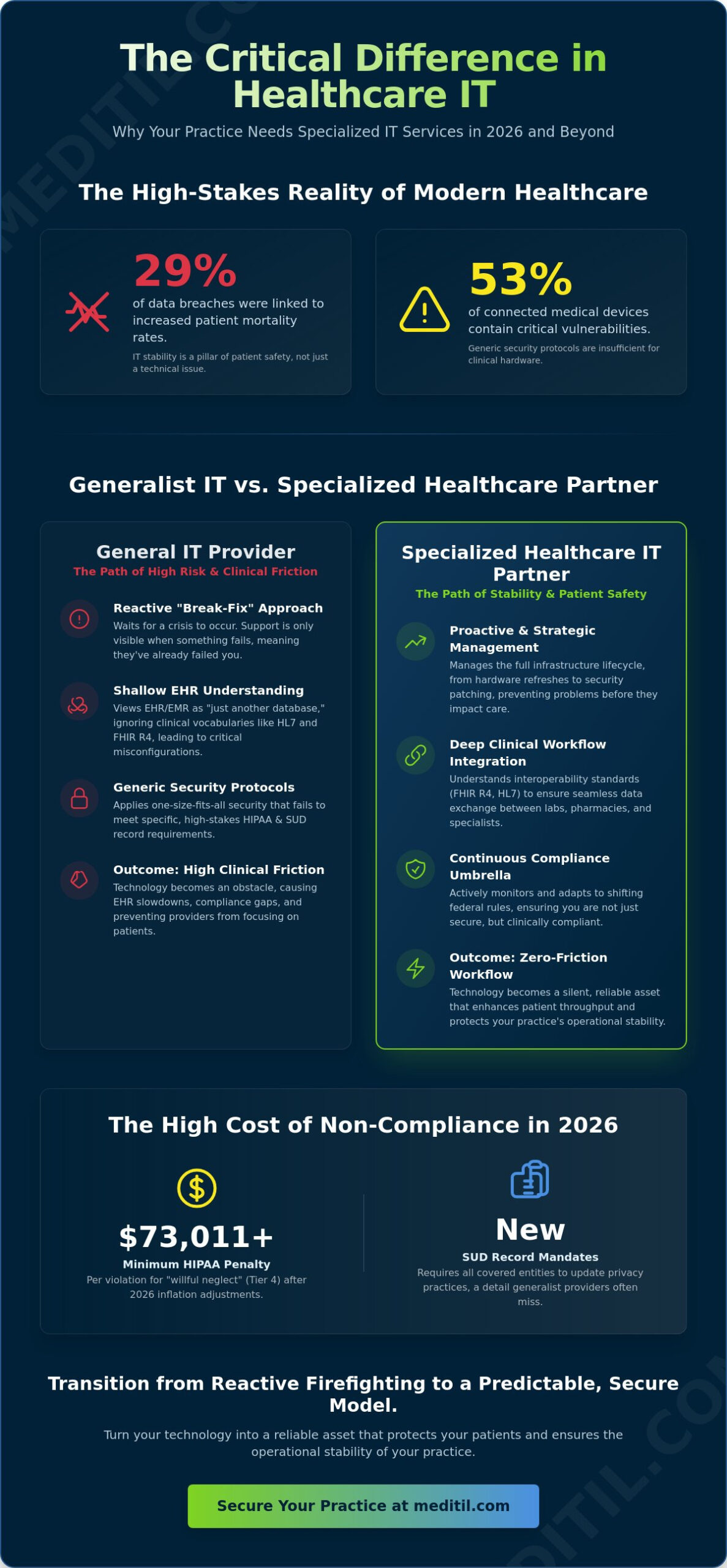
Did you know that 29% of healthcare organizations experiencing a data breach in the past year reported an increase in patient mortality rates as a direct consequence? This sobering reality proves that IT stability isn’t just a technical concern; it’s a fundamental pillar of patient safety. You likely feel the mounting pressure of escalating costs and the persistent anxiety of a potential HIPAA audit. It’s frustrating when your EHR hangs during a critical patient consultation or when you’re unsure if your current provider truly understands the new 2026 SUD record requirements. Standard support often treats your clinic like any other small business, but specialized managed services for healthcare recognize that technical friction in a clinical environment is a risk you can’t afford.
We’ll dismantle the myths surrounding general IT and demonstrate why a strategic partnership is required to navigate today’s high-stakes regulatory environment. You’ll discover how to transition from reactive firefighting to a predictable model that ensures zero-friction workflows and robust data protection. This guide covers everything from the latest 2026 HIPAA penalty adjustments to the critical vulnerabilities currently found in 53% of connected medical devices. We’ll show you how to secure your infrastructure and turn your technology into a reliable asset that protects your patients and your practice’s operational stability.
Key Takeaways
- Understand why generalist IT providers often struggle with the specific technical demands and clinical vocabulary of modern EHR and EMR environments.
- Discover how specialized managed services for healthcare replace reactive support with proactive infrastructure management and strategic roadmapping.
- Reframe the concept of control by contrasting the transparency of a managed team against the common limitations of a single in-house IT employee.
- Analyze the financial impact of technical debt and learn why specialized IT investment is more cost-effective than managing the recruitment of internal staff.
- Gain a practical framework for selecting an IT partner that prioritizes clinical alignment and regulatory compliance over generic technical support.
Why General Managed IT Fails the Healthcare Sector in 2026
In 2026, the definition of a Managed Service Provider (MSP) has evolved beyond simple help-desk support. For the medical community, managed services for healthcare represent a holistic integration of infrastructure management, cybersecurity, and clinical strategy. While a generalist provider might successfully manage a law firm or a retail chain, they often falter when faced with the intricate demands of a clinical environment. This failure stems from a fundamental misunderstanding of how technology interacts with patient care. Specialized providers focus on reducing “clinical friction,” which is the technical resistance that prevents a provider from focusing entirely on the patient. A truly holistic approach includes:
- Interoperability Management: Ensuring seamless data exchange via FHIR R4 standards.
- Clinical Workflow Optimization: Aligning IT systems with the way clinicians actually work.
- Continuous Compliance: Real-time monitoring against evolving HIPAA and state privacy laws.
The Clinical Language Barrier
General IT firms typically view an Electronic Health Record (EHR) system as just another database or office application. This perspective is dangerous. Healthcare systems rely on complex interoperability standards like HL7 and the federally mandated FHIR R4 protocol to ensure data moves safely between labs, pharmacies, and specialists. If a technician doesn’t understand these “clinical vocabularies,” they cannot effectively troubleshoot a connectivity issue that might delay a life-saving diagnosis. Specialized healthcare MSPs bridge the gap between technical uptime and clinical patient outcomes through deep familiarity with medical operational workflows.
Regulatory Stakes in 2026
The regulatory landscape has become significantly more punitive this year. As of February 2026, the Department of Health and Human Services (HHS) adjusted HIPAA civil monetary penalties for inflation, with Tier 4 “willful neglect” violations now carrying a minimum penalty of $73,011 per violation. Additionally, new mandates regarding Substance Use Disorder (SUD) records required all covered entities to update their Notice of Privacy Practices by February 16, 2026. Standard security protocols used in other industries aren’t designed to handle these specific, high-stakes requirements. Utilizing managed it services for healthcare provides a continuous compliance umbrella that adapts to these shifting federal rules. This proactive approach ensures that your practice isn’t just “secure” by general standards, but compliant by clinical ones.
Myth vs. Reality: Managed Services for Healthcare are More Than a Help Desk
Many practice administrators view a Managed Service Provider (MSP) as a sophisticated version of a remote help desk. This myth suggests that you only call for support when a workstation freezes or a peripheral device fails. In reality, modern managed services for healthcare function as a strategic extension of your clinical leadership. Success isn’t measured by how many tickets were resolved last month. Instead, we focus on how technical stability directly improves clinical outcomes and patient throughput. If your IT support is purely reactive, you’re essentially waiting for a crisis to occur before taking action.
Transitioning from a “break-fix” mentality to a proactive model is essential for survival in 2026. If your IT provider is only visible when something breaks, they’ve already failed you. A specialized partner manages the entire lifecycle of your infrastructure, ensuring that hardware is refreshed before it reaches a point of failure and that security patches are applied without disrupting patient care. This shift ensures that your technology remains a silent, reliable background to your clinical expertise.
The Role of the Fractional CIO
Strategic leadership is often the missing component in general IT support. Through virtual cio services, healthcare organizations gain access to high-level expertise that aligns technology investments with clinical goals. This isn’t about choosing the fastest laptop; it’s about long-term budgeting and roadmapping to prevent the sudden, five-figure emergency expenditures that plague unmanaged practices. A strategic partner helps you decide which innovations, such as advanced telehealth integrations, will provide a genuine return on investment rather than just adding unnecessary complexity to your workflow.
Proactive Monitoring vs. Reactive Repair
The 2026 technical landscape allows for unprecedented levels of oversight. AI-driven monitoring tools now predict hardware failures, such as failing storage drives or overheating server components, weeks before they actually stop a clinic’s operations. This allows for scheduled maintenance during off-hours, resulting in “silent” updates that don’t interrupt physician workflows. This level of 24/7 vigilance is particularly critical for the stability of Remote Patient Monitoring (RPM) systems. If a patient’s connected medical device loses connectivity, the system must trigger an immediate technical remediation to ensure continuous data flow. If you’re currently operating without a clear three-year technology plan, it’s time to evaluate how strategic leadership can stabilize your clinical operations.
The “Control” Fallacy: How Managed IT Enhances Clinical Visibility
The most common objection we encounter is the fear of losing control. Practice managers often believe that having a technician physically present in the building provides a higher degree of oversight. However, relying on a single individual often creates a “Black Box” environment where technical decisions and system configurations are known only to one person. This lack of transparency makes it difficult for leadership to verify if backups are successful or if security patches are actually current. In contrast, specialized managed services for healthcare provide a level of transparency that an internal hire rarely matches. Through comprehensive reporting and centralized dashboards, you gain real-time visibility into your network health, security posture, and system performance. You aren’t losing control; you’re gaining the data necessary to exercise it effectively.
A managed model shifts the dynamic from “I hope it’s working” to “I know it’s working.” We provide regular business intelligence and analytics that allow you to see exactly how your infrastructure supports your clinical objectives. This data-driven approach replaces the anecdotal updates of a single employee with verified, technical evidence of stability. When you can see the health of your entire network at a glance, you’re in a much stronger position to make strategic decisions about the future of your practice.
Eliminating the Single Point of Failure
Consider the operational risk of a single IT employee. When that individual takes a vacation, falls ill, or eventually leaves the organization, they take critical institutional knowledge with them. This creates a dangerous “single point of failure” that can lead to prolonged downtime during a technical crisis. A professional managed team ensures that every aspect of your medical it infrastructure is meticulously documented and managed by multiple experts. This team-based approach guarantees 100% coverage, ensuring that your clinical workflows remain uninterrupted regardless of individual staffing changes. We move the knowledge from a single person’s head into a secure, accessible repository that belongs to your practice.
Data Governance and Ownership
A common misconception is that outsourcing IT means relinquishing ownership of your patient data. This is fundamentally incorrect. Your healthcare organization always maintains full ownership and governance of its data. Specialized managed services for healthcare actually improve your ability to access and utilize this information. By optimizing systems integration and interoperability, we ensure that data flows securely between your EHR and other clinical tools. This visibility extends to your financial health as well. Through billing automation and integration, we provide real-time analytics that allow you to track revenue cycles and operational efficiency with precision. You’re leveraging business intelligence to make informed, strategic decisions for your practice’s future.
Busting the Cost Myth: Technical Debt vs. Strategic Managed IT Investment
A common misconception in clinical administration is that internal IT staffing is more cost-effective than a partnership model. This perspective often ignores the accumulation of technical debt. In a medical environment, technical debt refers to the compounding cost of maintaining legacy systems, unpatched software, and inefficient workflows. While a “quick fix” might save capital today, the long-term interest on that debt is paid in system downtime, security vulnerabilities, and eventual hardware failure. Shifting to managed services for healthcare allows organizations to trade these unpredictable liabilities for a stable, predictable financial model.
The financial impact of a data breach provides the strongest argument for proactive investment. With the average cost of a healthcare breach in the U.S. reaching approximately $10.22 million, the expense of a specialized security infrastructure is negligible by comparison. Healthcare data breach prevention isn’t just a defensive measure; it’s a financial strategy designed to protect the organization’s long-term viability and reputation. Investing in prevention is always more economical than funding a multi-million dollar recovery effort.
The True Cost of an In-House IT Team
When calculating the expense of internal staff, you must look beyond the base salary. The “fully burdened” cost includes payroll taxes, healthcare benefits, retirement contributions, and the physical office space required for the team. Additionally, the rapid evolution of medical technology requires constant, specialized training in HIPAA compliance, cybersecurity protocols, and specific EMR architectures. For many practices, the cost of keeping a single employee’s skills current in the 2026 regulatory landscape is prohibitive. Utilizing an augmented IT team provides access to a diverse group of specialists without the overhead of individual recruitment and retention.
Calculating the ROI of Clinical Stability
System performance is directly linked to provider satisfaction and patient throughput. When EHR systems are sluggish or networks are unreliable, physician burnout increases and the quality of patient interactions decreases. By implementing strategic healthcare it services, you ensure that your technology supports, rather than hinders, clinical delivery. The difference between 99.9% uptime and 95% uptime in a high-volume clinic represents dozens of lost patient encounters and thousands in unrealized revenue every month. High-performing infrastructure pays for itself by maximizing the number of patients your team can treat effectively. If you’re ready to stabilize your budget and eliminate technical friction, contact our team to discuss a customized strategic roadmapping session.
Selecting Your Healthcare IT Service Provider: The Path to Clinical Alignment
Selecting a partner is a decision that impacts every facet of your clinical operations. While many providers claim to offer technical support, generalist experience is often a red flag in a medical setting. A provider who splits their time between retail, law, and healthcare lacks the specialized focus required to maintain a HIPAA-compliant environment. You need a partner that understands the specific urgency of a surgeon unable to access imaging or a front desk blocked by a billing integration error. Choosing a provider without a deep understanding of clinical workflows often leads to technical solutions that hinder, rather than help, your staff’s ability to provide care.
A specialized partner acts as a strategic consultant, not just a service vendor. This distinction is critical for long-term stability and growth. We prioritize the alignment of your technology with your clinical mission, ensuring that every infrastructure update or security patch serves the ultimate goal of patient safety and operational efficiency. When your IT partner speaks your language, the friction between technology and medicine begins to disappear.
The Healthcare-Specific Checklist
When evaluating potential partners, look for specific markers of clinical maturity. Does the organization offer fractional CIO leadership to align your technology with your growth goals? Verify their experience with complex systems integration and billing automation, as these are critical for maintaining a healthy revenue cycle. To ensure you’re applying the most rigorous standards during your evaluation, review our comprehensive 2026 checklist for vetting healthcare IT service providers against clinical alignment and regulatory compliance benchmarks. Finally, assess their approach to healthcare cybersecurity services. A specialized partner won’t just offer “standard” protection; they’ll provide a framework specifically designed to protect life-critical data and maintain continuous regulatory compliance in the 2026 landscape. Your checklist should include:
- Demonstrated expertise in EMR/EHR implementation and ongoing training.
- Documented processes for HIPAA-compliant data governance and ownership.
- A clear roadmap for interoperability and FHIR R4 standard compliance.
- Proven experience managing the Internet of Medical Things (IoMT) and remote monitoring devices.
The Integration of People, Process, and Technology
Effective managed services for healthcare recognize that technology is only as good as the people using it. This is why we prioritize EMR/EHR implementation and training as a core component of our service model. We don’t just deploy hardware; we ensure your staff is proficient and confident in using the tools. Our help desk is trained to recognize clinical urgency, understanding that a system lag in a patient room is a higher priority than a printer issue in the back office. Starting the transition to a managed model doesn’t have to be disruptive. We utilize a methodical, phased approach that ensures your infrastructure is stabilized before we begin strategic enhancements.
Choosing a specialized partner means you no longer have to worry about the complexities of interoperability, technical debt, or shifting regulations. At MEDITIL, we act as the steady hand at the wheel, managing your technology infrastructure with precision and discipline. This partnership allows your team to redirect their focus where it belongs: on patient care and clinical excellence. Let us handle the technical strategy so you can lead your practice with confidence.
Securing Your Clinical Future Through Strategic Alignment
The 2026 healthcare landscape leaves no room for technical ambiguity or reactive support. We’ve explored how general IT providers often fail to bridge the clinical language barrier and how the accumulation of technical debt can compromise both your budget and patient safety. Transitioning to a model built on transparency and proactive oversight ensures that your infrastructure remains a silent, reliable partner in care delivery. By prioritizing specialized managed services for healthcare, you eliminate the risks associated with a single point of failure and gain the strategic visibility necessary to lead your practice with confidence.
Stability in a regulated environment requires more than just hardware maintenance; it demands a partner with a deep understanding of clinical urgency and interoperability. MEDITIL provides the expertise needed to navigate these complexities through HIPAA-compliant infrastructure, specialized EMR/EHR integration and training, and strategic Fractional CIO leadership. It’s time to move beyond the limitations of “break-fix” support and embrace a high-performing technical strategy.
Request a Strategic IT Consultation with MEDITIL to align your technology with your clinical mission and secure your practice’s operational future.
Frequently Asked Questions
What is the difference between managed IT and a traditional IT help desk?
Managed IT is a proactive, strategic partnership, whereas a traditional help desk is primarily a reactive, transactional service. A help desk typically waits for a problem to occur before providing a fix. In contrast, a managed model focuses on preventing issues through continuous monitoring and infrastructure optimization. This approach ensures your clinical workflows remain stable and predictable rather than constantly interrupted by technical failures.
Is managed IT for healthcare more expensive than hiring an in-house technician?
Managed IT is generally more cost-effective when you calculate the fully burdened cost of an internal employee. An in-house technician requires a salary, benefits, payroll taxes, and ongoing specialized training. They also represent a single point of failure for your practice. Managed services provide an entire team of specialists for a predictable monthly fee, giving you access to broader expertise without the overhead of recruitment.
How do managed services ensure HIPAA compliance in 2026?
Specialized managed services for healthcare provide a continuous compliance umbrella through real-time monitoring and automated risk assessments. In 2026, regulatory bodies focus on evidence of ongoing risk management rather than static documentation. We ensure your systems meet the latest standards, including the updated Notice of Privacy Practices required by the 2024 HHS Final Rule, while maintaining rigorous encryption and access controls.
Can a managed service provider help with my specific EHR implementation?
Yes, specialized providers offer EMR/EHR implementation and training as a core part of their service delivery. We manage the technical integration, data migration, and staff training necessary to ensure the system aligns with your specific clinical workflows. This expertise prevents the common performance bottlenecks that occur when a generalist IT provider attempts to set up a complex medical application.
Will I lose control over my practice’s technology if I use managed services?
You actually gain more control through increased transparency and data-driven reporting. Instead of relying on the anecdotal updates of a single employee, you receive detailed analytics on your network health and security posture. You maintain full ownership of your data and infrastructure while gaining the professional oversight needed to make informed, strategic decisions for your organization’s future.
What is a fractional CIO, and is it included in managed services?
A fractional CIO is a strategic leader who provides high-level IT consulting and budgeting without the expense of a full-time executive. This role is a standard component of professional managed services. They help align your technology investments with your long-term clinical goals. This ensures you aren’t surprised by emergency technical expenditures and that your infrastructure supports your practice’s growth.
How does managed IT impact patient safety and clinical outcomes?
High-performing managed services for healthcare improve patient safety by ensuring that critical systems are always available and that data remains accurate. When clinicians have zero-friction access to patient records, they can make faster, better-informed decisions. Reliable infrastructure also protects against the care disruptions that recent industry data has linked to increased patient mortality rates following technical failures.
What happens to my data if I decide to switch managed service providers?
Your organization always maintains full ownership of its data and system configurations. A professional provider ensures that all documentation is current and accessible, allowing for a smooth transition if you choose to move your services. We prioritize healthcare data breach prevention so that your information remains portable and secure regardless of your service partnership, ensuring no disruption to your patient records.
2 Responses