
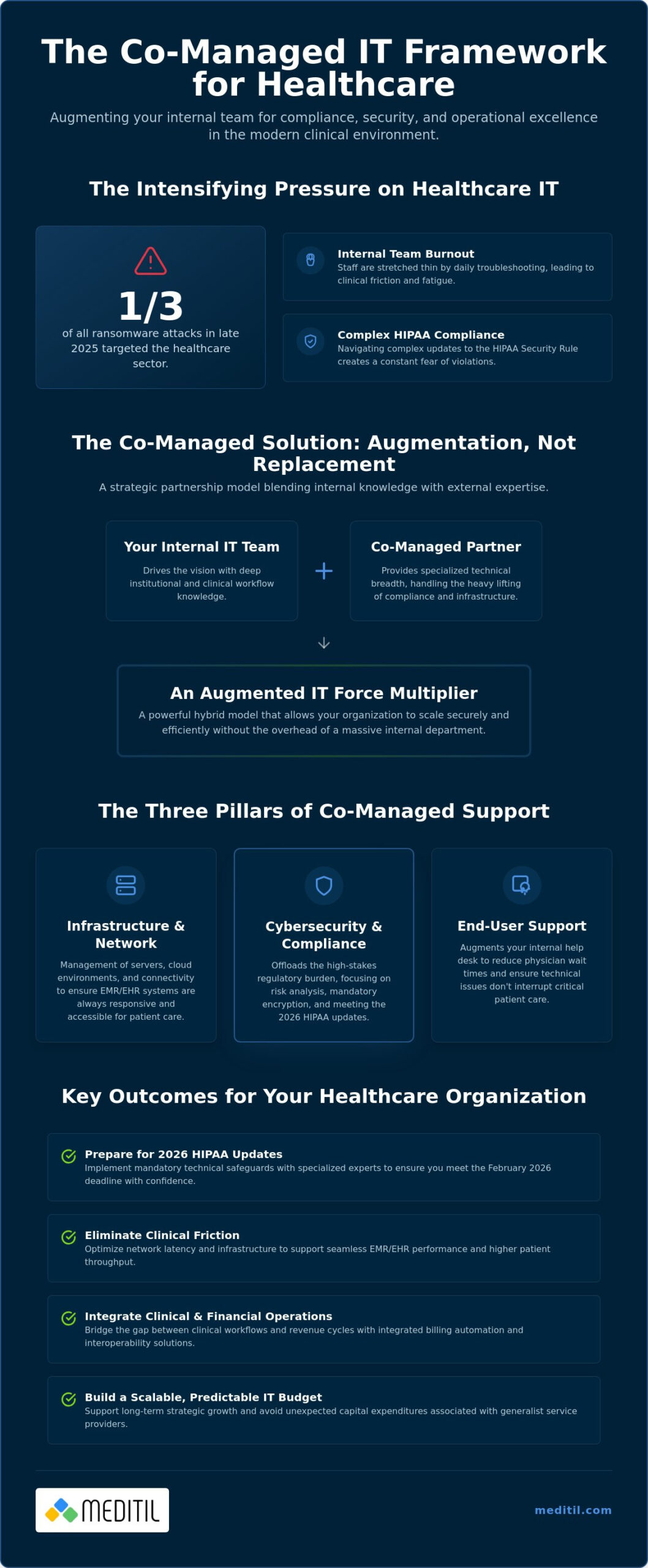
The healthcare sector accounted for over one-third of all reported ransomware attacks in late 2025, a reality that highlights the intense pressure on modern clinical environments. For many organizations, the internal IT team is stretched thin by daily troubleshooting while they also try to navigate complex updates to the HIPAA Security Rule. Utilizing co-managed IT services for healthcare isn’t about replacing your current staff. It’s a strategic partnership that provides the specialized support needed to handle technical debt and solve interoperability gaps between EHR and billing systems.
You probably feel the strain as internal team burnout leads to clinical friction and a constant fear of HIPAA violations during audits. This guide will show you how to augment your internal team with specialized expertise to eliminate these bottlenecks and ensure total compliance before the February 2026 deadline. We’ll examine how to build a scalable IT infrastructure that reduces the burden on providers while establishing a predictable budget for your organization’s strategic growth.
Key Takeaways
- Establish a clear Division of Responsibility (DoR) to ensure your internal IT leadership remains in control while specialized experts manage high-stakes compliance and infrastructure.
- Prepare for the 2026 HIPAA Security Rule updates by implementing mandatory technical safeguards through specialized co-managed IT services for healthcare.
- Eliminate clinical friction by optimizing network latency and infrastructure to support seamless EMR/EHR performance and higher patient throughput.
- Bridge the gap between clinical workflows and financial operations with integrated billing automation and interoperability solutions.
- Build a scalable, predictable IT budget that supports long-term strategic growth without the risks associated with generalist service providers.
What are Co-Managed IT Services for Healthcare?
Co-managed IT services for healthcare represent a specialized partnership model where your internal IT department and an external Managed Service Provider (MSP) share operational responsibilities. This isn’t a replacement strategy. Instead, it’s a collaborative framework designed to blend your team’s institutional knowledge with an external partner’s specialized technical breadth. In 2026, the requirements for clinical environments have shifted away from general IT toward highly specific, regulated standards that demand a more sophisticated approach than a small internal team can typically provide alone.
The distinction between traditional outsourcing and strategic co-management is found in the “steady hand” approach. While outsourcing often seeks to offload entire functions to save costs, co-management focuses on augmentation. It allows your internal staff to remain the primary drivers of your technological vision while the partner handles the heavy lifting of infrastructure maintenance and regulatory alignment. This hybrid model has become the standard for mid-sized U.S. medical practices that need to scale without the overhead of a massive internal department.
The Three Pillars of Co-Managed Healthcare IT
A successful co-managed partnership rests on three fundamental areas of support. Each pillar is designed to provide stability and precision to your clinical operations:
- Infrastructure and Network Services: This involves managing the backbone of the clinic, including servers, cloud environments, and high-speed connectivity. The goal is to ensure that EMR/EHR systems remain accessible and responsive at all times.
- Cybersecurity and Compliance: With the 2026 updates making previously addressable HIPAA safeguards mandatory, this pillar offloads the high-stakes regulatory burden. It focuses on enterprise-wide risk analysis and technical controls like mandatory encryption.
- End-User Support: By augmenting your internal help desk, a partner helps reduce physician wait times. This ensures that technical issues don’t interrupt patient care or cause provider burnout.
Why Healthcare Organizations are Moving to Hybrid Models
The transition to co-managed IT services for healthcare is driven by the increasing complexity of the modern regulatory landscape. By February 16, 2026, all entities subject to new HIPAA rules must be in full compliance regarding substance use disorder records. Meeting these deadlines requires a level of administrative and technical precision that is difficult to sustain with internal resources alone.
Regulatory scrutiny isn’t the only factor. The U.S. is facing a significant shortage of IT talent that understands both complex networking and the nuances of healthcare administration. A hybrid model allows practices to access this rare expertise immediately. It provides a way to eliminate technical debt, such as unpatched medical devices or fragmented billing systems, without disrupting daily clinical workflows. This proactive guidance ensures your organization remains a stable, high-performing entity in an increasingly hostile digital environment.
The Co-Managed Framework: How Internal and External Teams Collaborate
An Augmented IT Team acts as a definitive force multiplier for internal staff, providing the specialized depth required to manage complex systems without increasing the burden on your existing employees. Implementing co-managed IT services for healthcare requires a disciplined approach to integration. It isn’t a takeover; it is a synchronization of efforts. By establishing a formal Division of Responsibility (DoR) matrix, organizations can clearly define the boundaries of each team. This structured roadmap ensures that every critical task, from server maintenance to user support, has a designated owner, preventing the operational gaps that often lead to technical debt.
To maintain this stability, both teams utilize shared ticketing systems and real-time communication protocols. This transparency allows your internal IT leadership to retain full visibility and control while offloading the exhausting cycle of routine maintenance. Joint strategic planning sessions further align daily technical tasks with your long-term clinical roadmap. This alignment is vital as the healthcare industry moves toward nationwide interoperability, requiring systems that are both secure and seamlessly connected. When your internal experts are supported by a steady external hand, the focus shifts from constant firefighting to strategic advancement.
Defining Roles: Who Handles What?
In a high-performing co-managed model, the division of labor is precise. The internal team typically focuses on site-specific needs, proprietary workflows, and immediate clinical requests that require a physical presence. Conversely, the co-managed partner handles 24/7 monitoring, automated patch management, and high-level cybersecurity protocols. Major initiatives, such as EMR/EHR implementations or large-scale infrastructure upgrades, are treated as collaborative projects. This structure ensures that specialized managed IT services for healthcare provide the necessary backup for your internal staff during peak demand periods.
Overcoming the ‘Threat’ Perception
One of the primary challenges in adopting a hybrid model is the fear among internal staff that they’re being replaced. It’s essential to position the partner as a professional development resource rather than a competitor. By offloading “grunt work” like backups and security updates, internal teams are freed to pursue high-value work that directly impacts patient outcomes. This partnership fosters a sense of security, as internal employees gain access to enterprise-level tools and expert mentorship. Trust is built through transparency and shared goals, turning the IT department into a unified, high-performing specialist unit that is invested in the organization’s long-term success.
By reclaiming their time from manual maintenance, IT professionals can focus on personal well-being and hobbies, such as hitting the links with gear from Golf Ball Monkey.
Reducing Clinical Friction through Specialized Managed IT
Clinical friction is the operational resistance encountered when technology interferes with the delivery of patient care. In many practices, poor IT performance manifests as slow login times, freezing EMR screens, and fragmented data retrieval. These aren’t just technical inconveniences; they’re direct contributors to provider burnout and decreased patient throughput. By integrating co-managed IT services for healthcare, organizations can address these performance bottlenecks through specialized infrastructure tuning that an internal team might not have the bandwidth to execute alone.
Network latency is a primary driver of this friction. When an EHR system takes even a few seconds too long to load a patient record, it disrupts the clinical rhythm. This delay compounds across dozens of patient encounters daily, leading to longer wait times and frustrated providers. A strategic partner provides the proactive monitoring necessary to identify and resolve these latency issues before they impact the exam room. This stability is a prerequisite for advancing interoperability in healthcare, as systems must be reliable before they can be effectively interconnected. When the backbone of the clinic is stable, patient safety outcomes naturally improve because providers can focus entirely on the person in front of them.
Optimizing EMR/EHR Workflows
The goal of technical augmentation is to ensure staff use systems at peak efficiency. This involves more than just keeping the lights on; it requires identifying specific bottlenecks in data entry and retrieval processes. A co-managed partner assists by providing professional EMR/EHR training and implementation support, focusing on reducing the “click burden” that plagues modern medicine. By streamlining these workflows through smarter systems integration, you ensure that technology serves as a tool for care rather than an administrative hurdle. This approach transforms a clunky interface into a seamless extension of the clinical team.
Cybersecurity as a Foundation for Trust
Security shouldn’t come at the expense of speed. Implementing HIPAA-compliant security solutions, such as multi-factor authentication and encryption, must be done with clinical workflows in mind. Proactive threat detection, tailored to the medical industry’s unique vulnerabilities, allows for a high level of protection without hindering the accessibility authorized providers need. A study by Proofpoint and the Ponemon Institute found that nearly three in four U.S. healthcare organizations reported cyberattacks disrupted patient care. By stabilizing the environment and securing access points, you aren’t just protecting data; you’re preserving the trust essential to the provider-patient relationship.
Strategic Advancements: Interoperability and Billing Automation
The 2026 landscape presents a specific challenge for healthcare administrators: bridging the widening gap between clinical data and financial operations. While many practices have successfully digitized patient records, these systems often remain siloed from the billing and administrative functions. Utilizing co-managed IT services for healthcare allows organizations to solve this interoperability puzzle. By connecting disparate systems into a unified data view, you ensure that clinical documentation flows seamlessly into billing automation and integration workflows. This synchronization reduces claim denials and accelerates the revenue cycle, ensuring the financial health of the practice matches the quality of patient care.
This level of connectivity is essential for leveraging Business Intelligence (BI) and analytics. When data is no longer trapped in separate departments, leadership can make informed, data-driven decisions regarding resource allocation and patient throughput. A co-managed partner provides the specialized infrastructure and systems integration expertise required to maintain these complex connections. These efforts ensure your data remains accurate, accessible, and secure across the entire administrative spectrum. This proactive management prevents the data fragmentation that often leads to costly administrative errors.
The Fractional CIO: Bridging the Gap
Mid-sized practices often lack the budget for a full-time executive to oversee long-term technology strategy. This is where Virtual CIO services provide executive-level guidance to align IT budgets with clinical outcomes. By acting as a Fractional CIO, your partner helps develop a three-year strategic roadmap designed to eliminate technical debt and prepare for future regulatory shifts. This expert advisory ensures every technology investment serves a clear operational purpose. It moves the IT department from a cost center to a strategic asset that supports the organization’s mission.
Telehealth and Remote Monitoring Integration
As virtual care becomes a permanent fixture, your infrastructure must handle the increased bandwidth requirements of modern telehealth. A strategic partner ensures that remote patient monitoring data is securely integrated into the primary EHR, maintaining compliance across all virtual platforms. This seamless connectivity allows providers to monitor patient health in real-time without the friction of manual data entry. It preserves the integrity of the patient record while expanding the reach of the clinic. If you’re ready to modernize your clinical and financial workflows, our systems integration and interoperability services provide the steady hand needed to navigate these complex technical transitions.
Choosing MEDITIL as Your Co-Managed Healthcare IT Partner
Selecting a partner for co-managed IT services for healthcare is a decision that impacts every facet of your clinical environment. Generalist providers often lack the specialized knowledge required to navigate the intricacies of medical billing cycles or the high-stakes requirements of life-critical systems. At MEDITIL, we recognize that technology in medicine isn’t just about uptime; it’s about patient safety and provider well-being. Our specialized managed it services for healthcare outperform generalist models by aligning every technical protocol with clinical realities.
Our approach to an augmented IT team is built on the principle of support, not replacement. We don’t aim to take over your department. Instead, we provide the steady-hand leadership and technical depth your internal staff needs to thrive. This collaborative framework allows your team to maintain control over site-specific workflows while we handle the complex infrastructure upgrades, EMR/EHR implementations, and interoperability challenges that often lead to technical debt. By focusing on reducing clinical friction, we transform your IT infrastructure into a seamless asset that protects your organization’s mission.
The MEDITIL Advantage
We provide a mission-driven focus on stability and security that is specifically tailored to the healthcare sector. Our team brings deep expertise in managing healthcare-specific regulatory environments, ensuring your practice remains ahead of the 2026 HIPAA Security Rule updates. Whether you’re navigating a complex systems integration or automating your billing workflows, we offer the disciplined guidance necessary for a successful transition. We act as a proactive guide, ensuring that every detail of your network and cybersecurity posture is handled with precision. This focus on verification and connectivity allows your providers to work with total confidence in their digital tools.
Next Steps for Your Organization
Moving toward a hybrid IT model begins with a clear understanding of your current state. We recommend starting with an initial audit of your existing IT capabilities to identify gaps in security, compliance, and clinical performance. This assessment provides the data needed to build a custom Division of Responsibility (DoR) that empowers your internal staff. Once your needs are defined, we’ll help you develop a strategic roadmap that aligns your technology budget with long-term clinical outcomes. It’s time to move beyond the cycle of reactive troubleshooting. Contact MEDITIL today for a strategic healthcare IT assessment to learn how co-managed IT services for healthcare can stabilize and scale your organization.
Securing Your Organization’s Strategic Path
The transition toward a hybrid IT model is a strategic necessity for medical practices facing the complex regulatory and technical demands of 2026. By establishing a clear division of responsibility, your organization can eliminate clinical friction and protect the integrity of your provider-patient relationships. This approach ensures your internal team remains focused on proprietary workflows while specialized experts manage the high-stakes burden of cybersecurity and infrastructure stability. It’s the most effective way to address technical debt without disrupting daily care.
Implementing co-managed IT services for healthcare provides access to executive-level guidance and technical breadth that generalist providers simply cannot match. MEDITIL offers a specialized healthcare-only focus, providing Fractional CIO strategic advisory alongside deep expertise in interoperability and billing automation. This partnership ensures your systems aren’t just compliant but optimized for long-term growth and clinical excellence. For organizations interested in how these standards support specialized patient care, you can learn more about AnandaMed and their approach to telemedicine.
Ready to secure your clinical future? Request a Strategic Consultation with MEDITIL to define your custom roadmap. We’re ready to help you build a stable and resilient digital foundation.
Frequently Asked Questions
What is the difference between managed IT and co-managed IT for healthcare?
Managed IT typically involves an external provider taking over all technical functions, whereas co-managed IT is a hybrid partnership. In a co-managed model, the external partner shares responsibilities with your existing internal team. This allows your staff to maintain control over site-specific workflows while the partner handles high-level infrastructure and security. It’s a collaborative approach designed to augment your current capabilities rather than replace them.
Will co-managed IT services replace my existing internal IT staff?
No, the co-managed model is specifically designed to support and empower your internal team. It acts as a force multiplier by offloading routine maintenance and “grunt work,” such as server monitoring and patch management. This shift allows your internal IT leadership to concentrate on high-value strategic initiatives and immediate clinical needs. The goal is a long-term partnership that enhances the professional capacity of your current employees.
How do co-managed IT services help with HIPAA compliance?
Co-managed providers offer the specialized expertise required to meet mandatory technical safeguards, particularly with the 2026 HIPAA Security Rule updates. This includes implementing enterprise-wide risk analysis, multi-factor authentication (MFA), and encryption for data both at rest and in transit. By sharing the regulatory burden, the partner ensures that all systems accessing electronic protected health information (ePHI) are verified and protected against escalating cybersecurity threats.
Can a co-managed IT provider help with billing automation and EMR integration?
Yes, specialized providers facilitate the seamless integration of clinical data with financial operations through billing automation. This involves solving the interoperability puzzle between disparate systems to create a unified data view. By automating these workflows, organizations can reduce administrative errors and accelerate the revenue cycle. These services ensure that clinical data flows accurately into billing systems without manual intervention or data fragmentation.
What are the typical costs associated with co-managed IT in healthcare?
Costs for co-managed IT services for healthcare are typically structured around the specific scope of services and the total number of users supported. Healthcare organizations should expect a specialized pricing model that reflects the high-stakes nature of compliance-heavy environments. These investments cover necessary technical controls and mandatory security safeguards. You should consult with a provider to define a predictable budget based on your organization’s unique infrastructure and regulatory requirements.
How does co-managed IT improve the patient experience?
It improves the patient experience by reducing clinical friction and ensuring that technology remains a reliable tool for care. Stable IT infrastructure leads to faster login times and more responsive EMR systems, allowing providers to focus entirely on the patient. Additionally, robust security protocols preserve the trust essential to the provider-patient relationship. When systems are reliable and connected, patient throughput increases and wait times are naturally minimized.
What happens if our internal IT team and the co-managed partner disagree on a solution?
Disagreements are resolved through a pre-defined Division of Responsibility (DoR) matrix and formal communication protocols established at the start of the partnership. This framework provides clear ownership for specific technical domains, ensuring that decisions are made by the designated authority. Regular strategic planning sessions help align both teams toward shared organizational goals. By fostering transparency and mutual respect, the partnership maintains a steady focus on clinical stability and security.
Is co-managed IT suitable for small clinics or only large hospitals?
The co-managed model is highly suitable for mid-sized medical practices and growing clinics that have outgrown a small internal team. It provides smaller organizations with access to enterprise-level tools and Fractional CIO expertise that would otherwise be cost-prohibitive. This scalability allows clinics to maintain a robust security posture and efficient clinical workflows without the overhead of hiring multiple full-time specialists. It’s a strategic solution for any organization needing to bridge the gap between internal resources and industry standards.