
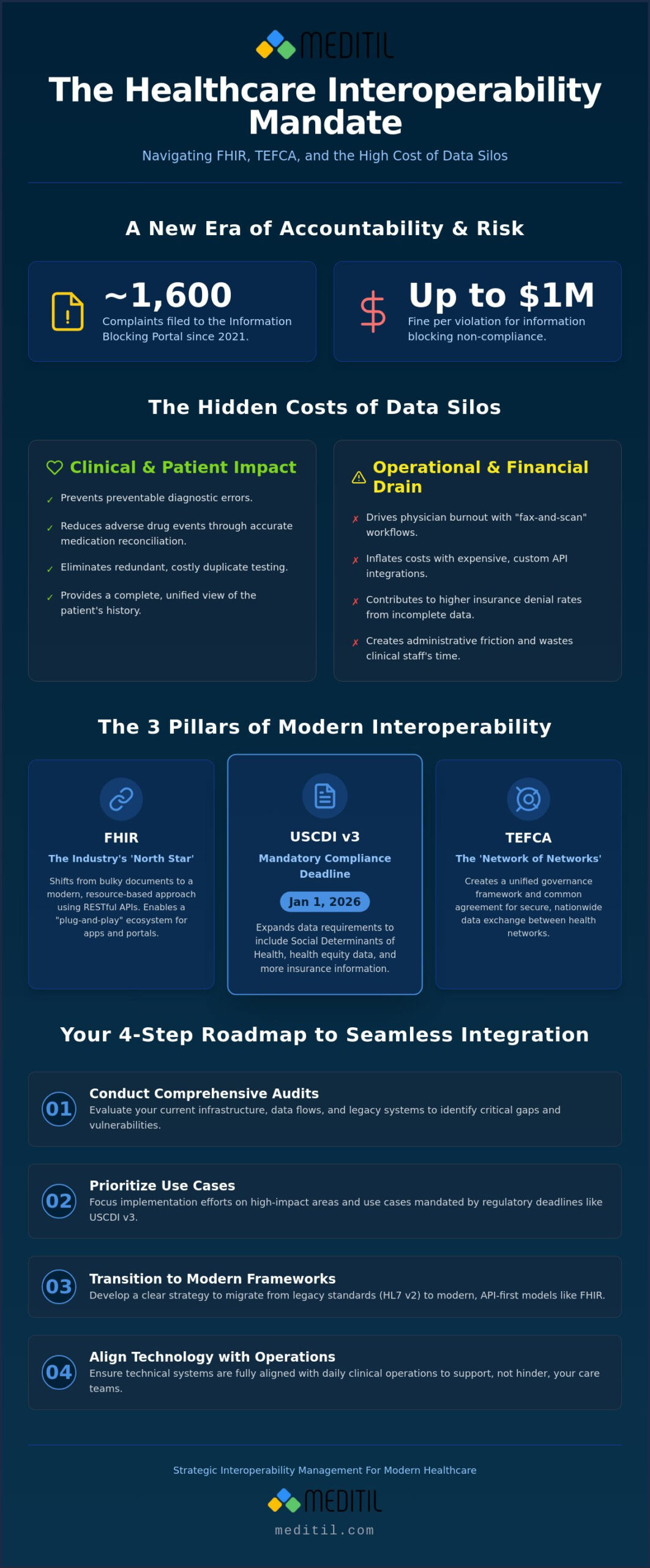
Since its launch in 2021, the Information Blocking Complaint Portal has received nearly 1,600 complaints, highlighting a rigorous new era of accountability for health IT systems. Achieving true healthcare interoperability is no longer a secondary IT project; it’s a foundational requirement for any organization seeking to maintain regulatory compliance and clinical excellence. With fines for information blocking reaching up to $1 million per violation, the stakes for data connectivity and strategic integration have never been higher.
You’ve likely seen how fragmented data systems lead to physician burnout and inflated costs for custom API integrations. It’s a persistent challenge that often prevents a unified view of the patient experience and creates unnecessary administrative friction for your clinical staff. This guide will show you how to master these technical complexities to eliminate data silos and improve patient outcomes. We’ll explore the mandatory shift toward FHIR-based standards, the specific requirements of USCDI Version 3 compliance, and the strategic steps required for a seamless, secure flow of information across your entire enterprise.
Key Takeaways
- Understand the critical transition from basic data exchange to semantic interoperability using modern frameworks like FHIR and TEFCA.
- Identify the hidden financial and clinical costs of data silos, including increased insurance denial rates and preventable diagnostic errors.
- Establish a clear implementation roadmap by conducting comprehensive infrastructure audits and prioritizing use cases based on regulatory deadlines.
- Learn how strategic guidance from a Fractional CIO can streamline healthcare interoperability and align technical systems with daily clinical operations.
Beyond Data Exchange: Why Healthcare Interoperability is a Strategic Mandate
Modern healthcare interoperability has evolved far beyond the simple act of moving a file from one server to another. While early efforts focused on basic connectivity, the industry is now moving toward semantic interoperability. This level of integration ensures that when a system receives data, it understands the context and clinical significance without manual intervention. It’s the difference between receiving a flat PDF and receiving actionable data points that populate a patient’s longitudinal record automatically. When systems speak the same language, they eliminate the “guessing game” that often plagues complex clinical encounters.
Strategic leaders recognize that a robust Health Information Exchange framework is no longer a technical luxury. It’s a regulatory necessity driven by the 21st Century Cures Act. This legislation mandates that patients have immediate access to their electronic health information without “information blocking” barriers. Organizations that fail to adapt risk more than just federal penalties; they risk falling behind in a value-based care landscape where data-driven outcomes determine reimbursement levels. Precise data integration is the foundation of competitive advantage in this new era.
Connecting Connectivity to Patient Outcomes
Real-time access to external clinical records prevents the redundancy of duplicate testing. When an emergency department physician can instantly view a patient’s recent imaging from an outside facility, they make faster, more accurate decisions. Accurate medication reconciliation also relies on this seamless flow. Without it, providers are left to reconcile disparate lists manually, which often leads to adverse drug events. Instant data availability ensures that the care team operates with a complete, verified picture of the patient’s history at every point of contact.
Solving the Physician Burnout Crisis
Fragmented systems are a primary driver of provider exhaustion. When data doesn’t flow automatically, clinical staff are forced into “fax-and-scan” workflows that belong in the previous decade. This manual data entry drains energy and distracts from actual patient care. There’s a heavy psychological toll when physicians must make life-altering decisions based on incomplete or siloed histories. Modernizing your healthcare interoperability architecture isn’t just an IT upgrade; it’s a vital intervention to return time to your physicians and restore their focus on medicine. It’s about creating a stable environment where technology supports the clinician rather than hindering them.
With clinical staff freed from administrative friction, healthcare leaders can finally prioritize their own well-being; those seeking a restorative retreat in the Greek islands can discover YAL’OOU Exclusive Yachting & More and its bespoke luxury services.
Decoding the Standards: FHIR, TEFCA, and the USCDI Framework
The technical architecture of healthcare interoperability rests on three pillars: FHIR, TEFCA, and the USCDI framework. As of January 1, 2026, compliance with United States Core Data for Interoperability (USCDI) Version 3 is mandatory for certified health IT. This version expands requirements to include social determinants of health, health equity data, and expanded insurance information. Certification of health IT ensures your modules meet federal security and functionality standards, providing a layer of protection against technical failure and data breaches. It’s the primary mechanism for verifying that your infrastructure meets federal benchmarks.
Why FHIR is the Industry’s ‘North Star’
Transitioning from legacy HL7 v2 models to Fast Healthcare Interoperability Resources (FHIR) represents a fundamental shift in data philosophy. While older standards relied on bulky, document-based exchanges, FHIR utilizes a resource-based approach. It breaks data into discrete, modular components. By leveraging RESTful APIs, FHIR enables a “plug-and-play” ecosystem similar to modern consumer technology. This shift allows for the integration of mobile health applications and patient-facing portals that provide real-time access to clinical data.
This modern architecture reduces the need for expensive, custom-coded interfaces for every new connection. Instead, it creates a standardized environment where different applications can interact with the EHR without compromising data integrity. If you’re struggling to modernize legacy systems, professional systems integration and interoperability services can help bridge the gap between old data models and these new API requirements. It’s a strategic investment that simplifies long-term maintenance.
Navigating TEFCA and Information Blocking Rules
The Trusted Exchange Framework and Common Agreement (TEFCA) provides the legal and operational foundation for nationwide connectivity. Beginning January 1, 2026, Qualified Health Information Networks (QHINs) must adopt HL7 FAST security procedures for all FHIR transactions. This standardization reduces the legal liability for individual organizations by creating a single on-ramp for secure exchange. It simplifies the process of joining a national network, as seen in the Social Security Administration’s expanded use of TEFCA to include hundreds of additional clinics.
Adherence to these frameworks is critical to avoid “Information Blocking” violations. The Office of the National Coordinator (ONC) has established active enforcement in 2026, with potential fines of up to $1 million per violation for health IT developers and exchanges. Organizations must ensure their data-sharing policies and vendor contracts don’t inadvertently hinder the access or exchange of electronic health information. Payers are also facing new pressure, as they are required to begin reporting annual metrics on the usage of their Patient Access APIs by January 1, 2026. Proactive management of these standards ensures your practice remains both compliant and functionally efficient.
The Cost of Disconnection: Identifying and Eliminating Data Silos
Data silos represent a structural failure in the modern clinical environment. When your clinical documentation, billing codes, and administrative registries exist in isolation, the organization loses its ability to form a cohesive view of patient care. This disconnection isn’t merely a technical inconvenience. It’s a persistent financial drain that manifests as administrative waste and clinical friction. The Essential Role of Interoperability in Healthcare underscores how these fragmented systems directly contribute to higher operational costs and lower quality of care.
Achieving true healthcare interoperability requires identifying where these silos exist and understanding the specific risks they pose to your infrastructure. Without a unified strategy, you aren’t just losing data; you’re losing the ability to provide safe and efficient care.
Revenue Cycle Impact of Fragmented Data
Inaccurate patient matching is one of the most common reasons for insurance claim rejections. If your front-office registration data doesn’t align perfectly with clinical records, the resulting data mismatch triggers an immediate denial. This is where medical billing automation solutions become essential. These tools depend on a seamless flow of data to verify eligibility and ensure that coding reflects the actual services rendered. Interoperability also plays a critical role in automating prior authorizations. When data flows freely between payers and providers, you eliminate the manual back-and-forth that delays treatment and consumes staff time. Bridging these gaps doesn’t just fix billing; it improves your overall business intelligence by providing a clean, verified dataset for clinical analytics.
Security Risks in Unintegrated Environments
Disconnected systems often force staff to adopt “Shadow IT” workarounds. When providers can’t share a patient’s history through secure, integrated channels, they might resort to unapproved methods like personal email or consumer messaging apps. These workarounds create massive HIPAA compliance risks and leave your organization vulnerable to data breaches. Utilizing unified data architectures simplifies the implementation of healthcare cybersecurity services because there are fewer disparate endpoints to protect and monitor. Manually syncing disparate databases is also a recipe for data corruption. A single entry error during a manual transfer can lead to mismatched medication records or incorrect allergy alerts, directly compromising patient safety. A centralized system, simplified through robust healthcare interoperability protocols, ensures that data remains consistent and protected across the entire enterprise.
Building a Roadmap for Interoperable Healthcare Infrastructure
Transitioning from a fragmented system to a unified clinical environment requires more than just technical adjustments. It demands a structured, phased approach that aligns your technical capabilities with clinical objectives. While federal standards provide the “what,” your organizational roadmap defines the “how.” A successful strategy for healthcare interoperability ensures that every system upgrade or integration serves a specific clinical purpose while maintaining strict regulatory compliance.
Your implementation plan should follow these five essential steps:
- Step 1: Conduct a comprehensive audit of current IT infrastructure and data flows to identify existing bottlenecks.
- Step 2: Prioritize use cases based on immediate clinical impact and upcoming regulatory deadlines, such as the 2026 USCDI Version 3 requirements.
- Step 3: Evaluate EMR/EHR vendors specifically for their native API support and FHIR readiness.
- Step 4: Establish a governance model to ensure data quality and the use of standardized clinical terminology.
- Step 5: Implement proactive monitoring protocols to maintain connection stability and security across all endpoints.
Auditing Your Clinical Ecosystem
The first stage of any strategic advancement is identifying “dead zones.” These are specific points in your workflow where data enters a system but cannot be exported or shared with external partners. You must assess the technical debt of your legacy servers and unpatched networking gear, as these outdated components often lack the security protocols required for modern exchange. Mapping the patient journey allows you to find friction points where manual data collection still overrides automated processes. This audit provides the baseline for all future infrastructure investments.
Vendor Management and System Selection
EHR vendors often promise connectivity, but the reality of their interoperability roadmap may differ from your practice’s needs. You must ask critical questions regarding their support for bulk FHIR exports and the costs associated with third-party API access. It’s vital to understand whether a solution offers “built-in” integration or relies on expensive middleware that adds another layer of complexity to your stack. These decisions shouldn’t happen in a vacuum. Aligning your technology choices with strategic IT budgeting ensures that your healthcare interoperability goals remain financially sustainable over the long term.
Building this infrastructure is a significant undertaking that requires expert oversight. If your internal team is overextended, our Infrastructure & Network Services can provide the technical precision needed to audit your systems and design a scalable integration strategy. We focus on creating a stable, high-performing environment that supports your clinical mission without increasing administrative burden.
Strategic Interoperability Management with MEDITIL
Implementing a robust framework for healthcare interoperability requires a partner who understands both the technical architecture and the clinical reality of a modern practice. MEDITIL serves as this essential bridge. We translate complex federal mandates into manageable daily operations, ensuring that your data flows don’t just meet compliance standards but actually improve provider efficiency. Our approach focuses on creating a stable, high-performing environment where technology acts as a silent facilitator of care rather than a source of administrative friction.
Successful integration isn’t a one-time event; it’s a continuous process of verification and optimization. We provide the technical precision needed to connect disparate platforms, including billing systems, EMRs, and telehealth portals. By centralizing these connections, we eliminate the need for costly custom workarounds and reduce the burden on your internal staff.
Fractional CIO Leadership for Data Strategy
Navigating the evolving requirements of TEFCA and HIPAA requires more than basic technical support. It demands strategic foresight. Our virtual CIO services provide your organization with seasoned leadership to design a long-term interoperability roadmap. This advisory role is critical for aligning your data exchange goals with broader organizational growth and patient safety initiatives. We ensure that every infrastructure investment is verified against current regulatory benchmarks, protecting your practice from the legal and financial risks associated with information blocking.
A Steady Hand for Complex Integrations
The transition to new data workflows often fails during the implementation phase due to poor staff adoption. MEDITIL prioritizes comprehensive training and support to ensure your clinical team feels confident using integrated systems. We provide 24/7 monitoring of your integration engines to prevent data flow interruptions that could compromise patient care or revenue cycle performance. This proactive stance is why we’re a preferred partner for managed IT services for healthcare. We maintain a constant vigil over your network stability, allowing you to focus on clinical outcomes while we handle the complexities of high-volume data exchange.
Our custom systems integration services are designed to scale with your practice. Whether you’re expanding your telehealth capabilities or automating your billing cycle, we ensure that your healthcare interoperability strategy remains flexible and secure. We don’t just provide a service; we act as a strategic partner invested in the long-term stability and success of your clinical environment. Our goal is to provide a steady hand at the wheel, managing every technical detail with the precision your patients deserve—a focus on excellence shared by 5280 Restorative Medicine in their work with high-performing executives.
Future-Proofing Your Clinical Data Strategy
Achieving seamless data integration requires a shift from viewing connectivity as a technical burden to seeing it as a strategic asset. You’ve seen how mastering standards like FHIR and TEFCA can eliminate clinical friction and protect your organization from significant regulatory penalties. By prioritizing a unified data architecture, you don’t just solve technical problems; you restore focus to patient care and reduce the administrative strain on your clinical team.
Effective healthcare interoperability is a continuous journey of optimization and security. MEDITIL provides the specialized EMR/EHR integration experience and HIPAA-compliant managed IT infrastructure needed to maintain a stable, high-performing environment. Our expert Fractional CIO advisory ensures your roadmap remains aligned with both federal mandates and your long-term growth objectives.
Ready to transform your data infrastructure into a reliable engine for clinical excellence? Schedule a Strategic Interoperability Consultation with MEDITIL today. We’re here to provide the steady hand you need to navigate the complexities of modern health IT with confidence.
Frequently Asked Questions
What is the difference between health information exchange (HIE) and interoperability?
Healthcare interoperability is the technical ability of different systems to exchange and use information, while Health Information Exchange (HIE) refers to the actual electronic movement of health data among organizations. Interoperability provides the standardized foundation and semantic understanding that allows systems to communicate. HIE is the functional application of that foundation, often managed through regional or national networks that facilitate the secure transfer of patient records between disparate providers.
How does the 21st Century Cures Act affect my medical practice’s IT strategy?
The 21st Century Cures Act mandates that your practice provide patients with immediate, electronic access to their health information without unnecessary delay. It establishes standardized API requirements and strictly prohibits information blocking by providers and software vendors. Your IT strategy must prioritize systems that support automated data sharing to remain compliant and avoid potential federal investigations or significant financial penalties associated with non-compliance.
What are the four levels of healthcare interoperability?
The four levels are foundational, structural, semantic, and organizational. Foundational interoperability allows one system to receive data from another without interpreting it. Structural defines the format and syntax of the data exchange. Semantic interoperability ensures that the receiving system can interpret and use the data contextually. Organizational interoperability involves the legal and social frameworks required for secure, seamless data flow across different administrative entities and healthcare systems.
Why is FHIR considered superior to older HL7 standards?
FHIR is superior because it utilizes modern RESTful APIs and modular resources rather than the bulky, document-based messaging of older HL7 standards. This resource-based model allows developers to access specific data points, such as a single medication or lab result, without downloading an entire patient record. It significantly simplifies the integration of mobile health applications and patient portals, making healthcare interoperability more flexible and easier to maintain long-term.
What is information blocking, and how can my clinic avoid penalties?
Information blocking is any practice likely to interfere with, prevent, or materially discourage the access, exchange, or use of electronic health information. To avoid penalties, your clinic should review vendor contracts for restrictive data clauses and ensure internal policies don’t create technical or administrative hurdles for patients. Active enforcement is underway in 2026, with potential fines of up to $1 million per violation for health IT developers who hinder data flow.
How much does it cost to implement a fully interoperable EHR system?
Implementation costs vary significantly based on your current infrastructure, the number of integrated endpoints, and your EHR vendor’s specific API licensing fees. While specific figures depend on the scale of your organization, costs typically include software configuration, data migration, and the ongoing maintenance of integration engines. You should consult with a strategic IT partner to conduct a thorough audit and determine the exact budgetary requirements for your specific clinical environment.
Can interoperability help reduce physician burnout?
Interoperability reduces physician burnout by eliminating the need for manual data entry and inefficient “fax-and-scan” workflows. When patient data flows automatically into the EHR from external sources, clinicians spend less time on administrative tasks and more time on patient care. This seamless access to complete clinical histories also reduces the cognitive load and stress associated with making critical medical decisions based on incomplete or fragmented patient information.
What is the role of TEFCA in national healthcare data sharing?
TEFCA establishes a universal floor for healthcare interoperability by creating a single on-ramp for secure, nationwide health information exchange. It allows different networks to connect through Qualified Health Information Networks (QHINs), ensuring that data can follow a patient across state lines and different health systems. This framework simplifies the legal and technical requirements for organizations, reducing the need for multiple, complex individual data-sharing agreements between different providers.