
Why are your most talented billing specialists spending hours manually reconciling data that should have moved automatically across your systems? It’s a persistent frustration when a high-performance platform like athenahealth feels isolated by sync errors and API bottlenecks. You likely invested in this ecosystem to gain efficiency, yet technical friction often leaves your revenue cycle stuck in a loop of manual re-entry and unpredictable performance. If you’re seeking athenahealth billing integration help, you’ve likely realized that software alone isn’t a silver bullet for true interoperability.
We agree that a stable data bridge requires expert networking and precise configuration to be truly effective. This guide provides the strategic framework you need to master technical complexities, allowing you to eliminate data silos and accelerate your revenue cycle. We’ll examine how to build a robust IT infrastructure that supports real-time visibility into your billing metrics and ensures an automated, error-free flow of information across your entire organization. By focusing on the underlying architecture, you can transform your billing operations into a predictable, high-performing asset.
Key Takeaways
- Understand the technical architecture required to build a resilient data bridge between athenahealth and external servers for real-time RCM updates.
- Identify and mitigate common technical bottlenecks, such as API throttling and sync errors, that disrupt claim submission cycles.
- Access professional athenahealth billing integration help to transition from manual data re-entry to a fully automated, interoperable workflow.
- Learn the two-phase roadmap for executing a successful integration project, beginning with a comprehensive infrastructure and network load audit.
- Discover how a strategic IT partner manages the complex technical bridge between systems, allowing your team to focus on clinical excellence.
Navigating the Complexity of Athenahealth Billing Integration
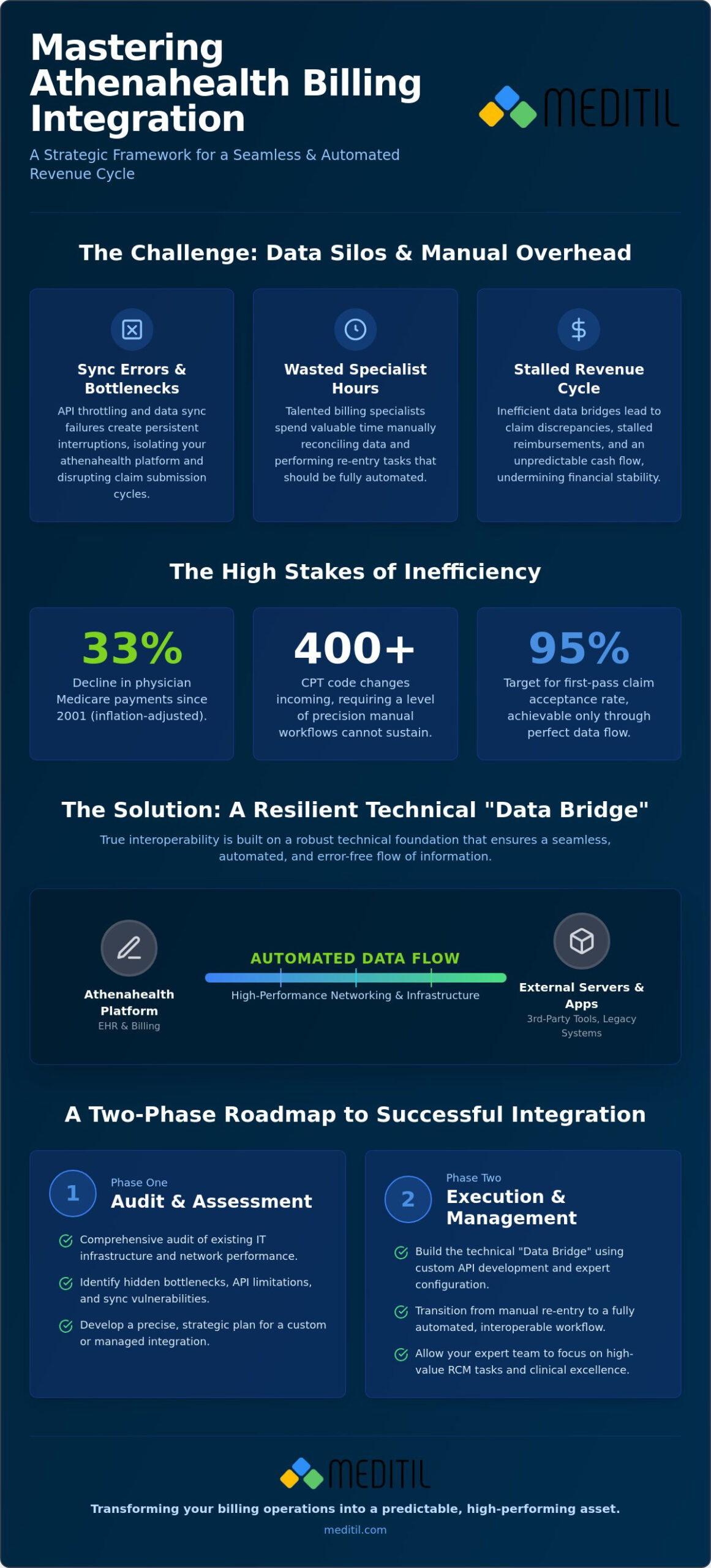
The landscape of healthcare administration has shifted toward total interoperability. In 2026, the complexity of the Medicare Physician Fee Schedule and the influx of over 400 CPT code changes require a level of precision that manual workflows cannot sustain. Integration is no longer a secondary IT project; it’s the central nervous system of your Revenue Cycle Management (RCM). When your billing data remains trapped in silos, your practice faces “clinical friction.” This occurs when administrative hurdles distract providers from patient care. It’s a direct result of inefficient data bridges. Seeking professional athenahealth billing integration help is often the first step toward reclaiming operational stability and ensuring your team focuses on clinical outcomes rather than data entry.
Modern RCM requires a move away from the “manual sync” mentality. With physician payments under Medicare declining by 33% since 2001 when adjusted for inflation, every percentage point of your collection rate matters. Supporting patients in finding the right coverage through The Modern Medicare Agency can help ensure that insurance data is accurate and valid before it enters your billing workflow. Automated interoperability ensures that patient data, insurance verification, and claim codes move between systems without human intervention. This shift reduces the administrative burden on your staff and minimizes the risk of human error in a high-stakes regulatory environment.
Native vs. Custom Integration: Which Path for Your Practice?
athenahealth offers a comprehensive marketplace with over 300 partners, but out-of-the-box connectors have inherent limitations. These native tools are designed for general use and might not account for the specific API versioning needs of your practice. For example, the 26.3 triannual release included specific updates for patient gender identity values that requires precise mapping to stay compliant. Custom API development provides the granularity needed for specialized billing or proprietary legacy systems. For mid-sized clinics, managed integration services offer the technical expertise to manage these complex APIs without the overhead of an in-house development team.
The Impact of Integration on RCM Stability
Broken integrations lead to a cascade of financial issues. If data doesn’t sync correctly, claim discrepancies rise and reimbursements stall. Maintaining a 95% first-pass claim acceptance rate requires every piece of the data bridge to function perfectly. Data silos are the enemy of consistent cash flow. When your systems don’t talk to each other, you lose the “network effect” that makes modern platforms valuable. Investing in medical billing automation solutions ensures that your IT infrastructure is a high-performing asset rather than a liability. It provides the steady hand needed to navigate the evolving regulatory environment and maintain a predictable revenue stream.
The Technical Architecture of a Seamless Data Flow
While many practices focus on the dashboard interface, the true strength of a revenue cycle lies in the “Data Bridge.” This bridge represents the technical transport layer between athenahealth and your external servers or third-party applications. If the bridge is weak, the data fails to move, regardless of how powerful the software is. High-performance networking is the silent engine of this process. It maintains the throughput required for real-time billing updates, ensuring that a patient check-in at the front desk instantly triggers the necessary eligibility and coding workflows. Infrastructure stability is not just an IT preference; it is the foundation of every successful EHR integration.
As part of nationwide interoperability efforts, the focus has shifted toward creating more resilient connections. Healthcare Interoperability is the ability of disparate systems to exchange and use information securely. When you seek athenahealth billing integration help, the focus should be on this underlying architecture. If you find your team struggling with sync delays, a professional Managed IT and infrastructure audit can reveal hidden bottlenecks in your network that software settings alone cannot fix.
API Management and Webhooks in 2026
When managing athenahealth billing integration help at a technical level, Athenahealth APIs are the primary conduits for secure data exchange. In 2026, these APIs receive biweekly updates and triannual releases, such as the 26.3 release which introduced expanded gender identity endpoints for patient records. Webhooks serve as the “push” mechanism, providing instant notifications when a billing status changes or a claim is denied. Without proactive monitoring, these connections can suffer from “silent failures” where the system appears active but data isn’t actually moving. We recommend implementing automated alerts to verify that every webhook payload reaches its destination successfully.
Interoperability Standards: HL7 and FHIR
FHIR (Fast Healthcare Interoperability Resources) has emerged as the gold standard for modern billing due to its use of modern web technologies and granular data access. However, many practices still operate in hybrid environments where legacy HL7 feeds are necessary for specific laboratory or imaging integrations. Managing the transformation between these messaging formats requires a deep understanding of data integrity. Every field must map correctly to prevent claim discrepancies that could impact your 95% first-pass claim acceptance rate. Precise verification of these data streams ensures that your financial reporting remains accurate across all connected platforms.
Overcoming Common Billing Integration Hurdles
Technical success requires more than just a functioning data bridge. It demands a robust troubleshooting framework to address the “messy” reality of daily operations. Practices often seek athenahealth billing integration help when they realize that standard support documentation doesn’t account for the unique data structures of their legacy systems. Identifying the root causes of sync errors is the first step toward maintaining a stable revenue cycle. These discrepancies often arise from timing mismatches or mismatched data formats between athenahealth and external clearinghouses. If these errors go unaddressed, they lead to claim denials and significant cash flow disruptions.
High-volume practices face a specific challenge known as “API Throttling.” This occurs when the number of data requests exceeds the platform’s rate limits, causing the system to temporarily reject new information. Throttling can delay real-time updates and disrupt the 95% first-pass claim acceptance rate that efficient practices strive to maintain. Managing these limits requires intelligent queuing and strategic data batching. Additionally, technical debt within your internal network can sabotage even the most sophisticated software. Outdated switches or unpatched local servers act as anchors, slowing down the secure exchange of information and creating vulnerabilities in your infrastructure.
Data Mapping and Field Discrepancies
The “Square Peg, Round Hole” problem is a frequent obstacle in systems integration. It happens when custom fields in one platform don’t have a direct equivalent in another. For example, a specialized clinical note in your EHR must be precisely mapped to the correct billing code field to ensure accurate reimbursement. We recommend using automated validation scripts to audit data accuracy before it reaches the clearinghouse. These scripts act as a first line of defense, reducing the need for manual auditing and catching errors that human reviewers might overlook. This proactive verification ensures that the data moving across your bridge is clean and ready for processing.
Security and Compliance Protocols
Maintaining HIPAA compliance during cross-platform data transfers is a non-negotiable requirement. Adhering to the CMS Interoperability and Patient Access Final Rule is not just a regulatory hurdle; it’s a blueprint for secure, patient-centric data exchange. Every transfer must utilize end-to-end encryption to protect sensitive financial and patient information from interception. For practices requiring deep-tier protection, our healthcare cybersecurity services provide the necessary encryption and compliance monitoring to keep your data safe. Implementing these protocols builds a foundation of trust and security that supports long-term operational growth.
Strategic Roadmap for a Successful Integration Project
A resilient revenue cycle isn’t built by simply activating a software setting. It requires a disciplined, multi-phase approach to ensure your data bridge is secure, scalable, and efficient. When practices seek athenahealth billing integration help, they often overlook the preparatory stages that prevent long-term technical friction. A successful project moves through five distinct phases, starting with a meticulous evaluation of your current environment and ending with a managed maintenance plan that adapts to the platform’s triannual release cycles. This methodical progression ensures that every technical detail is handled with precision, providing a steady hand at the wheel during complex transitions.
- Phase 1: Comprehensive Infrastructure Audit. We verify that your network hardware and cloud environments can sustain the increased data load of real-time API calls.
- Phase 2: Defining the Integration Scope. This involves identifying exactly which data elements move between systems and determining the frequency of those syncs to avoid API throttling.
- Phase 3: Development and Sandbox Testing. All data flows are validated in a non-production environment to catch mapping errors before they impact live claims.
- Phase 4: Go-Live and Hyper-care. Our team provides intensive monitoring during the first 48 hours of live operation to resolve any immediate anomalies.
- Phase 5: Managed Maintenance. We ensure the integration evolves alongside athenahealth’s biweekly updates and triannual feature releases.
Pre-Implementation: The Infrastructure Foundation
Before writing a single line of code, you must assess server capacity and cloud readiness. High-performance networking is essential to support the low-latency requirements of modern billing APIs. If your network isn’t optimized, even the most expensive software will underperform. It is also critical to align these technical requirements with your strategic IT budget. Planning for infrastructure upgrades early prevents mid-project delays and ensures a predictable financial roadmap for your practice’s growth.
Validation and Quality Assurance
Meticulous testing is the only way to safeguard your cash flow. We stress-test the integration under peak billing volumes to ensure the system remains stable during high-traffic periods. Developing a robust rollback plan is equally important; it provides a safety net in the unlikely event of data corruption. Finally, we train your billing team to recognize integration anomalies. This empowers your staff to report issues before they escalate into claim denials. If you are ready to stabilize your RCM through professional Systems Integration and Interoperability, a structured roadmap is your most valuable asset.
Optimizing Your Athenahealth Ecosystem with MEDITIL
The strategic roadmap outlined in the previous phase requires a steady hand at the wheel to ensure long-term operational stability. While software providers offer limited advisory services focused on their own platforms, MEDITIL manages your entire technical ecosystem. We act as a proactive partner that oversees the network, security, and infrastructure that software resides upon. By seeking professional athenahealth billing integration help through a managed partnership, you transition from reactive troubleshooting to a disciplined state of infrastructure maturity. This comprehensive oversight ensures that your data bridges remain resilient even as regulatory requirements and technology standards evolve.
Technical friction is a primary driver of physician and staff burnout in modern healthcare. When billing specialists must navigate sync errors or manual workarounds, it detracts from the efficiency of the practice and the quality of patient care. We eliminate these bottlenecks by refining the underlying IT architecture. Our goal is to create a seamless environment where data moves effortlessly between systems. This allows your clinical team to focus on their mission while we handle the complexities of your digital infrastructure with technical confidence and precision.
Managed IT Services: The Engine of Integration
A high-performing revenue cycle cannot exist without a stable foundation. Our managed IT services for healthcare provide the essential engine that drives successful RCM interoperability. We don’t just set up a connection; we monitor every data bridge and network endpoint to ensure continuous uptime. Our team acts as an extension of your internal staff, providing the specialized expertise needed to manage complex API versioning and HL7/FHIR feeds. This ongoing support prevents the “silent failures” that often plague unmonitored systems, ensuring your billing data flow remains uninterrupted.
Fractional CIO Leadership for Strategic Growth
Successful integration is not merely a technical task; it’s a strategic objective that must align with your long-term business goals. Our virtual CIO services provide the high-level leadership necessary for scaling practices. We help you design a roadmap that supports future interoperability requirements and strategic growth. By providing expert athenahealth billing integration help at the executive level, we ensure that every IT investment contributes to the financial health and stability of your organization. Are you ready to secure a partner who understands the high stakes of healthcare IT? Let’s discuss how we can stabilize and optimize your revenue cycle infrastructure today.
Securing Your Revenue Cycle Through Technical Excellence
Achieving a seamless data flow requires moving beyond basic software configurations to address the underlying network infrastructure. By prioritizing technical architecture and automated validation, you protect your practice from the silent failures that disrupt cash flow. If you require athenahealth billing integration help, remember that true interoperability is a continuous process of optimization and strategic alignment. A resilient digital bridge is the difference between a reactive administrative burden and a proactive, high-performing revenue cycle.
MEDITIL serves as a steady hand at the wheel, offering expert Managed IT specifically for Healthcare and Fractional CIO advisory to ensure your RCM remains optimized. Our proven success in complex healthcare systems integration allows your team to focus on clinical excellence while we maintain the security and stability of your data transfers. We invite you to Schedule a Strategic Integration Consultation with MEDITIL to stabilize your IT operations and eliminate technical friction.
Your path to an error-free, automated revenue cycle starts with a resilient technical foundation. We look forward to helping you build a more stable and efficient future for your practice.
Frequently Asked Questions
What are the most common reasons for Athenahealth billing integration failures?
Most integration failures stem from network latency, incorrect data field mapping, or unmanaged API version updates. When local infrastructure cannot sustain the throughput required for real-time syncs, data packets are often dropped or delayed. Failures also occur when triannual platform updates introduce new data requirements, such as the 2026 gender identity endpoints, that haven’t been properly configured in the practice’s local bridge.
Do I need a third-party developer to integrate Athenahealth with my billing service?
While native marketplace connectors offer basic functionality, custom or proprietary billing services typically require specialized athenahealth billing integration help. Professional integration experts ensure that the connection remains stable beyond simple software settings. This technical oversight is essential for managing the complex transport layers and security protocols required to protect sensitive financial data across disparate systems.
How does API throttling impact my medical practice’s billing speed?
API throttling occurs when the volume of data requests exceeds the platform’s set limits, causing a temporary rejection of new information. For high-volume practices, this results in significant backlogs and delayed claim updates. Managing these limits requires intelligent queuing and strategic data batching. Without these optimizations, your revenue cycle may suffer from unpredictable performance and stalled reimbursements during peak traffic periods.
Is it possible to automate the transfer of patient insurance data between systems?
Automation is fully achievable through the use of secure webhooks and specific API endpoints that trigger insurance verification workflows. This process ensures that eligibility data synchronizes across your EHR and billing platforms immediately upon patient check-in. By automating this transfer, you eliminate the need for manual data re-entry, which reduces administrative burnout and minimizes the risk of human error in the billing cycle. Just as automation protects your workflow, Strong Pillars Insurance LLC provides the insurance and retirement solutions necessary to protect your long-term financial stability.
What is the difference between an HL7 feed and a FHIR-based integration for billing?
HL7 is a legacy messaging standard used for sending discrete data packets, whereas FHIR utilizes modern web technologies for granular, real-time data access. FHIR is the 2026 industry standard for interoperability due to its flexibility and security. However, many practices still utilize hybrid environments where HL7 is necessary for specific legacy connections, requiring a technical partner who can manage the transformation between both formats.
How often should I audit my billing integration for data accuracy?
You should conduct a comprehensive audit at least triannually to coincide with major platform release cycles. These audits verify that your data mapping remains accurate and compliant with the latest regulatory standards. Additionally, we recommend weekly monitoring of sync logs and error rates. This proactive approach helps identify “silent failures” before they can negatively impact your 95% first-pass claim acceptance rate.
Can MEDITIL help if my current IT team is overwhelmed by integration issues?
MEDITIL provides augmented IT teams and specialized athenahealth billing integration help to support overwhelmed internal departments. We act as a steady hand by managing the complex technical infrastructure and interoperability layers. This partnership allows your internal staff to focus on clinical support and high-level strategy while we ensure your billing data bridges remain secure, stable, and high-performing.
How long does a typical custom billing integration project take to complete?
A standard integration project generally spans 8 to 12 weeks from the initial audit to the final maintenance phase. This timeline includes a comprehensive infrastructure assessment, development in a secure sandbox environment, and rigorous stress testing under peak volumes. The final stages involve a critical 48-hour hyper-care period to monitor the live bridge and ensure all data flows meet your practice’s specific operational requirements.