
What if the main gap in your healthcare IT isn’t another support ticket, but clear executive ownership of the decisions behind it? A fractional cio for healthcare can connect technology strategy with clinical operations, helping leaders set priorities across infrastructure, applications, security, and investment without adding a full-time executive role.
Healthcare technology changes need to support staff and patients without disrupting care. But when IT decisions are handled in separate lanes, security, compliance, systems, and operational needs can compete for attention. Managed IT support helps keep technology running. Fractional CIO leadership focuses on why priorities matter, how they fit together, and what should happen next.
This article explains what a fractional CIO does in a healthcare organization, where the role’s practical boundaries sit, and how it differs from managed IT and other IT support. You’ll also learn what to consider when choosing an engagement model, whether you have an internal IT team or need broader operational support. The goal is to connect technology priorities to clinical, operational, security, and financial needs, with a clearer basis for decisions.
Key Takeaways
- A fractional CIO provides part-time executive IT leadership, helping healthcare organizations set priorities and guide technology investment.
- Strategic planning brings clinical, operational, security, and financial needs into decisions about infrastructure, systems, and competing initiatives.
- Compare fractional CIO leadership with managed IT, vCIO services, and a full-time CIO to identify which responsibilities your organization needs covered.
- Before engaging a fractional cio for healthcare, define the scope, decision rights, meeting cadence, deliverables, and internal owners.
- Assess whether strategic guidance should complement your existing IT team or connect with operational support such as managed IT, infrastructure, cybersecurity, and integration.
What Does a Fractional CIO for Healthcare Actually Do?
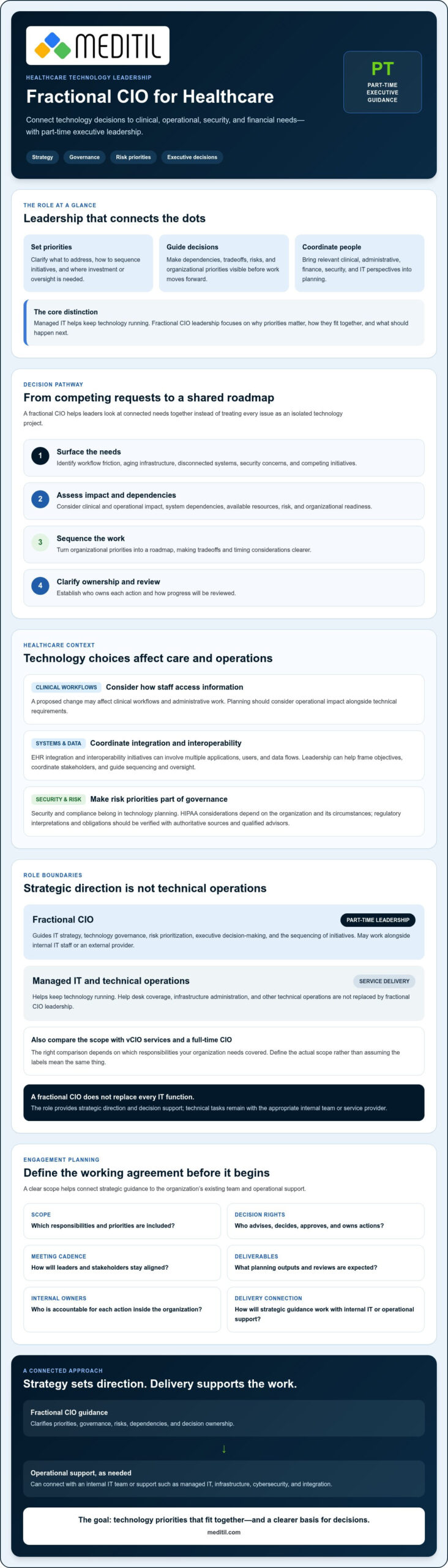
A fractional CIO for healthcare provides part-time executive IT leadership tailored to an organization’s needs. The role helps leaders decide which technology priorities to address, how to sequence initiatives, and where investment and oversight are needed. Unlike an outsourced IT support team, a fractional CIO provides strategic direction and decision support. They may work alongside internal IT staff or an external provider, but they don’t replace help desk coverage, infrastructure administration, or other technical operations.
The role draws on the broader responsibilities of a Chief Information Officer (CIO), adapted to a part-time engagement. A fractional CIO can provide leadership continuity as priorities shift, linking technology decisions to organizational goals rather than treating each project or service issue in isolation. Specific responsibilities depend on the agreed scope.
Which decisions and responsibilities belong to the role?
A fractional CIO typically guides IT strategy, technology governance, risk prioritization, and executive decision-making. They help translate organizational priorities into a sequenced roadmap, clarifying dependencies and tradeoffs before initiatives move forward. This may include helping leaders evaluate infrastructure needs, disconnected systems, or competing project proposals, without taking on every technical task personally.
Effective planning involves the people affected by decisions. The CIO coordinates with clinical, administrative, finance, security, and IT stakeholders to understand requirements, surface constraints, and support informed choices. The result is a shared basis for deciding what to pursue, who owns each action, and how progress will be reviewed.
How does healthcare change the CIO’s priorities?
Healthcare technology choices are closely tied to clinical workflows, patient data, and continuity of services. A proposed change may affect how staff access information or complete administrative work, so planning needs to consider operational impact alongside technical requirements. The CIO helps bring those considerations into prioritization before teams commit resources or change systems.
For example, EHR integration and interoperability initiatives may involve multiple applications, users, and data flows. A fractional CIO can help frame the objectives, coordinate stakeholders, and guide decisions about sequencing and oversight. This does not guarantee a particular technical outcome.
Security and compliance should also be part of governance. HIPAA considerations depend on the organization and its circumstances, so leaders should verify regulatory interpretations and obligations with authoritative sources and qualified advisors. A fractional CIO can help make security and risk priorities visible in technology planning while coordinating with the appropriate internal or external specialists.
Where a Healthcare Fractional CIO Adds Strategic Value
Strategic value often starts with making connected problems visible. Aging infrastructure can increase operational risk, while disconnected systems can require staff to enter or reconcile information across workflows. Meanwhile, multiple initiatives may compete for limited budget, staff capacity, and leadership attention. A fractional CIO helps assess these issues together instead of treating each request as an isolated technology project.
Healthcare technology decisions need to account for how care is delivered and how sensitive patient data is handled, alongside operational continuity and financial constraints. Prioritization brings clinical, administrative, security, finance, and IT perspectives into the same planning process. This doesn’t mean every stakeholder has the same decision authority. It means relevant impacts and dependencies are considered before leaders commit to a course of action.
Align technology priorities with clinical and operational needs
Stakeholder interviews can help identify friction in clinical and administrative workflows. A clinician may describe delays accessing information, while billing staff may point to repeated work caused by disconnected processes. The CIO can turn these findings into decision criteria, such as risk, operational impact, system dependencies, available resources, and organizational readiness.
Those criteria help leaders sequence work: address a pressing infrastructure concern, clarify integration requirements, or defer an initiative until the organization has capacity to implement it responsibly. Telehealth, remote monitoring, and billing automation may be relevant priorities, but only when they support the organization’s service model and stated needs. They shouldn’t be treated as automatic investments.
Coordinate security, interoperability, and infrastructure decisions
Security planning depends on more than selecting a safeguard. Infrastructure, applications, user access, data flows, and operational procedures can affect one another. A CIO can help leadership coordinate these dependencies, assign owners, and determine which technical assessments or implementation work require specialists. This oversight supports informed planning, but it doesn’t establish HIPAA compliance or guarantee that an incident will be prevented.
Authoritative references can help frame the work without replacing organization-specific review. The U.S. Department of Health and Human Services (HHS) provides HIPAA guidance, while the NIST Cybersecurity Framework offers a voluntary structure for managing cybersecurity risk. HL7 FHIR is a standard for exchanging health information electronically. A fractional CIO can help assess whether and how these resources relate to an organization’s priorities, systems, and obligations. Verify regulatory interpretations with authoritative sources and qualified advisors.
For organizations that need strategic direction connected to practical execution, healthcare IT consulting can include fractional CIO guidance alongside services such as infrastructure, cybersecurity, and systems integration. The right scope depends on the gaps leadership needs to address and the expertise already available internally.
Fractional CIO vs. Managed IT, vCIO, and a Full-Time CIO
The key difference is accountability: who sets technology direction, who operates the systems, and how much leadership capacity the organization needs. Titles and service scopes vary, so compare written responsibilities, decision rights, and deliverables rather than relying on labels alone.
| Role or service | Typical focus | What to clarify |
|---|---|---|
| Fractional CIO | Part-time executive leadership, strategy, governance, prioritization, and investment guidance. | Which decisions the CIO leads, what work is advisory, and how often leadership is engaged. |
| Managed IT provider | Ongoing technical operations, such as help desk, monitoring, and infrastructure support, as defined in the agreement. | Included systems, service responsibilities, escalation paths, and exclusions. |
| vCIO | Technology guidance delivered virtually, often as part of a managed service relationship. | Whether the role owns strategic planning or primarily advises on the provider’s services. |
| Full-time CIO | Dedicated executive leadership with ongoing involvement in organizational decisions and technology oversight. | Whether the organization needs and can support continuous in-house executive capacity. |
These are common distinctions, not universal definitions. For more context on how providers describe virtual CIO services, compare the actual scope alongside the title.
When does fractional leadership differ from managed IT support?
Managed IT support generally covers operational work, such as responding to user issues and maintaining agreed systems. A fractional CIO focuses on executive planning and governance: deciding which needs take priority, coordinating stakeholders, and guiding technology decisions. Strategic leadership can coordinate operations, but it doesn’t replace every technical function or ensure support tasks will be performed.
An organization may need both at once. For example, an IT provider could manage day-to-day support while a fractional CIO guides priorities and reviews whether operational work aligns with organizational plans. The service agreement should make ownership clear. See managed IT services for healthcare for more on operational service models.
When might an internal CIO or another model fit better?
The right model depends on decision volume, organizational complexity, leadership availability, and the continuity required. A full-time CIO may fit when technology decisions demand sustained executive attention across the organization. Fractional leadership may suit a defined need for strategic guidance, while an internal IT leader or another arrangement may better match existing capabilities.
Reassess as systems, responsibilities, and organizational needs change. Confirm who owns strategy, operations, approvals, and escalations so important work doesn’t fall between roles.
How to Scope and Start a Healthcare Fractional CIO Engagement
A well-scoped fractional CIO for healthcare engagement starts with a defined business need, not a generic list of technology tasks. Agree on the priorities to address, the authority the CIO will have, and how leaders will determine whether the work is useful. A practical sequence keeps strategic advice connected to the organization’s systems and decision-making process.
- Define priorities. Identify the decisions or challenges leadership needs help with, such as competing projects, infrastructure concerns, or investment planning.
- Assess current systems. Review the technology environment, existing work, and stakeholder needs before recommending a roadmap.
- Agree on scope. Specify responsibilities, decision rights, deliverables, exclusions, and how the CIO will work with internal teams and providers.
- Establish governance. Set the meeting cadence, escalation paths, approval processes, and named internal owners.
- Review progress. Use regular leadership reviews to assess decisions, risks, dependencies, and roadmap status, then adjust priorities when needed.
What should an initial assessment establish?
The initial assessment should create a shared picture of organizational priorities and the technology environment. Review infrastructure, applications, vendors, security processes, and active projects. Include clinical and administrative stakeholders to validate workflow needs and dependencies rather than relying only on system documentation or leadership assumptions.
Record what is known, what remains uncertain, and what needs further review. Findings should distinguish urgent risks from longer-term improvements, identify constraints such as staff capacity or project dependencies, and flag issues that require specialist assessment. This baseline gives leaders a reasoned starting point for sequencing work.
How can leaders evaluate progress and accountability?
Agree on a baseline, named owners, and a review schedule at the outset. A concise executive report can track roadmap milestones, open decisions, project status, dependencies, and risk-register changes. The aim is to understand whether planned work is advancing and where leadership action is needed, not to measure activity volume alone.
- Record decisions, approvals, and unresolved questions.
- Review milestone status alongside risks and dependencies.
- Confirm owners and next steps for work requiring follow-up.
Investment planning should connect proposed work to priorities, timing, and available resources. A strategic IT budgeting guide for medical practices can help frame that discussion. Revisit the engagement scope if organizational priorities or technology requirements materially change.
For help defining priorities, scope, and governance, review MEDITIL’s fractional CIO consulting.
How MEDITIL Connects Fractional CIO Guidance With Healthcare IT Delivery
Once you’ve identified the leadership gap, clarified the engagement scope, and decided how success will be reviewed, consider how strategic guidance will connect with your organization’s IT environment. MEDITIL provides healthcare-focused fractional CIO consulting alongside managed IT, infrastructure, cybersecurity and compliance support, and systems integration. This combination may suit leaders who want strategic direction coordinated with operational services, provided responsibilities and decision rights are clearly defined.
Match strategic guidance to the organization’s operating model
The right arrangement depends on what your organization already has in place. MEDITIL can provide fractional CIO leadership alongside an existing internal IT team or augment the team’s capacity. The engagement scope can reflect identified needs, such as interoperability, cloud services, analytics, or cybersecurity. These capabilities can support planning and execution, but the work, ownership, and expected deliverables should be agreed in advance.
MEDITIL also supports EHR implementation and training. It does not sell EHR products or software. That distinction matters when defining an engagement: leadership and implementation support can help an organization plan and coordinate its work without implying that the advisory partner supplies the underlying product. Clarify how responsibilities will be divided among your organization, existing vendors, and any IT partner.
Prepare for a productive conversation with an IT partner
A focused first discussion can help determine whether the service model fits. Bring a brief summary of current organizational priorities, active technology projects, known risks, and existing internal or external support arrangements. You don’t need a complete inventory to begin, but sharing what’s known can make gaps and decision points easier to identify.
Use the conversation to clarify practical boundaries. Ask:
- Which strategic decisions and deliverables are within scope?
- What authority will the fractional CIO have, and which decisions remain with organizational leadership?
- How will priorities, risks, and project status be reported?
- How will the work coordinate with internal staff and current service providers?
- Could needs such as integration, infrastructure, or cybersecurity support be addressed through the agreed engagement or require a separate scope?
Clear answers help you assess whether a fractional cio for healthcare engagement can address your leadership needs and how it may fit with other IT services. The aim is to establish a workable scope, not assume one model or provider is right for every organization.
Learn about MEDITIL’s healthcare IT services and consider how they may fit your operating model.
Set a Clear Direction for Your Healthcare IT
A fractional cio for healthcare can provide executive direction when technology decisions need consistent ownership, clearer priorities, and coordination across clinical, operational, security, and financial needs. The role is distinct from managed IT: strategic leadership guides decisions and governance, while operational teams handle technical work. Depending on your organization’s needs, these functions may be coordinated or provided separately.
The right engagement starts with a defined scope. Identify the priorities to address, clarify decision rights and internal owners, and agree how progress and risks will be reviewed. Revisit the arrangement as your systems, responsibilities, or organizational needs change.
MEDITIL provides healthcare-focused fractional CIO consulting alongside managed IT, infrastructure, cybersecurity, and integration capabilities. Its support can complement an existing IT team or help organizations seeking broader IT management. Consider discussing your priorities and the responsibilities you need covered to determine whether the service model fits.
Discuss your healthcare IT leadership needs with MEDITIL to explore your priorities, the responsibilities you need covered, and whether its capabilities fit your operating model.
Frequently Asked Questions
What does a fractional CIO do for a healthcare organization?
A fractional CIO provides part-time executive IT leadership tailored to an organization’s needs. They help set technology priorities, guide investment decisions, oversee governance, and align initiatives with clinical and operational goals. For example, they may help leaders sequence infrastructure improvements alongside integration projects and security priorities. A fractional CIO guides decisions and accountability, but doesn’t automatically perform help desk, infrastructure administration, or every technical task.
Is a fractional CIO the same as a vCIO for healthcare?
Not necessarily. The terms are sometimes used interchangeably, but the scope can differ by provider. A fractional CIO may take an embedded leadership role with defined responsibility for strategy and outcomes. A vCIO may offer advisory support, sometimes as part of a managed IT relationship, with a focus on the systems that provider supports. Compare decision authority, deliverables, and responsibilities in writing rather than relying on the title alone.
How much does a fractional CIO cost for a healthcare organization?
There isn’t one standard fee that applies to every healthcare organization. Cost depends on the engagement’s scope, level of involvement, deliverables, and whether operational IT services are included separately or alongside strategic guidance. To evaluate proposals, compare what each includes: assessment work, leadership meetings, roadmap development, reporting, and coordination with internal teams or vendors. Ask providers to document assumptions, exclusions, and how changes in scope would be handled.
Can a fractional CIO replace a healthcare IT department?
Usually, fractional CIO leadership is not a substitute for every IT department function. The CIO focuses on executive direction, planning, governance, and prioritization, while staff or service providers handle responsibilities such as user support, system administration, and infrastructure operations. Some organizations may arrange broader IT management separately. Clarify which technical functions are covered, who owns day-to-day work, and how issues are escalated before finalizing an engagement.
What happens if a healthcare organization already has a managed IT provider?
A fractional CIO can work alongside an existing managed IT provider if responsibilities and communication are clear. The CIO can help leadership set priorities, evaluate proposals, and connect operational work to broader organizational goals, while the provider performs services defined in its agreement. Document who approves changes, coordinates projects, reports risks, and handles escalations. Review both scopes together to identify gaps or duplicated responsibilities before work begins.
How should a practice evaluate a fractional CIO engagement?
Start by defining the decisions and priorities that need executive ownership. Then assess the proposed scope, decision rights, deliverables, meeting cadence, reporting format, escalation paths, and named internal owners. Useful progress measures can include roadmap milestones, project status, open decisions, dependencies, and risk-register reviews. Ask how the engagement will be reassessed if priorities or technology requirements change. A clear baseline makes it easier to evaluate whether the work remains relevant.
Does a fractional CIO ensure HIPAA compliance?
No. Engaging a fractional CIO doesn’t by itself ensure HIPAA compliance or guarantee that an organization will avoid security incidents. The CIO can help incorporate security and compliance considerations into technology planning, coordinate risk priorities, and clarify where specialist review is needed. The organization should verify applicable obligations using authoritative sources and qualified advisors. Define who is responsible for compliance assessments, technical safeguards, policies, and follow-up actions within the engagement scope.