
What if the most critical instrument in your exam room isn’t the stethoscope or the ultrasound, but the invisible infrastructure connecting them? In 2026, a robust medical office network setup is no longer a back-office luxury. It’s the backbone of modern clinical delivery. You’ve likely felt the frustration of an EHR that lags while a patient waits, or perhaps you’ve worried about how your current guest WiFi might impact the security of your clinical devices. These technical friction points do more than just slow down your workflow; they create unnecessary risks for patient data and practice reputation.
We understand that clinical efficiency and data integrity are non-negotiable. This guide provides a strategic roadmap to help you implement a medical-grade network that ensures HIPAA compliance and zero-downtime access. You’ll discover how to leverage the latest Wi-Fi 7 standards and meet the mandatory technical safeguards of the 2026 HIPAA Security Rule updates. We’ll examine the specific infrastructure needed to achieve seamless interoperability and a secure, scalable environment for your practice.
Key Takeaways
- Identify why standard IT infrastructure fails to meet the high-availability and low-latency requirements of modern clinical environments.
- Select the essential hardware for a secure medical office network setup, including firewalls with Deep Packet Inspection and managed PoE switches.
- Recognize the “Compliance Gap” where off-the-shelf routers fall short of mandatory 2026 HIPAA encryption and logging standards.
- Implement a structured five-step roadmap, beginning with a comprehensive site survey, to align your technology with clinical workflows.
- Explore how professional management and strategic infrastructure services provide a steady hand for maintaining long-term stability and security.
Why Standard IT Fails: The Essentials of Medical-Grade Network Infrastructure
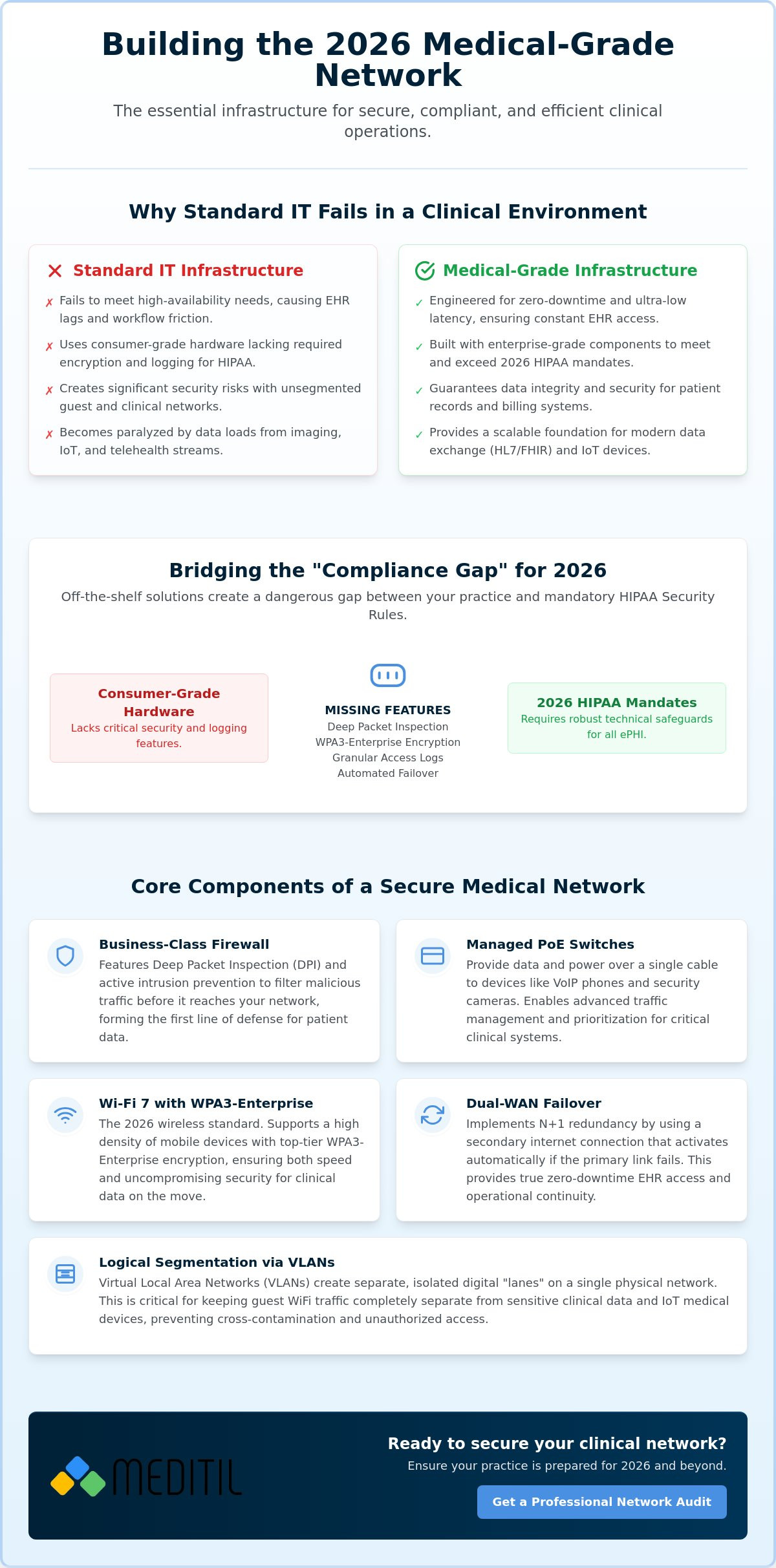
Most business owners view their internet connection as a utility, similar to electricity or water. In a clinical environment, this perspective is dangerous. A professional medical office network setup must function as a life-critical system rather than a simple administrative tool. Medical-grade infrastructure is defined by three non-negotiable pillars: high-availability, strict HIPAA compliance, and ultra-low latency. When these elements are missing, the clinical cost is immediate. Seconds of lag during an EHR lookup don’t just frustrate staff; they contribute directly to physician burnout and fragmented patient care.
Relying on consumer-grade hardware from big-box retailers is a significant liability for a modern practice. These devices lack the sophisticated encryption, granular logging, and traffic prioritization required for a regulated space. As we move through 2026, the data load from high-resolution diagnostic imaging and real-time telehealth streams will paralyze unoptimized systems. You need a foundation built for the heavy lifting of modern medicine, ensuring that every packet of data reaches its destination without delay or compromise.
The Interoperability Foundation
A resilient network is the primary requirement for modern data exchange. Your infrastructure must handle HL7 and FHIR data standards seamlessly to ensure that patient records move between systems without corruption. This stability is also the first step toward implementing medical billing automation solutions, as intermittent connectivity can lead to synchronization errors and lost revenue. Furthermore, the modern clinic is filled with IoT medical devices. Your network must support these tools on isolated segments, preventing them from consuming the primary clinical bandwidth needed for patient visits.
Reliability as a Patient Safety Metric
In healthcare, network uptime is a direct patient safety metric. Reliability ensures immediate access to life-critical patient records, allergy lists, and medication histories. This architecture is especially vital for supporting remote patient monitoring (RPM) and telehealth services where a dropped connection disrupts the therapeutic bond. To maintain this environment, sophisticated Health network surveillance is necessary to identify and resolve bottlenecks before they impact care. Medical-grade reliability is the strategic elimination of every single point of failure within the clinical infrastructure. This proactive approach ensures that your team can focus on the patient, while the technology remains a silent, steady partner in the room.
Core Components of a Secure Medical Office Network Setup in 2026
Constructing a resilient clinical environment requires a shift from standard hardware to enterprise-grade assets designed for high-density traffic. The perimeter of a professional medical office network setup requires mandatory business-class firewalls. These units must feature Deep Packet Inspection (DPI) and active intrusion prevention to filter malicious traffic before it reaches your internal workstations. This level of scrutiny aligns with the HHS Cyber Security Guidance, which emphasizes technical safeguards that go beyond simple password protection. It’s about building a fortress around your patient data.
Internal connectivity relies on managed switches equipped with Power over Ethernet (PoE). These switches provide both data and power to essential devices like VoIP phones and IP security cameras, reducing cable clutter and simplifying management. For wireless needs, the 2026 standard is WiFi 7. By utilizing WPA3-Enterprise encryption, access points can support a high density of mobile clinical devices without compromising speed or security. To prevent the practice from grinding to a halt during an ISP outage, we recommend N+1 redundancy. Implementing dual-WAN failover ensures that if your primary fiber connection fails, a secondary link takes over immediately. This configuration provides the zero-downtime EHR access your staff expects.
Logical Segmentation via VLANs
Physical hardware is only half of the equation; how you organize traffic is equally vital. Virtual Local Area Networks (VLANs) allow you to isolate guest WiFi from clinical data. This ensures that a patient’s smartphone never shares a path with protected health information (PHI). You should create dedicated segments for EHR traffic, medical devices, and administrative staff. Our healthcare cybersecurity services play a critical role here, providing the continuous monitoring required to detect unauthorized lateral movement between these segments. If you are concerned about your current configuration, consulting with a strategic IT partner can help clarify your requirements.
Structured Cabling and Physical Security
Future-proofing requires investing in high-quality copper. While Cat6 is common, Cat6a or Cat7 is preferred for a 2026 medical office to support 10Gbps speeds and beyond. This bandwidth is necessary for the rapid transfer of large diagnostic images. Physical security is the final layer. Just as a professional evaluation from A Premier Home Inspection ensures a building’s structural readiness, your network closet must have restricted access controls and environmental monitoring to prevent failure. Every cable should be labeled and documented. This methodical approach to physical infrastructure simplifies long-term troubleshooting and ensures your network remains a stable asset for years to come.
The Hidden Risks of DIY: Professional Setup vs. “Off-the-Shelf” Solutions
The temptation to handle a medical office network setup internally is often driven by the availability of low-cost, consumer-grade equipment. Online forums frequently suggest that a high-end gaming router or a basic mesh system is sufficient for a small practice. This approach ignores the profound “Compliance Gap” that exists between home-office gear and clinical requirements. Consumer hardware rarely offers the granular audit trails or the robust encryption required to meet evolving NIST cybersecurity guidance. When you choose off-the-shelf solutions, you aren’t just buying hardware; you’re inheriting a significant regulatory liability.
Calculating the real cost of a DIY setup requires looking beyond the initial receipt. If a consumer router fails, a clinic can face hours or even days of paralysis. For a busy practice, the revenue loss per hour often exceeds the entire cost of a professional-grade firewall. When a network is paralyzed, the losses manifest in several ways:
- Direct loss of billable provider time.
- Administrative overhead of rescheduling patient visits.
- Potential compromise of time-sensitive diagnostic data.
There is no such thing as “set it and forget it” in a healthcare environment. Professional integration ensures that managed it services for healthcare function as intended, providing the proactive monitoring needed to prevent outages before they disrupt patient care.
Addressing the HIPAA Liability
The Office for Civil Rights (OCR) doesn’t accept “budget constraints” as a valid excuse for missing access logs during an audit. Consumer hardware typically fails the audit test because it lacks the capacity to store long-term, immutable traffic records. Additionally, manufacturers of consumer gear won’t sign a Business Associate Agreement (BAA), which is a core requirement for any partner handling your infrastructure. Practice leaders must recognize that a data breach occurring on unmanaged, DIY hardware often leads to “willful neglect” findings by regulators, resulting in significantly higher penalties.
Scalability and Technical Debt
Choosing cheap hardware today often creates a cycle of expensive “rip and replace” projects every 24 months. As your practice grows or adds new diagnostic tools, underpowered systems quickly become bottlenecks. By prioritizing strategic IT budgeting for medical practices, you avoid the trap of technical debt. Expert configuration doesn’t just improve security; it streamlines operations. Professionally optimized networks often reduce help desk tickets by up to 60%, allowing your staff to remain focused on clinical outcomes rather than troubleshooting connectivity issues.
The 5-Step Roadmap to a Resilient Clinical Network Implementation
Implementing a medical office network setup is a methodical process that requires balancing technical precision with clinical reality. Success isn’t measured simply by whether the lights on the router are green, but by how effectively the system supports the daily movements of providers and patients. To achieve this, we follow a rigorous five-step implementation roadmap designed to eliminate surprises and ensure long-term stability. This journey transforms technology from a potential point of failure into a reliable clinical asset.
Step 1: The Clinical Workflow Audit
The process begins by mapping how data actually moves through your practice. We interview staff to identify existing “friction points,” such as tablet lag in specific exam rooms or slow imaging downloads in the lab. This audit determines peak concurrent user counts, which is vital for proper bandwidth allocation. We also identify “shadow IT,” such as unauthorized personal hotspots or unmanaged switches, which can create security vulnerabilities and interfere with primary wireless signals. Understanding these human and technical variables is the only way to build a network that truly serves the clinic.
Following the audit, we move into Architecture Design. This phase involves aligning hardware selection with the specific requirements of your EHR and telehealth platforms. By selecting components that match your expected data throughput, we prevent the bottlenecks that often plague unoptimized medical environments. It’s about ensuring the hardware can handle the specific demands of your specialty, whether that involves high-volume imaging or constant remote patient monitoring data streams.
Step 3: Security-First Configuration
Once the physical infrastructure is in place, the focus shifts to hardening the environment. We move away from shared WiFi passwords in favor of per-user authentication, ensuring that every connection is identifiable and authorized. This stage also includes setting up automated, encrypted off-site backups to facilitate rapid disaster recovery. Throughout this process, consulting with virtual CIO services ensures that your technical configuration remains aligned with your long-term operational goals and regulatory obligations.
The final phases involve Validation and Stress Testing. We simulate high-traffic scenarios, such as simultaneous high-resolution imaging transfers and multiple telehealth sessions, to verify that the network remains stable under pressure. Following a successful go-live, the system transitions to Ongoing Governance. This includes managed monitoring and proactive updates to address emerging threats before they can impact your practice. If you’re ready to modernize your clinical infrastructure with a proven implementation strategy, contact our infrastructure and network services team to begin your assessment.
Infrastructure & Network Services: The MEDITIL Partnership
A successful medical office network setup represents the beginning of a long-term operational commitment rather than a final destination. MEDITIL acts as a steady hand for practices navigating the complexities of healthcare IT migrations, ensuring that the transition from legacy systems to a 2026-compliant architecture is managed with surgical precision. Whether you’re launching a solo specialty clinic or overseeing a multi-site ambulatory center, our infrastructure and network services are customized to meet the specific data throughput and security requirements of your patient population. This applies to all specialties; for instance, those who visit RED Physiotherapy expect a seamless professional experience from start to finish. We prioritize stability, knowing that every minute of connectivity is a minute spent on patient care.
Our partnership model extends far beyond the initial implementation. We provide the ongoing management necessary to maintain compliance with the rigorous technical safeguards mandated by the 2026 HIPAA Security Rule updates. By integrating fractional CIO leadership into your network strategy, we help you anticipate technological shifts before they impact your budget or clinical workflow. This high-level oversight ensures that your infrastructure remains a competitive advantage rather than a source of technical debt. We don’t just fix problems; we engineer systems that prevent them from occurring.
Seamless Integration and Interoperability
We manage the entire IT lifecycle, allowing your clinical staff to remain focused on the patient encounter. Our approach prioritizes systems integration and interoperability, ensuring that your network provides the stable foundation required for billing automation and EHR optimization. Through proactive infrastructure monitoring, we identify and resolve potential bottlenecks before they manifest as clinical friction. This methodical oversight transforms your technology into a silent, reliable partner in every exam room, supporting the high-resolution imaging and real-time data exchange that modern medicine demands.
Ready to Secure Your Clinical Foundation?
Choosing a healthcare-exclusive IT partner is a critical decision for practice leaders in 2026. A generalist provider may understand networking, but they often lack the deep familiarity with the regulatory nuances and life-critical urgency of a clinical environment. Partnering with MEDITIL provides the peace of mind that comes from a network designed specifically for the protection of PHI and the delivery of high-quality care. If you’re ready to build a resilient, medical-grade environment, schedule a consultation with MEDITIL to design your medical-grade network.
Stabilizing Your Clinical Infrastructure for 2026
Modern medicine requires more than just a fast connection. It demands a resilient, secure, and compliant foundation. We’ve examined how a professional medical office network setup eliminates clinical friction and protects patient data through logical segmentation and enterprise-grade hardware. By moving away from off-the-shelf solutions and following a structured roadmap, your practice can achieve the high-availability and technical security mandated by current 2026 standards. This transition ensures that your focus remains on patient care rather than troubleshooting connectivity issues.
MEDITIL serves as a strategic partner to ensure your technology remains an asset rather than a liability. Our specialized healthcare IT experts provide full HIPAA-compliant infrastructure management and strategic fractional CIO advisory to guide your long-term growth. Every decision we make is focused on improving clinical outcomes and maintaining the integrity of your practice. Don’t leave your clinical efficiency to chance. Contact MEDITIL for a Professional Healthcare IT Assessment today to secure your digital environment. We’re ready to help you build a network that patients and providers can trust.
Frequently Asked Questions
What are the minimum HIPAA requirements for a medical office network?
The minimum requirements include mandatory multi-factor authentication (MFA) for all system access, encryption of data both at rest and in transit, and the maintenance of immutable audit logs. These technical safeguards ensure that access to protected health information is strictly controlled and verifiable. A professional medical office network setup must also include a business-class firewall capable of deep packet inspection to prevent unauthorized intrusions and data exfiltration.
Is WiFi 7 necessary for a small medical practice in 2026?
WiFi 7 is highly recommended for practices in 2026 to support high-density environments and bandwidth-intensive applications like real-time telehealth and high-resolution imaging. It offers superior latency management and enhanced security through WPA3-Enterprise. While older standards may still function, WiFi 7 provides the scalability needed to handle the increasing number of connected medical devices without compromising the primary clinical throughput required for patient visits.
How do I separate guest WiFi from my patient data records?
You separate guest WiFi from patient records by implementing Virtual Local Area Networks (VLANs) that provide logical isolation at the switch and firewall level. This configuration ensures that traffic from the guest segment cannot communicate with the clinical segment where protected health information is stored. By using a managed firewall, you can enforce strict security rules that physically prevent data packets from crossing between these two distinct environments.
Can I use a residential internet connection for my medical office?
You shouldn’t use a residential internet connection because it lacks the Service Level Agreements (SLAs) and static IP addresses required for professional medical operations. Business-class connections offer prioritized support and guaranteed uptime, which are essential for zero-downtime EHR access. Residential terms of service often prohibit commercial use and don’t provide the high-availability infrastructure needed for life-critical clinical environments where connectivity is a safety metric.
What is N+1 redundancy and why is it recommended for healthcare?
N+1 redundancy refers to a configuration where you have at least one independent backup component for every critical system in your medical office network setup. In healthcare, this typically involves dual-WAN failover or redundant power supplies to ensure that a single hardware failure doesn’t paralyze the clinic. This approach is recommended because it minimizes the risk of downtime, ensuring that providers always have immediate access to patient records.
How often should medical office network hardware be replaced?
Medical office network hardware should generally be replaced every three to five years to maintain security and performance standards. As software requirements and security threats evolve, older equipment becomes a liability due to a lack of firmware updates or throughput bottlenecks. Regular replacement cycles prevent technical debt and ensure your infrastructure can support modern clinical workflows and the latest regulatory requirements without constant troubleshooting.
Do I need a server on-site if we use a cloud-based EHR?
Even with a cloud-based EHR, many practices still benefit from a small on-site server to manage local authentication, print services, and local file storage. A local server can also act as a gateway for medical device integration and provide a layer of redundancy for identity management. While the scale of this hardware is reduced compared to traditional on-premises environments, it remains a vital component for maintaining local operational efficiency.
How does a virtual CIO help with network infrastructure planning?
A virtual CIO provides strategic leadership by aligning your network infrastructure with long-term business goals and regulatory changes. They assist with technology roadmaps, budgeting, and ensuring that your clinical environment remains compliant with evolving HIPAA standards. This expert guidance allows practice owners to make informed investment decisions that prioritize security and clinical efficiency over temporary, reactive fixes that often lead to higher long-term costs.