
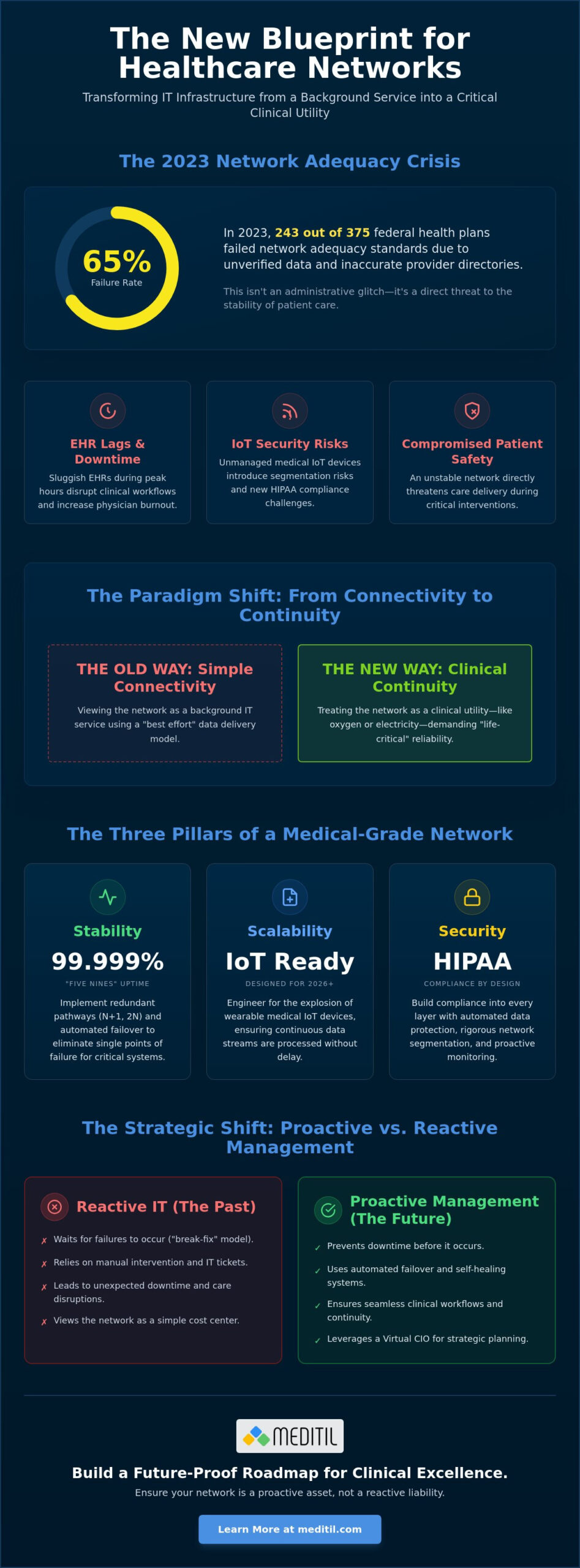
In 2023, 243 out of 375 federal health plans failed to meet network adequacy standards due to unverified data and inaccurate directories. This statistic underscores a vital shift in 2026. A modern healthcare network architecture must be viewed as a critical clinical utility, not just a background IT service. When your EHR lags during peak rounding hours or a new IoT medical device introduces a segmentation risk, it isn’t merely a technical glitch. It’s a direct threat to the stability of patient care delivery.
You understand that maintaining HIPAA compliance while managing a surge in telehealth and remote monitoring requires more than just increased bandwidth. It demands a steady, expert hand to ensure every connection is secure and verified. This guide provides a strategic roadmap to achieving a zero-downtime infrastructure that automates security and optimizes telehealth performance. We will examine how to align your systems with the latest TEFCA interoperability standards and FGI Guidelines to ensure your facility remains a high-performing environment for clinical excellence. By prioritizing clinical continuity over simple connectivity, you can transform your network into a proactive asset for patient safety.
Key Takeaways
- Understand why a specialized healthcare network architecture is essential for meeting the unique latency requirements of PACS imaging and EHR systems.
- Discover how N+1 redundancy and SD-WAN protocols create a resilient foundation for seamless multi-site clinical connectivity.
- Learn the benefits of transitioning from reactive IT support to proactive managed infrastructure services that prevent downtime before it occurs.
- Identify the role of a Virtual CIO in creating a future-proof roadmap that aligns legacy system modernization with long-term clinical goals.
Defining Healthcare Network Architecture: Why Connectivity is a Clinical Utility
A healthcare network architecture is the holistic design and orchestration of hardware, software, and protocols tailored specifically for the medical environment. In 2026, it’s no longer just an administrative support system. It has evolved into a clinical utility. Just as a hospital cannot function without oxygen or electricity, modern care delivery stops when the network fails. This shift requires a transition from “best effort” data delivery to “life-critical” reliability. When a network is unstable, the consequences go beyond IT tickets. They manifest as physician burnout from sluggish EHRs and, in the most severe cases, compromised patient safety during critical interventions.
The Anatomy of a Medical Grade Network
Building a medical-grade environment requires a disciplined three-tier hierarchy: the Core, Distribution, and Access layers. The Core layer acts as the high-speed backbone, ensuring that traffic moves across the facility without congestion. The Distribution layer manages policy and routing, while the Access layer connects end-user devices. For real-time EHR synchronization, low-latency paths are non-negotiable. Even a few milliseconds of delay can disrupt the flow of clinical documentation. Additionally, high-density Wi-Fi is essential for mobile clinical staff who rely on tablets and VoIP handsets while moving between patient rooms. This requires real-time monitoring to ensure signal strength remains consistent despite the physical interference common in hospital settings. Through active oversight, administrators can identify potential bottlenecks before they impact the point of care.
Strategic Objectives: Stability, Scalability, and Security
The primary objective of a sophisticated healthcare network architecture is “five nines” (99.999%) uptime. This level of stability ensures that life-critical systems are available when every second counts. Beyond immediate availability, the design must account for long-term growth and protection. Key strategic focuses include:
- Stability: Implementing redundant pathways to eliminate single points of failure for critical clinical systems.
- Scalability: Designing for the 2026 explosion of wearable medical IoT devices, which flood the network with continuous data streams that must be processed without delay.
- Security: Building HIPAA compliance into the physical and logical network layers through automated data protection and rigorous network segmentation.
By treating the healthcare network architecture as a foundational clinical tool, organizations can bridge the gap between technical performance and patient outcomes. It’s about more than just keeping the lights on; it’s about providing a steady hand for the clinicians who rely on these systems every day. This proactive approach ensures that the infrastructure supports, rather than hinders, the mission of care.
This level of reliability is essential for specialized clinical services like Neurobics, where professional neurofeedback training requires a stable network to help individuals regulate brain activity for improved focus and mental health.
Core Components of Resilient Management and Networking
Resilient management and networking in 2026 requires a shift from static hardware configurations to dynamic, self-healing systems. A sophisticated healthcare network architecture isn’t defined solely by the quality of its routers; it’s defined by the synergy between high-performance hardware and proactive monitoring. Clinical workflows don’t have the luxury of waiting for manual intervention. By integrating automated failover mechanisms, the network can detect a circuit failure and reroute traffic in milliseconds. This ensures that the EHR remains accessible even if a primary data path is compromised. This level of orchestration transforms the network from a passive pipe into an active participant in care delivery.
Redundancy and High Availability
To achieve high availability, organizations must move beyond basic backups to N+1 or 2N redundancy models. In an N+1 model, a single extra component is ready to take over if any one part of the system fails. For critical clinical hubs, a 2N model provides a fully mirrored system, ensuring that even a catastrophic hardware failure won’t result in downtime. Dual-homed internet connections are equally vital. By utilizing two different ISPs, a facility maintains connectivity during local provider outages. Redundant core switches in the data center further protect the healthcare network architecture, ensuring that data synchronization between servers and bedside monitors remains uninterrupted.
Network Segmentation for Security and Compliance
Security isn’t just about firewalls; it’s about how the network is partitioned. Logical isolation through VLANs is a cornerstone of HIPAA compliance. It ensures that sensitive patient data is never on the same segment as less secure traffic. For instance, Guest Wi-Fi must be physically and logically isolated from the internal EMR network. This prevents a visitor’s compromised device from accessing clinical records. Additionally, a dedicated “Medical IoT” segment is necessary to protect infusion pumps and cardiac monitors. These devices often lack robust internal security, so shielding them from the open web is a critical defensive measure. Organizations seeking to align these technical requirements with clinical goals often find that strategic IT leadership is the best way to oversee such complex modernizations.
SD-WAN and Quality of Service (QoS)
In 2026, SD-WAN has become the standard for multi-site clinical connectivity. It allows administrators to aggregate diverse connection types into a single, intelligent path that prioritizes traffic based on urgency. Quality of Service (QoS) protocols are essential here. By tagging VoIP and Telehealth traffic as high priority, the network ensures that a video consultation won’t stutter because a large imaging file is being transferred in the background. This granular control over packet prioritization is what separates a medical-grade network from a standard office environment. It guarantees that life-critical data always has the right of way.
The Strategic Intersection: Proactive Management vs. Reactive IT
Transitioning from a reactive to a proactive posture is a fundamental requirement for 2026. Traditional “break-fix” IT models, where technicians respond only after a system failure occurs, are inherently dangerous in a clinical setting. Instead, modern managed infrastructure services focus on maintaining the health of the healthcare network architecture through continuous oversight. This strategy ensures that performance bottlenecks are identified and resolved before they can crash the EHR or disrupt a telehealth session. A key component of this management is rigorous configuration control. It prevents the emergence of “shadow IT,” where individual departments install unauthorized devices that can compromise the entire network’s security posture and compliance status. To integrate secure, professional-grade entry management into your facility’s infrastructure, visit Mathfel GmbH & Co. KG.
Architecture is never a “set and forget” project. It’s a living system that must evolve alongside clinical needs and regulatory changes. This requires a disciplined commitment to management, ensuring that every update improves stability rather than introducing new risks. When the network is managed as a strategic asset, it becomes a reliable partner in care delivery rather than a source of technical frustration. This proactive approach builds a foundation of trust between the IT department and the clinical staff who rely on these systems every day.
Real-Time Visibility and Analytics
Modern network management relies on deep visibility into every data packet moving through the facility. In 2026, AI-driven analytics have become the standard for predicting hardware failures, allowing for the replacement of aging components during scheduled maintenance windows rather than during a clinical emergency. Monitoring traffic patterns also serves a strategic purpose in capacity planning. As hospitals add new departments or expand remote monitoring programs, the network must scale to accommodate the increased data load. Automated alerts for security anomalies further enhance this visibility, providing a steady hand that can isolate suspicious traffic in real time before it reaches sensitive patient databases.
Interoperability and Systems Integration
A well-managed network acts as the primary engine for healthcare interoperability. It facilitates the secure and seamless exchange of data between internal systems and external partners. At the network level, this involves the tight integration of billing automation and EHR platforms, ensuring that financial and clinical data remain synchronized across the entire organization. API management plays a critical role here, as it allows disparate clinical applications to share information without friction. When the healthcare network architecture is designed with integration in mind, it removes the technical barriers that often hinder patient care coordination and administrative efficiency.
By prioritizing proactive maintenance and strategic integration, organizations can move beyond simple connectivity to create a platform that actively supports the mission of the facility. This evolution ensures that the infrastructure remains resilient in the face of changing standards and emerging medical technologies. It’s a methodical process that requires technical precision and a deep understanding of the unique demands of the healthcare environment.
Overcoming the Generalist Trap: Why Standard Architecture Fails Healthcare
The assumption that a standard office network is “good enough” for a clinical environment is a dangerous misconception. While a generalist setup handles basic administrative tasks, it lacks the specialized healthcare network architecture required for life-critical operations. Medical facilities process massive data sets, specifically high-resolution PACS and DICOM imaging. These files demand high bandwidth and ultra-low latency to ensure clinicians can access diagnostic images without delay. A network that chokes during an image transfer isn’t just an IT issue. It’s a direct impediment to patient care.
The Cost of Technical Debt in Medical Infrastructure
Choosing consumer-grade hardware or “cheap” short-term fixes creates significant technical debt. This debt is the long-term cost of choosing convenience over quality. It often manifests as system lag, which is a primary driver of physician burnout. When clinicians spend their shifts waiting for records to load, the facility’s efficiency suffers. In contrast, the cost of a proactive managed IT service is far lower than the price of a major system failure. Investing in medical-grade infrastructure protects your clinical stability and your bottom line.
Compliance as a Structural Requirement
Regulatory standards like HIPAA and HITECH are structural requirements, not just administrative hurdles. Your healthcare network architecture must support the automated audit trails and access controls required by federal law. Generalist providers often fail to account for the risks of unmanaged medical devices (IoMT) on a flat network. If a bedside monitor is on the same logical segment as a guest laptop, the risk of a breach increases exponentially. This is why healthcare cybersecurity services must be integrated directly into the network design. If your current provider treats your clinic like a standard office, you’re likely carrying hidden risks. Consult with a healthcare IT specialist to ensure your infrastructure meets the rigorous demands of 2026.
Building a Future-Proof Roadmap: The MEDITIL Strategic Approach
Securing a resilient healthcare network architecture is not an isolated technical achievement. It is the strategic outcome of deliberate planning and expert oversight. At MEDITIL, we recognize that clinical leaders should focus on patient care, not the complexities of network management. Our approach begins by positioning a Virtual CIO as a steady hand at the wheel. This seasoned expert ensures that every infrastructure decision directly supports your medical mission. This partnership model allows us to manage your IT teams and systems with the precision required in a high-stakes, regulated environment.
Our assessment process is thorough and intentional. We conduct a deep dive into your data flow patterns, security posture, and hardware lifecycle. This ensures that the modernization plan is customized to your facility’s unique operational rhythm. By allowing MEDITIL to manage the day-to-day technical operations, clinical administrators regain the time needed to prioritize patient outcomes. We act as a strategic partner, providing the discipline and focus necessary to navigate the complexities of modern medical technology.
Aligning IT Budgets with Clinical Outcomes
Modernizing a legacy network often requires a shift in financial philosophy. A vCIO provides the necessary guidance for strategic IT budgeting, helping organizations transition from unpredictable Capital Expenditure (CapEx) to a stable Operating Expenditure (OpEx) model. Managed infrastructure services offer this predictability, allowing for scalable growth without sudden, unbudgeted costs. The return on investment is clear. A stable network improves patient throughput and enhances staff retention by eliminating the daily frustrations of system lag and downtime. It creates a reliable environment where technology serves as a bridge, not a barrier, to care.
Getting Started: The Infrastructure Audit
The journey toward a future-proof environment begins with a comprehensive infrastructure audit. This methodical assessment identifies vulnerabilities in your current healthcare network architecture, from aging hardware to gaps in HIPAA compliance. We evaluate your network’s ability to handle the 2026 demands of telehealth and high-resolution imaging. Once the foundation is secure, MEDITIL provides the specialized support needed for complex projects, such as implementation and training for new EHR rollouts. We ensure that your staff is fully prepared to utilize new systems without disrupting clinical workflows. To move your facility toward a more stable and secure future, we invite you to begin a dialogue about your specific needs. A strategic consultation can provide the roadmap your organization requires to maintain clinical excellence in 2026 and beyond.
Securing the Future of Clinical Stability
In 2026, the distinction between technical performance and patient care has dissolved. A specialized healthcare network architecture is the foundation of a resilient practice, ensuring that EHR latency and security vulnerabilities don’t compromise your mission. By moving beyond the limitations of generalist IT and adopting a proactive management strategy, you protect both your staff from burnout and your patients from avoidable risk.
The transition to a medical-grade infrastructure requires a disciplined partner who understands the high stakes of regulatory compliance and data protection. We provide tailored IT solutions and fractional CIO leadership to ensure your technology remains aligned with your long-term strategic goals. Our focus on HIPAA compliance and medical data protection offers the steady hand you need to navigate this complex environment with confidence. Partner with MEDITIL for a stable, high-performance healthcare network infrastructure. We’re ready to help you build a reliable platform that supports the excellence of your clinical team.
Frequently Asked Questions
What is the difference between management and networking in a healthcare setting?
Networking refers to the physical and logical infrastructure, such as the routers, switches, and cabling that facilitate data movement. Management involves the continuous oversight, orchestration, and optimization of that traffic. While networking provides the “highway” for data, management acts as the “traffic control system.” This ensures that clinical applications remain stable and that performance bottlenecks are identified before they impact patient care.
Why is network segmentation critical for HIPAA compliance?
Segmentation creates logical boundaries that isolate sensitive Protected Health Information (PHI) from less secure traffic. By partitioning the network, you ensure that a vulnerability in a guest Wi-Fi or a non-medical IoT device cannot provide a path to clinical databases. This structure is essential for maintaining the rigorous access controls and audit trails required by federal HIPAA standards. It prevents unauthorized lateral movement within your infrastructure.
What is N+1 redundancy and how does it prevent clinical downtime?
N+1 redundancy is a design principle where you include one extra component (+1) for every essential system element (N). If a primary power supply or core switch fails, the redundant unit immediately assumes the load without manual intervention. This configuration eliminates single points of failure within the facility. It provides a steady hand that keeps critical clinical systems online even during unexpected hardware malfunctions.
Can my existing office network support high-volume telehealth services?
A standard office network often lacks the Quality of Service (QoS) protocols required to prioritize real-time video over administrative tasks. High-volume telehealth demands a specialized healthcare network architecture that can manage concurrent high-definition streams without packet loss. Without proper prioritization, your video consultations will likely suffer from jitter and lag. This creates a frustrating experience for both clinicians and patients during peak rounding hours.
How does healthcare network architecture impact EHR performance?
The architecture determines the latency and throughput of data moving between your local servers and clinical workstations. A well-designed healthcare network architecture minimizes “hop counts” and optimizes data paths to ensure that patient records load instantly. When the infrastructure is neglected, clinicians face chronic system lag. This inefficiency directly contributes to physician burnout and can delay time-sensitive medical decisions during a shift.
What role does a Virtual CIO play in network design?
A Virtual CIO acts as a strategic partner who aligns your technical infrastructure with your long-term clinical and financial objectives. They provide the leadership necessary to oversee complex modernization projects and regulatory compliance audits. By focusing on strategic alignment rather than just hardware, a vCIO prevents technical debt. This ensures that your network scales appropriately as your practice adopts new medical technologies and remote monitoring programs.
What are the risks of using consumer-grade Wi-Fi in a medical practice?
Consumer-grade Wi-Fi lacks the sophisticated encryption and device-handling capacity required for a high-density clinical environment. These systems often fail to support the seamless roaming needed when staff move between patient rooms with mobile tablets. Additionally, they don’t offer the advanced segmentation features required to keep internal data silos secure. Using consumer hardware introduces unnecessary vulnerabilities that can lead to significant data protection failures and HIPAA violations.
How often should a healthcare network architecture be audited?
Organizations should conduct a comprehensive infrastructure and security audit at least once a year. It’s also vital to perform an audit whenever significant changes occur, such as a new EHR implementation or a facility expansion. Regular assessments identify configuration drift, aging hardware, and emerging security threats. This proactive schedule ensures that your systems remain compliant with evolving standards and continue to provide the stability required for modern care delivery.