
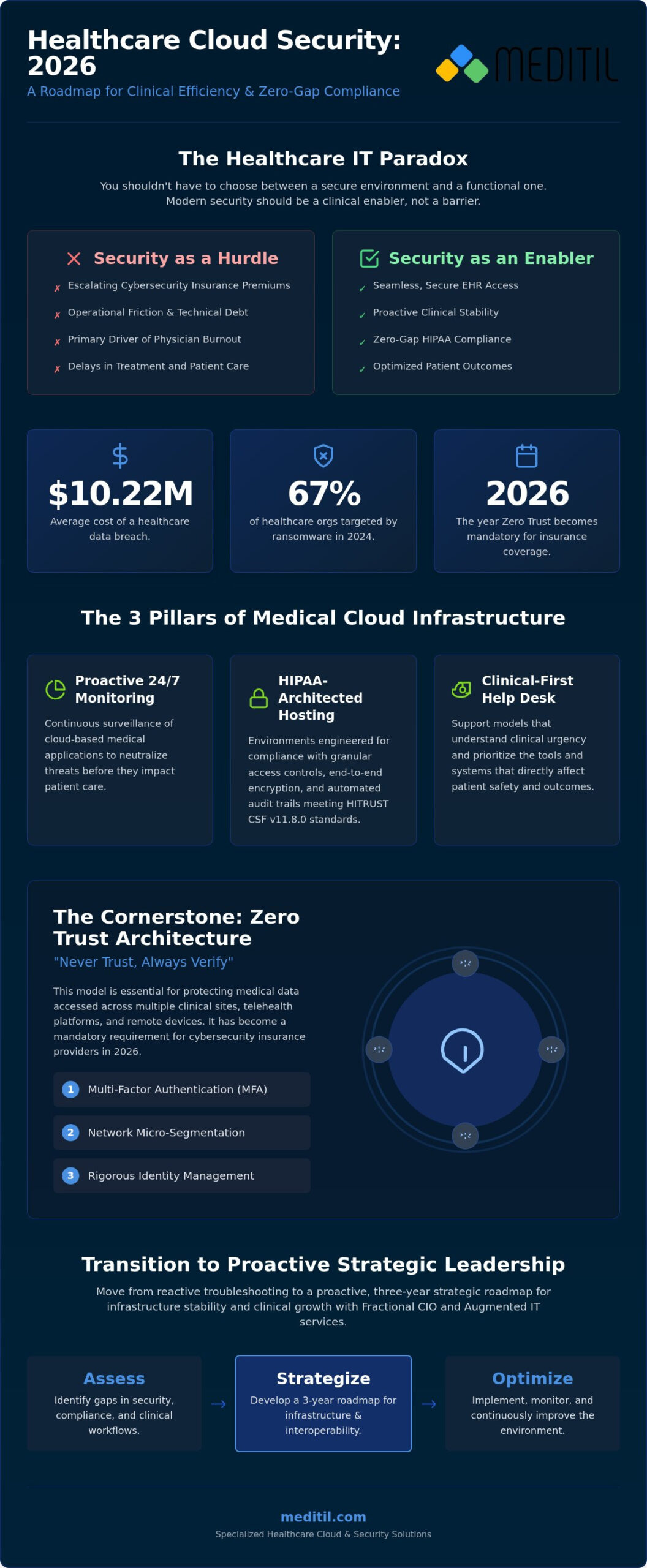
Your most robust security protocols may actually be the primary driver of physician burnout and clinical inefficiency. It’s a frustrating paradox. As cybersecurity insurance premiums escalate and the average cost of a healthcare data breach reaches $10.22 million, the very measures meant to protect patient data often create technical debt and operational friction. You shouldn’t have to choose between a secure environment and a functional one.
This guide provides a strategic roadmap to master healthcare cloud security solutions in 2026. You will learn how to achieve zero-gap HIPAA compliance while eliminating the barriers that slow down patient care. We will examine how Zero Trust Architecture, HITRUST CSF v11.8.0 standards, and proactive leadership can transform your infrastructure from a defensive hurdle into a seamless clinical enabler. By aligning your security posture with clinical workflows, you can protect patient health information while ensuring your providers have secure, predictable access to EHR data across every site of care.
Key Takeaways
- Identify how modern healthcare cloud security solutions serve as a clinical enabler by balancing rigorous PHI protection with seamless workflow interoperability.
- Implement Zero Trust Architecture to meet the stringent demands of 2026 cybersecurity insurance providers and ensure audit-ready HIPAA compliance.
- Leverage Fractional CIO services to transition from reactive troubleshooting to a proactive, three-year strategic roadmap for infrastructure stability.
- Eliminate clinical friction and physician burnout by optimizing EHR performance and securing data access across multiple sites.
- Evaluate the augmented IT team model as a solution to bridge specialized talent gaps while maintaining a steady hand over your complex technology environment.
What are Healthcare Cloud Security Solutions in 2026?
In 2026, the distinction between general corporate IT and specialized healthcare cloud security solutions is no longer a matter of preference; it’s a requirement for clinical survival. While standard IT focuses on uptime and data integrity, medical cloud infrastructure must prioritize patient safety and the high-availability of life-critical systems. A single minute of downtime in a clinical environment doesn’t just impact productivity. It delays treatment, interrupts surgical workflows, and compromises patient outcomes. Applying universal Cloud Computing Security Principles is only the baseline. Medical environments require specialized controls to manage Protected Health Information (PHI) across fragmented, telehealth-heavy networks.
The evolution of PHI protection has moved beyond the four walls of the clinic. With the rise of remote patient monitoring and decentralized care, your security perimeter now extends to every physician’s tablet and every patient’s home device. The current environment mandates a shift from reactive troubleshooting to proactive clinical stability. In 2025, the average cost of a healthcare data breach reached $10.22 million. This financial reality, combined with the fact that 67% of healthcare organizations were targeted by ransomware in 2024, makes strategic managed IT a core component of risk management. It’s about building an infrastructure that remains resilient under pressure.
The Core Pillars of Medical Cloud Infrastructure
True healthcare cloud security solutions are built on three essential pillars designed for the rigors of modern medicine:
- Proactive 24/7 Monitoring: We don’t wait for a system to fail. Continuous surveillance of cloud-based medical applications ensures that potential bottlenecks or security threats are neutralized before they impact patient care (to learn more about the tools that enable this, visit Trinity Networx, LLC).
- HIPAA-Architected Hosting: Hosting environments must be specifically engineered for compliance. This includes granular access controls, end-to-end encryption, and automated audit trails that meet the HITRUST CSF v11.8.0 standards released in May 2026.
- Clinical-First Help Desk: Technical support must understand clinical urgency. A help desk that treats a frozen EMR with the same priority as a printer error is a liability. Our support models prioritize the tools that directly affect patient safety.
Why Generalist MSPs Struggle with Medical Data
Generalist Managed Service Providers (MSPs) often lack the deep industry knowledge required to manage complex medical ecosystems. There’s a significant risk of generalists misconfiguring PHI access controls because they don’t understand the nuances of HIPAA’s “minimum necessary” rule. They often lack familiarity with specific EMR/EHR vendor security requirements, leading to integration gaps that create technical debt. Without a partner who understands the intersection of technology and regulation, medical groups struggle to find the strategic consulting needed for sustainable growth. A generalist might keep your servers running, but they won’t help you build a three-year roadmap for clinical interoperability.
Proactive Data Protection: Cybersecurity and Compliance Frameworks
The implementation of zero-trust architecture has become the cornerstone of modern healthcare cloud security solutions. This model operates on the principle of “never trust, always verify,” which is essential when medical data is accessed across multiple clinical sites and remote locations. By 2026, cybersecurity insurance providers have transformed these technical standards from suggestions into mandatory requirements for coverage. Organizations that fail to implement multi-factor authentication, micro-segmentation, and rigorous identity management face prohibitive premiums or outright denial of coverage. We help medical groups bridge this gap by providing continuous compliance monitoring as a service. In 2026, HIPAA compliance is a continuous technical process of verification rather than a static, one-time audit event.
Strategic alignment between your managed IT standards and insurance requirements is no longer optional. Insurers now look for specific proof points, such as documented incident response plans and regular vulnerability scans, before issuing a policy. These proactive measures don’t just lower your financial risk. They create a more stable environment for your providers. When your infrastructure is built to meet these high standards, you reduce the likelihood of the catastrophic disruptions that lead to clinical friction and patient safety concerns. If you’re looking to strengthen your posture, our team can help you build a strategic security roadmap tailored to your specific clinical needs.
Modern Threat Detection and Response
Protecting endpoint devices in a clinical setting requires more than traditional antivirus software. We utilize Endpoint Detection and Response (EDR) and Managed Detection and Response (MDR) to provide real-time visibility into every device accessing your network. This proactive approach includes automated threat hunting specifically designed to identify ransomware variants that target medical records. For a deeper dive into these protocols, see our guide on Healthcare Cybersecurity Services: A Strategic Guide for 2026. These systems ensure that if a breach is attempted, it’s identified and contained in minutes, not the months-long windows often reported in industry data.
Compliance in the Age of Remote Monitoring
Remote Patient Monitoring (RPM) and telehealth have significantly expanded the attack surface for medical practices. Securing these data streams requires specialized encryption and secure API integrations to prevent the unauthorized interception of patient vitals. Following HHS Cloud Security Best Practices is vital for maintaining the privacy of patients participating in remote care programs. Beyond technical barriers, staff training remains a critical defense. We provide ongoing education on data privacy to ensure your team stays ahead of 2026 regulatory shifts in telehealth and remote monitoring.
Strategic Leadership: Fractional CIO and vCIO Security Governance
Many medical groups mistake technical troubleshooting for strategic leadership. Tactical support keeps the lights on, but it doesn’t prepare you for the next three years of regulatory shifts or infrastructure demands. Strategic governance ensures your healthcare cloud security solutions are integrated into your long-term business goals. This involves more than just selecting software; it requires a deep understanding of HHS guidance on HIPAA and cloud computing to ensure every strategic move remains compliant. Without this executive oversight, organizations often find themselves reacting to crises rather than preventing them. A Fractional CIO builds a comprehensive three-year roadmap that anticipates growth, ensuring your technology scales alongside your patient volume.
Aligning your IT budget with clinical outcomes is the only way to ensure sustainable growth. When technology is treated as a line-item expense rather than a strategic asset, the resulting technical debt eventually compromises patient care. Strategic leadership bridges the gap between the boardroom and the exam room, translating complex technical requirements into clear business objectives. This ensures that every dollar spent on infrastructure directly supports the mission of the practice. By focusing on long-term stability, you create an environment where technology serves the providers, not the other way around.
What is a Fractional CIO for Healthcare?
A Fractional CIO provides the executive-level guidance your organization needs without the financial burden of a full-time C-suite salary. These experts are particularly valuable when managing IT team transitions or overseeing large-scale infrastructure overhauls that require a steady hand. They don’t just manage servers; they provide strategic advisory on business intelligence and medical data analytics to help you make informed clinical decisions based on real-time data. By leveraging Virtual CIO Services: Strategic IT Leadership for Healthcare in 2026, you gain a partner who understands how to align technology with patient outcomes. This leadership role is essential for navigating the complexities of interoperability and ensuring that your data flows securely between different clinical sites.
Eliminating Technical Debt through Strategic Budgeting
Technical debt is the hidden cost of legacy systems and patchwork security fixes. It accumulates when organizations prioritize short-term savings over long-term stability, leading to systems that are vulnerable and inefficient. A Fractional CIO eliminates this debt through smart infrastructure lifecycle management, ensuring that your healthcare cloud security solutions are modern, scalable, and resilient. This proactive approach reduces long-term costs and prevents the clinical friction caused by failing hardware or outdated protocols. You can learn more about this in our guide on Strategic IT Budgeting for Medical Practices: A 2026 Financial Roadmap. Ultimately, justifying security spend becomes easier when you can demonstrate its direct impact on physician productivity and patient safety. When doctors don’t have to fight their technology, they can focus entirely on their patients.
Reducing Clinical Friction through Secure EHR and Interoperability
Security protocols that interfere with patient care aren’t just an inconvenience. They’re a primary driver of physician burnout. Modern healthcare cloud security solutions must be designed to enhance, rather than obstruct, the clinical workflow. By optimizing EMR/EHR performance, we ensure that doctors spend more time with patients and less time navigating cumbersome authentication layers or waiting for slow system responses. Bridging data silos through secure interoperability allows for a seamless flow of information across the care continuum. This connectivity is essential for maintaining data integrity while providing providers with the real-time insights they need at the point of care without compromising privacy.
The role of billing automation extends beyond financial efficiency. It acts as a stabilizer for the entire data ecosystem by ensuring that sensitive financial and clinical data remain synchronized and protected. Implementing automated billing processes reduces administrative overhead by up to 30%, which allows your staff to focus on higher-value clinical support tasks. This reduction in manual data entry also minimizes the risk of human error, which is a frequent cause of both security vulnerabilities and claim denials. When your financial and clinical systems communicate securely, you create a more predictable revenue cycle and a more stable environment for your patients.
Secure EMR/EHR Implementation and Optimization
Professional setup and integration of medical record systems require a deep understanding of the clinical environment. We perform detailed workflow mapping to ensure that security protocols align with clinical reality rather than working against it. This includes configuring single sign-on and biometric access where appropriate to balance protection with speed. Staff training is a critical component of this process. High system adoption only occurs when the team feels confident that the technology is reliable and the security measures don’t hinder their ability to deliver care. By aligning these systems with daily tasks, we foster a culture of compliance that feels natural.
Medical Billing Automation and Security
Integrating secure billing software with existing EHR systems is a strategic necessity for medical groups aiming for long-term growth. Secure data integrity management is the primary defense against the cascading effects of a data breach on your revenue cycle. Our approach focuses on creating a “closed-loop” system where financial data is protected by the same rigorous standards as clinical records. You can explore these strategies in depth in our guide on Medical Billing Automation Solutions: A Strategic Guide for Healthcare Leaders in 2026. These solutions ensure that your practice remains financially stable while meeting the highest standards of data protection. If your current systems are causing clinical delays, contact our team to discuss a clinical workflow optimization audit.
Selecting a National Partner for Augmented Healthcare IT Support
Deciding between an Augmented IT Team and a fully outsourced managed model depends on your existing internal resources and long-term growth objectives. Many medical groups possess a capable internal IT manager but lack the specialized depth required to manage complex healthcare cloud security solutions at scale. An augmented model allows you to retain your internal talent while providing them with high-level support for infrastructure overhauls and compliance audits. This partnership ensures that your internal team isn’t buried under tactical tickets, allowing them to focus on site-specific clinical needs while we handle the broader strategic governance. For a deeper look at these models, see our Managed IT Services for Healthcare: The 2026 Definitive Strategic Guide.
A partner with a national scope offers a level of redundancy and specialized medical expertise that local generalists simply can’t match. In 2026, the complexity of the regulatory environment requires a partner who understands the nuances of national HIPAA audit priorities and the specific security requirements of diverse healthcare platforms. Transitioning to a new partner can be daunting, but a disciplined onboarding process minimizes disruption to patient care. We prioritize a methodical transition that maps out every dependency before a single system is moved. This intentional pace ensures that clinical operations remain stable and predictable throughout the integration phase.
Scalability for Growing Medical Groups
Standardized, secure IT infrastructure is the foundation of successful multi-site expansion. As your medical group grows, maintaining consistent healthcare cloud security solutions across every location becomes a significant operational challenge. We provide centralized management for diverse healthcare applications, ensuring that a provider in a satellite clinic has the same secure, high-performance experience as one in the main hospital. This standardized approach includes:
- Standardizing security protocols across all satellite locations to prevent fragmented compliance.
- Implementing centralized management for EMR/EHR performance monitoring.
- Ensuring seamless interoperability between legacy on-premise systems and modern cloud platforms.
The MEDITIL Approach: Stability and Precision
We serve as a steady hand at the wheel for your IT operations, prioritizing infrastructure stability and patient safety above all else. Our approach is built on long-term partnership and proactive strategic planning rather than reactive troubleshooting. We understand that every clinical environment is unique, which is why our advisory services focus on customizing protection to your specific workflows. If you’re ready to transition from technical debt to strategic advancement, the next step is a comprehensive cloud security and infrastructure assessment. Our team is prepared to conduct a methodical review of your current posture and build a roadmap that ensures your technology remains a silent, reliable partner in patient care.
Securing the Future of Clinical Excellence
Success in the 2026 healthcare environment requires moving beyond reactive technical support. Implementing robust healthcare cloud security solutions is a strategic imperative that protects patient data while actively reducing clinical friction. By integrating Zero Trust Architecture and leveraging executive-level governance, your organization can achieve both HIPAA compliance and operational agility. This disciplined approach ensures that your technology serves as a reliable partner in delivering high-quality care.
MEDITIL provides the national support and healthcare-specific expertise necessary to manage multi-site medical groups and specialty clinics. Our Fractional CIO leadership builds the strategic roadmaps that drive growth and eliminate technical debt. We focus on the precision of your infrastructure so you can focus on the safety of your patients. It’s time to transition to a more stable and predictable IT environment.
Take the next step toward a secure and high-performing clinical environment. Schedule a Strategic IT Consultation with MEDITIL to begin your infrastructure assessment. We’re ready to provide the steady hand your practice deserves.
Frequently Asked Questions
What is the difference between general cloud security and healthcare cloud security solutions?
Healthcare cloud security prioritizes clinical availability and the protection of Protected Health Information (PHI) over standard data integrity. While general IT focuses on broad uptime, healthcare cloud security solutions are architected for HIPAA compliance and integration with life-critical medical applications. These specialized frameworks include granular access controls and encryption protocols that generalist providers often overlook. It’s the difference between simple data storage and a resilient, clinical-grade infrastructure.
How do managed IT services ensure HIPAA compliance in the cloud?
Managed IT providers maintain HIPAA compliance through continuous technical monitoring and automated safeguards that go beyond annual audits. This process includes implementing end-to-end encryption, multi-factor authentication, and detailed audit trails for every access attempt. We ensure that your hosting environment meets the latest HITRUST CSF standards. This proactive approach transforms compliance into a steady, verifiable process that protects your practice from regulatory penalties and data breaches.
Can healthcare cloud security solutions actually reduce physician burnout?
Yes, specialized healthcare cloud security solutions reduce burnout by streamlining authentication and optimizing EMR performance. When security protocols are designed with clinical workflows in mind, doctors spend less time navigating technical barriers and more time focusing on patient care. We eliminate the high-friction security measures that frustrate providers. This results in a more efficient clinical environment where technology supports the physician rather than hindering their work.
What does a Fractional CIO do for a healthcare organization’s security strategy?
A Fractional CIO provides the executive-level leadership needed to align your technical infrastructure with long-term clinical and financial goals. They develop comprehensive three-year roadmaps and oversee large-scale security transitions that require a steady hand. This role ensures that your security spend is a strategic investment in growth rather than a reactive expense. You get the benefit of a seasoned expert who understands the intersection of regulation and operations.
How do managed IT services handle EHR/EMR interoperability across different vendors?
Managed IT services utilize secure APIs and standardized integration protocols to ensure data flows seamlessly between disparate medical systems. We bridge data silos by creating a secure environment where information from various vendors can be exchanged without compromising PHI. This connectivity allows for a comprehensive view of patient health across different clinical sites. Our focus is on maintaining data integrity throughout the entire interoperability process to ensure clinical precision.
What happens to our current internal IT team if we hire a managed service provider?
Hiring a managed service provider typically creates an augmented IT model where our specialists support and empower your existing staff. We handle the complex infrastructure management and security governance, which allows your internal team to focus on immediate, site-specific clinical needs. This partnership closes specialized talent gaps and reduces the daily burden on your employees. It’s a collaborative approach that strengthens your overall technical posture without replacing your trusted internal resources.
How does zero-trust architecture improve cybersecurity for medical data?
Zero-trust architecture improves security by requiring explicit verification for every access attempt, regardless of where the request originates. This model assumes a breach is possible and limits the lateral movement of attackers within your network. By verifying every user and device, we protect sensitive medical data from unauthorized access and ransomware. It’s a disciplined defense strategy that is essential for securing decentralized care environments and telehealth platforms in 2026.
Are specialized healthcare cloud security solutions cost-effective for smaller medical practices?
Specialized healthcare cloud security solutions are highly cost-effective because they prevent the devastating financial and reputational costs of a data breach. Smaller practices gain access to enterprise-grade protection and strategic leadership without the expense of a full-time C-suite executive. This investment ensures predictable IT budgeting and protects the long-term stability of the clinic. It allows smaller groups to compete with larger health systems by maintaining a modern, secure, and compliant infrastructure.