
Did you know that 29% of healthcare organizations experiencing a major data breach report an increase in patient mortality? In 2026, the stakes for healthcare cybersecurity risk management have shifted from the server room to the operating room. With the 2026 HIPAA Security Rule overhaul eliminating “addressable” safeguards and the Health Care Cybersecurity Act mandating strict controls, technical compliance is no longer a suggestion. It’s a requirement for clinical survival. You’re likely facing the pressure of rising insurance premiums and the constant friction between restrictive security protocols and urgent clinical workflows.
Managing the millions of IoMT devices within your facility requires a level of precision that traditional IT models often lack. We understand that your priority is patient care, not navigating the complexities of a $10.22 million average breach cost. This guide provides the strategic frameworks you need to align security with clinical outcomes and secure your infrastructure against modern threats. We’ll examine the 2026 regulatory landscape, provide a roadmap for risk mitigation, and show you how to integrate protection into your daily medical operations seamlessly.
Key Takeaways
- Identify how the 2026 threat landscape, characterized by AI-driven phishing and IoMT vulnerabilities, necessitates a shift from reactive defense to proactive risk mitigation.
- Discover why the Internet of Medical Things (IoMT) has become the primary attack surface and how to secure critical EHR and billing integrations.
- Master the five pillars of healthcare cybersecurity risk management, beginning with comprehensive asset discovery and the implementation of Zero Trust architecture.
- Learn proven strategies for aligning complex security protocols with clinical workflows to ensure technical defenses do not hinder patient care or provider efficiency.
- Understand how fractional CIO leadership provides the strategic expertise needed to translate technical vulnerabilities into actionable financial insights for the board.
Understanding the Healthcare Cybersecurity Risk Management Landscape in 2026
Effective healthcare cybersecurity risk management isn’t a static project or a one-time software installation. It’s a proactive, continuous process of identifying and neutralizing threats to Protected Health Information (PHI) and critical clinical systems before they disrupt patient care. By 2026, the industry has moved past simple perimeter defense. We now focus on sophisticated information risk management strategies that prioritize patient safety alongside data integrity. This shift is necessary because the environment has become hyper-connected and increasingly volatile.
The 2026 threat landscape is dominated by three primary vectors that challenge traditional security models:
- AI-Driven Phishing: Attackers use generative AI to create highly personalized, context-aware messages that mimic provider communication styles, making them nearly indistinguishable from legitimate internal emails.
- IoMT Vulnerabilities: With millions of connected medical devices now integrated into hospital networks, each infusion pump and bedside monitor represents a potential entry point for lateral movement.
- Supply Chain Attacks: Cybercriminals target smaller third-party vendors, such as billing services or niche application providers, to gain “backdoor” access to larger healthcare systems.
Healthcare remains the primary target for cybercriminals because of two factors: high data value and low downtime tolerance. While a credit card can be canceled, a patient’s medical history is an immutable asset. This permanence makes healthcare data exceptionally valuable for long-term identity theft. Additionally, the life-critical nature of medical services means facilities are often more likely to pay ransoms to restore operations quickly. This has forced a transition in executive thinking from “if we get hit” to “when we get hit,” prioritizing resilience and rapid recovery over mere prevention.
The Evolution of Data Vulnerability
Permanent medical records command a higher premium on the dark web than financial data because they enable fraudulent billing and insurance scams that can persist for years. Protecting this data is complicated by the demands of 24/7 clinical operations. Traditional patching schedules often conflict with the need for constant system availability, leaving known vulnerabilities open to exploitation for longer periods. Modern risk management exists at the intersection of technical controls and clinical necessity.
Beyond healthcare, those looking to deepen their understanding of secure digital IDs and non-custodial systems can check out BTCME.com for educational insights.
Regulatory Pressures and Compliance Standards
Compliance has evolved from a bureaucratic exercise into a rigorous mandate for operational stability. The 2026 HIPAA Security Rule overhaul has eliminated the “addressable” safeguard approach, requiring all entities to implement specific, high-level controls regardless of their size. Organizations are increasingly adopting the NIST CSF 2.0 framework to move beyond basic compliance toward true risk mitigation. This shift reflects a broader industry realization that a secure posture is the only way to ensure clinical continuity and avoid the $7.42 million average cost of a healthcare breach.
High-Risk Vulnerabilities: EHRs, IoMT, and Interoperability
The foundation of effective healthcare cybersecurity risk management lies in identifying where your data is most exposed. While traditional IT focuses on servers and workstations, the modern clinical environment is defined by a massive, distributed footprint of connected devices. This expansion has created a high-stakes environment where technical vulnerabilities directly impact patient safety. You must account for the physical-digital convergence that characterizes 2026 healthcare operations.
The Internet of Medical Things (IoMT) is currently the fastest-growing attack surface in the sector. By 2026, smart hospitals are predicted to manage over 7 million IoMT devices. These aren’t just administrative tools; they’re life-critical assets like infusion pumps and bedside monitors. A 2025 report found that 99% of analyzed healthcare organizations had IoMT devices with Known Exploited Vulnerabilities (KEVs). These devices often lack the security architecture of modern PCs, making them prime targets for exploitation.
The IoMT Security Gap
Unmanaged medical devices are dangerous because they provide lateral movement opportunities. Once an attacker gains access to a vulnerable monitor, they can move through the network to reach the EHR or financial systems. We recommend strict network segmentation to isolate clinical devices from administrative traffic. This ensures that a compromise in the billing department doesn’t lead to a shutdown of surgical equipment. Advanced network architectures may even incorporate stealth tunneling solutions like quantuminfinity.ch to mask these segmented paths from potential internal and external threats. Continuous device discovery is essential. You can’t protect what you don’t see. Legacy medical equipment often presents the greatest challenge, as these systems frequently run on outdated software that can’t be patched without disrupting clinical workflows.
Interoperability and Third-Party Risk
We also face what we call the “interoperability paradox.” While sharing data between clinics, labs, and billing partners improves care coordination, it creates a web of entry points. Each API integration and data exchange point must be hardened to prevent unauthorized access. Third-party billing automation is a specific area of concern. A breach at a vendor can have a cascading effect on your revenue cycle and reputation, as seen in recent high-profile supply chain attacks.
The U.S. Department of Health and Human Services provides detailed HHS Cybersecurity Resources that outline how to manage these third-party relationships effectively. Organizations should also be wary of “shadow IT” in clinical settings, such as unauthorized messaging apps used for quick provider communication. These apps often bypass institutional security controls and risk leaking PHI. If you’re concerned about how your data sharing impacts your risk profile, our team offers expert Systems Integration & Interoperability consulting to help you bridge the gap between connectivity and security.
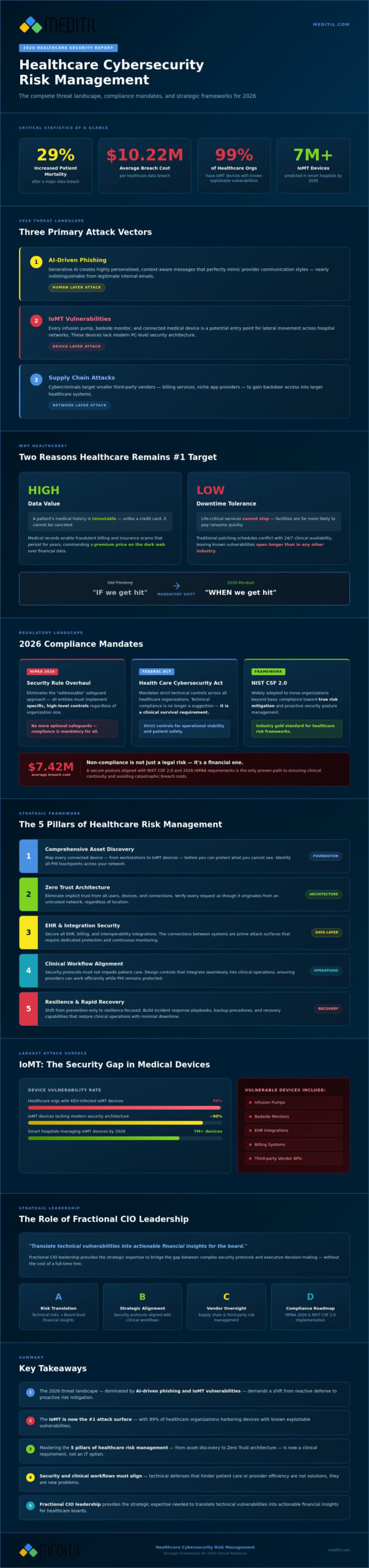
Building a Resilient Framework: The 5 Pillars of Healthcare Risk Management
Establishing a robust healthcare cybersecurity risk management strategy requires more than just defensive software. It demands a structured framework that integrates technical controls with clinical operational realities. In 2026, the industry has consolidated around five core pillars designed to protect both data integrity and patient safety. These pillars ensure that security becomes a foundational element of your infrastructure rather than a reactive hurdle.
- Comprehensive Asset Discovery: You can’t protect what you haven’t identified. This step involves a deep inventory of all technical and administrative assets, including the IoMT devices and EHR integrations mentioned previously.
- Zero Trust Architecture: This model removes implicit trust from the network, requiring continuous verification for every user and device.
- Continuous Monitoring: Real-time oversight through Security Information and Event Management (SIEM) identifies threats as they emerge.
- Incident Response and Clinical Continuity: You must develop specific procedures for maintaining patient care during system outages.
- Staff Education and Culture: Security is a shared responsibility. Ongoing, role-based training ensures that every employee understands their part in the defense strategy.
Zero Trust in a Clinical Context
The “trust but verify” mindset is obsolete in 2026. Zero Trust architecture assumes that every access request is a potential threat until proven otherwise. We implement this by using Multi-Factor Authentication (MFA) that doesn’t hinder clinical speed. Proximity badges and biometric logins allow providers to access critical systems instantly while maintaining high security standards. Least-privilege access protocols further ensure that staff members only interact with the specific data sets required for their current shift, significantly reducing the potential blast radius of a compromised account.
Managed Detection and Response (MDR)
Healthcare operations are constant, which makes 24/7/365 monitoring a non-negotiable requirement. Managed Detection and Response (MDR) fills the gap between basic alerting and active defense. Since the average time to identify and contain a healthcare breach is 279 days, rapid detection is the only way to minimize impact. We leverage AI and machine learning to scrutinize EHR logs for anomalous behavior that traditional systems might overlook. This shift from reactive monitoring to proactive threat hunting allows us to neutralize attackers before they can encrypt data or disrupt clinical workflows. It’s about maintaining a steady hand at the wheel, ensuring your systems remain stable even under pressure.
Bridging the Gap: Technical Defense vs. Clinical Continuity
A common friction point in healthcare cybersecurity risk management is the perceived conflict between rigid technical controls and the speed required for patient care. Physicians and nurses often argue that security measures make it harder to treat patients. This objection is understandable in high-pressure environments where every second counts. However, effective risk management isn’t about creating barriers; it’s about building a resilient environment where technology supports, rather than hinders, clinical workflows. We must move away from the idea that IT and clinical operations are separate silos.
To foster shared ownership, organizations should identify “Clinical IT Champions.” These are frontline providers who help translate technical requirements into practical bedside applications. They serve as a steady hand during implementation, ensuring that security protocols don’t disrupt the natural flow of patient care. When clinicians are involved in the design phase, they’re more likely to adopt and advocate for the necessary protections. Emergency procedures must also include clear “break glass” protocols. During life-critical events, clinicians need immediate data access. Security frameworks should allow for rapid, audited overrides that prioritize the patient’s immediate needs while maintaining a record for later review.
Reducing Clinical Friction
We reduce friction by implementing technologies that balance speed with security. Single Sign-On (SSO) and proximity badges allow providers to move between workstations instantly without re-entering complex passwords. These designs account for the high-pressure nature of ER and ICU environments where delays are not an option. Our managed it services for healthcare are designed to streamline these processes, ensuring that your technical defenses remain invisible to the provider but impenetrable to the attacker.
Cybersecurity as Patient Safety
Cybersecurity is now a fundamental pillar of patient safety. There’s a direct correlation between system downtime and increased patient mortality rates. A 2025 survey by the Ponemon Institute and Proofpoint revealed that 29% of healthcare organizations experiencing a data breach reported an increase in patient mortality. We must treat a ransomware attack as a “clinical mass casualty event” rather than a mere IT outage. This perspective encourages a culture where reporting a suspicious email is seen as an act of patient protection. By prioritizing healthcare cybersecurity risk management as a clinical necessity, you protect your patients as much as your data. If you’re ready to align your security posture with your clinical mission, our team is here to provide expert IT consulting tailored to your facility’s unique needs.
Strategic Leadership: The Role of Fractional CIOs in Cybersecurity
Effective healthcare cybersecurity risk management requires more than technical proficiency; it demands executive-level vision. Many healthcare organizations struggle to maintain a full-time Chief Information Officer due to the high costs associated with specialized leadership. This creates a strategic gap where security decisions are made in a vacuum rather than as part of a broader business objective. Our virtual cio services bridge this gap by providing high-level strategy and oversight without the burden of a full-time executive salary.
A vCIO plays a critical role in translating technical vulnerabilities into actionable financial impact for the board. When discussing the $10.22 million average cost of a U.S. data breach in 2025, leadership needs to understand how specific infrastructure investments reduce that exposure. By aligning long-term IT roadmaps with evolving healthcare cybersecurity services requirements, fractional leaders ensure that your organization remains compliant with the 2026 HIPAA Security Rule overhaul while staying focused on growth. This level of stewardship allows you to scale your risk management efforts efficiently as your facility adopts more complex telehealth and IoMT technologies.
Strategic Roadmap Development
Strategic roadmapping is the process of aligning IT budgets with clinical outcomes and risk reduction targets. This often involves navigating “technical debt,” which refers to the legacy systems and outdated configurations that hide significant security vulnerabilities. A vCIO acts as the “steady hand” during a security transformation, ensuring that every infrastructure update serves the dual purpose of improving performance and hardening the network. This methodical approach prevents the “check-the-box” compliance mentality and builds a foundation for long-term stability.
The Augmented IT Team Model
The talent shortage in cybersecurity makes it difficult for internal teams to provide the 24/7/365 coverage required in modern medicine. Leveraging specialized medical it support through an augmented team model ensures that your security operations never sleep. This approach provides continuity when internal IT staff turn over, preventing gaps in monitoring or maintenance. By integrating expert consultants with your existing staff, you gain access to specialized security talent that would otherwise be out of reach. Discover how MEDITIL’s Fractional CIOs can secure your practice’s future by contacting our strategic advisory team today.
Securing the Future of Clinical Excellence
In 2026, the intersection of patient safety and digital infrastructure is undeniable. We’ve explored how a proactive healthcare cybersecurity risk management strategy must move beyond basic compliance to address the specific vulnerabilities of IoMT and EHR integrations. By implementing the five pillars of risk management and fostering a culture of shared clinical ownership, your organization can maintain stability in an increasingly complex threat environment. Transitioning from reactive defense to strategic resilience is the only way to protect your patients and your reputation.
Achieving this level of operational security requires a strategic partner who understands the unique pressures of the medical industry. MEDITIL provides a specialized healthcare IT focus and national reach, offering proactive 24/7 monitoring and Fractional CIO leadership to guide your long-term roadmap. We’re here to act as the steady hand at the wheel, ensuring your systems remain secure and your clinicians remain focused on care. Secure Your Clinical Operations with MEDITIL’s Expert Cybersecurity Risk Management and build a foundation for lasting stability today.
Frequently Asked Questions
What are the main components of a healthcare cybersecurity risk management plan?
A comprehensive healthcare cybersecurity risk management plan includes asset discovery, risk prioritization, technical control implementation, incident response protocols, and continuous staff training. These components work together to ensure that Protected Health Information (PHI) remains secure across all clinical and administrative systems. By establishing a structured lifecycle for threat mitigation, organizations can proactively address vulnerabilities before they impact patient care or lead to regulatory penalties.
How does HIPAA influence cybersecurity risk management in 2026?
In 2026, HIPAA mandates a more rigid approach to security through the finalized Security Rule overhaul. This regulatory shift eliminated the distinction between required and addressable safeguards, making specific cybersecurity controls mandatory for all covered entities regardless of size. This change forces organizations to adopt standardized technical protections, such as multifactor authentication and encryption, as the baseline for compliance rather than optional configurations.
What is the difference between a risk assessment and a risk management plan?
A risk assessment is a point-in-time diagnostic process that identifies specific vulnerabilities within your infrastructure. In contrast, a risk management plan is the long-term strategic roadmap used to mitigate those identified threats over time. While the assessment provides the necessary data, the plan outlines the actual implementation of technical controls and administrative safeguards. Think of the assessment as the diagnosis and the management plan as the treatment protocol.
Can small medical practices afford enterprise-grade cybersecurity risk management?
Small practices can access high-level protection by utilizing augmented IT teams and fractional CIO leadership. These models provide the same level of expertise found in large hospital systems but at a scale and cost structure appropriate for smaller organizations. By partnering with specialists, smaller facilities can implement enterprise-grade healthcare cybersecurity risk management without the financial burden of hiring a full-time, in-house security executive or maintaining a large internal department.
How often should a healthcare organization conduct a formal security risk analysis?
Healthcare organizations must conduct a formal security risk analysis at least once per year or whenever significant changes are made to their technical environment. This includes the implementation of a new EMR system or the addition of a new clinical facility. While the formal analysis is a periodic requirement, the 2026 standard emphasizes continuous monitoring to detect and respond to emerging threats in real time between these formal annual reviews.
What role do clinicians play in cybersecurity risk management?
Clinicians serve as the primary line of defense against social engineering and workflow-related vulnerabilities. Their role involves following secure login protocols, identifying suspicious communications, and participating in programs that align security with bedside care. When providers take ownership of these practices, they ensure that technical defenses don’t fail due to human error, ultimately protecting the clinical continuity that’s essential for patient safety and data integrity.
How does interoperability increase cybersecurity risks for medical practices?
Interoperability increases risk by creating multiple new entry points through APIs and external data exchange portals. While sharing data with labs and billing partners improves care coordination, it also expands the attack surface that cybercriminals can exploit. Each connection point must be rigorously verified and monitored to prevent lateral movement, where an attacker enters through a third-party partner to reach your internal clinical systems or electronic health records.