
What if your technology functioned as a silent partner in patient care instead of a primary driver of physician burnout? For many healthcare executives, the friction of poorly integrated systems and the constant threat of catastrophic HIPAA fines make infrastructure feel like a liability. You likely recognize that maintaining clinical stability requires specialized managed it services for healthcare that go beyond a reactive help desk; it demands a proactive strategy that evolves with the 2026 regulatory environment.
This guide offers a definitive roadmap to achieving zero-downtime infrastructure and predictable operational costs. We’ll explore how to navigate the latest HHS mandates, such as mandatory encryption and the February 16, 2026, deadline for Substance Use Disorder record alignment. From fractional CIO leadership to advanced systems integration, this strategic overview prepares your organization for a future where technology empowers growth rather than hindering it.
Key Takeaways
- Identify the critical differences between general technical support and specialized partnerships designed for life-critical clinical environments.
- Navigate the 2026 cybersecurity landscape and the high-availability infrastructure requirements essential for maintaining HIPAA compliance.
- Evaluate the impact of Fractional CIO leadership and augmented IT models on your organization’s long-term strategic roadmap.
- Leverage managed it services for healthcare to achieve seamless EHR interoperability and billing automation, effectively reducing physician burnout.
- Apply a 5-point evaluation framework to select an IT partner that prioritizes clinical stability and demonstrates deep regulatory expertise.
What is Managed IT Services for Healthcare?
Healthcare is a high-stakes environment where technology failure isn’t just an inconvenience; it’s a risk to patient safety. While the general definition of What is a Managed Service Provider (MSP)? involves third-party management of IT infrastructure, managed it services for healthcare represent a specialized discipline. This field focuses on life-critical systems where uptime is measured in clinical outcomes and regulatory compliance is a non-negotiable baseline. It’s a strategic partnership that ensures technology serves the mission of care rather than obstructing it.
Distinguishing between a generalist MSP and a healthcare-specific partner is vital for leadership. Generalists often lack the nuanced understanding of clinical workflows or the gravity of HIPAA mandates. A specialized partner acts as a Healthcare Information Technology Specialist (HITS), prioritizing data integrity and patient safety above all else. The scope of these services is comprehensive, ranging from daily end-user support and help desk tasks to high-level Fractional CIO leadership. This leadership ensures that your technical roadmap supports long-term growth and operational resilience. For a foundational understanding of how medical IT infrastructure supports clinical excellence in 2026, a comprehensive overview can help leadership align technical investments with patient care goals.
The Evolution from Break-Fix to Managed Clinical Stability
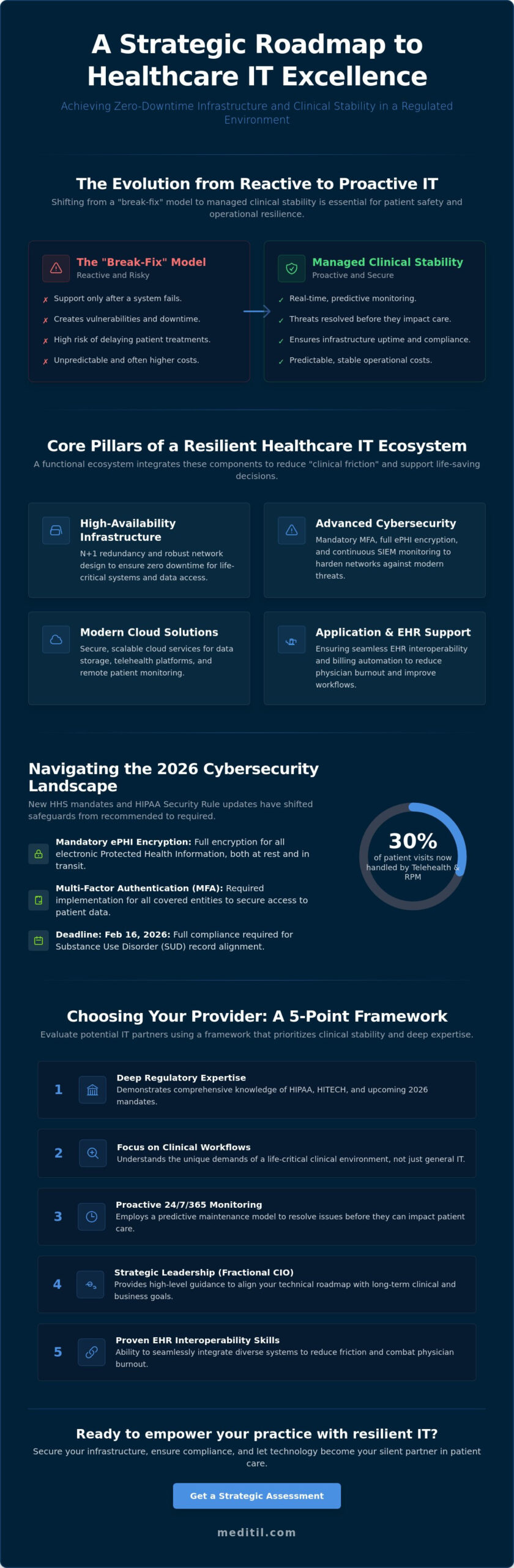
The traditional “break-fix” model, where you call for support only after a system fails, is dangerous for modern medical practices. Waiting for a network crash before taking action creates vulnerabilities that can delay treatments. Proactive managed it services for healthcare shift this toward predictive maintenance. By monitoring systems in real-time, partners resolve threats before they impact patient care. Clinical stability is the intersection of infrastructure uptime and rigorous regulatory compliance.
Key Components of a Healthcare IT Ecosystem
A functional ecosystem relies on several core pillars, including infrastructure services, cloud solutions, and healthcare application support. These components must integrate seamlessly to reduce “clinical friction.” This term refers to the technological resistance, such as EHR lag, that causes physician burnout. In acute care environments, constant monitoring is an industry necessity. Systems must remain operational to support life-saving decisions. It’s essential to verify a partner’s ability to maintain these high-availability standards.
Ultimately, this specialized model of IT management provides a steady hand at the wheel for organizations navigating a regulated environment. By focusing on disciplined, results-oriented support, a healthcare IT partner allows executives to pivot from managing technical crises to advancing strategic clinical goals. This transition is essential for any practice aiming for long-term stability and growth in an increasingly digital landscape.
Core Pillars of Healthcare IT Infrastructure and Cybersecurity
A resilient IT foundation is the prerequisite for clinical excellence. In a high-stakes medical environment, infrastructure must be designed for absolute reliability, ensuring that practitioners never lose access to life-critical data. This level of stability is achieved through managed it services for healthcare that prioritize high-availability network design. As we move through 2026, the integration of telehealth and remote patient monitoring (RPM) has added new layers of complexity. These services now handle up to 30% of patient visits, requiring a network capable of managing massive data throughput without compromising speed or security.
Modernizing legacy medical databases is no longer a choice but a necessity for operational survival. Moving beyond fragmented systems requires a focus on EHR Interoperability standards to ensure that patient information flows securely between departments and external partners. For organizations seeking to audit their current defenses, exploring professional infrastructure and network services can provide the necessary clarity to move forward.
Hardening the Medical Network Against Modern Threats
The 2026 HIPAA Security Rule updates have shifted the landscape from recommended safeguards to mandatory technical requirements. Every covered entity must now implement multi-factor authentication (MFA) and full encryption for electronic Protected Health Information (ePHI) both at rest and in transit. To maintain compliance, networks must utilize N+1 redundancy, ensuring that if one component fails, a backup is already in place to prevent downtime. Security Information and Event Management (SIEM) systems tailored for healthcare provide the continuous monitoring needed to detect anomalies in real-time. Under current mandates, you must conduct vulnerability scans at least twice a year and perform full penetration testing annually to verify your perimeter’s integrity. For IT teams looking to deepen their strategic knowledge beyond these technical requirements, reisinformatica.com provides a list of essential cybersecurity books that can help in building a more resilient organization.
Cloud Services and Data Management for Scalability
Cloud infrastructure offers the agility needed for multi-location practices to scale rapidly while maintaining centralized control. Hybrid cloud models are often the most effective for healthcare, combining the security of private storage for sensitive records with the flexibility of public clouds for administrative tasks. A disciplined approach to data management includes a rigorous business continuity plan. Current standards require organizations to demonstrate the ability to restore critical systems within 72 hours of an incident. By leveraging cloud-based disaster recovery, practices can ensure that patient care remains uninterrupted even during a catastrophic hardware failure. This methodical transition to the cloud reduces the burden on internal staff and creates a predictable framework for long-term growth.
Strategic Leadership: Fractional CIOs and Augmented IT Teams
Technology in a clinical setting is often treated as a utility, similar to electricity or water. However, this perspective ignores the reality that IT is a strategic clinical asset. Effective managed it services for healthcare must provide more than technical support; they must offer strategic foresight. This transition from reactive maintenance to proactive leadership is achieved through fractional CIO roles and augmented IT models. By aligning IT budgets with specific clinical outcomes, organizations can ensure that every technical investment directly supports patient care and operational efficiency.
The primary objection to high-level IT leadership is often the cost of a full-time executive. A full-time Chief Information Officer (CIO) commands a significant salary that may not be feasible for mid-sized practices or community hospitals. A Fractional CIO provides the same level of seasoned expertise on a part-time or project basis, making it a highly cost-effective alternative. This model allows your organization to access sophisticated leadership without the overhead of a permanent C-suite hire, ensuring your technical strategy remains disciplined and results-oriented.
The vCIO: Bridging the Gap Between Technology and Medicine
A Virtual CIO (vCIO) acts as a steady hand at the wheel, translating complex technical data into actionable business intelligence. They handle the critical tasks that often overwhelm administrative staff, such as vendor management and contract negotiations. By centralizing these processes, a vCIO can often identify significant cost savings and eliminate redundant services. Their primary deliverable is a 3-5 year technology roadmap. This document serves as a structured guide for infrastructure upgrades, security enhancements, and interoperability goals, preventing the “emergency spending” cycles that plague many healthcare organizations. Through business intelligence and analytics, they help leadership understand how technology impacts patient throughput and billing cycles.
Managing and Empowering Internal IT Departments
For organizations that already have an internal IT team, the goal isn’t replacement, but empowerment. An augmented IT team model allows a specialized partner to provide the oversight and advanced tools that internal generalists may lack. This co-managed IT approach is particularly beneficial for large-scale healthcare networks where the internal team is often bogged down by daily help desk tickets. By taking over the management of IT teams, a strategic partner can introduce:
- Specialized training on 2026 HIPAA compliance standards and SUD record alignment.
- Advanced cybersecurity monitoring tools that internal teams might not have the budget to procure.
- Standardized workflows that improve internal performance and response times.
- Fractional leadership to guide internal staff through complex EMR/EHR implementations.
This collaborative model ensures that your existing staff remains focused on immediate site needs while the managed partner handles the high-level infrastructure and security protocols. It creates a seamless connectivity between daily operations and long-term strategic advancement.
Operational Excellence: EHR Interoperability and Billing Automation
Operational excellence in a clinical setting is frequently undermined by fragmented data and administrative friction. When electronic health records (EHR) don’t communicate with laboratory or imaging systems, the resulting manual data entry fuels physician burnout. Specialized managed it services for healthcare address these technical silos by building a unified data architecture. This process involves more than simple connectivity; it requires a disciplined approach to systems integration and interoperability that ensures data is both accessible and secure across the entire care continuum. Organizations that adopt strategic healthcare IT services can transform this fragmented landscape into a cohesive foundation that actively supports clinical workflows and eliminates the technical debt that slows care delivery.
The implementation and optimization of EMR/EHR systems must focus on the clinical workflow rather than just technical functionality. Many organizations struggle with disparate medical software that requires redundant logins and manual reconciliations. Strategic IT management resolves these challenges by creating seamless data liquidity. This ensures that a patient’s history, lab results, and imaging reports are available at the point of care without delay, allowing for more informed clinical decision-making. Understanding the full scope of medical IT requirements and best practices for 2026 can help executives make more informed decisions when evaluating integration strategies and vendor capabilities.
Solving the Interoperability Challenge
Achieving data liquidity requires modernizing interoperability architecture to meet evolving federal standards. This includes integrating EHRs with external laboratory information systems (LIS) and picture archiving and communication systems (PACS). Modernizing this architecture is especially critical as organizations work toward the February 16, 2026, deadline for aligning Substance Use Disorder (SUD) records with HIPAA standards. A methodical integration strategy removes the burden of administrative “hunting” for records, allowing clinicians to focus on the patient rather than the interface.
Billing Automation: Turning IT into a Revenue Driver
Revenue cycle management (RCM) is often viewed as an accounting function, but its success depends on technical integration. Billing automation and integration connect clinical documentation directly to the billing department. This synchronization reduces the time between service delivery and claim submission. Automated verification systems can identify errors or missing documentation before a claim is filed, which drastically reduces denial rates and improves cash flow. For practices looking to refine these workflows, you can explore Mental Health Billing to see how specialized RCM services optimize administrative efficiency.
Optimization of these workflows doesn’t require purchasing new software. Instead, it involves refining how your current systems interact to eliminate bottlenecks and manual workarounds. Professional billing automation and integration services ensure that your revenue cycle is as disciplined as your clinical care. By turning IT into a revenue driver, you can achieve a more predictable financial outlook while maintaining the highest standards of data integrity.
Choosing Your Provider: A Framework for Clinical Stability
Selecting a partner for managed it services for healthcare is a high-stakes decision that directly influences both patient safety and organizational resilience. A generalist provider often lacks the clinical depth required to navigate the complexities of a regulated medical environment. To ensure your technology functions as a strategic asset rather than a liability, you need a partner who acts as a steady hand at the wheel. This requires a disciplined evaluation process that moves beyond superficial metrics and focuses on clinical stability and long-term growth.
The Healthcare IT Selection Checklist
A comprehensive evaluation should prioritize a provider’s ability to maintain data integrity while supporting seamless clinical workflows. Use the following 5-point framework to assess potential partners:
- Regulatory Verification: Confirm their expertise in the 2026 HIPAA Security Rule updates. They must demonstrate a clear protocol for mandatory multi-factor authentication (MFA) and full ePHI encryption at rest and in transit.
- Clinical Workflow Depth: Assess their experience with your specific EMR/EHR platforms. A partner should understand how to reduce clinical friction rather than simply maintaining the software.
- Recovery Capability: Verify their ability to meet the 2026 mandate for restoring critical systems within 72 hours of an incident. Ask for documented disaster recovery testing results.
- Strategic Leadership: Evaluate their Fractional CIO capabilities. A provider should offer a 3-5 year technology roadmap that aligns IT spend with clinical outcomes.
- Clinical Priority Support: Examine their help desk responsiveness. Their support structure must prioritize urgent clinical issues, such as EHR lag in an acute care setting, over routine administrative requests.
Industry-specific certifications and a proven audit history are non-negotiable. As the February 16, 2026, deadline for Substance Use Disorder (SUD) record alignment approaches, your provider must demonstrate a proactive plan to ensure your systems remain compliant. Don’t settle for a reactive service model; demand a partner that offers the technical nomenclature and professional rigor your practice deserves.
Next Steps: Securing Your Strategic Roadmap
The transition to a more stable IT environment begins with a thorough discovery and assessment process. This initial phase identifies hidden vulnerabilities in your current infrastructure and establishes a baseline for security and performance. Following this assessment, a managed partner guides you through a structured transition period. This phase focuses on stabilizing your network, implementing mandatory 2026 security controls, and optimizing your billing automation to drive revenue.
By moving from a fragmented support model to a unified strategic partnership, you can eliminate the technical friction that leads to physician burnout. This disciplined approach ensures that your infrastructure is prepared for the future of healthcare, from telehealth expansion to advanced interoperability. To begin this journey toward clinical stability, Partner with MEDITIL for a stable, secure, and strategic IT future.
Securing Your Path to Clinical Excellence
Navigating the 2026 regulatory landscape requires a disciplined approach to technology management. We have examined how specialized managed it services for healthcare provide the infrastructure necessary for clinical stability and regulatory compliance. By integrating Fractional CIO leadership, your organization can move beyond reactive maintenance toward a strategic roadmap that prioritizes patient safety and data integrity. These partnerships ensure that EHR interoperability and billing automation function as revenue drivers rather than administrative burdens.
The transition to a proactive IT model is essential for any healthcare executive aiming for long-term growth and operational resilience. MEDITIL offers a steady hand at the wheel, providing the technical nomenclature and professional rigor required in high-stakes environments. It’s our mission to ensure your infrastructure and clinical roadmaps allow you to focus on care while we handle the precision of your systems. Take the first step toward a secure and predictable technical future by choosing a partner invested in your long-term outcomes.
Request a Strategic IT Assessment from MEDITIL
Frequently Asked Questions
What exactly is included in managed IT services for healthcare?
These services provide a comprehensive technical foundation that includes infrastructure and network services, cybersecurity, and end-user help desk support. Specialized providers also manage healthcare application support, systems integration, and business intelligence. Unlike general IT, this model focuses on the specific uptime requirements of clinical environments and the maintenance of life-critical systems. It’s a disciplined approach to ensuring that technology remains a reliable asset for patient care.
How do managed IT services help with HIPAA compliance?
Managed providers implement the mandatory technical safeguards required by the 2026 HIPAA Security Rule updates. This includes enforcing multi-factor authentication for all system access and ensuring electronic Protected Health Information is encrypted at rest and in transit. They also manage the required annual penetration testing and bi-annual vulnerability scans. This continuous oversight ensures your organization remains audit-ready and protected against the threat of catastrophic regulatory fines.
What is the average cost of healthcare managed IT services in 2026?
The total investment for managed it services for healthcare depends on the complexity of your clinical environment and the required security tier. Organizations should focus on the total cost of ownership, which includes ongoing infrastructure support, compliance auditing, and strategic leadership. It’s important to verify what’s included in a service agreement to avoid hidden costs for project-based work or emergency restoration. A predictable monthly spend allows for better long-term financial planning.
Can a managed IT provider manage my existing internal IT staff?
Yes, a specialized partner can provide direct management of IT teams through an augmented IT model. This structure allows the external provider to introduce standardized workflows, specialized compliance training, and high-level oversight for your current employees. This collaboration empowers your internal staff to handle immediate site needs while the managed partner focuses on strategic infrastructure and cybersecurity. It’s an effective way to improve internal performance without restructuring your entire department.
What is a Fractional CIO and does my medical practice need one?
A Fractional CIO is a seasoned executive who provides high-level strategic leadership and technology roadmapping on a part-time basis. Your practice likely needs one if you’re struggling to align your IT budget with clinical outcomes or navigating complex vendor negotiations. This leader acts as a steady hand at the wheel, ensuring your technical investments support long-term growth. They provide the expertise of a full-time Chief Information Officer without the associated executive salary.
How does managed IT improve the patient experience?
Managed IT improves the patient experience by reducing clinical friction and ensuring system availability. When providers can access patient records instantly through seamless interoperability, wait times decrease and care coordination improves. Reliable telehealth and remote monitoring infrastructure also allow patients to receive care in their preferred environment with consistent connectivity. By stabilizing the technical environment, you allow clinicians to focus entirely on the patient rather than the interface.
What happens if our EHR goes down while under managed support?
Managed support providers use proactive monitoring to identify and resolve potential system failures before they cause downtime. If an outage occurs, the provider executes a pre-verified contingency plan to restore critical services. Under 2026 standards, organizations must be able to restore essential clinical systems within 72 hours of an incident. Your provider ensures that data backups are verified and that redundant network paths are in place to maintain clinical stability during a hardware failure.
Do managed IT providers sell EHR software?
Managed IT providers generally do not sell EHR software or medical devices. Their role is to provide the infrastructure, implementation, and ongoing support for the software you select. They focus on EMR/EHR implementation and training to ensure your chosen system integrates correctly with your network and billing workflows. This independence allows the provider to act as an objective consultant, ensuring your technology stack is optimized for your practice’s specific clinical needs.
40 Responses