
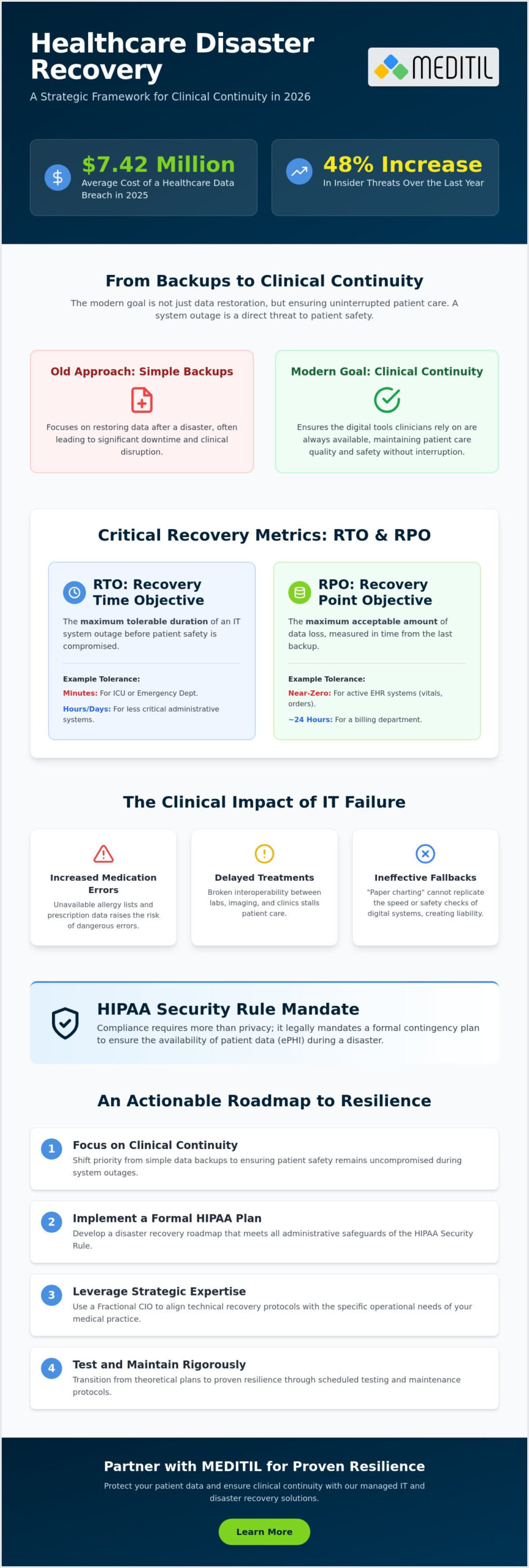
In 2025, the average cost of a healthcare data breach reached $7.42 million, marking the 14th consecutive year this sector has faced the highest financial recovery burden of any industry. You likely recognize that in a high-stakes clinical environment, effective healthcare disaster recovery planning is far more than a technical checklist; it’s a fundamental safety protocol. A system outage represents a direct threat to patient care and institutional trust. The pressure to maintain constant availability while navigating the complexity of evolving HIPAA regulations can feel overwhelming, especially with insider threats increasing by 48% over the last year.
This guide provides a strategic framework designed for the specific challenges of 2026. You’ll discover how to build a resilient IT infrastructure that protects sensitive patient data and ensures clinical continuity during unforeseen disruptions. We will outline a clear, actionable roadmap for IT resilience, covering the latest NYDFS filing requirements and proactive strategies to minimize clinical friction during an outage. This article provides the specialized insights needed to guarantee data integrity and maintain a steady hand during any crisis.
Key Takeaways
- Shift your focus from simple data backups to clinical continuity to ensure patient safety remains uncompromised during system outages.
- Navigate the complexities of the HIPAA Security Rule by implementing a formal roadmap for healthcare disaster recovery planning that meets all administrative safeguards.
- Utilize the strategic expertise of a Fractional CIO to align technical recovery protocols with the specific operational needs of your medical practice.
- Transition from theoretical plans to proven resilience through rigorous, scheduled testing and maintenance protocols.
- Explore how managed IT partnerships provide the infrastructure and monitoring necessary to protect data integrity and minimize clinical friction.
Beyond Backups: Why Healthcare Disaster Recovery Planning is a Patient Safety Priority
Disaster recovery is often confused with business continuity, but the distinction is vital for medical leadership. Business continuity is the broad strategy for keeping an entire organization operational during a crisis. In contrast, healthcare disaster recovery planning focuses specifically on the technical restoration of the IT infrastructure that supports care. The industry has moved past the era where simply having a tape backup was sufficient. The primary goal in 2026 is “clinical uptime,” ensuring that the digital tools clinicians rely on are available without interruption. When systems fail, the impact isn’t just financial; it’s a direct threat to the quality and safety of patient care.
The threat landscape has grown more volatile. Ransomware remains the dominant breach pattern, but we’ve also seen a rise in significant cloud provider outages and localized infrastructure failures. These disruptions break the flow of real-time data that modern medicine requires. Understanding foundational IT disaster recovery principles allows administrators to move beyond technical jargon and focus on resilience. Effective planning ensures that when a server fails or a network is compromised, the path back to a functional clinical state is already mapped and tested.
Defining RTO and RPO for Clinical Environments
Recovery Time Objective (RTO) and Recovery Point Objective (RPO) are the two most critical metrics in healthcare disaster recovery planning. RTO defines the maximum tolerable duration of clinical downtime before patient safety is compromised. For high-acuity areas like the ICU or Emergency Department, this may be measured in minutes. RPO represents the limit of acceptable data loss, essentially marking how far back you can afford to go when restoring from a backup. While a billing department might tolerate an RPO of 24 hours, an active EHR system requires an RPO as close to zero as possible to prevent the loss of recent vitals, orders, or progress notes.
The Clinical Impact of IT Failure
An EHR outage is a clinical crisis. Without immediate access to patient records, the risk of medication errors increases because allergy lists and current prescriptions are unavailable. Treatments are frequently delayed when interoperability between labs, imaging centers, and clinics breaks down. While many organizations still view “paper charting” as a reliable fallback, it’s rarely a viable long-term solution in a modern facility. Manual processes cannot replicate the speed or safety checks of digital systems, making prolonged outages a significant liability. True resilience requires an infrastructure that prevents the need for paper charting altogether.
The Regulatory Framework: HIPAA Compliance and the Security Rule
Compliance with the HIPAA Security Rule is often viewed through the lens of privacy and encryption, yet its core mandate includes the availability of electronic protected health information (ePHI). Under the Administrative Safeguards section of the rule, healthcare organizations must implement a formal contingency plan. This isn’t merely a recommendation; it’s a legal requirement designed to ensure that patient data remains accessible even when primary systems fail. A compliant roadmap for healthcare disaster recovery planning starts with a comprehensive risk analysis. This process identifies potential vulnerabilities within your specific infrastructure, from EHR server dependencies to the interoperability of lab result interfaces.
The Department of Health and Human Services (HHS) emphasizes that a “one-size-fits-all” template is insufficient for a modern clinical environment. Your plan must reflect the unique operational realities of your facility. For instance, the way a multi-site clinic manages data restoration differs significantly from a single-specialty surgical center. Leveraging the NIST Contingency Planning Guide provides a structured methodology for aligning your technical safeguards with these federal expectations. This alignment ensures that your organization remains resilient against the top breach patterns identified in 2026, such as system intrusions and ransomware.
HIPAA-Mandated Contingency Plan Components
A robust contingency strategy must include several distinct sub-plans to meet regulatory standards. First, the Data Backup Plan requires that you maintain exact, retrievable copies of ePHI. This data must be stored securely and separately from your primary network. Second, the Disaster Recovery Plan outlines the specific procedures for restoring any lost data. Finally, the Emergency Mode Operation Plan ensures that your most critical clinical processes continue while you work in a diminished technical state. These components work together to protect patient safety and maintain institutional integrity during a crisis.
Auditing and Documentation for Compliance
In the event of an Office for Civil Rights (OCR) audit, a theoretical plan has little value without proof of execution. Documentation is the cornerstone of compliance. You must maintain detailed logs of your testing intervals, staff training sessions, and any revisions made to the plan based on identified gaps. Protecting the integrity of these backups is equally vital. Implementing sophisticated healthcare cybersecurity services ensures that your secondary data remains untainted by the same malware or ransomware that might have compromised your primary systems. If you’re concerned about your current state of readiness, a professional compliance assessment can identify hidden gaps before they become liabilities during an audit or a real-world outage.
Strategic Leadership: The Role of a Fractional CIO in DR Planning
Internal IT departments are frequently consumed by the immediate, high-pressure demands of help desk support and EMR troubleshooting. While these teams are exceptionally skilled at maintaining daily operations, they often lack the strategic bandwidth to manage the high-level complexities of healthcare disaster recovery planning. This strategic gap can lead to plans that are technically sound but operationally disconnected from clinical workflows. A Fractional CIO serves as the essential bridge between clinical necessity and IT execution. They ensure that recovery protocols don’t just exist on paper but actually support the specific pace and pressure of patient care.
Strategic leadership is particularly critical during an active system failure or a ransomware event. In these high-stakes moments, having a “steady hand at the wheel” prevents panic and ensures that the recovery roadmap is followed with absolute precision. By integrating principles from the NIST Contingency Planning Guide, a Fractional CIO provides a disciplined framework that moves beyond technical guesswork. This professional guidance ensures that every technical action taken during a crisis is aligned with the long-term stability and reputation of the practice. It transforms IT from a cost center into a resilient asset that protects the organization’s mission.
Aligning IT Budgets with Clinical Resilience
Effective disaster recovery isn’t achieved through emergency spending after a breach occurs. It requires intentional it budgeting for medical practices that prioritizes high-availability systems over traditional, slower backup methods. A vCIO analyzes the financial impact of downtime versus the cost of proactive infrastructure investment. This shift allows medical leadership to evaluate the return on investment (ROI) based on risk mitigation and clinical continuity rather than just hardware costs. By planning for these expenses in advance, a practice can avoid the budget shocks associated with emergency technical repairs or regulatory fines.
Creating a Strategic IT Roadmap for 2026
Resilience is a journey that requires a long-term vision. Through virtual cio services, organizations can develop a multi-year roadmap for infrastructure modernization. This plan ensures that as a practice expands, adds new locations, or adopts new telehealth capabilities, the disaster recovery framework scales accordingly. A strategic roadmap prevents the accumulation of technical debt and ensures that the organization remains compliant with evolving standards without requiring sudden, disruptive overhauls. It provides a clear path forward, giving stakeholders confidence that the practice is prepared for both current and future challenges.
Moving from Theory to Resilience: Testing and Maintenance Protocols
A written plan is merely a theory until it’s validated through rigorous execution. In the high-stakes environment of a medical facility, assuming a protocol will work during a ransomware attack is a risk no provider should take. Comprehensive healthcare disaster recovery planning requires a commitment to ongoing verification. Without regular testing, hidden gaps in network configurations or outdated vendor contact lists can turn a manageable outage into a clinical catastrophe. Resilience isn’t a state you reach; it’s a discipline you maintain.
Modern medical practices must move away from the traditional annual testing mindset. As technology stacks evolve and new interoperability layers are added, the potential for failure points increases. We recommend a tiered testing schedule where critical systems undergo technical failover tests quarterly, while broader tabletop exercises occur biannually. This cadence ensures that both the technical infrastructure and the human response remain sharp. With 95% of all cybersecurity data breaches resulting from human error, according to 2026 industry data, training through testing is your most effective defense against the chaos of an actual outage.
Resilience isn’t just an IT metric; it’s a staff competency. Involving clinical leadership in testing ensures that the emergency mode operation plans discussed in previous sections actually work on the floor. When clinicians participate in drills, they identify workflow friction that IT teams might overlook, such as how to handle STAT lab orders when the primary interface is down. If your current plan hasn’t been tested in the last six months, it’s time to schedule a professional resilience audit to ensure your practice remains protected.
Types of Disaster Recovery Testing
- Tabletop Exercises: These are discussion-based sessions where key stakeholders walk through a specific scenario, such as a localized power failure or a cloud outage. It’s a low-risk way to identify gaps in communication and decision-making.
- Simulated Failover: This involves the technical activation of backup systems in a controlled environment. It verifies that the RTO and RPO targets established during the strategic planning phase are actually achievable.
- Full-Scale Drills: These are comprehensive evaluations of the organization’s ability to operate in emergency mode. They test everything from data restoration to the manual processes staff must use during a prolonged outage.
Continuous Improvement and Documentation
Every test must conclude with a formal “lessons learned” session. Capturing these insights allows for the immediate refinement of your healthcare disaster recovery planning manual. You must update contact lists, vendor agreements, and system configurations to reflect the current state of your infrastructure. It’s also vital to maintain a version-controlled, physical copy of the recovery manual. This ensures that even during a total network failure, your team has a clear, accessible set of instructions to follow. Steady leadership depends on having reliable information when digital systems are unavailable.
Partnering for Resilience: MEDITIL’s Managed IT and DR Solutions
MEDITIL provides the specialized expertise required to transform healthcare disaster recovery planning from a compliance burden into a strategic asset. By serving as a comprehensive partner for managed it services for healthcare, we allow medical leaders to focus on patient outcomes while we manage the complex technical layers of their infrastructure. Our augmented IT teams provide the constant monitoring necessary to detect and neutralize threats before they impact clinical operations. This proactive approach ensures that your facility remains operational even when the broader industry faces disruption.
A truly resilient practice also considers the financial aspects of recovery. We integrate medical billing automation solutions directly into your disaster recovery roadmap. This integration ensures that even if a primary system is compromised, your revenue cycle remains protected and retrievable. Professional, specialized management offers the peace of mind that generic IT providers simply cannot replicate in a high-stakes medical environment. You deserve a partner that understands the nuances of clinical workflows and regulatory pressure.
Managed Infrastructure and Network Services
Reliability starts at the foundation. We implement N+1 redundancy across critical systems to ensure that there’s always a standby component ready to take over if a primary unit fails. This stable network management prevents many outages before they ever reach the clinical floor. For insights into maintaining high-availability systems in other critical sectors like logistics, check out Jealco International, Inc.. Our proactive monitoring tools identify early indicators of ransomware or hardware degradation, allowing for intervention before data integrity is threatened. By customizing cloud services for your specific EHR needs, we guarantee that patient data remains available across all locations, regardless of local hardware status.
Expert Consulting and Fractional Leadership
Regulatory standards in 2026 are more stringent than ever. Navigating this landscape requires more than just technical skill; it requires strategic foresight. Our advisory services help you interpret and implement the latest standards without disrupting daily workflows. Whether you need project-based support for EMR/EHR implementation or long-term fractional leadership, we provide the steady hand at the wheel. Our approach to healthcare disaster recovery planning ensures that your technology remains a reliable, high-performing asset that grows with your practice while maintaining total compliance.
Securing Your Clinical Future
Securing patient data and maintaining operational continuity in 2026 requires a fundamental shift in perspective. Effective healthcare disaster recovery planning is no longer a peripheral IT task; it’s a core patient safety protocol that demands strategic oversight. By prioritizing clinical uptime and implementing a rigorous testing cadence, your organization can transform a theoretical document into a resilient infrastructure. This proactive approach ensures that your facility remains a steady, reliable presence for your patients, even during the most complex technical disruptions.
Professional management provides the disciplined foundation necessary for long-term stability. MEDITIL delivers managed IT services tailored specifically for the medical sector, complemented by expert Fractional CIO leadership to guide your strategic roadmap. Our approach includes proactive cybersecurity and constant HIPAA compliance monitoring to protect your practice from evolving threats. Schedule a strategic consultation with MEDITIL to secure your clinical continuity. You can move forward with confidence, knowing that your infrastructure is managed with the precision and expertise your mission deserves.
Frequently Asked Questions
What is the difference between a backup and a disaster recovery plan in healthcare?
A backup is simply a copy of your data, whereas a disaster recovery plan is the comprehensive strategy for restoring that data and resuming clinical operations. While a backup might exist on a secure drive, the plan details exactly how to use that drive to rebuild your system. In a medical environment, having data isn’t enough; you must have a tested roadmap to ensure your clinicians can resume patient care immediately.
Is disaster recovery planning a mandatory requirement under HIPAA?
Yes, healthcare disaster recovery planning is a mandatory requirement under the HIPAA Security Rule. The Administrative Safeguards specifically mandate that covered entities establish a formal contingency plan. This plan must include a data backup strategy, a disaster recovery protocol, and an emergency mode operation plan. Failing to maintain and document these elements can lead to substantial fines and liability issues during an Office for Civil Rights audit.
How often should a medical practice test its disaster recovery plan?
We recommend that medical practices conduct tabletop exercises at least twice a year and perform technical failover tests quarterly. This regular cadence ensures that your staff stays sharp and your technical infrastructure remains capable of meeting its recovery targets. If you add new clinical applications or locations, you should conduct additional tests to verify that the expanded network remains fully protected under your existing recovery strategy.
What are RTO and RPO, and why do they matter for clinical operations?
Recovery Time Objective (RTO) refers to the maximum amount of time your systems can be down before patient safety is at risk. Recovery Point Objective (RPO) is the maximum amount of data loss, measured in time, that your practice can tolerate. These metrics are vital because they define your technical requirements. For example, a critical EMR system typically requires a much lower RTO than a non-essential administrative application.
Can a small medical practice afford a comprehensive disaster recovery strategy?
Small practices can certainly afford robust disaster recovery by leveraging scalable cloud services and managed IT partnerships. These solutions eliminate the need for expensive, on-site secondary servers. By focusing on the most critical clinical data first, a small organization can implement a highly effective strategy that meets all regulatory requirements. It’s about investing in the right resilience level rather than purchasing unnecessary, high-end hardware that doesn’t fit your needs.
How does a Fractional CIO help with disaster recovery planning?
A Fractional CIO provides the strategic leadership necessary to ensure your recovery plan aligns with your clinical and financial goals. They act as a proactive guide, helping you prioritize IT investments and navigate complex compliance standards. During an actual outage, they provide a steady hand at the wheel, managing the technical response so your clinical team can focus entirely on patient care. This specialized expertise ensures your roadmap is both practical and effective.
What role does cloud storage play in modern healthcare disaster recovery?
Cloud storage provides the essential off-site redundancy required for modern healthcare disaster recovery planning. It allows your practice to store encrypted copies of ePHI in geographically separate locations, protecting data from local physical disasters. Because cloud environments are highly scalable, they can facilitate rapid system restoration. This ensures that your critical patient records remain available through a secure internet connection even if your primary local server is completely inaccessible or destroyed.
In addition to data redundancy, maintaining the physical integrity of your facility is a critical component of any continuity plan. For healthcare locations managing their own utility systems, Texas Septic Solutions provides the expert infrastructure services needed to prevent environmental disruptions and ensure site safety.
How do I protect my healthcare backups from ransomware attacks?
To protect backups from ransomware, you must implement immutable storage solutions where data cannot be changed or deleted after it’s written. We also recommend maintaining air-gapped copies that are physically or logically disconnected from your primary network. Using multi-factor authentication for all backup access adds another layer of security. These safeguards ensure that even if your main network is compromised, you have a clean, uncorrupted version of your data ready for restoration.