
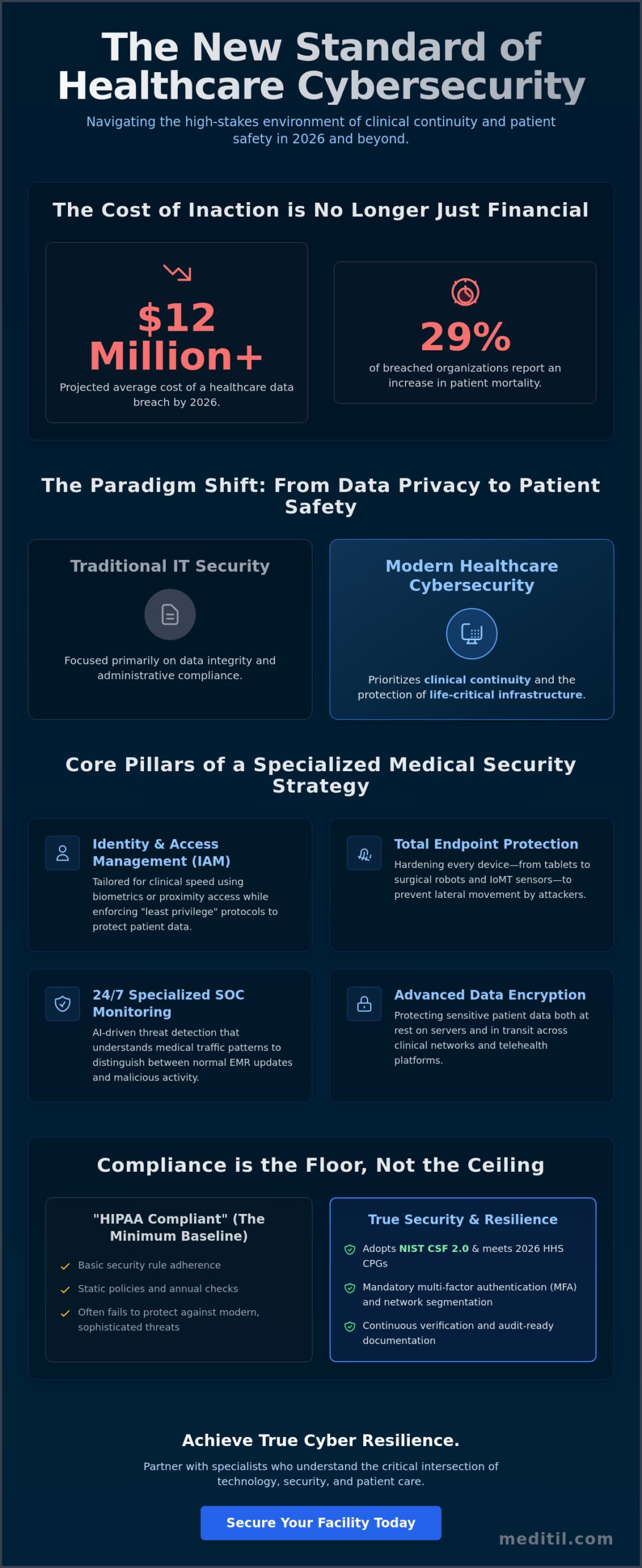
With the average cost of a healthcare data breach projected to surpass $12 million by the end of 2026, the stakes for your organization have never been higher. You likely recognize that protecting patient data isn’t just about avoiding massive HIPAA fines or preventing ransomware from locking your systems. Utilizing healthcare cybersecurity services is now a fundamental requirement for ensuring that life-critical medical infrastructure remains operational when patients need it most. Balancing the complexity of securing connected medical devices with the need for seamless clinical workflows is a constant, high-pressure challenge.
This guide outlines how these specialized services provide the technical precision and strategic oversight needed to navigate this high-stakes environment. You’ll learn how to implement a zero-trust model that protects against sophisticated AI-driven threats without slowing down your providers. We’ll also provide a roadmap for achieving long-term digital stability through proactive governance and robust infrastructure protection, ensuring your facility remains a safe and compliant environment for those in your care.
Key Takeaways
- Understand why modern security has evolved from simple data privacy to a mission-critical focus on operational uptime and patient safety.
- Explore how specialized healthcare cybersecurity services implement identity management and endpoint protection that accommodate high-speed clinical workflows and complex medical devices.
- Learn strategies to eliminate the trade-off between security and speed, ensuring robust protection doesn’t impede the delivery of urgent patient care.
- Gain a structured framework for conducting HIPAA-aligned risk assessments and prioritizing vulnerabilities based on their potential clinical impact.
- Discover how a fractional CIO provides the executive-level strategy needed to bridge the gap between technical security protocols and long-term organizational stability.
What are Healthcare Cybersecurity Services in 2026?
In 2026, healthcare cybersecurity services are defined as specialized, defense-in-depth strategies engineered specifically for the medical environment. This discipline has evolved beyond simple data encryption; it now focuses on clinical continuity and the protection of life-critical infrastructure. While general IT security often focuses on data integrity alone, specialized medical defense prioritizes the availability of systems that clinicians rely on to keep patients alive. These services provide the technical confidence needed to manage complex systems without compromising the speed of care.
The paradigm shifted significantly following high-profile attacks that disrupted entire health systems. Security is no longer just an administrative checkbox; it’s a clinical safety requirement. Data from industry surveys indicates that 29% of healthcare organizations experiencing a breach reported an increase in patient mortality. This reality makes a proactive, specialized approach mandatory for any modern health system. General IT providers often lack the clinical context to understand how a security protocol might disrupt a surgical workflow. Specialized healthcare cybersecurity services bridge this gap by ensuring that security measures are invisible to the clinician yet impenetrable to the attacker.
The Expanding Medical Attack Surface
The vulnerability of a healthcare facility now extends far beyond the server room. The proliferation of the Internet of Medical Things (IoMT) includes everything from bedside infusion pumps to wearable cardiac sensors. These devices often run on proprietary code or outdated operating systems that can’t be patched using standard methods. Protecting these assets requires a deep understanding of Digital Health and Cybersecurity protocols. Securing telehealth platforms and remote patient monitoring (RPM) data streams adds another layer of complexity. Each connection point is a potential entry for AI-driven threats that can disrupt care in seconds. A strategic partner identifies these hidden risks and implements segmentation to isolate vulnerable legacy equipment.
Regulatory Compliance vs. True Security
Being “HIPAA compliant” doesn’t mean your organization is secure. While the HHS has proposed significant updates to the HIPAA Security Rule for 2026, these regulations represent a minimum baseline rather than a complete defense. True resilience involves meeting the 2026 HHS Cybersecurity Performance Goals (CPGs) and adopting the NIST CSF 2.0 framework. This includes mandatory multi-factor authentication (MFA) and stricter network segmentation. Continuous verification and audit-ready documentation are essential. They prove that your security posture is active, not just a static policy on a shelf. The 2026 CPGs introduce more rigorous requirements for incident response and testing schedules. These aren’t suggestions; they’re the new standard for operational stability. Selecting HIPAA compliant IT services that treat compliance as a continuous operational state rather than a periodic checklist is essential for avoiding the Tier 4 penalties that now accompany these updated mandates.
Core Pillars of a Specialized Medical Security Strategy
A robust strategy for healthcare cybersecurity services begins with Identity and Access Management (IAM) tailored for the unique pressures of the clinical floor. In a high-speed medical environment, traditional security hurdles can delay life-saving interventions. Specialized strategies utilize biometric verification or proximity-based access to ensure clinicians reach patient data instantly while maintaining strict “least privilege” protocols. This protection extends to every endpoint. Whether it’s a mobile tablet used for rounding or a sophisticated surgical robot, each device must be hardened against intrusion to prevent it from becoming an entry point for lateral movement.
Continuous 24/7 monitoring through a specialized Security Operations Center (SOC) is no longer optional. Cyber threats in 2026 are often AI-driven and move at machine speed. A specialized SOC understands medical traffic patterns and can distinguish between a routine EMR update and a malicious data exfiltration attempt. This is supported by advanced encryption for data at rest and in transit across clinical hubs. Utilizing the NIST Cybersecurity Framework helps organizations build this resilience by following globally recognized standards for detection and response. While general providers struggle with medical nuances, specialized healthcare cybersecurity services focus on the intersection of technical defense and clinical uptime.
Network Security and Infrastructure Resilience
Implementing zero-trust architecture ensures that no device or user is trusted by default, regardless of their location on the network. Infrastructure resilience requires N+1 redundancy, meaning every critical clinical application has at least one independent backup ready to take over immediately. Healthcare network segmentation for medical devices isolates critical clinical equipment from the broader business network to prevent lateral movement during a security breach. For organizations seeking to fortify their foundations, exploring professional infrastructure and network services is a logical next step.
EMR and EHR Integration Security
Securing the data flow between EMR systems, interoperability solutions, and billing software is a complex task. These integration points are often the most vulnerable. Managing third-party risk is vital, as 58% of individuals affected by breaches in 2023 were compromised through a third-party provider. Protecting the integrity of medical records ensures that unauthorized alterations don’t lead to incorrect dosages or diagnostic errors. Maintaining this integrity requires continuous verification of every data stream entering your clinical database. Organizations that also deploy medical billing automation solutions can further reduce the exposure created by manual data entry errors at these critical integration points.
Overcoming Clinical Friction: Balancing Security and Patient Care
The belief that robust protection must inherently slow down medical staff is a persistent myth. In reality, clinical friction often arises from poorly designed protocols rather than the security measures themselves. Specialized healthcare cybersecurity services focus on removing these barriers by aligning technical defenses with the natural rhythm of patient care. When security is integrated correctly, it becomes a silent partner in the clinical process. It protects the provider’s focus by ensuring that systems are both accessible and resilient.
Designing authentication methods that work in a fast-paced clinic is essential for provider satisfaction. Tools such as RFID badge tap-in systems or biometric scanners allow clinicians to move between workstations without re-entering complex passwords dozens of times per shift. These solutions maintain high security while respecting the physician’s time and workflow. Technical debt also plays a significant role in friction. Outdated, legacy systems are not only harder to secure but are also slower and more prone to crashes. This combination frustrates providers and creates vulnerabilities that attackers exploit. Modernizing these systems through specialized healthcare cybersecurity services creates a dual benefit: a stronger security posture and a more efficient clinical environment.
Workflow-Aware Security Implementation
Effective security must be role-specific to avoid unnecessary hurdles. A surgeon in the operating room requires a different access profile than a billing clerk in the administrative office. By customizing protocols based on these specific needs, you ensure that staff members have immediate access to the data they require for their specific tasks. “Break-glass” protocols are also a critical component of this strategy. These allow for emergency access to patient records during a crisis while maintaining a strict audit trail for later verification. Integrating this training into standard clinical onboarding ensures that security becomes a foundational part of the organizational culture rather than an afterthought.
Reducing Technical Debt for Better Outcomes
Eliminating technical debt is a strategic priority for achieving long-term digital stability. Modernizing your underlying infrastructure simultaneously improves system speed and closes security gaps that exist in older hardware. This transition is often supported by managed it services for healthcare, which provides the stable foundation required for advanced security layers. Additionally, implementing medical billing automation solutions reduces the risks associated with manual data entry and ensures that administrative tasks don’t distract from patient care. A streamlined, automated environment is naturally more secure because it reduces the opportunities for human error and ensures that data flows through verified, protected channels.
A Step-by-Step Framework for Medical Cyber Resilience
Building a resilient organization requires a shift from reactive patching to a disciplined, cyclical framework. This process begins with a comprehensive, HIPAA-aligned risk assessment that looks beyond technical vulnerabilities to examine clinical workflows and data handling practices. Given that 92% of healthcare organizations experienced a cyberattack in the last 12 months, your defensive strategy must be active rather than passive. Utilizing specialized healthcare cybersecurity services ensures that this assessment is conducted with an understanding of how medical data moves through your specific infrastructure.
Once vulnerabilities are identified, they must be prioritized based on their potential clinical impact and data sensitivity. This isn’t just about technical severity; it’s about patient safety. Protecting a surgical navigation system or an EMR database takes precedence over administrative workstations. To maintain this defense, deploying managed detection and response (MDR) is essential. MDR systems tailored for healthcare traffic can identify anomalies in real-time, such as unauthorized access to patient records or unusual data transfers from bedside monitors. This level of oversight provides the steady hand at the wheel needed to manage 2026-era threats. For a detailed evaluation of your current posture, you can partner with our experts for Cybersecurity & Compliance services.
Risk Assessment and Prioritization
Effective resilience starts by identifying your “crown jewel” assets. These typically include your EMR system, patient databases, and diagnostic imaging archives. Mapping data flows helps identify hidden vulnerabilities in interoperability, particularly where your network connects to third-party vendors or billing platforms. Using business intelligence to quantify these risks in financial and clinical terms allows leadership to make informed decisions about resource allocation. This structured approach ensures that every dollar spent on healthcare cybersecurity services directly contributes to organizational stability.
Incident Response and Business Continuity
A clinical-first incident response plan focuses on maintaining patient care when systems fail. This includes developing “downtime procedures” that allow staff to continue treating patients using manual or offline processes during an attack. While data backup ensures information isn’t lost, business continuity ensures that clinicians can still treat patients safely even when the primary network is unavailable. Regularly testing these protocols for your EMR systems is vital to ensure that recovery times align with clinical needs. A well-designed healthcare network segmentation strategy is a foundational element of these continuity plans, as it limits the blast radius of any breach and keeps critical clinical systems operational. Finally, ongoing staff education must address modern threats like AI-driven phishing, ensuring that every employee understands their role in the facility’s defense.
Strategic Partnership: The Role of a Fractional CIO in Security
A common mistake in medical administration is treating security as a one-time installation. This “set it and forget it” mentality fails because the 2026 threat landscape is dynamic. Effective healthcare cybersecurity services require continuous leadership that bridges the gap between technical protocols and executive-level strategy. Without a strategic guide, technical teams may focus on isolated fixes while the organization’s broader clinical and financial goals remain vulnerable. A Fractional CIO acts as that bridge, ensuring that every security investment aligns with the facility’s long-term stability and patient care mission.
Budgeting for security often feels like a defensive necessity rather than a strategic advantage. However, a seasoned expert can transform these costs into investments that improve clinical outcomes. By aligning cybersecurity budgets with operational goals, you ensure that high-priority areas like surgical suites and emergency departments receive the most robust protection. This approach also includes utilizing an augmented IT team to provide 24/7 support. This ensures that a specialized professional is always available to handle complex infrastructure issues, allowing your internal staff to focus on immediate clinical needs. This level of partnership suggests every detail is being handled with precision, providing a steady hand at the wheel for your digital infrastructure.
vCIO Leadership for Cybersecurity Roadmap
Many organizations find that virtual cio services offer the high-level expertise required for complex environments without the expense of a full-time executive salary. A vCIO manages the entire lifecycle of your medical technology, preventing the security obsolescence that often plagues legacy systems. They provide strategic advisory for expanding telehealth platforms and securing remote monitoring streams, ensuring that new care models don’t introduce unmanaged risks. This proactive leadership is essential for navigating the regulatory and technical hurdles of 2026. It allows you to plan for growth while maintaining a disciplined security posture.
Choosing the Right Healthcare IT Partner
Selecting a partner requires evaluating their specific experience within the medical industry. A general IT provider may not understand the nuances of EMR integration or the critical nature of clinical uptime. You need a partner capable of managing your entire IT department or augmenting your existing team to fill critical skill gaps. When evaluating vendors, reviewing a comprehensive HIPAA compliant IT services buying guide can help you identify the mandatory technical standards and strategic criteria that distinguish a truly qualified healthcare IT partner. For organizations with an internal staff, providing them with network security best practices is a vital step in maintaining a unified defense. The right partnership ensures that your healthcare cybersecurity services are backed by deep expertise and a commitment to long-term digital stability.
Advancing Toward Clinical Resilience in 2026
Securing a medical environment in 2026 requires more than just meeting basic compliance standards. It’s about ensuring that life-critical infrastructure remains available during every patient encounter. By prioritizing specialized healthcare cybersecurity services, you protect your organization from sophisticated AI-driven threats while reducing the clinical friction that often hinders providers. This dual focus ensures that your security posture supports, rather than disrupts, the delivery of care.
Achieving this level of digital stability requires a partner who understands the intersection of technology and medicine. MEDITIL brings a specialized healthcare IT focus and comprehensive managed infrastructure expertise to your organization. Our Fractional CIO strategic leadership ensures your technology roadmap is both proactive and aligned with your clinical objectives. Secure your clinical future with MEDITIL Cybersecurity & Compliance services. Building a secure, compliant, and efficient practice is a manageable journey when you have a steady hand at the wheel.
Frequently Asked Questions
What is the difference between general cybersecurity and healthcare cybersecurity services?
General cybersecurity focuses on protecting enterprise data and maintaining business operations across various industries. In contrast, healthcare cybersecurity services prioritize clinical uptime and patient safety by securing life-critical infrastructure. These specialized services are designed to protect medical workflows, EMR systems, and connected medical devices that must remain operational to prevent disruptions in patient care.
How does healthcare cybersecurity impact patient safety?
Cybersecurity is a direct component of clinical safety because attacks can lead to delayed treatments, diagnostic errors, and increased mortality rates. When systems like surgical navigation or infusion pumps are compromised, the ability to deliver care stops. Ensuring robust security maintains the availability of these systems, which is a fundamental requirement for protecting patients in a modern medical facility.
Is HIPAA compliance enough to protect my clinic from ransomware?
HIPAA compliance is a legal baseline but it is not a comprehensive defense against ransomware. Many organizations meet regulatory standards yet remain vulnerable to sophisticated, AI-driven attacks. True protection requires a multi-layered strategy, including real-time monitoring and immutable backups, to ensure clinical continuity and data integrity during an active security incident.
How much do healthcare cybersecurity services typically cost?
The investment for healthcare cybersecurity services varies based on the size of the organization, the complexity of the medical infrastructure, and the level of strategic leadership required. While industry reports show that healthcare facilities are increasing their security budgets to combat rising threats, specific costs depend on whether you require fractional leadership, managed IT support, or project-based consulting.
What is the “Internet of Medical Things” (IoMT) and why is it a security risk?
The Internet of Medical Things (IoMT) includes all connected medical devices, such as bedside monitors, wearable sensors, and imaging equipment. These devices are high-risk because they frequently run on legacy operating systems that lack modern security controls. This makes them prime targets for attackers looking to gain lateral access to your clinical network and disrupt critical care delivery.
How can we implement strong security without slowing down our doctors?
Implementing workflow-aware security, such as biometric access or RFID badge integration, allows for rapid authentication without the need for cumbersome passwords. By customizing protocols to match specific clinical roles, you ensure that security measures are effectively invisible to the provider. This approach protects the clinician’s focus while maintaining strict control over sensitive patient data and system access.
What are the most common cyber threats facing medical practices in 2026?
The most prevalent threats include AI-driven phishing attacks, ransomware targeting medical device uptime, and breaches occurring through third-party vendor connections. Attackers are increasingly using automation to exploit vulnerabilities in legacy systems and interoperability data streams. Proactive risk management and continuous monitoring are essential for defending against these rapidly evolving digital threats to your infrastructure. To explore how modern defenses can counteract these risks, you can discover CyberOne for expert cybersecurity insights.
Does a small medical practice really need a Fractional CIO for security?
Small practices often face the same regulatory and technical challenges as large hospitals but with significantly fewer internal resources. A Fractional CIO provides the executive-level strategy and security roadmap needed to ensure long-term digital stability. This allows smaller organizations to access high-level expertise for infrastructure protection and compliance without the expense of a full-time executive salary.
28 Responses