
With the U.S. healthcare RCM market projected to reach $72.96 billion in 2026, many providers are realizing that software alone cannot solve their financial leakage. You likely understand that even the most advanced billing platform will fail if it sits on a fractured technical foundation. High claim denial rates and the persistent lack of interoperability between EHRs and billing systems continue to place an unsustainable administrative burden on your clinical staff. Implementing effective healthcare revenue cycle management it solutions requires more than a digital tool; it demands a stable, integrated infrastructure that bridges the gap between clinical data and financial outcomes.
It’s frustrating to see reimbursement cycles slow down because of technical silos or the looming pressure of mandatory HIPAA security updates arriving in May 2026. You deserve a financial ecosystem that’s as reliable as the care you provide. This guide will show you how to optimize your financial performance by aligning your RCM software with a robust IT infrastructure and strategic management. We’ll explore how to navigate the shift toward two-sided financial risk models and leverage automation to secure a faster, more compliant path to reimbursement.
Key Takeaways
- Learn how to view healthcare revenue cycle management it solutions as a complete ecosystem of infrastructure and networking rather than just a collection of software tools.
- Identify the critical roles of connectivity, security, and interoperability in preventing revenue leaks and ensuring long-term financial stability.
- Understand the strategic shift toward managed IT services to overcome the common ROI failures associated with “set it and forget it” software implementations.
- Gain a clear implementation roadmap focused on auditing your current infrastructure and mapping the patient journey to reduce administrative burdens.
- Discover the value of integrating fractional CIO services to align your technical architecture with specific revenue outcomes and regulatory compliance.
What are Healthcare Revenue Cycle Management IT Solutions?
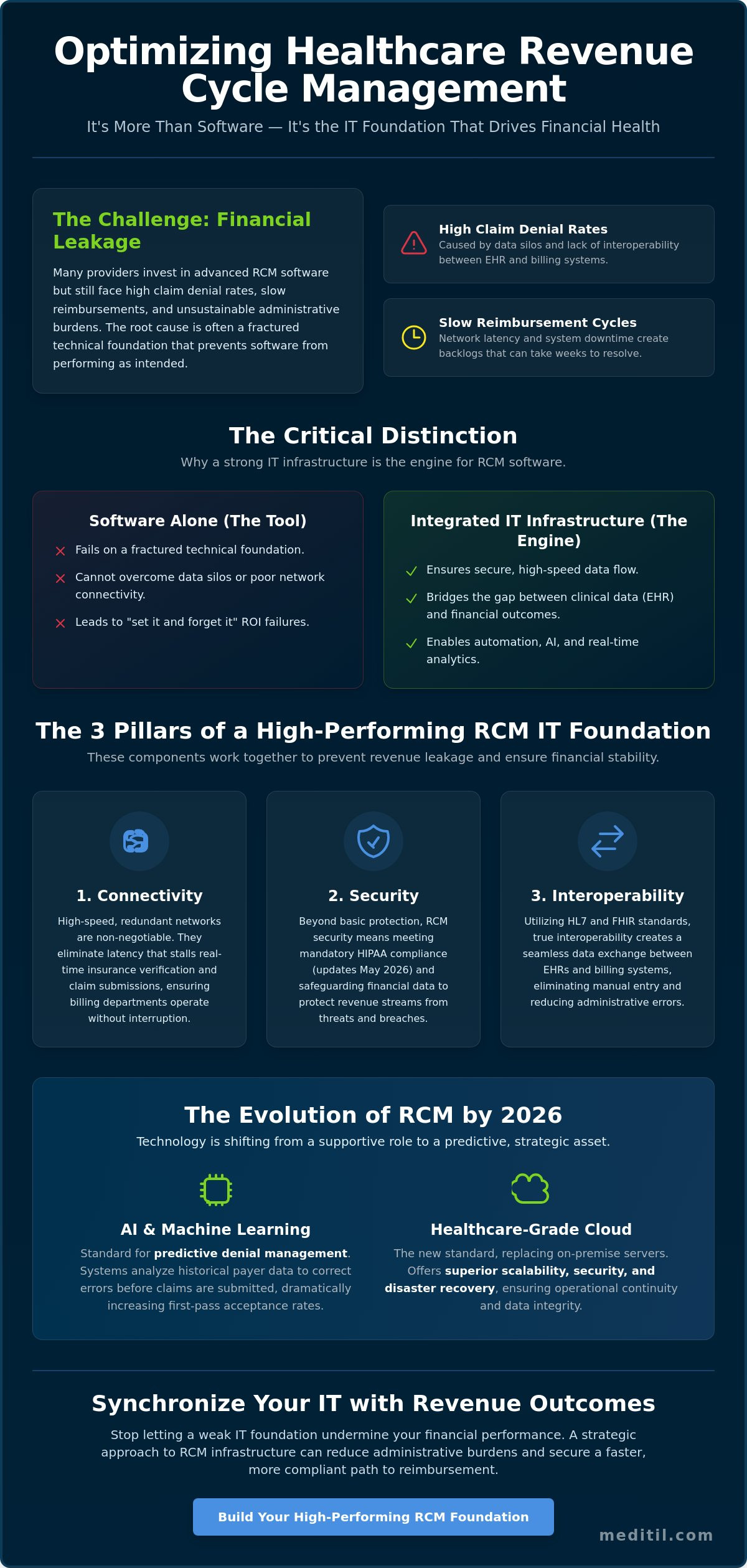
Healthcare revenue cycle management it solutions represent the comprehensive technical architecture designed to capture, track, and secure patient revenue from the initial point of contact to the final reconciliation. While many administrative leaders view this solely as a software purchase, it is actually a complex ecosystem of hardware, software, and networking protocols. In 2026, Revenue cycle management (RCM) has evolved into an automated, AI-enhanced workflow that eliminates the friction inherent in legacy billing processes.
The distinction between simple billing software and a true RCM IT infrastructure is critical. Software is a tool, but infrastructure is the engine that allows that tool to function. Without a secure, high-speed network and properly integrated databases, even the most expensive billing platform becomes a liability. In an economy defined by high inflation and tightening margins, these solutions have become life-critical for practice sustainability. Every delayed claim or unverified insurance instance represents a direct threat to the financial stability of the organization.
The Evolution of RCM Technology in 2026
By 2026, AI and machine learning have transitioned from experimental features to standard requirements for predictive denial management. These systems analyze historical data to identify patterns in payer behavior, allowing providers to correct errors before a claim is even submitted. Most organizations have moved away from local, on-premise servers in favor of secure, healthcare-grade cloud environments that offer superior scalability and disaster recovery. RCM IT solutions are the strategic integration of clinical data and financial operations.
Why General IT Support Isn’t Enough for RCM
General IT providers often lack the specialized knowledge required to maintain a high-performing financial ecosystem. Real-time insurance verification requires specific latency and uptime parameters that generalists don’t always prioritize. If your network experiences even brief instability, it can disrupt the automated links between your EHR and billing platform. Healthcare revenue cycle management it solutions require a level of precision that standard managed services rarely provide.
Generalists also struggle with the nuances of medical coding automation. They don’t understand how a minor configuration error in the background can lead to systemic claim rejections. The cost of technical downtime isn’t just an IT headache; it’s a direct loss of unbilled revenue. When your systems are offline, your ability to capture patient data and process payments stops entirely, creating a backlog that can take weeks to resolve.
Core Components of a High-Performing RCM IT Foundation
A high-performing financial ecosystem relies on three foundational pillars: connectivity, security, and interoperability. While billing software handles the calculations, these pillars ensure that data moves accurately and safely across the organization. To align with industry best practices for RCM, your technical architecture must prioritize these elements to prevent revenue leakage before it starts. Organizations that neglect the underlying network often face persistent latency that stalls real-time verification and claim submission. Effective healthcare revenue cycle management it solutions integrate these components into a single, cohesive strategy.
For multi-site practices, high-speed, redundant network paths are a necessity, not a luxury. If a primary connection fails at one location, the billing department shouldn’t experience a total work stoppage. This level of uptime is essential for running Business Intelligence (BI) tools that identify revenue leaks in real time. BI platforms allow administrators to see exactly where claims are stalling, whether it’s at the front-desk registration or within the clearinghouse transmission. To maintain this pace, your billing staff requires dedicated end-user support to resolve technical hurdles immediately, ensuring productivity never dips during peak filing periods.
Interoperability: Bridging the Gap Between EHR and Billing
Modern interoperability relies on HL7 and FHIR standards to facilitate seamless data exchange between disparate systems. When these standards are properly implemented, patient data flows from the clinical record to the billing module without manual intervention. Utilizing advanced healthcare interoperability solutions prevents double-entry errors that frequently lead to claim rejections. Data silos are a primary driver of physician burnout and administrative waste; breaking them down ensures that the “clean claim” rate remains high while reducing the time clinicians spend on paperwork.
Cybersecurity and HIPAA Compliance in the Revenue Cycle
Protecting the revenue cycle requires a dual focus on clinical data protected by HIPAA and financial data governed by PCI-DSS. By May 2026, the updated HIPAA Security Rule makes previously “addressable” safeguards mandatory, requiring multi-factor authentication and encryption across all organization sizes. These regulations are a response to the rise of ransomware targeting billing clearinghouses, which can freeze a practice’s cash flow for months. Proactive monitoring and zero-trust architectures are significantly more cost-effective than the fallout of a single data breach audit. Maintaining a secure environment is a core requirement for any reliable managed IT service provider focused on the healthcare sector.
By treating these technical components as a unified foundation, you move away from reactive troubleshooting and toward a stable, predictable financial operation. Healthcare revenue cycle management it solutions are only as strong as the infrastructure supporting them.
Software vs. Managed Services: Resolving the RCM Bottleneck
Choosing the right billing platform is only half the battle. Research indicates that approximately 70% of RCM software implementations fail to meet their projected ROI targets. This failure rarely stems from the software’s inherent features. Instead, it occurs because organizations treat these platforms with a “set it and forget it” mentality. Without a managed IT layer to oversee the underlying infrastructure, the software remains a static tool in a rapidly changing regulatory environment. Effective healthcare revenue cycle management it solutions require ongoing calibration to ensure the technical environment evolves alongside payer requirements and federal mandates.
The hidden costs of “free” software updates often catch administrators off guard. A routine patch from a vendor can easily break custom integrations between your EHR and your billing clearinghouse, leading to days of unbilled revenue. A managed partner provides the oversight necessary to test these updates in a sandbox environment before they disrupt your live operations. When leaders ask why they need a managed partner if they already have software, the answer lies in the management of the ecosystem. Software is the vehicle, but managed IT is the driver that ensures you reach your financial destination without costly breakdowns.
The Strategic Role of Fractional CIOs in Revenue Strategy
A Fractional CIO bridges the gap between technical spending and financial outcomes. Rather than just fixing broken hardware, this role focuses on how your IT architecture can proactively reduce days in Accounts Receivable (A/R). By moving away from a reactive “break-fix” model, organizations can identify systemic bottlenecks in the billing cycle before they impact cash flow. Strategic oversight ensures every dollar spent on technology directly supports clinical efficiency and revenue capture. This partnership allows mid-sized organizations to access executive-level expertise without the cost of a full-time hire. For a deeper understanding of how this leadership model works in practice, explore how virtual CIO services can align your technology roadmap with measurable clinical and financial outcomes.
Billing Automation: Beyond Simple Macros
Automation in 2026 has moved far beyond basic keyboard macros. High-performing practices now utilize AI-driven workflow optimization to handle complex tasks like prior authorization and denial prediction. Implementing these advanced healthcare revenue cycle management it solutions requires precise configuration to avoid automated errors. Utilizing healthcare it consulting services helps your organization select the correct automation triggers based on your specific payer mix. By automating the repetitive, administrative segments of the revenue cycle, you reduce clinical friction and allow your staff to focus on high-value patient interactions.
Implementation Roadmap: Building Your RCM IT Strategy
Transitioning to a high-performing financial model requires a structured approach that moves beyond simple software installation. Successful healthcare revenue cycle management it solutions are built on a foundation of strategic planning and technical readiness. To avoid the common pitfalls of failed implementations, organizations must follow a methodical roadmap that aligns their technical capabilities with their financial goals. This process ensures that every change provides a measurable return on investment while maintaining operational stability.
- Step 1: Conduct a Comprehensive IT Infrastructure Audit. Before introducing new tools, you must identify existing bottlenecks in your hardware and network. This audit should evaluate server latency, connection redundancy, and the age of your current terminals.
- Step 2: Map the Patient Journey. Document every touchpoint from initial registration to final payment reconciliation. This visibility reveals where data gaps occur, often highlighting the need for specialized intake support like ClicFone Télésecrétariat to ensure data accuracy at the source.
- Step 3: Evaluate Interoperability. Assess how well your EMR/EHR communicates with your billing clearinghouses. As discussed previously, utilizing HL7 and FHIR standards is essential for preventing the double-entry errors that lead to denials.
- Step 4: Implement a Phased Automation Rollout. Don’t attempt to automate every workflow simultaneously. Start with high-volume, low-complexity tasks like eligibility verification before moving to predictive denial management.
- Step 5: Establish Continuous Monitoring. Set up real-time dashboards to track both security threats and financial KPIs, such as clean claim rates and days in A/R.
If your current infrastructure feels fragmented, it’s time to consult with a partner who can provide a fractional CIO to lead your technical transformation.
Assessing Technical Debt in Your Current Billing System
Technical debt occurs when legacy systems are kept on “life support” rather than being modernized. If your maintenance costs are rising while your net collections remain stagnant, your legacy IT is likely costing you more than a new implementation would. Prioritize upgrades based on their direct impact on revenue capture. For many organizations, utilizing augmented IT teams is the most efficient way to manage this transition without overextending internal resources. These specialists can handle the heavy lifting of migration while your core team focuses on patient care.
Training and Staff Adoption: The Human Element
The most sophisticated healthcare revenue cycle management it solutions will fail if your staff doesn’t embrace them. Training is often the most overlooked component of a technical rollout, yet it’s the most critical for long-term success. Focus on building a culture of “Clean Claims First” by improving the UI/UX of your internal systems. When tools are intuitive, administrative burden decreases. Providing robust help desk support during system changes reduces frustration and ensures that minor technical hurdles don’t turn into major productivity losses.
MEDITIL: Synchronizing IT Infrastructure with Revenue Outcomes
MEDITIL occupies a unique position in the industry as a managed IT partner that deeply understands the intricacies of the healthcare revenue cycle. We recognize that technical stability is the primary driver of financial performance. When your infrastructure is misaligned, your billing department suffers from systemic delays and high denial rates. Our approach to healthcare revenue cycle management it solutions focuses on creating a seamless connection between your clinical data and your financial results. We don’t just manage servers; we optimize the entire ecosystem to ensure every claim has the best possible chance of immediate reimbursement.
For mid-sized healthcare organizations, the complexity of 2026 regulatory standards can be overwhelming. Our virtual CIO services provide the executive level guidance necessary to navigate these challenges without the overhead of a full-time hire. This strategic leadership allows your organization to move away from the burden of technical debt and toward a proactive IT roadmap. We prioritize secure, HIPAA-compliant cloud hosting for your RCM data, ensuring that your financial information is protected by the most advanced encryption and multi-factor authentication protocols available today. This commitment to security provides the “steady hand at the wheel” that modern healthcare leaders require.
Tailored Infrastructure for National Healthcare Providers
National providers face unique scalability challenges that require a highly structured technical response. Our managed services are designed to ensure 99.9% uptime for your billing operations, preventing the costly work stoppages that occur during network failures. By providing a single point of contact for all your IT and integration needs, we eliminate the confusion of managing multiple vendors. Our foundational commitment to cybersecurity ensures that your revenue cycle remains resilient against the rising threat of ransomware. This comprehensive support model allows your administrative teams to focus on productivity rather than troubleshooting technical silos.
Getting Started with a Revenue Cycle IT Audit
The first step toward financial optimization is understanding the current state of your technical environment. A MEDITIL consulting engagement begins with a thorough revenue cycle IT audit. During this process, we identify hidden revenue leaks within your network, such as high-latency connections that slow down real-time insurance verification or fractured EMR integrations that cause data loss. We analyze your systems to find the specific bottlenecks that are driving up your administrative overhead.
Don’t let legacy infrastructure dictate your financial future. It’s time to transition from reactive troubleshooting to a disciplined, results-oriented strategy. Contact us today to request your strategic IT roadmap and discover how our healthcare revenue cycle management it solutions can stabilize your operations and accelerate your reimbursement cycles. Let’s build a secure, high-performing financial ecosystem together.
Securing Your Financial Future Through Strategic Infrastructure
The landscape of 2026 requires a shift from reactive billing to proactive, infrastructure-led management. You’ve seen how the alignment of clinical data and technical architecture directly impacts your bottom line. Success depends on breaking down data silos and ensuring your network remains resilient against evolving security threats and regulatory changes. Implementing effective healthcare revenue cycle management it solutions is a continuous process of optimization and oversight rather than a one-time software installation.
By prioritizing interoperability and executive-level technical leadership, your organization can significantly reduce administrative overhead and accelerate reimbursement cycles. MEDITIL offers the specialized expertise needed to bridge these technical gaps. With our Fractional CIO expertise, specialized HIPAA-compliant cybersecurity, and a proven EHR/EMR implementation and integration track record, we provide the stability your practice deserves. We’re ready to help you navigate these complexities with precision and confidence.
Optimize your revenue cycle with MEDITIL’s strategic IT solutions. Take the first step toward a more predictable and secure financial ecosystem today.
Frequently Asked Questions
What is the difference between RCM software and RCM IT solutions?
RCM software refers to the specific applications used for billing and coding, while healthcare revenue cycle management it solutions encompass the entire technical ecosystem. This includes your network infrastructure, cybersecurity protocols, and the managed services that keep these systems operational. Software is a tool, but the IT solution is the engine that ensures the tool functions at peak efficiency. Without this foundation, even the best software cannot deliver its full ROI.
How does IT infrastructure impact medical claim denial rates?
Poor IT infrastructure causes connectivity issues that lead to incomplete data transfers and failed real-time insurance verifications. These technical gaps are a primary driver of claim denials. When your systems are properly integrated and your network is stable, clean claim rates improve because data flows accurately from the point of care to the billing clearinghouse. Stable infrastructure ensures that technical errors don’t interfere with your financial outcomes.
Do we need a full-time CIO to manage our revenue cycle technology?
Most mid-sized organizations don’t require a full-time CIO, but they do need strategic leadership to manage complex systems. A Fractional CIO provides executive-level guidance to align your technology spending with financial outcomes. This model offers the benefits of professional management and long-term planning at a fraction of the cost of a full-time hire. It’s an efficient way to gain a “steady hand at the wheel” for your technical strategy.
Can MEDITIL integrate our existing EHR with new billing automation tools?
MEDITIL specializes in systems integration and interoperability to ensure your existing EHR communicates seamlessly with new automation tools. We use industry standards like HL7 and FHIR to bridge data silos. This process eliminates the need for manual double-entry, which reduces administrative burden and minimizes human error in the billing process. Our goal is to create a unified data flow that supports both clinical and financial staff.
How does HIPAA compliance affect our choice of RCM IT solutions?
HIPAA compliance dictates the technical architecture of your environment, including mandatory encryption and multi-factor authentication. By May 2026, the updated HIPAA Security Rule makes these safeguards mandatory for organizations of all sizes. Your healthcare revenue cycle management it solutions must be built on a zero-trust architecture to protect both clinical and financial data. This ensures your financial ecosystem remains resilient against the rising threat of ransomware targeting billing clearinghouses.
What are the most common IT bottlenecks in the healthcare revenue cycle?
The most frequent bottlenecks include network latency during real-time verification and a lack of interoperability between clinical and financial databases. Outdated hardware that cannot support modern AI-driven automation also slows down the cycle. These technical hurdles create a backlog of unbilled claims and increase the time your staff spends on manual corrections. Identifying these leaks through a comprehensive audit is the first step toward improving your reimbursement speed.
How long does it take to see an ROI from RCM IT improvements?
Many organizations begin to see a measurable return on investment within three to six months of implementing infrastructure improvements. This ROI is typically driven by a reduction in claim denial rates and a decrease in the number of days in Accounts Receivable (A/R). Faster reimbursement cycles and reduced IT downtime contribute directly to improved cash flow. Strategic improvements often pay for themselves by capturing revenue that was previously lost to technical friction.
Is cloud-based RCM more secure than on-premise systems in 2026?
Healthcare-grade cloud environments are generally more secure than on-premise systems in 2026 because they offer superior redundancy and automated security patching. Maintaining the same level of protection on local servers requires significant capital investment and constant manual oversight. Cloud solutions provide a stable, scalable platform that simplifies compliance with evolving federal security mandates. They offer a more reliable way to protect sensitive data while ensuring 99.9% uptime for billing operations.
One Response