
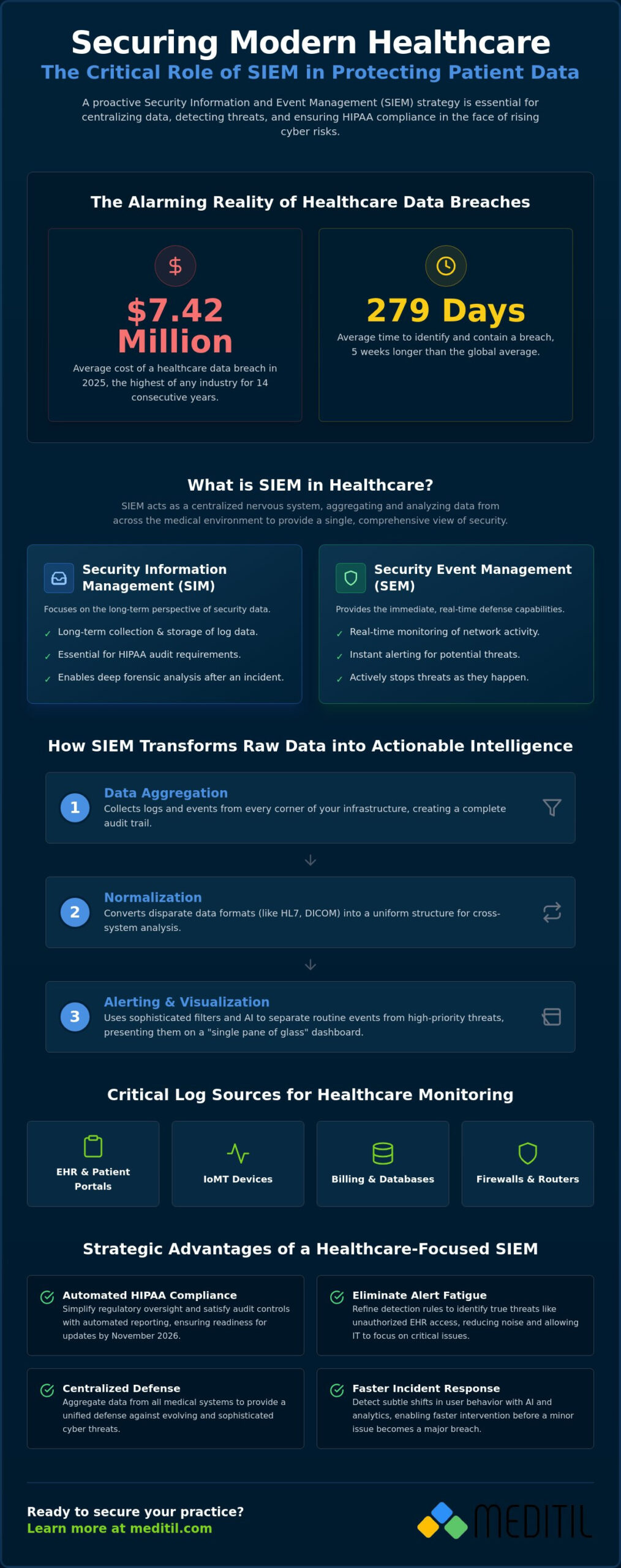
In 2025, the average cost of a healthcare data breach reached $7.42 million, marking the 14th consecutive year this sector has faced the highest financial risks. It takes an average of 279 days to identify and contain a breach in a medical environment, which is five weeks longer than the global average. You likely feel the weight of these statistics every time you face a mounting volume of security alerts or prepare for a HIPAA audit. It’s difficult to maintain constant vigilance over EHR access when your IT staff is already focused on supporting clinical operations.
This guide explains how security information event management siem technology serves as a steady hand for your infrastructure by centralizing data to detect threats and protect patient safety. You’ll learn how a proactive SIEM strategy helps your organization meet the mandatory HIPAA Security Rule updates by November 2026. We will outline the path toward automated compliance reporting and faster incident response to ensure your practice remains stable and secure.
Key Takeaways
- Understand how security information event management siem aggregates data from disparate medical systems to provide a centralized defense against evolving cyber threats.
- Distinguish between the long-term storage requirements of Security Information Management (SIM) and the real-time monitoring capabilities of Security Event Management (SEM).
- Learn strategies to eliminate alert fatigue by refining detection rules to identify unauthorized EHR access without disrupting urgent clinical workflows.
- Simplify regulatory oversight by using automated reporting to satisfy HIPAA audit controls and maintain a state of continuous compliance readiness.
- Evaluate the strategic advantages of managed security services to ensure constant infrastructure monitoring without the high overhead of internal staffing.
What is Security Information and Event Management (SIEM) in Healthcare?
In the high-stakes environment of patient care, digital visibility is synonymous with safety. Security Information and Event Management (SIEM) serves as the centralized nervous system for a healthcare organization’s IT infrastructure. It’s a platform that aggregates, analyzes, and stores log data from across your entire medical environment. By consolidating these disparate data streams, it provides a comprehensive view of network activity. This makes it possible to identify anomalies that could indicate a security breach or a critical system failure before clinical care is interrupted.
Understanding the architecture of this technology requires looking at its two core components. Security Information Management (SIM) focuses on the long-term collection and storage of log data. This is essential for meeting HIPAA audit requirements and performing forensic analysis after an incident. In contrast, Security Event Management (SEM) provides the real-time monitoring and alerting capabilities needed to stop an active threat. Together, they create a robust framework for both immediate protection and long-term regulatory compliance.
Generic SIEM solutions often fail in clinical settings because they aren’t designed to parse proprietary EHR protocols or specialized medical device data. A medical practice needs more than just firewall logs. It requires a system that understands the context of medical workflows. For example, a specialized system can distinguish between a physician accessing records during an emergency and an unauthorized user attempting to scrape a database. This provides IT teams with a “single pane of glass,” allowing them to monitor the health of the entire network from one dashboard without toggling between dozens of disconnected consoles.
The Evolution of SIEM for Modern Medical Practices
Modern healthcare security has moved far beyond simple log collection. By 2026, the industry standard has shifted toward proactive threat hunting powered by AI and behavioral analytics. Older, on-premise log servers are being replaced by scalable, cloud-based security information event management siem solutions. These platforms don’t just wait for a known virus signature. They analyze patterns to detect subtle shifts in user behavior that suggest a compromised account, allowing for faster intervention.
Critical Log Sources: Beyond the Standard Firewall
Effective healthcare monitoring looks beyond the standard network perimeter. It requires aggregating data from Electronic Health Records (EHR) and patient portals to track access to sensitive data. It also includes monitoring Internet of Medical Things (IoMT) devices, such as infusion pumps and bedside monitors, which are often vulnerable entry points. Finally, tracking administrative access to billing systems and sensitive patient databases ensures that financial and clinical data remain equally protected.
How SIEM Works: The Mechanics of Medical Threat Detection
The operational efficacy of a security information event management siem platform depends on its ability to ingest vast quantities of raw data and transform it into actionable intelligence. This process begins with data aggregation. The system collects logs from every corner of your infrastructure, including routers, servers, medical applications, and cloud endpoints. In a healthcare environment, this includes sensitive touchpoints like patient portals and pharmacy management systems. By pulling these signals into a central repository, the platform creates a comprehensive audit trail of every digital interaction within the organization.
Once data is collected, it undergoes normalization. Medical IT environments are often a patchwork of legacy systems and modern cloud services that communicate in different languages, such as HL7 or DICOM. Normalization converts these disparate formats into a uniform structure. This allows the system to compare a login attempt on a local workstation with a file access request in a cloud database. Strategic SIEM security management requires this structured approach to ensure that no signal is lost due to technical incompatibility.
The final stage of the basic mechanics involves alerting and visualization. The system uses sophisticated filters to separate routine clinical traffic from high-priority risks. Instead of forcing IT staff to scroll through thousands of benign events, the dashboard highlights only the anomalies that require immediate attention. Organizations looking to refine this process often seek professional cybersecurity and compliance consulting to ensure their alerting rules align with specific clinical workflows.
The Importance of Event Correlation in Clinical Settings
Event correlation is the process of linking separate network signals to uncover a single malicious intent. In a hospital, this might involve identifying “impossible travel” scenarios, such as a physician logging into the EHR from a local clinic and a foreign IP address simultaneously. It also detects patterns like bulk data exports occurring during non-clinical hours. By connecting these dots, the system can identify a coordinated cyberattack that would appear as unrelated, minor events to a human observer.
Data Retention and the SIM Component
The Security Information Management (SIM) aspect of the platform focuses on long-term stability and regulatory adherence. Federal and state laws often require medical practices to retain audit logs for several years to support potential investigations. A robust system ensures log integrity, meaning an intruder cannot delete their tracks after a breach. This historical data is invaluable for forensic investigations, allowing your team to determine exactly what happened and which patient records were impacted during a security incident.
Addressing Alert Fatigue: Making SIEM Actionable for Healthcare IT
One of the most significant challenges in healthcare cybersecurity is the phenomenon of alert fatigue. When a security information event management siem platform is poorly tuned, it generates an overwhelming volume of notifications. This creates a “Boy Who Cried Wolf” scenario where IT teams begin to ignore critical warnings due to the sheer number of false positives. In a clinical environment, this isn’t just a technical nuisance. It’s a patient safety risk. If a genuine threat is buried under a mountain of routine logs, the delay in response can lead to clinical downtime or data exfiltration.
Customizing detection rules is essential to account for the unique nature of medical workflows. For instance, an emergency physician accessing a patient record during a night shift shouldn’t trigger the same level of alarm as an administrative account attempting a bulk data export. Modern platforms utilize User and Entity Behavior Analytics (UEBA) to establish a baseline of normal clinical operations. By adhering to NIST log management guidelines, organizations can ensure their logging practices are both compliant and operationally efficient. These standards help teams prioritize the most critical signals across the infrastructure.
Effective threat isolation often requires integrating logs from healthcare network segmentation. When the security information event management siem identifies an infected device, it can leverage segmentation data to isolate that specific clinical zone. This prevents the lateral movement of ransomware while keeping other medical systems online and functional. This level of precision is what transforms a standard security tool into a strategic clinical safeguard.
Signal vs. Noise: Tuning Your Security Monitoring
To maintain high security, IT teams must define high-fidelity alerts. These are signals that represent a verified threat requiring immediate intervention. Automating the dismissal of routine, low-risk administrative events, such as successful password resets, frees up limited resources. Many practices find that a fractional CIO provides the strategic leadership necessary to refine these rules. They ensure your monitoring strategy aligns with the fast-paced reality of clinical care without creating unnecessary friction.
The Role of SOAR in Healthcare Automation
Security Orchestration, Automation, and Response (SOAR) takes actionability a step further. In a medical context, SOAR uses automated playbooks to respond to common threats instantly. If the system detects signs of ransomware on a workstation, the SOAR component can automatically isolate that machine from the network. This reduces the burden on IT staff by providing 24/7 triage and initial response. It ensures that critical infrastructure remains protected even when human monitors are off-duty, providing a steady hand for your network security.
SIEM as a Foundation for HIPAA and Regulatory Compliance
HIPAA compliance in 2026 requires more than a policy manual. It demands verifiable technical enforcement. Under 45 CFR § 164.312, the Technical Safeguards mandate that covered entities implement hardware, software, and procedural mechanisms that record and examine activity in information systems. A robust security information event management siem satisfies these requirements by creating an immutable record of every user who accesses, modifies, or deletes Protected Health Information (PHI). By integrating these logs with HIPAA compliant IT services, healthcare leaders can establish a defensible security posture that stands up to federal scrutiny.
The updated HIPAA Security Rule, which carries a finalized compliance deadline of November 2026, eliminates the “addressable” status for many controls. Standards that were once optional are now mandatory. This includes the requirement for routine vulnerability scanning every six months and annual penetration testing. Your platform acts as the central repository for these results, providing a single source of truth for your compliance status. It ensures that encryption for ePHI, both at rest and in transit, is consistently verified across the entire network infrastructure. As cloud security threats in healthcare grow more sophisticated in 2026, this centralized visibility becomes even more critical for maintaining a defensible compliance posture.
Beyond federal mandates, new requirements for Substance Use Disorder (SUD) records became mandatory as of February 16, 2026. These rules align SUD privacy protections with HIPAA breach notification standards. A centralized monitoring platform is essential for tracking access to these sensitive records and ensuring that any unauthorized disclosure is detected immediately. If you’re concerned about your current audit readiness, you can explore our cybersecurity and compliance solutions to bridge the gap between policy and technical execution.
Audit Readiness and Automated Reporting
Audit readiness should be a constant state, not a seasonal panic. Automated dashboards replace manual log reviews, providing daily and weekly summaries of access patterns and security events. This ensures that evidence of “continuous monitoring” is always available for auditors. By verifying log integrity, you reduce the financial and legal risk of non-compliance. You can prove exactly when a patch was applied or when a user’s access was revoked, creating a clear chain of accountability.
Incident Response and Forensic Accountability
When a security incident occurs, the clock starts ticking on the 60-day HIPAA breach notification rule. You must quickly identify the scope of the compromised data to meet legal obligations. A forensic trail allows you to reconstruct the timeline of events for legal and insurance purposes. This data is also vital for continuous improvement. After an attempted attack, teams use these insights to refine network security best practices and prevent future vulnerabilities from being exploited.
Strategic Implementation: Managed SIEM vs. In-House Solutions
Choosing the right deployment model is a critical decision for healthcare leadership. Building a security information event management siem capability internally involves significant capital expenditure. You must account for hardware acquisition, high licensing fees, and the continuous overhead of a 24/7 security team. Most mid-sized practices find it impossible to recruit and retain the specialized analysts required to monitor these systems around the clock. Without constant human oversight, the technology becomes a passive repository rather than a proactive defense tool.
Managed providers offer a more sustainable path by integrating the platform into a broader healthcare cybersecurity services framework. This approach ensures that security isn’t a siloed IT project but a core component of clinical stability. By outsourcing the management of these complex systems, your internal team can stay focused on supporting clinical applications and patient care. This alignment ensures that technology serves the mission of the organization rather than becoming a burden on limited resources.
Why Managed SIEM Outperforms In-House Efforts
Access to a professional Security Operations Center (SOC) is the primary advantage of a managed model. You gain a team of experts without the burden of hiring them individually. These providers also utilize pre-configured healthcare threat intelligence feeds. These feeds identify specific medical malware patterns that individual practices can’t easily access. As you add new clinicians or locations, your security posture scales seamlessly. This provides a steady hand at the wheel, ensuring your infrastructure remains protected during periods of growth or transition.
The vCIO’s Role in Cybersecurity Strategy
Strategic leadership is the bridge between raw data and clinical care. A fractional CIO ensures that insights from your security information event management siem inform long-term IT budgeting for medical practices. They translate complex technical logs into business intelligence for leadership. This allows you to make data-driven decisions about infrastructure investments. Crucially, a vCIO ensures that implementation doesn’t introduce clinical friction. Security should protect patient care, not slow it down. This expert guidance ensures that every detail is handled with precision, moving your organization from reactive troubleshooting to strategic advancement.
Strengthening Your Clinical Resilience for 2026
The shift toward mandatory technical controls and strict compliance windows requires a disciplined approach to network visibility. A properly implemented security information event management siem platform does more than just archive logs. It provides the real-time intelligence necessary to protect patient safety and maintain clinical continuity. By automating compliance reporting and refining alert logic, your organization moves from a reactive security posture to one of strategic stability.
Partnering with a specialist ensures your infrastructure is managed with the precision required in a regulated environment. MEDITIL provides the specialized healthcare IT expertise and Fractional CIO strategic leadership needed to navigate these complexities. We offer comprehensive HIPAA-compliant infrastructure management to ensure your data remains secure and your focus remains on patient care. It’s time to transform your security from a technical burden into a clinical safeguard.
Secure your clinical data with MEDITIL’s managed cybersecurity solutions and take a proactive step toward a more resilient future.
Frequently Asked Questions
Is SIEM a requirement for HIPAA compliance?
Yes, SIEM is essential for meeting the HIPAA Security Rule mandates for audit controls and information system activity reviews. While the regulation doesn’t name specific software, it requires covered entities to implement mechanisms that record and examine activity in systems containing ePHI. By November 2026, updated standards make continuous monitoring and vulnerability scanning mandatory, positioning this technology as a foundational requirement for a defensible compliance posture.
What is the difference between SIEM and a standard firewall?
A firewall acts as a perimeter gatekeeper that blocks or allows traffic based on predefined rules, whereas a SIEM platform aggregates and analyzes logs from across the entire network. While a firewall only sees what passes through it, a security information event management siem provides visibility into internal lateral movements, EHR access, and medical device behavior. It links disparate events to identify complex threats that a single firewall would overlook.
Can SIEM detect ransomware before it encrypts our medical records?
Yes, SIEM can detect early indicators of a ransomware attack, such as unauthorized lateral movement or unusual account privilege escalations. By utilizing behavioral analytics, the system identifies the reconnaissance phase of an attack before encryption begins. When integrated with automated response playbooks, it can isolate infected workstations instantly. This proactive approach is vital for preventing the massive clinical downtime seen in incidents like the 2025 Change Healthcare attack.
How long should a medical practice retain SIEM logs for audit purposes?
A medical practice should generally retain audit logs for at least six years to satisfy HIPAA requirements. This timeframe aligns with the federal statute of limitations for civil money penalties and documentation retention. However, certain state regulations or medical board requirements may mandate longer periods for specific clinical data. Maintaining log integrity throughout this period ensures that your organization remains prepared for retrospective forensic investigations or federal audits.
Does SIEM monitor our EHR and patient portal activity?
Yes, a properly configured platform monitors activity within your EHR and patient portals by ingesting application-level logs. It tracks who accessed specific patient records, the time of access, and any modifications made to the data. This level of granular visibility is critical for identifying insider threats, such as employees viewing records without a clinical need. This type of unauthorized access is a frequent source of HIPAA violations and data disclosures.
Is SIEM too expensive for a small to mid-sized medical clinic?
No, the adoption of cloud-based and managed service models has made this technology accessible for small to mid-sized clinics. While an in-house deployment involves high capital costs, a managed security information event management siem offers a predictable operating expense. This model provides the same level of enterprise-grade protection used by large hospitals without the need for a multi-million dollar internal IT budget or a 24/7 onsite security staff. Understanding the full landscape of cloud security threats facing healthcare organizations in 2026 can help smaller clinics prioritize where managed SIEM delivers the greatest return on investment.
What is the role of a SOC in managing a SIEM platform?
A Security Operations Center (SOC) provides the human expertise necessary to interpret the data generated by the platform. While the software identifies anomalies, SOC analysts investigate these alerts to determine if they represent genuine threats or benign clinical activity. This 24/7 oversight ensures that high-priority risks are addressed immediately. It prevents critical notifications from being missed during overnight hours or weekends, maintaining a steady hand over your network infrastructure.
How does SIEM help with medical device security (IoMT)?
SIEM improves medical device security by monitoring the network traffic patterns of Internet of Medical Things (IoMT) devices like infusion pumps and bedside monitors. Many of these devices cannot host traditional security software, making them vulnerable entry points. By analyzing their communication logs, the platform can detect if a device begins communicating with an unknown external server. This allows IT teams to isolate compromised hardware before it impacts patient care or system stability.