
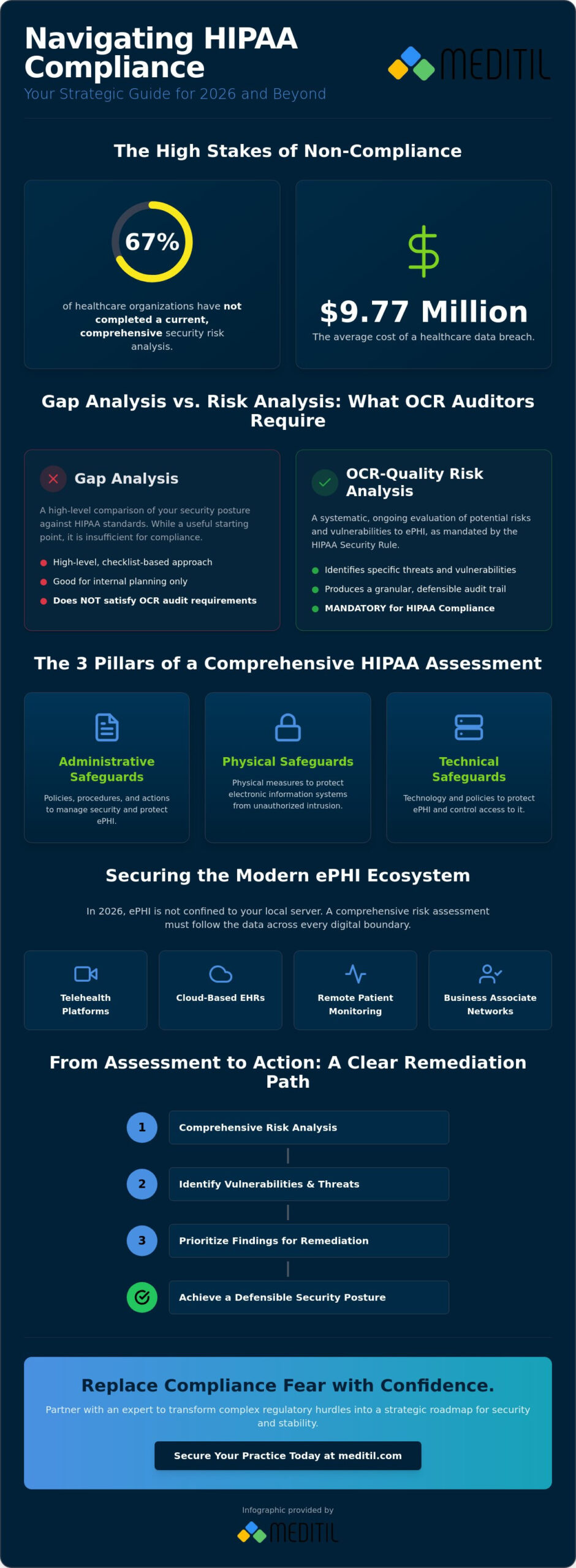
Sixty-seven percent of healthcare organizations have not completed a current, comprehensive security risk analysis. With the average healthcare data breach now costing $9.77 million, leaving your compliance to chance is no longer a viable strategy. It’s understandable if you feel the weight of mounting technical debt or find the distinction between administrative and technical safeguards confusing. The pressure is only increasing as the February 16, 2026, deadline for updating Notice of Privacy Practices approaches. You need a steady hand to manage these shifting requirements.
Professional hipaa risk assessment services transform these complex regulatory hurdles into a structured, strategic roadmap for your facility. You don’t have to carry the burden of developing internal expertise alone. By partnering with a seasoned expert, you can replace the fear of OCR fines with the confidence of a defensible security posture. This guide examines how a rigorous, OCR-quality risk analysis provides a clear remediation path. We will show you how to ensure your patient data remains secure while maintaining long-term operational stability and technical precision.
Key Takeaways
- Learn the critical distinction between a standard gap analysis and the comprehensive risk analysis required to satisfy OCR auditors.
- Understand how professional hipaa risk assessment services integrate administrative, physical, and technical safeguards to create a unified security posture.
- Discover why an asset-based approach is superior to “check-the-box” methods for identifying hidden vulnerabilities within your clinical infrastructure.
- Identify how to transform a list of security findings into a prioritized remediation roadmap that balances regulatory necessity with operational efficiency.
- Determine the essential criteria for selecting a strategic partner who possesses deep expertise in healthcare workflows rather than general IT standards.
What are HIPAA Risk Assessment Services in 2026?
A HIPAA risk assessment is a foundational requirement for any covered entity or business associate. It’s defined as a systematic, ongoing evaluation of potential risks and vulnerabilities to the confidentiality, integrity, and availability of electronic protected health information (ePHI). These services aren’t a simple checklist. They represent a deep dive into your organization’s unique operational DNA to identify where data might be exposed to unauthorized access or loss.
Many organizations confuse a “gap analysis” with a “risk analysis,” but the distinction is critical for regulatory compliance. A gap analysis is a high-level comparison of your current security posture against the standards of the Health Insurance Portability and Accountability Act (HIPAA). While useful for internal planning, it doesn’t satisfy the Office for Civil Rights (OCR) requirements. A full risk analysis, however, identifies specific threats, such as a malicious actor or a natural disaster, and the likelihood of those threats exploiting a particular vulnerability in your system. Professional hipaa risk assessment services provide the methodology needed to produce this granular level of detail.
The regulatory landscape in 2026 has shifted significantly, making these assessments more complex than in previous years. With the NIST Cybersecurity Framework 2.0 now serving as the de facto benchmark, auditors expect deeper technical testing. This includes annual penetration testing and biannual vulnerability scanning to validate that safeguards actually work. Relying on hipaa risk assessment services from third-party experts ensures an unbiased, defensible audit trail. Internal teams often suffer from blind spots due to their proximity to the infrastructure, whereas an external consultant provides the objective verification required to survive a federal audit.
The Legal Mandate Under the HIPAA Security Rule
The core requirement for a risk assessment is found in 45 CFR § 164.308(a)(1)(ii)(A). This regulation isn’t just a suggestion; it’s a mandatory implementation specification. The rule requires organizations to conduct an accurate and thorough assessment of potential risks to ePHI. Within this mandate, safeguards are categorized as either “Required” or “Addressable.” It’s a common misconception that addressable items are optional. In reality, you must either implement the safeguard or document a valid, technical reason why it’s not appropriate for your environment. Professional services help you navigate these nuances, moving beyond self-assessments that often fail under OCR scrutiny.
ePHI in the Modern Digital Ecosystem
In 2026, ePHI is no longer confined to a local server. It flows through telehealth platforms, remote patient monitoring devices, and cloud-based EHRs. Your risk assessment must follow this data across every digital boundary, including the networks of your business associates. ePHI consists of any individually identifiable health information created, received, maintained, or transmitted in electronic form, whether it exists as structured data in a database or unstructured notes in a telehealth transcript. Identifying these disparate data points is the first step toward securing them against the evolving threat landscape.
The Three Pillars of a Comprehensive HIPAA Assessment
A technical vulnerability scan is often the first step in a security review, but it’s rarely the last. In fact, relying solely on a technical scan is the primary reason many healthcare organizations fail their audits. A scan might identify an unpatched server, but it won’t detect a missing Business Associate Agreement or a lack of employee training. Comprehensive hipaa risk assessment services must evaluate the three pillars of compliance: administrative, physical, and technical safeguards. These elements don’t exist in isolation; they’re deeply interdependent parts of a single security ecosystem.
The HIPAA Security Rule requirements emphasize that a risk analysis is a foundational necessity for protecting patient data. When these three pillars are properly aligned, they form the bedrock of effective healthcare cybersecurity services. If your service provider only focuses on the digital perimeter, they’re leaving your clinical operations exposed to significant regulatory and operational risk.
Administrative Safeguards: The Policy Foundation
Administrative safeguards are the policies and procedures that govern workforce conduct and data management. This pillar is often the most scrutinized during an OCR investigation. An effective assessment evaluates your security management processes, information access management, and workforce training programs. A critical component involves verifying your Business Associate Agreements (BAAs). Research indicates that 41% of healthcare organizations have missing or outdated BAAs. Your assessment must ensure these contracts are current and legally sound. Risk management is an active administrative duty. It’s a cycle of constant verification rather than a static document stored in a drawer.
Physical and Technical Safeguards: Protecting the Infrastructure
Physical safeguards focus on the tangible protection of your facilities and equipment. This includes facility access controls, workstation security, and strict policies for device disposal. It’s not enough to have a firewall if a thief can walk into an unlocked server room. Technical safeguards then layer on the digital protection. In 2026, the standard for encryption is rigorous, requiring data to be protected both at rest and in transit. Multi-factor authentication (MFA) is now a mandatory expectation for any system accessing ePHI. Your assessment must validate that these technical controls are properly configured to prevent unauthorized access.
Ensuring your partner treats each of these pillars with equal depth is essential for clinical stability. If you’re concerned about your current compliance posture, you can consult with our team to evaluate your existing safeguards. A balanced approach ensures that no single point of failure compromises your patient data or your reputation.
Asset-Based vs. Control-Based Risk Analysis
Many organizations approach compliance as a checklist, a method known as control-based risk analysis. This style simply asks if a specific safeguard, such as a firewall or a password policy, is in place. While this helps satisfy basic requirements, it often fails to identify the nuanced threats facing your specific environment. In contrast, asset-based risk analysis focuses on the data itself. It identifies every asset that creates, receives, maintains, or transmits ePHI and analyzes the specific threats to those assets. Professional hipaa risk assessment services prioritize this asset-centric model because it provides a much clearer picture of your actual security posture.
The Office for Civil Rights (OCR) has expressed a clear preference for the asset-based approach during audits. A checklist can’t account for the unique vulnerabilities of a legacy server versus a modern cloud-native application. By cataloging ePHI repositories across your entire organization, you ensure that no data silo remains unprotected. This granular methodology directly informs it budgeting for medical practices, as it identifies exactly where capital investments will provide the highest return on security and compliance. Instead of guessing where to allocate funds, you can base your financial roadmap on documented risk levels and asset criticality.
Identifying and Categorizing Healthcare Assets
Modern healthcare delivery extends far beyond the traditional server room. A valid assessment must account for IoT devices, mobile clinics, and the dozens of third-party SaaS platforms that touch your patient data. We assign criticality levels to these assets based on their clinical impact and their potential for a compliance breach. A comprehensive asset inventory acts as a deterrent to shadow IT by ensuring that every device or application used to transmit health data is officially vetted and monitored, closing potential HIPAA gaps before they can be exploited. This systematic categorization is the only way to maintain a complete map of your digital footprint in 2026.
Threat and Vulnerability Mapping
Once assets are identified, we map specific threats to them, ranging from ransomware and hardware failure to simple internal errors. We then evaluate your “control efficacy,” which measures how well your current safeguards actually perform against those threats. If an asset has a high threat level but weak controls, it receives a high residual risk score. These scores are essential for hipaa risk assessment services to help you prioritize remediation. You can’t fix everything at once. By focusing on high-risk assets first, you maximize your protection while respecting operational and financial constraints.
From Assessment to Action: The Remediation Roadmap
An assessment that simply sits on a shelf is a liability rather than an asset. It is essentially a documented map of your vulnerabilities, providing a clear path for potential threats to exploit your infrastructure if left unaddressed. Real hipaa risk assessment services don’t stop at the delivery of a report. They provide a comprehensive remediation roadmap that translates technical findings into actionable operational tasks. This transition from diagnosis to cure requires a steady hand at the wheel, which is where virtual CIO services become indispensable for modern practices.
Strategic leadership ensures that your organization moves toward stability without disrupting the delicate balance of clinical care. By overseeing the roadmap, these experts help you navigate the complexities of resource allocation and technical implementation. They bridge the gap between compliance requirements and the reality of daily medical operations. This structured approach replaces the chaos of reactive fixes with a disciplined, results-oriented strategy that builds long-term resilience.
Strategic Prioritization of Security Gaps
You can’t fix every vulnerability simultaneously. We categorize security gaps by their severity, clinical impact, and the cost of remediation. High and critical risks demand immediate attention, typically within the first 30 to 90 days. Addressing these items quickly demonstrates “good faith” to regulators and provides an essential defense during an audit. However, security upgrades must be balanced with workflow efficiency. We document the specific logic behind every remediation decision, ensuring that you have a defensible reason for your prioritization choices. This level of detail is exactly what OCR auditors look for when evaluating a covered entity’s compliance efforts.
The Role of Continuous Monitoring
A risk assessment in 2026 is a snapshot in time, and its validity begins to decay the moment your infrastructure changes. This is why we integrate assessment findings into your ongoing managed it services for healthcare. Compliance must be a continuous activity rather than an annual event. By establishing a culture of compliance, your team learns to recognize and report vulnerabilities as they arise in real-time. This proactive stance ensures that your patient data remains secure long after the initial assessment period ends, turning a regulatory requirement into a permanent operational strength.
Ready to turn your compliance gaps into a strategic advantage for your practice? Schedule a consultation with our compliance experts today to begin building your custom remediation roadmap.
Choosing the Right HIPAA Risk Assessment Partner
Selecting a partner to evaluate your compliance posture is a decision that impacts your organization’s long-term stability and legal standing. Many general IT firms offer security scans, but they often lack the specialized healthcare context required to satisfy federal auditors. Effective hipaa risk assessment services must be delivered by experts who focus exclusively on the healthcare sector. These specialists understand that a server isn’t just a piece of hardware; it’s a critical component of patient care delivery. Your partner must demonstrate a deep understanding of clinical workflows to identify where data exposure actually occurs during daily operations.
Verifying a provider’s methodology is a non-negotiable step in your due diligence process. You should ensure their framework aligns strictly with NIST SP 800-30 standards, which is the recognized benchmark for conducting risk assessments in federal and healthcare environments. At MEDITIL, our Fractional CIO approach provides superior value by moving beyond the role of a traditional vendor. We act as a strategic partner, offering the high-level leadership necessary to manage complex regulatory requirements while you focus on clinical outcomes. This model ensures that compliance isn’t a burdensome distraction but a disciplined part of your operational excellence.
Expertise Beyond the Checklist
Many providers deliver software-generated reports that provide a “list of problems” without context. We believe in proactive management rather than reactive auditing. A static report can’t account for the nuances of your specific practice or the evolving nature of digital threats. MEDITIL bridges the gap between technical security and your strategic business goals. We analyze how security decisions affect your bottom line and your ability to serve patients. This high-performance focus ensures that every safeguard we recommend is both technically sound and operationally sustainable.
The MEDITIL Managed Compliance Advantage
Our managed compliance approach is built on customization and seamless connectivity. We don’t believe in one-size-fits-all solutions. Instead, we tailor every assessment to your unique clinical environment, whether you operate a single specialty clinic or a multi-site health system. Our hipaa risk assessment services integrate directly with our ongoing managed IT and cybersecurity support, creating a unified defense strategy. This integration allows for:
- Continuous verification of technical and administrative safeguards.
- Real-time updates to your risk management plan as your infrastructure grows.
- Direct access to strategic leadership for board-level reporting and financial planning.
- A steady, reliable presence that provides peace of mind during internal or external audits.
By choosing a partner that understands the high-stakes nature of healthcare, you ensure that your patient data is handled with precision and care. We provide the expert guidance needed to transform regulatory requirements into a robust roadmap for growth.
Strategic Resilience for the 2026 Regulatory Landscape
Transitioning from a reactive compliance posture to a proactive security strategy is the defining challenge for healthcare leaders in 2026. We’ve explored how moving beyond basic checklists to asset-based analysis provides the granular visibility needed to protect sensitive electronic health records. By addressing the administrative, physical, and technical pillars with equal rigor, your organization builds a foundation that can withstand both federal scrutiny and unexpected operational disruptions.
Professional hipaa risk assessment services act as a catalyst for this transformation, turning a regulatory mandate into a roadmap for clinical stability. At MEDITIL, we combine Fractional CIO strategic leadership with deep expertise in EMR/EHR implementation and interoperability. This ensures your technical infrastructure remains fully aligned with your long-term business objectives. Our tailored IT solutions for the healthcare sector provide the precision and technical confidence required in this high-stakes environment.
Secure your practice with an OCR-quality HIPAA risk assessment from MEDITIL today. We’re ready to provide the steady hand you need to navigate the complexities of modern compliance and protect the future of your organization.
Frequently Asked Questions
How often should a healthcare organization perform a HIPAA risk assessment?
You should perform a risk assessment at least once per year or whenever you implement significant changes to your technical infrastructure. These changes include adopting new EHR software, migrating to cloud environments, or opening new clinical locations. The 2026 regulatory updates emphasize that assessments must be accurate and thorough, meaning static reports from previous years are no longer sufficient to meet modern security standards.
Does the HHS SRA Tool count as a full HIPAA risk assessment?
The HHS Security Risk Assessment (SRA) Tool is a helpful self-assessment resource, but it doesn’t constitute a comprehensive risk analysis on its own. It lacks the deep technical verification, such as penetration testing and vulnerability scanning, that auditors now expect. While it helps identify administrative gaps, professional hipaa risk assessment services are necessary to validate technical controls and provide a defensible audit trail during a federal investigation.
What is the average cost of professional HIPAA risk assessment services?
Costs for these services vary significantly based on the size of your organization and the complexity of your digital ecosystem. Smaller practices with fewer than 50 staff members typically require a different level of investment compared to large enterprises with hundreds of employees. Factors influencing the final cost include the depth of technical testing required and whether the engagement includes a full remediation roadmap and strategic leadership support.
Can a general managed IT provider perform a valid HIPAA risk analysis?
A general provider may understand servers, but they often lack the specialized knowledge of clinical workflows and healthcare-specific regulations. A valid analysis requires an understanding of how ePHI moves through specialized medical applications and remote monitoring devices. This is especially relevant for specialized healthcare providers; for instance, when commercial drivers discover Miami CDL/DOT Physical Exam Center for their FMCSA medical exams, the clinic must ensure that sensitive health data is handled with the same precision as the physical assessment itself. Choosing a partner with a healthcare-only focus ensures that your hipaa risk assessment services account for the unique risks present in a medical environment.
What happens if a risk assessment identifies a major security gap?
Identifying a gap is the primary purpose of the assessment and allows you to address the vulnerability before a breach occurs. You must document the finding and create a prioritized remediation plan with specific timelines for resolution. Regulators look for good faith efforts; showing that you’ve identified a risk and are actively working to fix it provides a critical layer of audit defense and operational stability.
Is a HIPAA risk assessment required for small medical practices?
Yes, the HIPAA Security Rule requires all covered entities, regardless of their size, to conduct a thorough risk analysis. Small practices are frequently targeted by cybercriminals because they often have weaker security controls than larger systems. Performing a regular assessment isn’t just a legal mandate; it’s a vital step in protecting your practice from the devastating financial impact of a data breach.
What is the difference between a HIPAA audit and a HIPAA risk assessment?
A risk assessment is a proactive internal process used to identify and mitigate vulnerabilities before they’re exploited. In contrast, a HIPAA audit is an external review typically conducted by the Office for Civil Rights (OCR) to verify compliance with federal standards. Your risk assessment report serves as the primary piece of evidence during an audit to prove you’ve met your legal obligations under the Security Rule.
How long does a professional HIPAA risk assessment typically take?
A comprehensive assessment usually takes between four and eight weeks to complete. This timeline includes the initial data gathering phase, technical scans, administrative interviews, and the final delivery of the risk analysis and remediation roadmap. Larger organizations with multiple locations or complex systems integration may require additional time to ensure every asset is properly cataloged and evaluated for potential threats.