
With the February 16, 2026, deadline for the HHS Final Rule already here, is your clinical infrastructure a strategic asset or a compliance liability? Most healthcare leaders feel the weight of slow EHR systems and the constant threat of sophisticated ransomware. It’s exhausting to manage daily clinical friction while searching for healthcare it consulting services that can actually maintain 100% HIPAA compliance across disconnected platforms. You’ve likely realized that a technology roadmap shouldn’t just survive the current fiscal year; it should provide a steady hand for your entire operation.
This guide demonstrates how specialized IT consulting transforms clinical infrastructure into a secure, interoperable, and high-performing asset for modern healthcare organizations. You’ll learn how to align your infrastructure with the latest 2026 standards, including the mandatory shifts in the HIPAA Security Rule finalized this May. We’ll outline a path toward seamless data interoperability and robust cybersecurity that protects your patients and your reputation. This article provides a comprehensive look at optimizing digital workflows to ensure your organization remains both compliant and high-performing.
Key Takeaways
- Understand the distinction between general support and specialized healthcare it consulting services that prioritize clinical stability and regulatory compliance.
- Identify the core pillars of a resilient network that supports integrated telehealth models while meeting the latest 2026 HIPAA security requirements.
- Discover how fractional CIO leadership bridges the gap between technical execution and clinical objectives without the cost of a full-time executive.
- Explore methods to optimize digital workflows, including billing automation and EMR integration, to reduce physician burnout and administrative error.
- Establish a criteria for selecting an IT partner who demonstrates deep expertise in regulatory compliance and healthcare-specific systems integration.
What Are Healthcare IT Consulting Services?
Healthcare IT consulting services represent a specialized discipline that bridges the gap between medical practice requirements and digital infrastructure. It isn’t merely about fixing hardware or managing standard office applications. It’s about designing a strategic framework where Health information technology (HIT) supports clinical outcomes and operational stability. This specialized advisory focus ensures that every technical decision serves the ultimate goal of patient care while maintaining a secure, high-performing environment.
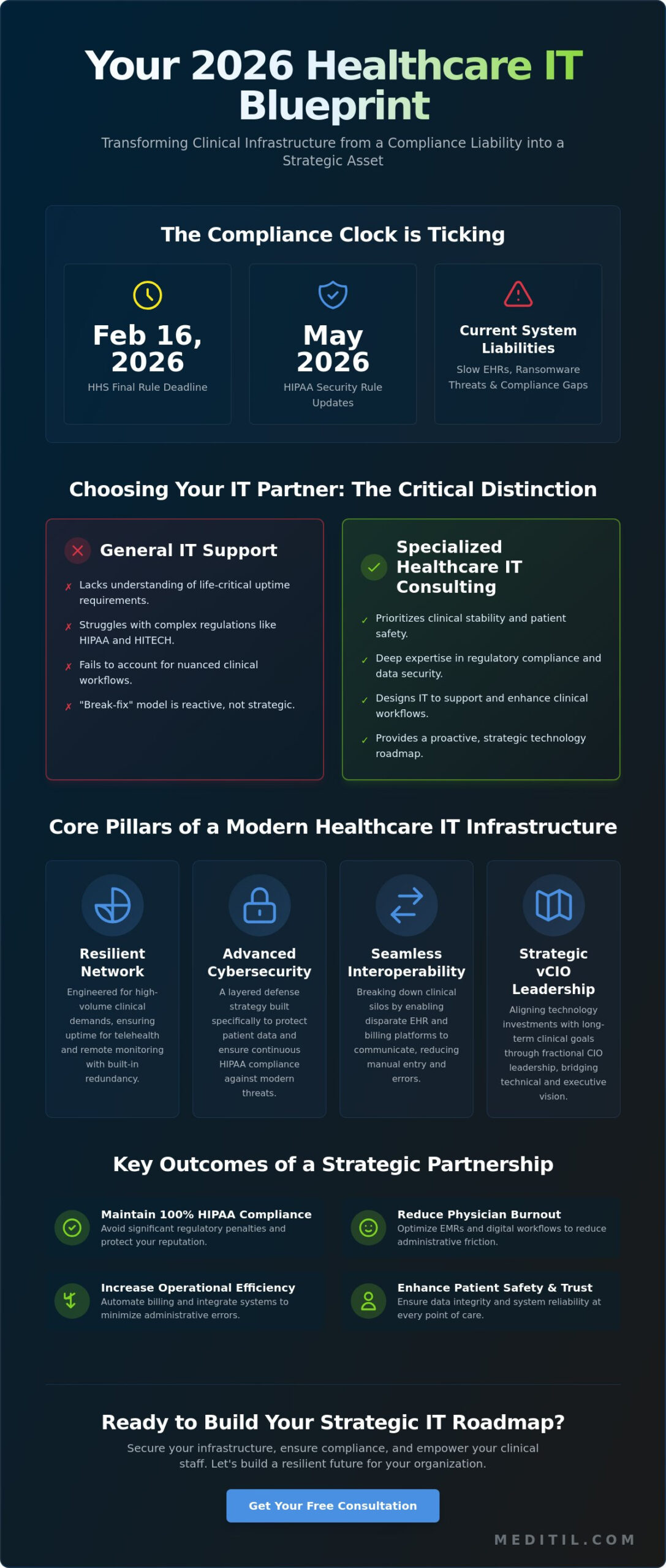
The year 2026 marks a pivotal transition for the industry. With the HHS Final Rule compliance deadline on February 16, 2026, and major updates to the HIPAA Security Rule finalized in May 2026, the traditional “break-fix” model is no longer viable. Organizations must move toward a proactive IT architecture. This shift allows providers to avoid significant regulatory penalties and operational disruptions that stem from outdated or reactive systems. Utilizing professional healthcare it consulting services helps organizations navigate these changes with technical confidence.
General IT support often focuses on generic connectivity. In contrast, healthcare-specific consulting prioritizes the high-stakes environment of patient care. Every system must be verified for security and performance under the pressure of clinical workflows. This distinction is critical for maintaining the integrity of sensitive data and ensuring that technology acts as an asset rather than a source of friction.
The Core Domains of Medical IT Advisory
Infrastructure and network design must be tailored for high-volume clinical environments where seconds matter. Cybersecurity frameworks are built around a layered defense strategy, focusing specifically on patient data protection and HIPAA standards. Strategic technology roadmapping provides a clear path for long-term growth. It ensures that investments in cloud services or telehealth systems align with the organization’s mission and financial objectives beyond the current fiscal year.
Why General IT Consulting Fails Healthcare Organizations
General consultants often lack an understanding of life-critical system uptime requirements. A system failure in a standard business is an inconvenience; in a clinical setting, it can compromise patient safety. Generic firms also struggle with the complex regulatory landscape, such as the nuances of HIPAA and HITECH. They may fail to account for clinical workflow nuances during implementation, which often leads to physician burnout and administrative errors. Specialized consultants understand that software must serve the staff, ensuring that integrations and updates don’t disrupt the care continuum.
Core Pillars of Modern Healthcare IT Infrastructure
A stable clinical environment relies on more than just functional hardware. It requires a sophisticated architecture designed to handle the specific demands of medical data and patient care. Modern healthcare it consulting services focus on building a foundation that ensures high-volume clinical environments remain operational under pressure. This infrastructure serves as the backbone for every patient interaction, from the initial check-in to long-term remote monitoring. By aligning technical capabilities with the Global strategy on digital health, organizations can move beyond basic connectivity toward a truly integrated model of care.
Resilient network foundations are now mandatory for the effective delivery of telehealth and remote monitoring. These systems must be engineered for redundancy to prevent downtime that could jeopardize patient safety. Similarly, cloud services offer the flexibility needed for modern accessibility but require careful management to maintain strict data sovereignty. Balancing these elements ensures that providers can access records from anywhere while keeping sensitive information within controlled, compliant environments. Strategic infrastructure and network services provide the stability needed to scale these virtual care models without compromising security.
Interoperability: The Key to Clinical Continuity
Clinical silos remain one of the largest obstacles to efficiency. Interoperability solutions work to break these barriers by ensuring seamless communication between disparate EHR platforms and billing software. When data flows freely, it significantly reduces manual entry and the resulting physician burnout. Modern healthcare it consulting services utilize standards like FHIR (Fast Healthcare Interoperability Resources) to create a unified data environment. This technical precision allows for better business intelligence and analytics, as leaders gain a comprehensive view of both clinical outcomes and financial performance.
Cybersecurity as a Clinical Requirement
In a medical environment, cybersecurity isn’t just a technical concern; it’s a patient safety issue. Protecting life-critical systems from ransomware requires a shift toward zero-trust architecture. This approach assumes that threats could exist anywhere and requires constant verification for every user and device. Proactive monitoring and incident response planning are no longer optional. With the May 2026 HIPAA Security Rule updates making previously addressable safeguards mandatory, organizations must implement robust encryption and multifactor authentication across all endpoints. This disciplined approach ensures that clinical operations continue uninterrupted, even in the face of evolving digital threats.
Strategic Leadership: The Role of vCIO and Fractional CIO Services
Mid-sized healthcare organizations often reach a technical plateau where standard support is no longer sufficient. They require high-level strategic leadership to navigate complex digital transformations but don’t always need a full-time executive salary. This is where a Fractional CIO or vCIO becomes a critical asset. These professionals provide seasoned guidance on a flexible basis, ensuring that technology investments directly support patient care outcomes and organizational ROI. By utilizing healthcare it consulting services that include fractional leadership, providers can bridge the communication gap between clinical staff and technical execution teams.
The role of a vCIO goes far beyond daily troubleshooting. These experts focus on budget planning and the reduction of technical debt, which often accumulates when systems are patched rather than optimized. They also provide continuous compliance oversight, which is vital for meeting the February 16, 2026, HHS compliance deadline. Vendor management is another core responsibility. A vCIO ensures your entire software stack works in harmony, preventing the data fragmentation that leads to administrative errors. This disciplined oversight allows clinical leaders to focus on patient care while knowing the technical foundation is managed with precision. Organizations seeking this level of executive guidance can explore virtual cio services designed specifically to align technology roadmaps with clinical outcomes and long-term compliance requirements.
vCIO Services: Beyond Daily Troubleshooting
Effective strategic leadership involves proactive audit preparation. A vCIO doesn’t just respond to a crisis; they build the frameworks that prevent them. This includes managing complex vendor relationships and ensuring that every piece of infrastructure is verified for security and performance. By aligning technical debt reduction with fiscal objectives, these leaders ensure that the organization remains agile and prepared for future regulatory shifts. It’s a methodical approach that prioritizes stability over short-term fixes.
The Impact of Strategic vCIO Guidance
Developing a 3-5 year technology roadmap is essential for anticipating industry shifts. This roadmap integrates business intelligence and analytics into daily clinical decision-making, providing a clear view of performance metrics. Research has shown the significant impact on GP workload and workflow when IT tools are implemented strategically rather than haphazardly. Organizations that leverage professional vcio services achieve long-term infrastructure stability. They move from a reactive posture to a proactive strategy that handles the high-stakes demands of a regulated environment with ease. This steady hand at the wheel ensures that every technical advancement serves the broader mission of clinical excellence.
Optimizing Clinical Workflows through IT Integration
Digital tools should enhance the care experience, not hinder it. When technology creates clinical friction, it leads to physician burnout and administrative backlogs. Strategic healthcare it consulting services prioritize the optimization of these digital pathways. By focusing on the intersection of technical capability and human interaction, organizations can ensure their systems serve the staff effectively. This process involves more than just technical setup; it requires a deep understanding of how clinicians interact with data throughout their shift. It’s about creating an environment where the technology is a silent, reliable partner in the room.
Effective telehealth and remote monitoring systems must be woven into existing clinical workflows rather than treated as standalone applications. This integration ensures a seamless experience for both patients and providers. It’s not enough to have the capability; the process must be intuitive. This is especially true in 2026, where virtual care is expected to be part of the broader care continuum. Staff training and adoption are the final, critical components of this integration. Without a disciplined approach to education, even the most advanced infrastructure will fail to deliver its intended value. Professional consultants act as a proactive guide, ensuring that every team member is confident in utilizing the new tools.
Electronic Medical Record (EMR) Optimization
A generic EMR configuration often results in significant “click fatigue” for medical staff. Optimization involves customizing interfaces to match specialty-specific clinical workflows, ensuring that the most relevant data is always accessible. This precision reduces the cognitive load on physicians. Seamless data flow between EMR systems and diagnostic imaging tools is essential for maintaining a high-performing clinical environment. When these systems are properly integrated, clinicians can spend more time with patients and less time navigating complex menus. It’s a fundamental shift from software management to clinical enablement.
Automation and Billing Integration
The revenue cycle remains a common source of administrative overhead. Streamlining this process through healthcare revenue cycle management it solutions reduces the frequency of manual entry errors. By improving data accuracy at the point of care, organizations can significantly reduce claim denials and identify existing billing bottlenecks. This methodical approach to integration ensures that the financial health of the organization is as stable as its clinical operations. It transforms the billing department from a reactive cost center into a disciplined, automated engine for growth. Reliable data governance at this level prevents the financial leakage that often plagues mid-sized practices.
Selecting the Right Healthcare IT Consulting Partner
Choosing a partner to manage your clinical infrastructure is a decision that impacts every facet of your organization, from patient safety to fiscal stability. Generalist firms often lack the specific technical nomenclature and regulatory awareness required to operate in a high-stakes medical environment. When evaluating healthcare it consulting services, the primary focus should be on their ability to navigate complex regulatory standards while maintaining a high-performing technical foundation. A partner must demonstrate a deep understanding of the intersection between clinical workflows and back-end infrastructure rather than just basic software troubleshooting.
The distinction between proactive management and reactive “emergency” services is critical. In healthcare, waiting for a system to fail before intervening can lead to catastrophic operational disruptions. A reliable partner focuses on continuous monitoring and preventative maintenance to ensure uptime. This approach requires transparency in reporting and a commitment to long-term strategic alignment. You aren’t just hiring a service provider; you’re selecting a strategic partner who acts as a steady hand at the wheel during digital transformations. This partnership ensures that technical decisions made today support the organization’s growth for years to come.
Key Questions for Potential IT Consultants
Evaluating a consultant requires asking targeted questions that reveal their depth of expertise. It’s essential to understand their specific processes for handling HIPAA compliance audits and their history with your specific EHR or billing platforms. Inquire about their strategy for reducing technical debt, as this indicates whether they’re focused on long-term stability or temporary patches. A qualified consultant should provide a clear roadmap that anticipates future regulatory shifts, such as the May 2026 updates to the HIPAA Security Rule. Their answers should reflect a disciplined, results-oriented methodology.
- How do you handle HIPAA compliance audits for your clients?
- What is your experience with our specific EHR or billing platform?
- Can you provide a roadmap for reducing our current technical debt?
The MEDITIL Approach to Healthcare IT
MEDITIL provides customized solutions designed specifically for the unique rigors of the medical sector. We focus on managed it services for healthcare that prioritize maximum uptime and layered cybersecurity. Our team acts as a proactive guide, helping organizations navigate the complexities of digital transformation with technical confidence. By integrating strategic advisory with robust infrastructure support, we ensure your technology remains a reliable asset. We’re committed to providing the disciplined oversight necessary to protect your patients and your reputation in an increasingly regulated landscape.
Securing Your Clinical Foundation for the Future
The transition to a proactive, resilient digital environment is no longer optional for healthcare organizations. As we move through 2026, the intersection of clinical efficiency and technical security defines the success of modern medical practices. Specialized healthcare it consulting services offer the disciplined oversight needed to manage this complexity. This ensures that your infrastructure supports both patient safety and operational growth. By prioritizing interoperability and layered cybersecurity, you protect your organization from the disruptions of compliance shifts and digital threats.
A strategic partner acts as a steady hand at the wheel, providing the executive-level guidance and technical precision required for long-term stability. Whether you’re addressing technical debt or integrating advanced healthcare revenue cycle management IT solutions to reduce financial leakage, the goal remains clinical excellence. MEDITIL maintains a specialized focus on HIPAA compliance, fractional CIO leadership, and the comprehensive management of infrastructure and data systems. It’s time to move beyond reactive troubleshooting and toward a secure, high-performing clinical asset.
Schedule a strategic consultation with MEDITIL’s healthcare IT experts today. We’re ready to help you build a technology roadmap that serves your mission for years to come.
Frequently Asked Questions
What exactly does a healthcare IT consultant do?
A healthcare IT consultant provides specialized advisory services focusing on the intersection of clinical practice and technology. They design resilient network foundations; manage layered cybersecurity; and develop strategic roadmaps for organizational growth. Their role is to ensure that your digital infrastructure serves as a secure, high-performing asset that supports daily medical operations without interruption.
How much do healthcare IT consulting services typically cost?
The cost of these services depends on the specific requirements of your clinical environment and the complexity of your infrastructure. Factors such as the number of endpoints, the scale of data interoperability needs, and the level of ongoing management required all influence the final investment. Engaging professional consultants helps mitigate the significant financial risks associated with data breaches and system downtime.
Is there a difference between a vCIO and a traditional IT consultant?
A traditional consultant typically focuses on specific, project-based technical tasks. In contrast, a vCIO provides high-level strategic leadership on a fractional basis. They bridge the gap between clinical leadership and technical execution, focusing on long-term budget planning, technical debt reduction, and ensuring technology investments align with patient care outcomes and ROI.
How can IT consulting help my practice stay HIPAA compliant?
Consulting services ensure your practice maintains compliance by implementing required technical controls like encryption and multifactor authentication. They provide continuous oversight of your security framework and manage regular documentation updates. This proactive approach helps your organization avoid the severe penalties associated with regulatory violations or data mismanagement in a high-stakes environment.
Can an IT consultant help with EHR implementation and staff training?
Yes, consultants manage the technical aspects of implementation while ensuring the software matches your specific clinical workflows. They provide specialized training to reduce staff friction and click fatigue. This ensures that your team can utilize the new system effectively without disrupting the care continuum or compromising the accuracy of patient records.
What is the ROI of investing in healthcare it consulting services?
Investing in healthcare it consulting services delivers ROI through improved operational efficiency and the reduction of administrative overhead. Automation in billing and optimized workflows decrease the time staff spends on manual entry. Additionally, robust cybersecurity prevents the massive financial impact of ransomware attacks and the long-term reputational damage caused by operational shutdowns.
Do you work with existing internal IT teams or replace them?
We provide flexible engagement models that can either augment your existing internal IT team or provide full management of IT teams. This collaboration allows your internal staff to focus on specific daily tasks while we handle high-level infrastructure, compliance, and strategic planning. We act as a seasoned partner to provide the steady hand your organization needs.
How does IT consulting improve the patient experience?
Stable technology allows clinicians to focus entirely on patient care rather than technical troubleshooting. By integrating seamless telehealth and remote monitoring tools, you provide patients with more accessible and reliable care options. When systems are fast and interoperable, the overall quality of the patient-provider interaction improves because the technology is a silent, reliable partner.
2 Responses