
Healthcare IT strategy is not a software purchase; it is the alignment of infrastructure, security, and clinical workflows into a single, resilient ecosystem. As we navigate 2026, medical leaders face a landscape where the global healthcare IT market is projected to reach nearly $1 trillion. Despite this significant investment, many organizations remain tethered to aging EHR systems and fragmented data silos that hinder interoperability. Engaging in professional healthcare IT strategy consulting has become a necessity for those seeking to bridge the gap between technical debt and clinical performance.
You likely recognize the strain that rising administrative burdens and the constant threat of HIPAA audits place on your staff. It’s difficult to focus on patient outcomes when your technical foundation feels unstable. This article provides a definitive strategic roadmap to help you navigate these challenges. You’ll discover how specialized consulting aligns your technical infrastructure with clinical excellence and regulatory stability. We will examine the impact of the HTI-5 rule, the shift toward FHIR-based APIs, and how to transform IT into a steady hand that manages your most complex requirements with precision and discipline.
Key Takeaways
- Understand the shift from reactive technical support to proactive healthcare IT strategy consulting that aligns long-term business goals with clinical performance.
- Identify the core pillars of a resilient roadmap, including non-negotiable cyber-resilience and the integration of interoperability standards for seamless data exchange.
- Evaluate the benefits of the Fractional CIO model, which provides high-level strategic leadership and expert guidance without the overhead of a full-time executive.
- Learn how to bridge the gap between technical infrastructure and the clinical floor by implementing automated billing and workflow solutions that reduce administrative burden.
- Discover how a strategic partnership ensures regulatory stability and provides a steady hand to manage complex compliance requirements and IT team performance.
What is Healthcare IT Strategy Consulting?
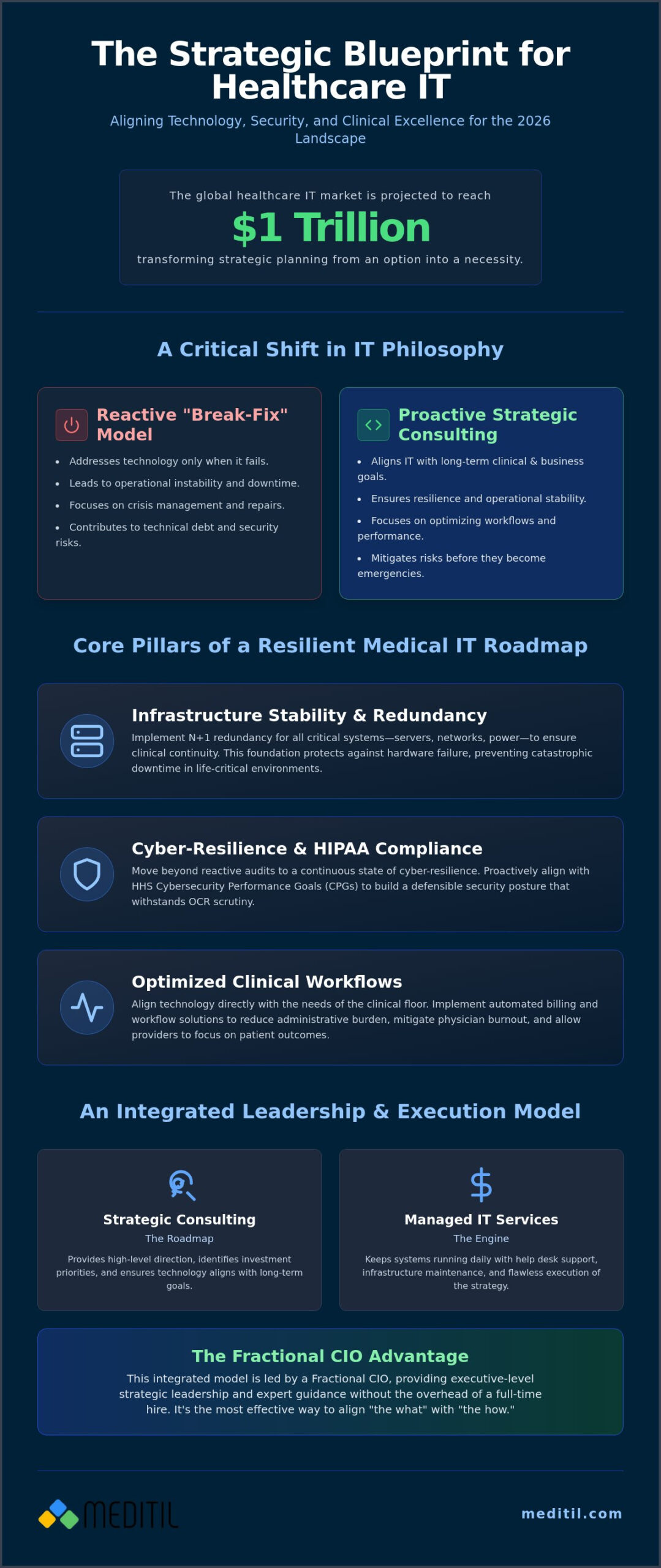
Healthcare IT strategy consulting is a specialized advisory service that aligns a medical organization’s technology investments with its clinical and business objectives. It moves beyond the traditional “break-fix” model where IT is only addressed when something fails. In the 2026 environment, this discipline acts as a proactive, strategic partnership. Healthcare IT strategy is the disciplined architecture of digital systems designed to optimize clinical workflows, ensuring that every technological investment directly enhances patient safety and maintains absolute data integrity. Engaging in healthcare it strategy consulting allows leaders to move from reactive crisis management to a state of operational stability.
General business consulting often falls short in this sector because it lacks the deep understanding of Health Informatics and the rigorous regulatory nuances required for medical data. A standard consultant might focus on general ROI, but they often overlook the specific technical debt found in aging EHR systems or the legal implications of HIPAA non-compliance. Medical leaders need a partner who understands that a system lag isn’t just an inconvenience; it’s a risk to patient care. Precision in data management is non-negotiable. Without a specialized roadmap, organizations risk investing in expensive tools that don’t talk to each other or fail to meet the strict security goals set by federal agencies.
The Evolution of IT Strategy in Modern Medicine
The 2026 landscape demands more than simple EHR maintenance. With the HTI-5 rule shifting focus toward FHIR-based APIs, medical leaders must prioritize interoperability over prescriptive functionality. This transition requires technical agility. You must move away from rigid, siloed systems toward a flexible infrastructure that supports real-time data access across the entire continuum of care. Strategic planning also plays a vital role in mitigating physician burnout. When technology supports the clinical floor rather than obstructing it, administrative burdens decrease. This allows providers to focus on their mission rather than fighting their tools.
Strategic Consulting vs. Managed Services
It’s helpful to distinguish between the roadmap and the engine. Strategic consulting provides the high-level roadmap, outlining where investments should go and how systems should integrate to meet long-term goals. Managed services provide the engine that keeps those systems running daily through help desk support and infrastructure maintenance. MEDITIL integrates both functions to ensure that your strategy is actually implementable. We act as a steady hand, providing the fractional leadership to design the plan and the managed IT capabilities to execute it. This dual approach ensures that “the what” and “the how” remain perfectly aligned, preventing the common failure where a grand strategy cannot be supported by the existing technical team.
Core Pillars of a Resilient Medical IT Roadmap
A resilient roadmap is built on more than just high-level goals. It requires a technical foundation that ensures clinical continuity even during system failures. Modern Health Information Technology (HIT) must prioritize infrastructure stability through N+1 redundancy. This means having backup systems ready to take over immediately if a primary server or network component fails. In life-critical environments, downtime isn’t an option. Expert healthcare IT strategy consulting ensures that these technical safeguards are integrated into the organization’s long-term vision rather than treated as afterthoughts.
Infrastructure stability is the engine that drives clinical excellence. When your network is designed with redundancy, you protect the organization from the catastrophic impact of hardware failure. This level of precision requires a disciplined approach to systems architecture. You must verify that your power supplies, cooling systems, and data pathways are all capable of sustaining operations during a localized outage. Strategic planning identifies these single points of failure before they become clinical emergencies.
Cybersecurity and HIPAA Compliance Strategy
Cyber-resilience is now a non-negotiable foundation. The Office for Civil Rights (OCR) increasingly uses the HHS Cybersecurity Performance Goals (CPGs) as benchmarks during HIPAA breach investigations. While these goals were once voluntary, 2026 rulemaking is pushing them toward mandatory status. Relying on annual audits is no longer sufficient. You need continuous monitoring to detect threats in real time. Integrating comprehensive healthcare cybersecurity services into your core strategy protects patient data and shields your organization from the rising costs of non-compliance.
Interoperability and System Integration
Interoperability has shifted from a “nice-to-have” feature to a regulatory mandate. The HTI-5 Proposed Rule, published on December 22, 2025, significantly changed the landscape by moving away from prescriptive functional requirements. The focus is now on FHIR-based Application Programming Interfaces (APIs). This allows for seamless data exchange between EMRs, billing platforms, and telehealth services. Breaking down these data silos reduces friction for clinicians and improves the patient experience by ensuring that accurate information is available at the point of care.
Successful integration depends on adhering to modern standards. Your 2026 IT strategy should focus on:
- Adopting HL7 and FHIR standards for seamless API-driven connectivity.
- Eliminating legacy data silos that prevent real-time information sharing.
- Verifying that third-party integrations meet the same security standards as your internal systems.
Effective data management transforms raw information into actionable business intelligence. Informed clinical decision-making relies on the ability to analyze trends across patient populations without manual data entry. A steady hand is required to manage these complex systems, ensuring that data stays secure yet accessible to those who need it. If you’re looking to strengthen your organization’s technical posture, professional healthcare IT consulting can help you identify and bridge existing gaps.
Fractional CIO vs. Traditional IT Consulting
Choosing the right model for healthcare it strategy consulting depends on your organization’s maturity and long-term objectives. Traditional consulting often focuses on a single deliverable, like a cloud migration or a security audit. While these projects are essential, they don’t always address the overarching need for a “steady hand at the wheel” to manage the complex regulatory shifts of 2026. This distinction is critical for medical leaders who must balance immediate technical needs with a sustainable roadmap for growth.
A Fractional CIO provides the high-level leadership of a full-time executive but at a fraction of the cost. This model is particularly effective for mid-market clinics that need a disciplined architecture for their IT spend. Instead of paying for a project that ends, you invest in a strategic partner who manages your entire IT lifecycle. This approach ensures that every technological decision is verified against your clinical and business goals, providing a level of technical confidence that transactional consulting cannot match.
What a Fractional CIO Delivers
Strategic IT budgeting and vendor management are core functions of this role. By aligning your IT spend with clinical outcomes, a Fractional CIO ensures that technology serves the mission of patient care rather than becoming a financial burden. You can learn more about virtual CIO services and their role in practice growth. This leadership model provides the technical confidence needed to navigate a regulated environment while maintaining a focus on improvement and stability.
When to Choose Project-Based Consulting
Traditional consulting is inherently transactional. It’s often the correct choice when you have a specific, time-bound problem to solve. If you’re managing a major EHR implementation or addressing a sudden gap identified in a HIPAA audit, a project-based consultant brings deep, specialized expertise for that specific task. These engagements are ideal for one-time transitions, such as moving legacy data to a hybrid cloud environment or conducting a specialized AI readiness assessment.
The challenge often arises when the project ends. Without an ongoing strategic partner, organizations risk reverting to a reactive posture where technical debt accumulates once again. The transition from project completion to continuous strategic management is where many medical leaders find the most value. In 2026, senior consultants with over 8 years of experience can charge $250 to $500 or more per hour. To efficiently source this high-level talent, many organizations rely on expert networks like consultingheads GmbH to find qualified independent consultants. The Fractional CIO model optimizes the cost-to-value ratio by providing this level of expertise on a consistent, part-time basis. This allows mid-market clinics to access elite leadership without the financial strain of a full-time executive salary.
Implementation: Bridging the Gap to Workflow Automation
A well-defined strategy is merely a theoretical exercise if it lacks a precise implementation phase. Many organizations discover that high-level planning fails when it doesn’t account for the daily realities of the clinical floor. Successful healthcare IT strategy consulting must bridge this gap by translating strategic objectives into functional, automated workflows. This phase requires a partner who understands both the technical architecture and the operational pressures faced by medical staff. Without this dual perspective, even the most sophisticated systems can become obstacles rather than assets.
Reducing the administrative burden is a primary goal of modern implementation. By focusing on intelligent system integration, you can automate repetitive tasks that lead to provider burnout. This isn’t just about installing software; it’s about verifying that every digital tool enhances clinical efficiency. A steady hand is required to manage the transition from legacy manual processes to a streamlined, automated environment that supports the organization’s long-term mission.
Billing Automation and Revenue Cycle Integration
Revenue cycle management often suffers from fragmented data and manual entry errors. By implementing medical billing automation solutions, you connect clinical documentation directly to the billing department. This alignment reduces claim denials caused by coding discrepancies or missing information. For practices looking to modernize their patient-facing financial tools, C Me Online provides expert e-commerce development that helps integrate secure and efficient online payment systems. Automation combined with user-friendly portals provides practice leaders with real-time financial visibility, allowing for proactive adjustments rather than reactive corrections. Clean data is the foundation of a healthy revenue cycle, ensuring that your organization remains financially stable while you focus on patient care.
EMR/EHR Optimization and Training
Standard “out of the box” EHR settings rarely meet the specific needs of a high-performing medical practice. Optimization involves customizing these clinical workflows to match how your providers actually work. This customization is essential for reducing “click fatigue” and allowing physicians to spend more time with patients. However, technical changes are only effective if the staff fully adopts them. Methodical training and ongoing support are non-negotiable components of a successful implementation strategy. You must ensure that every team member feels confident navigating the new architecture to realize the full value of your IT investment.
Precision in execution is what separates a successful digital transformation from a costly technical failure. If your current systems are creating more friction than flow, it’s time to align your infrastructure with your clinical goals. You can contact our team to discuss your implementation roadmap and ensure your technology supports your mission.
The MEDITIL Approach to Healthcare IT Strategy
MEDITIL provides a comprehensive partnership that addresses both the high-level vision and the daily operational needs of a medical practice. Our approach to healthcare IT strategy consulting is rooted in the belief that technical confidence is earned through precision and disciplined management. We don’t rely on generic IT templates or “one-size-fits-all” solutions. Instead, we customize every roadmap to align with your specific clinical goals and regulatory requirements. Whether we’re managing your entire internal IT team or providing fractional leadership, our focus remains on creating a secure, mission-driven environment that supports patient care.
The primary advantage of our model is the seamless connectivity between strategy and execution. Many firms offer advice but leave the technical implementation to others. We manage the high-level strategy while simultaneously overseeing the end-user help desk and infrastructure maintenance. This ensures that the insights gained from daily support tickets directly inform the long-term strategic plan. When your strategic partner also understands the common frustrations of your clinical staff, the resulting roadmap is more practical and effective. This dual capability provides a level of stability that transactional consulting firms cannot replicate.
Strategic IT Budgeting and Financial Roadmaps
Financial discipline is essential for long-term stability in a high-stakes industry. We help you plan for the future by implementing it budgeting for medical practices. This process involves a methodical review of your current technical landscape to identify and eliminate redundant software spend. Many organizations accumulate overlapping subscriptions and legacy tools over years of fragmented growth. By justifying every IT investment through a clear analysis of ROI and risk mitigation, we transform your technology from an unpredictable expense into a strategic asset. Our goal is to ensure that every dollar spent strengthens your infrastructure or improves your clinical output.
Your Steady Hand in a Regulated Environment
Operating in a highly regulated environment requires constant vigilance and an expert demeanor. We provide the peace of mind that comes from expert-led infrastructure management and a commitment to data protection. As your “steady hand at the wheel,” we ensure that your systems remain compliant with evolving federal standards while maintaining the seamless connectivity your providers require. We focus on the details of verification and protection so you can focus on your patients.
Beginning a partnership with MEDITIL starts with a thorough assessment of your current environment. This disciplined evaluation allows us to identify immediate security risks and long-term opportunities for workflow improvement. If you’re ready to move away from reactive IT and toward a proactive, strategic roadmap, our team is prepared to conduct a comprehensive assessment. Aligning your technical foundation with clinical excellence is a journey that requires a seasoned expert. We invite you to reach out and discover how a disciplined IT strategy can provide the stability your organization needs to thrive in 2026 and beyond.
Establishing a Resilient Foundation for 2026
The landscape of medical technology is shifting toward a model where interoperability and cyber-resilience are mandatory requirements. You’ve seen how a disciplined roadmap moves beyond simple maintenance to create a truly integrated ecosystem. By prioritizing N+1 redundancy and FHIR-based APIs, your organization can achieve the technical agility needed to thrive in an increasingly regulated environment. Precision in planning today prevents operational crises tomorrow.
Professional healthcare it strategy consulting ensures that your infrastructure supports, rather than hinders, your clinical mission. Whether you require Fractional CIO leadership for a mid-sized practice or managed IT services designed for clinical stability, the right partnership provides a steady hand at the wheel. MEDITIL offers specialized healthcare cybersecurity and HIPAA expertise to protect your data and your reputation. It’s time to move from a reactive posture to one of technical confidence and operational excellence.
If you’re ready to align your technical investments with clinical excellence, our team is prepared to guide your transformation. We invite you to Schedule a Strategic IT Consultation with MEDITIL to begin your assessment. We look forward to building a secure and stable future for your practice together.
Frequently Asked Questions
What is the difference between a vCIO and a traditional IT consultant?
A vCIO provides ongoing strategic leadership and executive-level guidance, whereas a traditional IT consultant typically focuses on specific, time-bound projects. The vCIO acts as a long-term partner invested in your organization’s overall stability and growth. In contrast, traditional consultants are often transactional, completing a predefined task or implementation and then concluding the engagement once the project is finished.
How long does a healthcare IT strategy engagement typically take?
A comprehensive initial assessment and roadmap development usually take between four to eight weeks. This duration depends on the size of the medical practice and the complexity of its existing infrastructure. Once the initial strategy is established, the engagement often transitions into a continuous management cycle to address evolving regulatory requirements and technical needs as they arise throughout the year.
Why is interoperability such a critical part of IT strategy in 2026?
Interoperability is essential because the HTI-5 rule mandates a shift toward FHIR-based APIs for seamless data exchange. In 2026, medical leaders must ensure that clinical and administrative systems communicate in real time to improve patient care and meet federal standards. Without interoperability, organizations remain trapped in inefficient data silos that increase administrative burden and prevent the effective use of population health data.
Can a small medical practice benefit from fractional CIO services?
Small practices gain significant value from fractional CIO services by accessing high-level expertise without the cost of a full-time executive. This model allows smaller organizations to implement professional healthcare IT strategy consulting that aligns their limited budgets with critical clinical goals. It provides a disciplined architecture for growth that is often unavailable to practices relying solely on reactive, “break-fix” technical support.
How does IT strategy consulting help with HIPAA compliance?
Strategy consulting integrates HIPAA compliance into the core technical architecture rather than treating it as a separate checklist. By aligning infrastructure with the HHS Cybersecurity Performance Goals, consultants ensure that data protection is continuous and verifiable. This proactive approach reduces the risk of breaches and prepares the organization for the increased scrutiny of federal audits through methodical documentation and security protocols.
What are the first steps in creating a healthcare IT roadmap?
The first step is a thorough discovery process that evaluates your current infrastructure, security posture, and clinical workflows. We identify existing technical debt and gaps in regulatory compliance to establish a baseline for improvement. This data-driven assessment informs the prioritization of investments, ensuring that the final roadmap addresses your most critical operational challenges and security vulnerabilities before moving to secondary objectives.
Does MEDITIL sell EMR or EHR software directly?
MEDITIL does not sell EMR or EHR software. We remain an independent advisory and managed services partner focused on the optimization and support of your chosen platforms. Our role is to provide expert guidance on the implementation, training, and integration of these systems to ensure they align with your organization’s specific clinical needs and strategic objectives without any vendor-related bias.
How do you measure the success of an IT strategy consulting engagement?
Success is measured through specific operational metrics such as reduced system downtime, improved claim denial rates, and increased clinician efficiency. A successful healthcare IT strategy consulting engagement also results in a clear, predictable IT budget and a measurable decrease in administrative burden for the clinical staff. We verify these outcomes through regular performance reviews that align technical performance with your practice’s mission-driven goals.