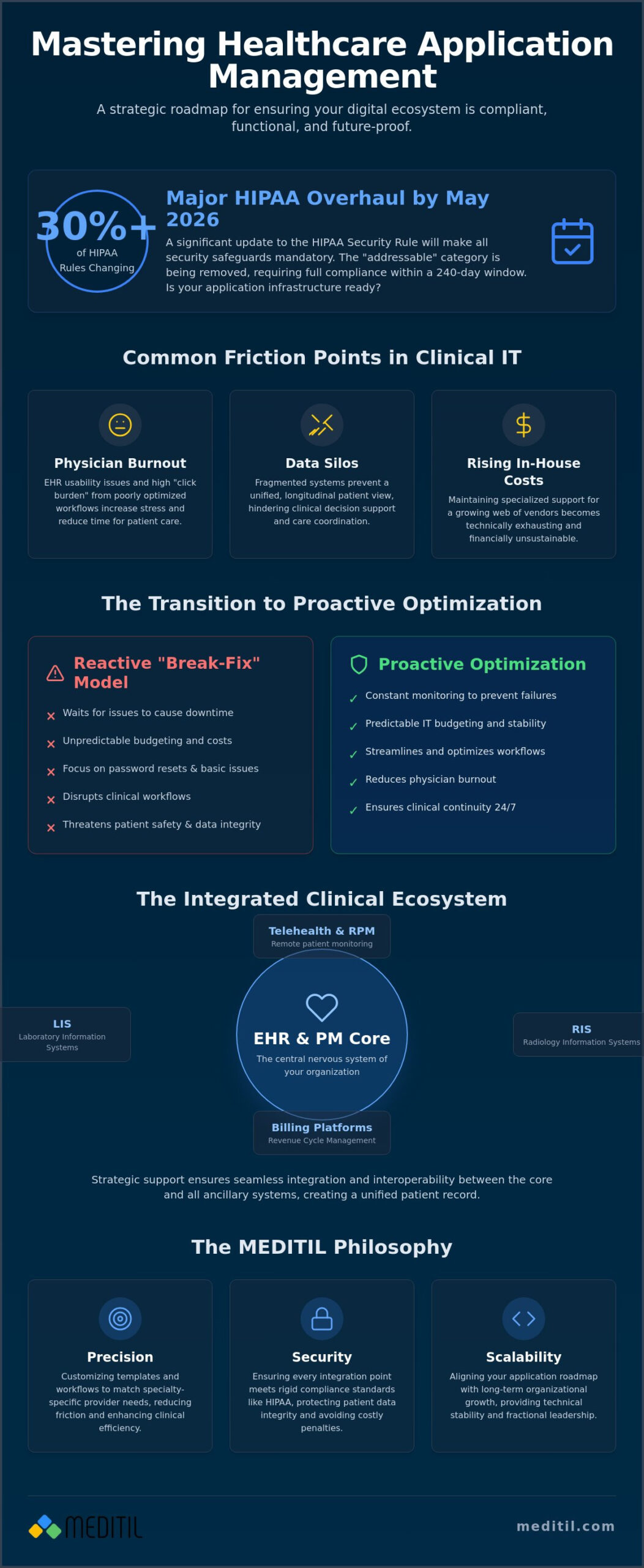
With over 30% of the HIPAA Privacy Rule set for a major overhaul by May 2026, clinical leaders can no longer treat their digital infrastructure as a static asset. You’ve likely felt the strain of physician burnout caused by EHR usability issues or the frustration of data silos that prevent a unified patient view. Maintaining specialized in-house healthcare application support services for a growing web of vendors is becoming prohibitively expensive and technically exhausting. We understand that your primary mission is patient care, not managing the friction of poorly integrated platforms.
This guide provides a strategic roadmap to master the complexities of application management, ensuring your digital ecosystem remains compliant and highly functional. You’ll learn how to achieve seamless interoperability between EHR, billing, and telehealth platforms while reducing clinical friction. We will examine the transition from reactive maintenance to proactive monitoring models that stabilize your infrastructure and provide predictable IT budgeting for the year ahead.
Key Takeaways
- Define the strategic scope of application management beyond the traditional help desk model to encompass the entire clinical hierarchy.
- Explore how specialized healthcare application support services facilitate interoperability to create a unified longitudinal patient record.
- Transition from reactive “break-fix” cycles to proactive optimization that streamlines clinical workflows and reduces physician burnout.
- Leverage fractional leadership to align your application roadmap with long-term organizational growth and technical stability.
- Implement the MEDITIL philosophy to ensure precision, security, and scalability across your entire digital ecosystem.
The Strategic Scope of Healthcare Application Support Services
Traditional IT help desks often fail in a clinical setting because they treat medical software like standard office productivity tools. True healthcare application support services go far beyond resetting passwords or troubleshooting hardware connectivity. This discipline requires a deep understanding of the Health information technology framework, where the primary goal is maintaining clinical continuity and data integrity. When an application fails in a hospital or clinic, it isn’t just an administrative inconvenience; it’s a potential threat to patient safety. Effective support ensures that life-critical data remains accessible 24/7, allowing providers to make informed decisions without technical interference.
Clinical leaders must view their software through a structured hierarchy. At the foundation lies the Electronic Health Record (EHR) and Practice Management (PM) systems, which serve as the central nervous system of the organization. Surrounding this core are ancillary systems like Radiology Information Systems (RIS), Laboratory Information Systems (LIS), and specialized billing platforms. General IT managed services often struggle with these nuances because they lack familiarity with HL7 standards or the specific interoperability requirements of medical data. Professional healthcare application support services bridge this gap by providing technicians who understand the clinical context of the data they’re protecting.
EHR and Practice Management Core Support
The heart of your digital ecosystem requires constant vigilance to remain efficient. Managing vendor relationships is a critical component of this support; you shouldn’t have to mediate between a software developer and a hardware provider. Expert support teams handle version updates and patches behind the scenes, ensuring that new features don’t disrupt established clinical paths or cause unexpected downtime. Customizing templates to match specialty-specific provider workflows is equally vital. It’s about reducing the “click burden” on physicians. We also prioritize the stability of patient-facing portals and scheduling tools, as even brief outages can damage patient trust and disrupt revenue cycles.
Supporting the Ancillary Clinical Ecosystem
A siloed EHR is a liability. Strategic support focuses on the seamless integration of RIS and LIS platforms to ensure that diagnostic results flow directly into the patient record without manual entry. As care models evolve, we also establish rigorous support protocols for telehealth and remote patient monitoring (RPM) platforms. These systems require specific security configurations and constant connectivity to monitor chronic conditions in real time. Comprehensive application support functions as the tactical execution of a broader healthcare it solutions strategy.
Interoperability Architecture and Data Integrity
Bridging fragmented data silos remains a primary challenge for clinical leadership. A longitudinal patient record requires more than simple connectivity; it demands a unified architecture where information flows without friction between EHRs, billing platforms, and diagnostic tools. When these systems communicate effectively, clinical decision support tools can provide real-time alerts that directly improve patient outcomes. However, achieving this requires healthcare application support services that prioritize data integrity at every touchpoint. During complex system migrations, the risk of data corruption or loss is high, necessitating a methodical approach to verification and validation.
Regulatory requirements add a layer of complexity to this architecture. In May 2026, a significant update to the HIPAA Security Rule is expected to finalize, making all security safeguards mandatory. The previous “addressable” category is being removed, and organizations will have only a 240-day window to reach full compliance. This shift places immense pressure on application support teams to ensure that every integration point meets these new, rigid standards. Maintaining a steady hand during these transitions is vital to avoid costly penalties and operational disruptions.
Modern Standards: HL7 and FHIR Integration
The Office of the National Coordinator for Health Information Technology (ONC) continues to push for the adoption of the FHIR standard to enhance patient access. While 8% of respondents in 2026 report using FHIR R5 as their primary standard, HL7 v2 still dominates internal data exchange. Strategic support involves managing this hybrid environment. We focus on API management to connect third-party clinical tools while proactively troubleshooting interface failures. This prevents technical glitches from delaying critical care or causing manual entry errors that compromise data quality.
Interoperability as a Security Frontier
Every new interface represents a potential entry point for unauthorized access. Securing data in transit requires robust encryption and precise Identity and Access Management (IAM) across the entire application stack. This ensures that only authorized personnel can access sensitive information as it moves between disparate systems. These efforts are inseparable from comprehensive healthcare cybersecurity services. If you are struggling to maintain data consistency across your platforms, exploring professional systems integration and interoperability consulting can provide the stability your clinical teams require.
Maintenance vs. Optimization: Shifting to Proactive Support
Reactive maintenance is a treadmill that leads to operational stagnation. Relying on a “break-fix” model ensures that your staff only interacts with IT during moments of failure, which builds technical debt and erodes trust in the digital ecosystem. Over time, these unresolved minor issues accumulate into significant clinical friction, slowing down patient care and frustrating providers. Strategic healthcare application support services prioritize optimization over simple repair, transforming the support function into a tool for continuous improvement.
Optimization in a clinical context means meticulously streamlining clicks, screens, and clinical paths. It’s about ensuring the software works for the clinician, rather than the clinician working for the software. By addressing the unique challenges for clinical leaders, proactive support identifies systemic workflow bottlenecks before they result in physician burnout. The financial impact of this friction is measurable; every minute a provider spends navigating a poorly optimized interface is a minute taken away from revenue-generating patient encounters.
Reducing Clinical Friction Through Application Tuning
We use support data as a diagnostic tool for your organization’s health. By analyzing EHR audit logs, support teams can identify redundant documentation steps that add no clinical value but consume valuable time. Collaborating directly with clinical staff allows us to refine application interfaces to better match the natural flow of a patient visit. This includes implementing automated alerts that provide critical value without contributing to alert fatigue. The goal is to create a “quiet” system that only interrupts the clinician when necessary, allowing them to focus on the patient.
Billing Automation and Revenue Cycle Support
The bridge between clinical care and financial sustainability lies in the application layer. Integrating billing software with clinical documentation allows for real-time coding, which significantly reduces the lag in the revenue cycle. When claims are rejected, we don’t just fix the individual error; we troubleshoot the underlying rejection patterns within the application to prevent future occurrences. For organizations looking to maximize their financial health, we recommend reviewing our guide on medical billing automation solutions. This level of deep optimization ensures that your healthcare application support services are actively contributing to the practice’s bottom line.
Building a Strategic Support Roadmap for 2026
A three year growth plan requires a technology foundation that scales alongside clinical volume. Application support cannot remain static while your organization expands; it must be integrated into a broader strategic roadmap that anticipates future needs and avoids the pitfalls of technical debt. Evaluating the Return on Investment (ROI) of an application upgrade versus a total system replacement is a complex calculation that requires deep industry expertise. Professional healthcare application support services provide the data necessary to make these high stakes decisions, ensuring that every dollar spent contributes to long term stability. When clinical leaders consider system replacements, they often overlook the hidden costs of training and data migration. A strategic roadmap evaluates these factors against the potential gains in efficiency and provider satisfaction.
Specialized healthcare application support services analyze current system performance to determine if an existing platform can be optimized or if it has reached its natural end of life. This proactive evaluation prevents the “sunk cost” fallacy, where organizations continue to fund failing systems simply because of the initial investment. By looking ahead to 2026, clinical leaders can ensure their infrastructure is not just functional for today, but ready for the next generation of medical technology.
The Role of the Fractional CIO in Application Strategy
The Fractional CIO acts as the bridge between clinical necessity and technical execution. This role is essential for translating provider needs into rigid technical requirements during vendor selection. Strategic oversight of it budgeting for medical practices ensures that resources are allocated efficiently, preventing the accumulation of technical debt that often plagues growing clinics. By aligning application support metrics with business intelligence (BI) goals, a vCIO ensures that your technology stack provides the actionable data required for executive decision making. This leadership ensures that application lifecycles are managed with precision, from initial implementation to eventual decommissioning.
Future-Proofing: AI and Machine Learning Readiness
Preparing for 2026 means readying your infrastructure for AI assisted diagnostic tools and ambient clinical intelligence. These technologies require robust data pipelines and specific support protocols to maintain accuracy and security. Since 72% of healthcare technology experts believe AI increases the importance of investing in FHIR, your roadmap must prioritize these standards to ensure seamless data flow. Support requirements for voice to EHR tools, for example, demand specialized network configurations and high bandwidth to function without latency. Managing the ethical and security implications of AI is no longer optional; it requires a disciplined approach to identity management and data protection to prevent unauthorized access to sensitive patient models.
If your current technology path feels disconnected from your organizational goals, our Fractional CIO services can provide the strategic leadership necessary to secure your future.
The MEDITIL Approach: Managed Support for Scalable Care
Precision in healthcare IT is not a luxury; it’s a requirement for patient safety and organizational stability. The MEDITIL “Steady Hand” philosophy is built on the understanding that every minute of application downtime or every lag in data exchange has a direct impact on clinical outcomes. We provide healthcare application support services that are specifically designed for the high-stakes nature of modern medicine. By moving beyond the generic help desk model, we offer a disciplined, methodical approach to infrastructure management that ensures your critical systems are always available and optimized for performance.
Scalability is a core component of our service delivery. Whether your organization is a single-specialty clinic or a multi-state health system, our support models are custom-tailored to meet your specific operational needs. We integrate virtual cio services directly with our frontline support teams to ensure that daily technical tasks are always aligned with your long-term strategic objectives. This national reach allows us to provide top-tier expertise without the constraints of regional talent pools, ensuring you have access to the best specialists in the industry regardless of your physical location.
Augmented IT Teams for Complex Environments
Many organizations possess a capable internal IT staff but lack the specific bandwidth to manage complex EHR ecosystems. Our augmented IT team model fills these specialized gaps, providing deep expertise in platforms such as Epic, Cerner, and NextGen. We don’t replace your existing staff; we blend seamlessly with them to scale your capacity and handle the heavy lifting of version updates and vendor management. This includes providing help desk support that is deeply familiar with medical terminology and clinical workflows. By handling the routine complexities of healthcare application support services, we allow your internal team to focus on high-level initiatives that drive practice growth.
Strategic Partnership and Business Intelligence
Our role as a strategic partner extends into the realm of actionable data. We move beyond simply resolving tickets to deliver business analytics that help you understand system utilization and provider efficiency. Continuous compliance monitoring is a standard feature of our support framework, ensuring that your applications remain aligned with the evolving regulatory requirements of 2026. We provide a steady presence that anticipates challenges before they disrupt your workflow, giving you the confidence that your technology is being handled with technical precision. MEDITIL transforms application support from a necessary expense into a high-performing clinical asset that empowers your providers and protects your patients.
Securing Your Clinical Infrastructure for 2026 and Beyond
Clinical leaders must transition from reactive maintenance to a proactive optimization model that prioritizes interoperability and data integrity. By aligning your application stack with long term growth objectives and emerging AI standards, you reduce the technical burden on your providers while ensuring strict regulatory compliance. Specialized healthcare application support services provide the technical precision required to manage these complex ecosystems effectively, allowing your staff to focus entirely on patient outcomes rather than software friction. To support these outcomes through inclusive care, you can visit Gender Identity Center for their guide on LGBTQ terminology and affirming communication.
Our approach provides the stability your organization requires through Fractional CIO leadership included in every strategic roadmap. We offer specialized expertise in major EHR and EMR platforms alongside national support coverage designed for high volume healthcare organizations. Schedule a Strategic Application Support Consultation with MEDITIL to begin optimizing your digital environment today. We are ready to help you transform your technology into a reliable engine for scalable, patient centered care.
Frequently Asked Questions
What is included in healthcare application support services?
These services include the comprehensive management of clinical software such as EHR/EMR, Practice Management, and billing systems. Support encompasses vendor management, version updates, interface troubleshooting, and proactive workflow optimization. By handling these technical complexities, the service ensures that your digital ecosystem remains functional and aligned with clinical needs without requiring your internal staff to mediate with software developers.
How does application support differ from general managed IT services?
Application support focuses on the functional layer of medical software and clinical workflows, while general managed IT handles the underlying hardware and network infrastructure. While general IT ensures your servers and workstations are running, application support ensures your specific clinical tools are optimized for provider efficiency. This distinction is vital for maintaining high performance in highly regulated, life-critical medical environments.
Can a third-party provider support a proprietary or niche clinical application?
Yes, experienced providers can support niche or proprietary applications by collaborating with the software vendor and documenting your specific organizational configurations. This process involves a technical analysis of the application’s database, interface standards, and security protocols. A strategic partner acts as a specialized extension of your team, ensuring even unique, specialty-specific tools are integrated into your broader support framework.
How do you ensure HIPAA compliance when accessing clinical applications remotely?
Remote access is secured through multi-factor authentication (MFA), encrypted VPN tunnels, and strict identity and access management (IAM) protocols. Every support interaction is logged and audited to ensure compliance with the latest HIPAA Security Rule requirements. This methodical approach protects patient data in transit and ensures that only authorized technicians can perform maintenance on sensitive systems containing protected health information.
What is the role of a vCIO in healthcare application management?
A vCIO provides high-level strategic oversight, aligning your application lifecycle with the organization’s long-term growth and financial goals. They oversee vendor selection, manage IT budgeting, and ensure that healthcare application support services deliver measurable value to the practice. This leadership role prevents technical debt by planning for future upgrades and ensuring all systems remain interoperable and compliant with evolving standards.
How can application support help reduce physician burnout?
Support teams reduce burnout by optimizing user interfaces and streamlining documentation workflows to minimize unnecessary clicks. By analyzing EHR audit logs, technicians can identify and remove redundant steps that cause clinical friction for your providers. When the technology works seamlessly with the clinician’s natural workflow, the administrative burden is significantly reduced, allowing them to focus more on patient care.
What is the typical response time for critical clinical application failures?
Response times for critical failures are governed by strict Service Level Agreements (SLAs) that prioritize life-critical systems. Professional healthcare application support services aim for immediate acknowledgment and rapid resolution of high-severity issues that directly impact patient safety or clinic operations. These protocols ensure that a steady hand is always available to restore functionality during an emergency, minimizing operational disruption and protecting clinical continuity.
How do you manage software updates for EHRs without disrupting patient care?
Updates are managed through a structured change management process that includes testing in a sandbox environment before live deployment. Deployments are typically scheduled during low-volume periods to avoid impacting clinical hours or patient access. This intentional pacing, combined with clear communication to staff regarding new features, ensures that version transitions occur smoothly without compromising provider productivity or the integrity of the patient record.