
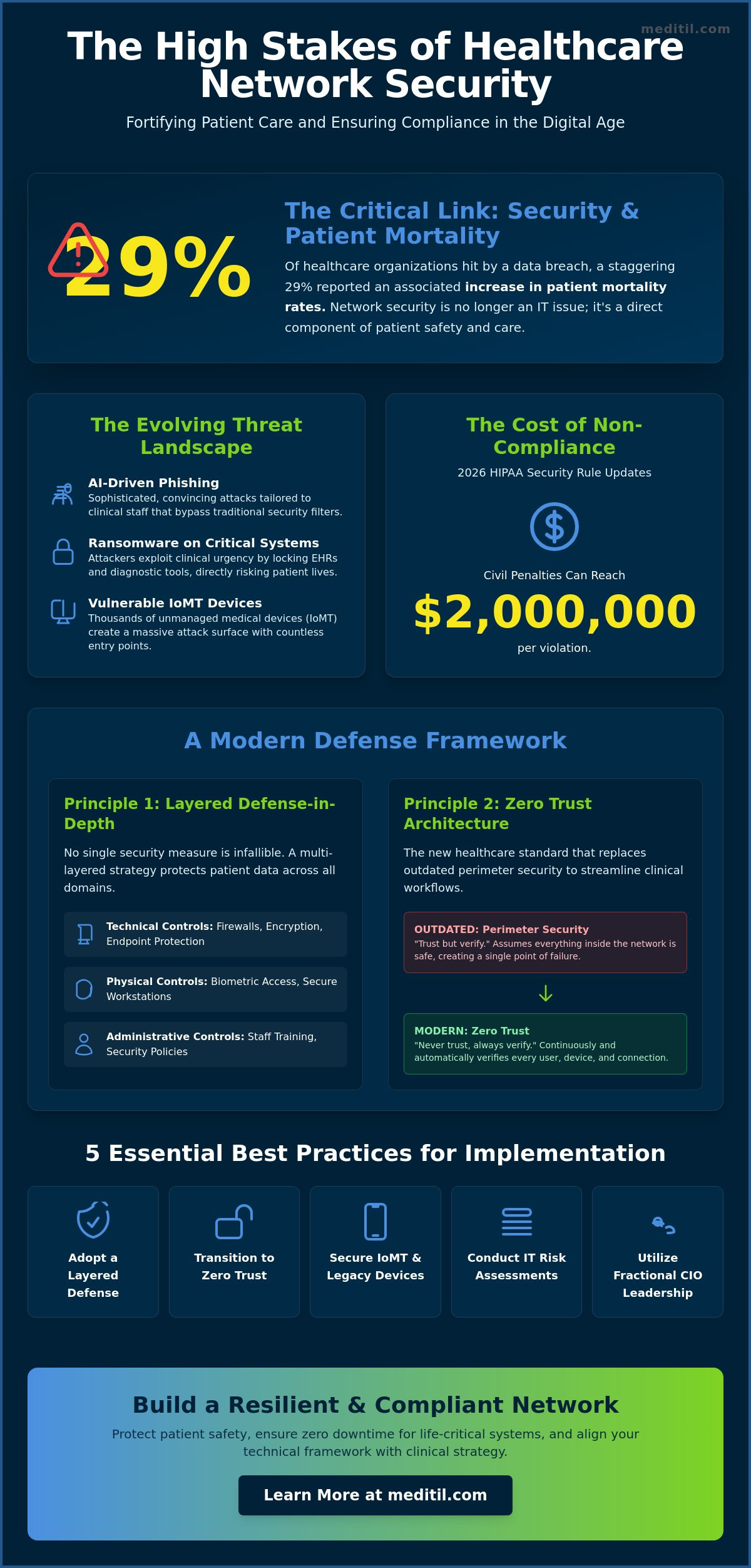
Did you know that 29% of healthcare organizations experiencing a data breach in 2025 reported a direct increase in patient mortality rates? This sobering reality confirms that network security is no longer just a back-office IT concern; it’s a fundamental component of patient care. As you refine your network security best practices, you’re likely feeling the pressure of the 2026 HIPAA Security Rule updates and the threat of civil penalties reaching $2 million per violation. It’s a difficult balance to maintain when you’re also managing legacy medical devices and trying to prevent clinician burnout from overbearing security protocols.
We understand that your goal is a secure, stable network that operates invisibly in the background. This guide provides a comprehensive framework for achieving full regulatory compliance and zero downtime for life-critical systems. We’ll examine the shift toward Zero Trust architecture, the new mandatory safeguards for encryption and multi-factor authentication, and strategic ways to fortify your infrastructure against evolving global threats without disrupting the clinical workflow.
Key Takeaways
- Understand the mechanics of a layered defense-in-depth model to protect life-critical systems from sophisticated ransomware threats.
- Learn how Zero Trust architecture can actually streamline clinical workflows by replacing outdated perimeter security with continuous, automated verification.
- Identify the essential network security best practices required to meet the 2026 HIPAA Security Rule updates and protect patient safety.
- Discover the strategic value of conducting comprehensive IT risk assessments to identify vulnerabilities in legacy medical devices and infrastructure.
- Explore how fractional CIO leadership bridges the gap between technical security frameworks and high-level clinical business strategy.
The Stakes of Healthcare Network Security in 2026
Healthcare network security represents the digital infrastructure that ensures life-critical data and medical systems remain accessible and accurate. As we navigate the complexities of 2026, the definition has expanded beyond simple encryption. It now encompasses the operational integrity of every device connected to the clinical environment. Medical practices remain high-value targets for ransomware because attackers recognize that clinical urgency creates leverage. When life-saving systems are locked, providers face an impossible choice between paying a ransom or risking patient lives. This vulnerability is often exacerbated by technical debt. These are the aging servers, unpatched workstations, and legacy medical devices that lack the capacity to support modern security protocols. Ignoring these upgrades creates a fragile foundation that cannot withstand modern intrusion attempts.
Beyond HIPAA: The Patient Safety Mandate
The conversation surrounding healthcare IT has shifted significantly. While regulatory compliance remains a priority, the primary driver for robust network security principles is now patient safety. Network downtime doesn’t just result in administrative delays; it leads to postponed surgeries, inaccessible diagnostic imaging, and medication errors. These disruptions carry profound legal and ethical consequences for any practice. A hospital that cannot access patient records is a hospital that cannot safely treat patients. Maintaining 24/7 uptime requires a proactive approach, often facilitated through managed it services for healthcare to ensure that security measures never impede the speed of care. IT teams must treat network stability as a clinical vital sign.
The Evolving Threat Landscape for Medical Practices
The threats facing modern clinics have become increasingly sophisticated. AI-driven phishing campaigns now create highly convincing social engineering attacks that bypass traditional filters. These attacks are tailored to clinical staff, often mimicking urgent administrative requests or patient inquiries. Simultaneously, the Internet of Medical Things (IoMT) introduces thousands of unmanaged endpoints into the network, each representing a potential entry point for exploits. Because EHR systems are deeply integrated with billing and diagnostic tools, a single point of failure can paralyze an entire organization. Implementing modern network security best practices is the only way to mitigate these risks. In this context, the “blast radius” of a breach is the total volume of clinical operations, patient lives, and financial assets affected by a single compromised credential.
Implementing a Layered Defense-in-Depth Model
A defense-in-depth model operates on the principle that no single security measure is infallible. In a healthcare setting, this requires a multi-layered strategy that protects patient data across administrative, technical, and physical domains. Technical controls such as next-generation firewalls, end-to-end encryption, and robust endpoint protection form the digital perimeter. However, these must be supported by physical controls, including biometric access to server rooms and the secure positioning of workstations to prevent unauthorized viewing of protected health information (PHI). By layering these defenses, you ensure that if one barrier is breached, additional obstacles remain to protect the network. This comprehensive approach is central to modern network security best practices and aligns with the transition toward a Zero Trust Architecture as defined by NIST.
Securing the IoMT and Legacy Medical Devices
The Internet of Medical Things (IoMT) presents a unique challenge for IT teams because many devices lack native security features. Effective management begins with an exhaustive inventory. You cannot protect what you cannot see. Once cataloged, legacy systems that are no longer eligible for manufacturer patches should be isolated through network micro-segmentation. This isolation prevents a compromised infusion pump or imaging machine from serving as an entry point to the broader hospital network. If you’re struggling to balance these technical requirements with daily operations, seeking professional infrastructure and network services can provide the specialized expertise needed to secure these vulnerable endpoints without disrupting care.
Administrative Safeguards and Clinical Training
Administrative controls are the policies and procedures that govern human interaction with technology. A successful security framework requires a healthcare-specific network infrastructure audit to identify gaps in current protocols. From there, IT teams should develop “Clinical-First” policies. These are security measures designed to fit into a doctor’s or nurse’s workflow rather than obstructing it. For example, implementing single sign-on (SSO) can improve security while reducing the time clinicians spend logging into various systems. Regular, role-based training is also vital. Staff should receive education tailored to their specific duties, ensuring they understand their role in maintaining network security best practices. When clinicians view security as a tool that protects their patients rather than a hurdle to overcome, the overall resilience of the organization increases significantly.
Zero Trust Architecture: The New Healthcare Standard
The traditional “castle-and-moat” security model is no longer sufficient for the modern medical environment. Zero Trust architecture represents a fundamental shift in network security best practices by operating on a single, uncompromising principle: never trust, always verify. Under this framework, no user or device is granted inherent trust based on their location within the network. Every request for access to clinical data or applications must be authenticated, authorized, and continuously validated. This approach assumes that threats already exist both inside and outside the perimeter. By requiring strict verification for every interaction, IT teams can significantly reduce the risk of unauthorized access to sensitive patient information.
A common concern among healthcare administrators is that increased security will inevitably lead to clinical friction. However, a well-executed Zero Trust strategy often has the opposite effect. By replacing manual, perimeter-based checks with automated, identity-centric verification, you can actually streamline the provider experience. Security becomes a silent, background process that protects the organization without requiring clinicians to jump through unnecessary hoops. It moves the focus from securing the network as a whole to securing the individual data points and applications that providers use every day. Organizations looking to implement this model effectively should explore specialized healthcare cybersecurity services that are purpose-built to address the unique demands of clinical environments.
Micro-segmentation for Clinical Continuity
Micro-segmentation is the process of dividing a network into small, isolated zones to maintain granular control over data traffic. In a healthcare setting, this means strictly separating guest Wi-Fi from administrative traffic and clinical data. This isolation is vital for preventing the lateral movement of threats. If a ransomware infection reaches a single workstation, micro-segmentation ensures the threat is contained within that specific segment. For example, an IT team can isolate a compromised billing computer in real time without having to shut down the entire EHR system. This containment strategy ensures that life-critical systems remain operational even during an active security incident, preserving both data integrity and patient safety. A comprehensive healthcare network segmentation strategy provides the clinical-first framework needed to implement these protections effectively across your entire infrastructure.
Advanced Identity and Access Management
Identity and Access Management (IAM) serves as the foundation of the Zero Trust model. Implementing Multi-Factor Authentication (MFA) is now a mandatory requirement, but it must be deployed in a way that doesn’t hinder urgent care. Modern IAM solutions use adaptive authentication, which adjusts security requirements based on the user’s context, such as their location or device health. Single Sign-On (SSO) further improves efficiency by allowing providers to access multiple clinical applications with a single set of verified credentials. Additionally, IAM frameworks must extend to third-party partners. Managing vendor access for billing or insurance partners through time-limited, “least-privileged” permissions ensures that external entities only see the data they absolutely need to perform their roles.
5 Essential Best Practices for Healthcare IT Implementation
Establishing a resilient infrastructure requires moving beyond theoretical frameworks into specific, actionable steps. These five core pillars represent the essential network security best practices for any modern medical facility. Implementing these measures ensures that your organization remains compliant with 2026 standards while maintaining a focus on clinical continuity.
- Step 1: Conduct a Comprehensive Healthcare IT Risk Assessment. This process identifies how patient data flows through your systems and highlights vulnerabilities in legacy medical devices. With the average cost of a healthcare breach projected to reach $12.6 million in 2026, understanding your risk profile is a financial necessity.
- Step 2: Enforce Strict End-to-End Encryption for PHI. You must ensure that Protected Health Information is encrypted both at rest and in transit. This prevents unauthorized parties from accessing sensitive data even if they manage to intercept network traffic.
- Step 3: Implement Automated Patch Management for All Systems. Manual updates are prone to human error and often fall behind. Automation ensures that every server, workstation, and connected medical device receives critical security fixes immediately.
- Step 4: Establish Real-Time Network Monitoring and SIEM. Continuous oversight allows your team to detect and respond to threats before they can cause significant damage.
- Step 5: Develop and Test a Robust Disaster Recovery Plan. A plan is only effective if it’s proven to work under pressure. Regular testing ensures that your team can restore critical systems within the required timeframes.
If your internal team is overstretched by these requirements, our cybersecurity and compliance specialists can help you implement these frameworks with precision, ensuring your network remains a reliable asset for patient care.
Real-Time Monitoring and Incident Response
Security Information and Event Management (SIEM) acts as the central nervous system of your security operations. It aggregates logs from across the network to provide a unified view of potential threats. By defining “normal” network behavior, such as typical login times or standard data transfer volumes, the system can instantly flag anomalies that suggest a breach. Your incident response plan must also include clinical communication protocols. IT teams need a clear method for informing providers about system statuses to prevent confusion and maintain safety during a security event.
Disaster Recovery and Business Continuity
There’s a critical difference between a backup and business continuity. A backup is simply a copy of data; continuity is the ability to maintain clinical operations during a system failure. Testing your recovery times is essential to ensure they align with the needs of urgent care. For an EHR system, the Recovery Time Objective (RTO) is the maximum acceptable duration that a clinical application can be offline before it begins to compromise patient safety. Maintaining high standards for network security best practices means ensuring that your recovery protocols are as robust as your defensive barriers.
Scaling Security with Strategic vCIO Leadership
Effective network security is not a static destination; it’s a strategic journey that requires high-level oversight. While technical teams focus on the daily execution of network security best practices, a fractional CIO bridges the gap between these operational tasks and your organization’s long-term business objectives. This leadership ensures that cybersecurity investments aren’t just technical expenses but are directly aligned with clinical outcomes and return on investment. By providing a steady hand at the wheel, MEDITIL acts as a strategic partner that understands the high-stakes nature of healthcare infrastructure management. This partnership allows you to focus on patient care while we manage the complexities of your digital environment.
A virtual CIO services partner is particularly valuable when navigating the rapid regulatory shifts occurring in 2026. With the recent updates to the HIPAA Security Rule making previously addressable safeguards mandatory, having a seasoned expert to interpret these changes is essential. We help you transition from reactive troubleshooting to proactive infrastructure advancement, ensuring your network remains a stable foundation for growth. Our approach prioritizes precision and reliability, suggesting that every detail of your security framework is being handled with expert care.
Strategic Roadmap Development
A vCIO develops a customized roadmap that prioritizes security upgrades based on a rigorous analysis of risk and budget. This ensures that your most critical vulnerabilities are addressed first, preventing the accumulation of technical debt that often plagues aging medical facilities. As your practice expands into telehealth and remote monitoring initiatives, we ensure your network scales seamlessly to handle increased data loads without compromising security. Managing the lifecycle of medical IT assets is a core part of this strategy; we ensure that legacy systems are decommissioned or isolated before they become liabilities. This methodical approach transforms your IT department from a cost center into a resilient clinical asset.
Proactive Compliance and Risk Management
Staying ahead of evolving HIPAA and state-level data protection laws requires constant vigilance. In 2026, regulators are shifting their focus from the mere existence of a risk analysis to how organizations act on those findings. We provide continuous compliance monitoring to ensure your practice is always prepared for an audit. This proactive stance significantly reduces the risk of massive civil penalties, which can now reach $2 million per violation category. By integrating network security best practices into every level of your administration, we build a culture of security that protects both your reputation and your patients. Schedule a consultation with MEDITIL to secure your practice today.
Securing the Future of Clinical Excellence
The digital landscape of 2026 demands a fundamental shift in how we perceive healthcare infrastructure. It’s no longer just about maintaining connectivity; it’s about safeguarding the clinical integrity of every patient interaction. By adopting a Zero Trust framework and implementing rigorous network security best practices, your organization can transition from a reactive posture to one of proactive resilience. This strategic shift ensures that your life-critical systems remain operational and your compliance with updated HIPAA standards is unshakeable.
Navigating these complexities requires more than just technical support; it requires a seasoned partner. We offer a specialized Healthcare IT focus and fractional CIO strategic advisory to help you scale your defenses with precision. Our comprehensive Cybersecurity & Compliance solutions provide the steady hand your practice needs to thrive in an increasingly regulated environment. Partner with MEDITIL for Authority-Led Healthcare IT Security to secure your infrastructure today. You have the power to build a secure foundation that empowers your providers and protects your patients for years to come.
Frequently Asked Questions
What are the most common network security threats facing healthcare in 2026?
In 2026, healthcare organizations face sophisticated AI-driven phishing campaigns and state-sponsored ransomware attacks designed to disrupt life-critical systems. These threats often target the proliferation of Internet of Medical Things (IoMT) devices, which frequently lack modern security features. Attackers leverage these vulnerabilities to gain entry into the broader network, aiming to exfiltrate patient data or lock clinical systems for ransom.
How does network segmentation help with HIPAA compliance?
Network segmentation supports HIPAA compliance by isolating Protected Health Information (PHI) within secure, restricted zones that are inaccessible to unauthorized users. This practice directly addresses the technical safeguards required under the HIPAA Security Rule by limiting the “blast radius” of a potential breach. By separating guest Wi-Fi and administrative traffic from clinical data, organizations demonstrate a proactive commitment to protecting sensitive patient records. Explore our detailed guide on healthcare network segmentation strategies for 2026 to learn how to implement these protections in your practice.
Can we achieve high security without slowing down our EHR performance?
You can achieve high security without compromising EHR performance by implementing background-optimized network security best practices. Modern security tools like micro-segmentation and adaptive authentication are engineered to operate with minimal latency. When these systems are properly configured by experts, security becomes a silent facilitator of clinical care rather than a bottleneck for provider productivity.
What is the role of MFA in a clinical environment?
Multi-Factor Authentication (MFA) serves as a mandatory safeguard in 2026 that prevents unauthorized access even if a clinician’s credentials are compromised. In a fast-paced clinical environment, adaptive MFA uses context-aware triggers to verify identities without requiring constant, manual re-authentication during urgent care. This balance ensures that patient data remains protected while providers maintain the speed necessary for life-saving treatments.
How often should a medical practice perform a network security audit?
A comprehensive network security audit should be performed at least annually, though the industry is shifting toward continuous compliance monitoring. Regular assessments are necessary to identify new vulnerabilities in your evolving infrastructure and ensure alignment with the latest regulatory updates. More frequent audits are often required after significant system integrations or the introduction of new medical devices to the network.
What happens if our medical devices cannot be updated with the latest security patches?
If legacy medical devices cannot support modern security patches, they must be isolated through strict network micro-segmentation. This approach places vulnerable hardware on a separate, restricted network segment to prevent any potential infection from spreading to the rest of the facility. This containment strategy allows you to continue using essential clinical equipment while maintaining the overall integrity of your healthcare network.
Is cloud-based healthcare storage more secure than on-premises servers?
Cloud-based healthcare storage is often more secure than on-premises servers because major cloud providers offer advanced physical security and automated patching that many clinics cannot maintain internally. However, security in the cloud operates on a shared responsibility model where the practice remains responsible for managing access controls and data encryption. A properly managed cloud environment effectively reduces the risk of technical debt and hardware failure.
How does a fractional CIO help with network security?
A fractional CIO provides the strategic leadership needed to align your technical network security best practices with your organization’s long-term clinical and financial goals. They act as a seasoned expert who navigates complex regulatory changes, manages IT budgets, and develops a proactive security roadmap. This leadership ensures that your infrastructure is not just protected but also optimized for operational stability and clinical excellence.
2 Responses