
Nearly 1 in 4 healthcare providers reported an increase in patient mortality rates following a ransomware attack in 2025. This sobering statistic from the Ponemon Institute highlights a critical reality: network security is no longer just an IT concern; it’s a fundamental patient safety mandate. You likely recognize that your current defenses are under immense pressure. The threat of ransomware moving laterally across your practice is a constant worry, yet you cannot afford to introduce clinical friction that hinders a physician’s ability to deliver timely care. Implementing a sophisticated healthcare network segmentation strategy is the most effective way to isolate these threats while maintaining the continuity of life-critical workflows.
We understand the anxiety surrounding upcoming regulatory shifts and the technical complexity of modern infrastructure. You deserve a security posture that provides both protection and performance. This article outlines a clinical-first framework for 2026 that ensures your organization remains compliant with the latest proposed HIPAA mandates. We will examine how to replace addressable safeguards with mandatory controls, how to maintain a precise asset inventory, and how to build a resilient network that protects your patients and your reputation.
Key Takeaways
- Understand how architectural isolation prevents the lateral movement of ransomware across sensitive clinical systems.
- Discover specific segmentation patterns designed to secure EHR traffic and Internet of Medical Things (IoMT) devices.
- Evaluate the advantages of software-defined micro-segmentation over traditional VLANs for more granular, identity-based security.
- Follow a structured roadmap for healthcare network segmentation that prioritizes clinical workflow continuity during the policy design phase.
- Learn how a strategic security framework ensures alignment with 2026 HIPAA mandates while minimizing operational friction.
The Role of Healthcare Network Segmentation in 2026
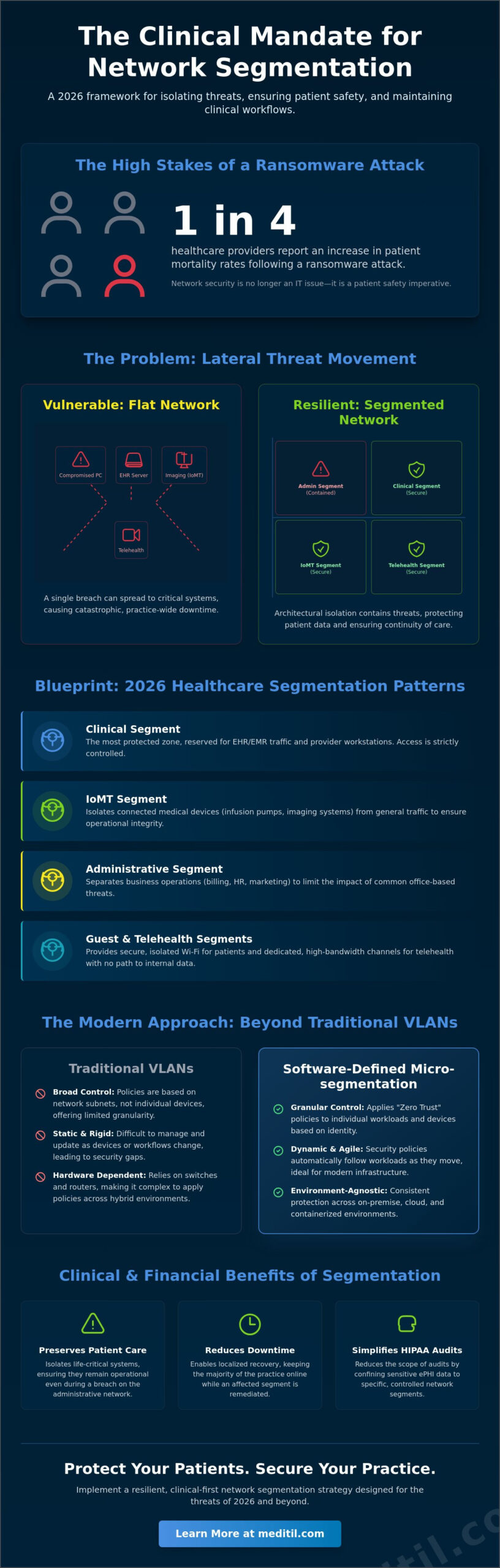
In the current threat environment, healthcare network segmentation has evolved from a technical recommendation to a foundational pillar of clinical safety. At its core, Network segmentation is the architectural isolation of sensitive clinical data and systems into distinct, controlled sub-networks. This strategy creates internal barriers that prevent a single point of compromise from escalating into a practice-wide catastrophe. By 2026, the traditional “flat network” model, where all devices share the same communication pathways, has become a significant liability. If an administrative workstation is infected with ransomware, a flat network allows that malware to move laterally, potentially reaching electronic health records (EHR) or life-sustaining medical equipment.
The strategic shift in 2026 focuses on moving beyond simple perimeter defense. While firewalls at the edge remain necessary, they can’t stop threats that originate from within or bypass the boundary through compromised credentials. Modern security requires micro-segmentation. This approach applies granular policies to individual workloads, ensuring that only authorized traffic can pass between specific segments of the practice. It’s a “steady hand at the wheel” approach that prioritizes stability and control over the entire digital infrastructure. You’re no longer just building a wall; you’re building a vault with individual safety deposit boxes.
Beyond HIPAA: The Clinical Necessity of Isolation
While regulatory compliance is a major driver, the primary motivation for segmentation is the preservation of patient care. Isolating life-critical systems, such as real-time monitoring and surgical equipment, ensures that these devices remain operational even if the administrative network suffers a breach. Additionally, segmentation manages network congestion. High-bandwidth activities like telehealth consultations or large imaging transfers shouldn’t compete for resources with critical patient telemetry. Comprehensive healthcare cybersecurity services must include this architectural isolation to guarantee that clinical workflows remain uninterrupted during localized incidents. It’s about ensuring the heart monitor stays connected even if the billing department is offline.
The Financial Impact of a Flat Network
The economic consequences of a flat network are often staggering. In a non-segmented environment, a breach usually necessitates a total network shutdown to contain the threat, leading to massive downtime costs. Conversely, a segmented network allows for localized recovery, keeping the majority of the practice online while the affected area is remediated. This structure also significantly reduces the scope of HIPAA audits. When sensitive data is confined to a specific segment, auditors only need to verify the controls within that boundary, saving hundreds of administrative hours. Finally, many insurance providers now offer premium reductions to organizations that demonstrate mature network security services, viewing segmentation as a key indicator of a low-risk profile.
Mapping the Healthcare Network: 2026 Segmentation Patterns
Effective healthcare network segmentation requires a blueprint that mirrors your clinical reality. It’s not a one-size-fits-all solution. In 2026, successful practices utilize specific patterns to ensure that data flows stay within their intended boundaries. When executing healthcare network segmentation, the goal is to create a predictable environment where every packet of data has a known, authorized destination. These patterns typically include:
- The Clinical Segment: This zone is reserved exclusively for EHR/EMR traffic and provider workstations. It is the most highly protected area of your infrastructure.
- The IoMT Segment: Connected medical devices like infusion pumps and imaging systems reside here, isolated from the public internet and general office traffic.
- The Administrative Segment: Business operations, such as billing, HR, and marketing, are kept separate from patient care systems to limit the impact of common office-based threats.
- The Guest Segment: Patients and visitors receive secure, isolated Wi-Fi that has no logical path to any internal practice data.
- The Telehealth Segment: High-priority, low-latency paths are established to ensure remote care remains clear, stable, and encrypted.
Securing the IoMT (Internet of Medical Things)
Medical devices are frequently identified as the weakest link in a practice’s defense. Many of these assets run on legacy operating systems that cannot be patched against modern threats. To mitigate this risk, you must profile every device and place it in an isolated segment. This prevents a compromised infusion pump or patient monitor from being used as a gateway to your patient database. Adhering to network security best practices involves continuous monitoring of these device behaviors to detect anomalies before they escalate into a breach.
Administrative vs. Clinical Data Flows
Separating business functions from clinical care is a matter of both security and efficiency. By applying the principle of least privilege, you ensure that staff members only access the specific segments required for their roles. According to HHS guidelines on network segmentation, this logical separation is vital for protecting ePHI from common entry points like email phishing in the administrative department. In 2026, the ideal network architecture maintains a zero-trust boundary between administrative operations and clinical data, ensuring that a compromise in business functions never translates into a risk for patient care. If you need help identifying these critical paths, our team offers specialized Infrastructure & Network Services to guide your implementation.
Micro-segmentation vs. Traditional VLANs: Which is Better?
Selecting the appropriate technology to enforce healthcare network segmentation is a critical decision for your organization’s long-term stability. For years, the industry standard was the Virtual Local Area Network (VLAN). This legacy approach relies on port-based segmentation, where traffic is restricted based on the physical hardware port a device uses. While VLANs provide a basic level of isolation, they’re often too rigid for the dynamic nature of a modern medical practice. If a clinician moves a laptop between exam rooms or a new piece of imaging equipment is installed, manual reconfiguration is required. This often leads to configuration errors and security gaps that attackers can exploit.
Modern micro-segmentation offers a more resilient alternative through software-defined, identity-based control. Rather than focusing on physical ports, this method identifies the specific user, the device type, and the intended application. Security policies follow the identity of the asset regardless of where it connects to the network. For a growing practice, this reduces maintenance overhead significantly. You can manage global security policies from a central dashboard rather than adjusting individual switches at every site. This scalability is essential for distributed clinic environments where cloud-native security services must remain consistent across multiple locations.
The Rise of Software-Defined Security
Technologies like SD-WAN and SASE (Secure Access Service Edge) are fundamentally redefining traditional network boundaries. These tools allow for centralized policy management, ensuring that a security update in one clinic is instantly applied across the entire organization. This shift is most effective when integrated with comprehensive managed it services for healthcare. By leveraging software-defined infrastructure, your IT team can maintain high-performance connectivity without sacrificing the granular isolation required to protect patient data.
The Zero Trust Integration
In 2026, healthcare network segmentation serves as the primary enforcement arm of a Zero Trust policy. The industry has moved away from traditional VPNs, which often grant too much broad access once a user is authenticated. Instead, practices are adopting Zero Trust Network Access (ZTNA). This framework requires continuous verification of user identity before granting access to specific network segments. By referencing NIST’s healthcare cybersecurity projects, we see a clear national consensus: verifying every access request is the only way to maintain clinical integrity. This ensures that even if a set of credentials is compromised, the intruder remains trapped in a single, non-critical segment.
Implementation Roadmap: Balancing Security with Clinical Speed
Executing a healthcare network segmentation project requires a methodical approach that respects the urgency of medical care. It’s a strategic undertaking that must be performed with a steady hand to avoid unintended disruptions. Unlike a standard enterprise environment, a healthcare practice can’t risk blocking a critical data flow during a surgical procedure or emergency consult. The following roadmap ensures a transition that prioritizes both protection and performance:
- Step 1: Audit and Discovery. Use passive monitoring tools to map every existing data flow across your infrastructure. You can’t secure what you haven’t identified. This phase captures the “who, what, and where” of your network without introducing any latency.
- Step 2: Policy Design. Create rules based on clinical workflows rather than generic IT logic. This involves interviewing department heads to understand how data moves between the EHR, imaging labs, and provider workstations.
- Step 3: Test Phase. Implement your new policies in a “log-only” mode. This allows you to see exactly which connections would be blocked without actually stopping the traffic. It’s the most effective way to identify potential friction points before they impact care.
- Step 4: Phased Enforcement. Roll out the enforcement of these rules one department at a time. Start with low-risk areas, such as the guest Wi-Fi or administrative offices, before moving to the core clinical segments.
- Step 5: Continuous Monitoring. Integrate your segmented architecture with a Security Information and Event Management (SIEM) system. This provides a centralized view to detect anomalies or unauthorized attempts to cross segment boundaries.
Avoiding Clinical Friction
The greatest risk to any security initiative is the “workaround.” If healthcare network segmentation makes a physician’s job harder, they’ll naturally find ways to bypass the controls. You must design your segments to support seamless EHR interoperability. This often means implementing Single Sign-On (SSO) solutions that allow doctors to move between segmented zones without repeated, redundant logins. Training is equally vital. When medical staff understand that these measures protect patient safety and prevent the delays caused by ransomware, they’re much more likely to support the transition.
The Role of the Fractional CIO in Implementation
Modern network architecture requires high-level strategic leadership that bridges the gap between technical execution and clinical necessity. A multi-year segmentation project involves complex budgeting and long-term planning that often exceeds the capacity of a standard IT manager. Our virtual CIO services provide the seasoned expertise needed to manage this roadmap. This leadership ensures that security investments align with your practice’s growth objectives while maintaining strict regulatory compliance. If you’re ready to modernize your infrastructure with a clinical-first approach, contact us for a consultation regarding our Infrastructure & Network Services.
The MEDITIL Approach: Resilient Infrastructure for Modern Medicine
MEDITIL functions as a proactive guide for organizations navigating the complexities of modern digital infrastructure. We don’t view healthcare network segmentation as an isolated IT project but as an ongoing commitment to clinical stability and patient safety. Our approach centers on “Zero-Friction” security. This methodology ensures we design and manage technical barriers that isolate threats without ever impeding the speed of patient care. By integrating advanced cybersecurity protocols into your daily IT operations, we ensure that protection is a seamless, invisible part of your practice’s workflow. We provide the technical confidence you need to operate in a high-stakes environment.
Our managed services are built on the understanding that every millisecond counts in a clinical setting. We act as a seasoned expert and a strategic partner, providing a reliable presence that allows your medical staff to focus entirely on their patients. This partnership extends beyond simple troubleshooting; we invest in your long-term outcomes by aligning your technical architecture with your strategic goals. We take a disciplined, results-oriented approach to infrastructure, ensuring that every detail is handled with precision. It’s about more than just uptime; it’s about building a foundation for growth and stability.
Managed Infrastructure as a Strategic Asset
We treat your network as a strategic asset that directly influences patient safety and clinical outcomes. Our team possesses deep expertise in securing complex hybrid environments, specifically managing the delicate balance between on-premises EHR systems and cloud-based telehealth platforms. We understand that a Business Associate Agreement (BAA) isn’t just a legal formality; it’s a technical roadmap for protecting ePHI. This specialized knowledge allows us to maintain a high level of formality and precision in every configuration we deploy. Whether you’re integrating new billing automation or expanding remote monitoring, we ensure your connectivity remains seamless and secure. A robust security information event management SIEM platform is a critical component of this oversight, providing the real-time visibility needed to detect threats across every segment of your infrastructure.
Get Started with a Network Security Audit
The first 30 days of a MEDITIL engagement focus on a thorough, methodical audit of your existing environment. We move from broad strategic objectives to specific operational capabilities, identifying every vulnerability in your current healthcare network segmentation strategy. As a firm with a national footprint and a strict healthcare-only specialization, we bring a level of focus that generalist IT providers simply cannot match. We don’t believe in generic solutions. Our goal is to provide a comprehensive roadmap that addresses your immediate risks while preparing your practice for the mandatory regulatory requirements of 2026.
We invite you to take the first step toward a more resilient future. Schedule a Strategic Network Assessment with MEDITIL to ensure your infrastructure is prepared for the challenges ahead.
Securing the Future of Clinical Connectivity
The transition from legacy VLANs to software-defined micro-segmentation isn’t just a technical upgrade; it’s a fundamental commitment to patient safety and operational resilience. By isolating critical clinical data and securing IoMT devices, your practice can effectively neutralize the threat of lateral ransomware movement. Implementing a robust healthcare network segmentation framework ensures your organization remains ahead of proposed HIPAA mandates while maintaining the speed of care. This strategic shift transforms your infrastructure from a potential liability into a resilient asset that supports long-term clinical outcomes.
MEDITIL provides the expert guidance required to manage this evolution with precision. Our services include HIPAA-compliant managed IT infrastructure, specialized healthcare Fractional CIO advisory, and proactive 24/7 network monitoring to ensure every segment of your network remains secure and high-performing. We are ready to act as your strategic partner in building a more stable environment for your providers and patients alike. Secure Your Clinical Infrastructure with MEDITIL and take the first step toward a more resilient practice today.
Frequently Asked Questions
What is healthcare network segmentation?
Healthcare network segmentation is the strategic practice of dividing a medical facility’s digital infrastructure into smaller, isolated sub-networks. This architectural design ensures that sensitive clinical data, such as ePHI, remains separated from general office traffic and public internet access. By creating these internal boundaries, organizations can apply specific security policies to each zone, significantly reducing the overall attack surface and enhancing the precision of their defensive measures.
Why is network segmentation required for HIPAA compliance?
While historically considered a best practice, proposed updates to the HIPAA Security Rule for 2026 aim to make network segmentation a mandatory requirement for protecting electronic protected health information. This shift moves the control from an addressable safeguard to an explicit legal mandate. Effective segmentation ensures that access to sensitive data is strictly limited to authorized users and systems, fulfilling the core HIPAA requirement of preventing unauthorized disclosure or lateral movement by intruders. To understand the full scope of what these new mandates require from your IT provider, reviewing a comprehensive guide to HIPAA compliant IT services can help clarify the technical and operational standards your organization must now meet.
How does segmentation prevent ransomware from spreading in a hospital?
Segmentation prevents ransomware from spreading by creating internal barriers that halt lateral movement across the infrastructure. If a single workstation in the administrative department is compromised, the malware is trapped within that specific segment. Without a logical path to the clinical or EHR segments, the ransomware cannot encrypt life-critical systems or patient databases. This containment strategy allows the IT team to isolate and remediate the infection without requiring a total network shutdown.
Will network segmentation slow down my EHR or medical imaging systems?
Modern healthcare network segmentation strategies actually improve performance by reducing network congestion and prioritizing critical traffic. By isolating high-bandwidth flows, such as medical imaging or telehealth, from routine administrative traffic, you ensure that clinical systems have the dedicated resources they need. When implemented correctly using software-defined policies, segmentation doesn’t introduce perceptible latency. Instead, it provides a more stable and predictable environment for the real-time data exchanges essential to patient care.
What is the difference between a VLAN and micro-segmentation?
The primary difference lies in the level of granularity and the method of enforcement. Traditional VLANs rely on port-based isolation, which is often rigid and requires manual hardware configuration. In contrast, micro-segmentation uses software-defined policies to apply security at the individual workload or device level. Micro-segmentation is identity-based, meaning security rules follow the user or device regardless of their physical location on the network, providing superior scalability for distributed healthcare environments.
Do I need a separate firewall for every network segment?
You don’t need a physical firewall for every segment. Modern infrastructure utilizes virtual firewalls and software-defined gateways to manage traffic between zones from a single, centralized platform. This approach allows for the creation of hundreds of secure micro-segments without the cost or complexity of managing numerous physical appliances. Centralized management ensures that security policies remain consistent across the entire organization, providing a steady hand over the practice’s digital boundaries.
How do I handle medical devices (IoMT) that cannot be updated?
Legacy medical devices that lack modern security patches should be placed in a strictly isolated segment with no-trust communication rules. By profiling these assets, you can restrict their traffic to only the specific servers or services they need to function. This vault approach ensures that even if a device has a known vulnerability, it cannot be used as an entry point to reach other clinical systems or patient records. It’s a proactive way to maintain safety for unpatchable hardware.
What is a Business Associate Agreement (BAA) and why do I need one for my security provider?
A Business Associate Agreement (BAA) is a legally binding contract that establishes the responsibilities of a third-party provider regarding the protection of ePHI. You need a BAA with your security provider because they have access to your network environment where sensitive data resides. This agreement ensures the provider is held to the same HIPAA standards as your practice. It provides a formal framework for liability and demonstrates your organization’s commitment to regulatory verification and compliance. When evaluating vendors, selecting a partner that delivers fully HIPAA compliant IT services ensures that every technical control, including your BAA obligations, is treated as a continuous operational standard rather than a one-time checkbox.
2 Responses