
With the HIPAA Security Rule update finalized in May 2026, healthcare organizations can no longer treat critical security safeguards as optional suggestions. You likely recognize that your technology should serve as a clinical asset, yet rising cybersecurity insurance costs and the complexity of compliance audits often make it feel like a liability. It’s difficult to maintain a focus on patient outcomes when general IT providers fail to understand the nuances of interoperability and HIPAA mandates.
Selecting the right managed it support for healthcare is no longer just a technical decision; it’s a fundamental strategy for clinical safety and revenue protection. This guide offers a comprehensive framework to help you navigate these complexities and eliminate the technical friction that often leads to physician burnout. We’ll explore how to establish a zero-downtime clinical environment, ensure full regulatory compliance without an added administrative burden, and implement a scalable infrastructure that supports the next generation of telehealth and remote patient monitoring.
Key Takeaways
- Identify why generalist IT providers often leave critical compliance gaps and how specialized managed it support for healthcare addresses the unique technical debt found in clinical settings.
- Prioritize interoperability to ensure seamless data integration between your EMR, billing systems, and telehealth platforms for a frictionless provider experience.
- Utilize the “Clinical Gap” evaluation framework to determine if a potential partner understands high-stakes medical workflows or merely manages basic hardware.
- Follow a structured two-step strategy to conduct a clinical technology audit and define your specific requirements for billing automation and security.
- Leverage flexible partnership models, such as augmented IT teams or fractional CIO services, to ensure your infrastructure remains scalable and secure.
Why General Managed IT Support Fails the Healthcare Sector in 2026
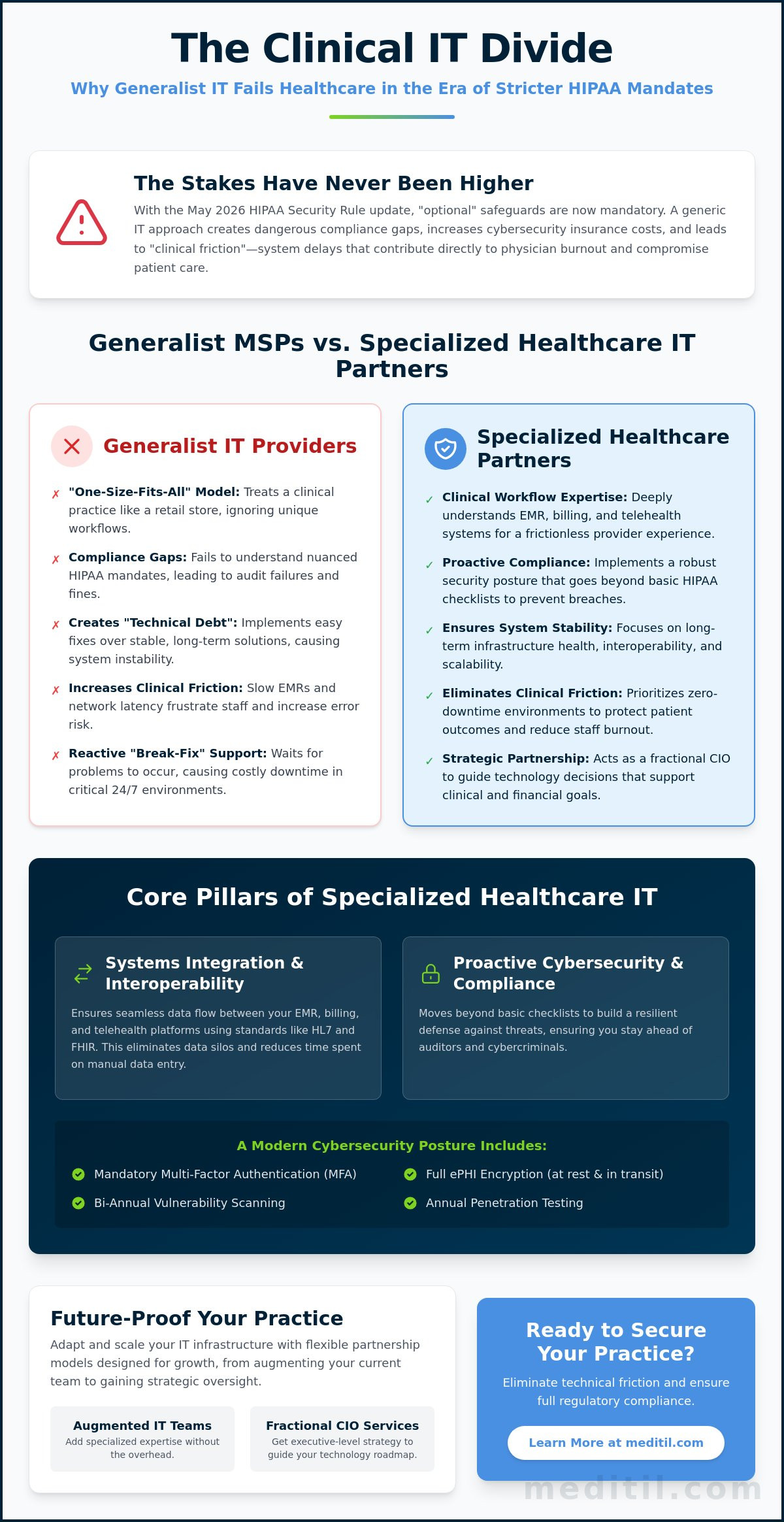
Generalist managed service providers often treat medical practices like standard retail or professional service offices. This “one size fits all” approach creates dangerous gaps in highly regulated environments. In 2026, the stakes are higher than ever. With the finalization of new HIPAA Security Rule mandates in May 2026, many safeguards that were previously considered addressable are now strictly mandatory. A generalist provider might secure your email but fail to understand how a legacy imaging system creates a back door for ransomware. This lack of specialization leads to increased vulnerability and higher long-term costs.
Specialized managed it support for healthcare requires a deep understanding of Health Information Technology (HIT) and its direct influence on patient outcomes. When an IT partner lacks this expertise, the result is often “technical debt.” Technical debt is the cumulative cost of choosing easy IT fixes over long-term clinical stability. Over time, these quick fixes lead to system instability, security vulnerabilities, and ultimately, a breakdown in patient care. Relying on a provider that doesn’t speak the language of clinical workflows is a risk most modern practices can’t afford to take.
The Hidden Impact of Clinical Friction
Technology should be invisible during a patient encounter. Instead, many clinicians face “clinical friction” caused by slow EMR logins, network latency, and fragmented systems. These delays aren’t merely inconveniences; they directly contribute to physician and nurse burnout. When a system lags, the risk of clinical error increases because providers are forced to find workarounds to maintain their workflow. High-availability systems are essential for 24/7 medical environments where a ten-minute outage can have life-altering consequences. Effective managed it support for healthcare focuses on eliminating these friction points to restore the patient-provider relationship.
Regulatory Evolution and the Cost of Non-Compliance
The regulatory landscape in 2026 has shifted toward aggressive enforcement. Beyond the March 1 reporting deadline for small data breaches, the Office for Civil Rights (OCR) has increased the frequency of proactive audits. Relying on a “check-the-box” compliance strategy is no longer sufficient. A specialized partner moves beyond basic HIPAA requirements to implement a proactive cybersecurity posture. This includes:
- Mandatory multi-factor authentication across all clinical applications.
- Full encryption of ePHI at rest and in transit.
- Vulnerability scanning conducted at least every six months.
- Annual penetration testing to identify deep-seated infrastructure weaknesses.
Non-compliance doesn’t just result in federal fines; it leads to rising cybersecurity insurance premiums that can cripple a practice’s bottom line. Moving toward a managed cybersecurity model ensures that your practice stays ahead of both threats and auditors.
Core Pillars of Specialized Managed IT Support for Healthcare
To move beyond the limitations of generalist providers, a strategic approach to managed it support for healthcare must rest on pillars that prioritize clinical continuity and data integrity. It isn’t enough to simply keep the servers running. The infrastructure must be resilient enough to handle high-volume clinical demands while maintaining absolute security. This requires a shift from reactive troubleshooting to a proactive, mission-driven operational model that treats technology as a clinical asset rather than a utility.
Systems Integration and Data Interoperability
Disparate medical applications often create data silos that hinder care coordination. A specialized partner bridges this gap by ensuring seamless data flow between your EMR, billing automation, and telehealth platforms. This integration relies heavily on technical standards like HL7 and FHIR, which allow different systems to communicate reliably across the care continuum. For those seeking deeper strategies on managing these complex integrations, reviewing comprehensive medical IT solutions provides a necessary roadmap. When systems are properly integrated, clinicians spend less time on manual data entry and more time on patient care.
Proactive Cybersecurity and Compliance Monitoring
The high-stakes nature of medical data makes it a primary target for cybercriminals. The Cybersecurity and Infrastructure Security Agency (CISA) emphasizes that the healthcare sector requires a robust, collaborative defense to protect critical infrastructure. Implementing medical-grade SIEM (Security Information and Event Management) and SOC (Security Operations Center) services allows for the continuous monitoring of network traffic. This proactive stance identifies threats before they can disrupt clinical workflows. Beyond technical barriers, managing the “human element” through healthcare-specific security awareness training is vital to prevent phishing and other social engineering attacks.
Infrastructure redundancy is equally critical for modern practices. In high-volume clinical hubs, a single point of failure can lead to dangerous downtime. Implementing N+1 redundancy ensures that if a primary component fails, a secondary unit is ready to take over immediately. This level of stability is supported by a clinical-grade help desk. Support staff must be trained in medical terminology and understand the hierarchy of clinical urgency. They should recognize that an EMR sync error in the middle of a patient visit is a high-priority event that requires immediate resolution. Deploying healthcare IT help desk services that speak the language of HL7 and clinical workflows ensures these critical incidents are resolved with the urgency they demand. You can learn more about our clinical support models to see how this specialized expertise reduces operational friction.
General MSPs vs. Healthcare Partners: An Evaluation Framework
The distinction between a standard Managed Service Provider (MSP) and a dedicated healthcare technology partner lies in their understanding of the “Clinical Gap.” A generalist provider view’s your office as a collection of workstations and servers. In contrast, a partner providing managed it support for healthcare views your environment as a series of interconnected clinical workflows. They understand that a login failure isn’t just a ticket; it’s a patient waiting in an exam room and a physician falling behind schedule. This specialized perspective ensures that technical decisions always prioritize clinical continuity and patient safety.
Legal and financial safeguards also separate these two categories. A general MSP might hesitate to sign a comprehensive Business Associate Agreement (BAA) or may lack the specific professional liability coverage required for handling electronic Protected Health Information (ePHI). A true healthcare partner embraces these requirements as foundational. They also demonstrate technical depth in areas that directly impact your bottom line, such as billing automation and revenue cycle integration. If your provider doesn’t understand how your clearinghouse integrates with your practice management system, they can’t effectively protect your revenue stream.
Decoding the Healthcare-Specific Service Level Agreement (SLA)
Standard IT SLAs often prioritize response times based on broad severity levels that fail in a medical context. For a generalist, a printer being offline might carry the same weight as a localized EMR sync error. In a clinical environment, the latter is a critical event. Your SLA should define specific metrics for life-critical application failures with aggressive time-to-resolution targets. To maintain this focus, ensure your partner provides a dedicated healthcare vCIO. This strategic lead ensures your technology roadmap aligns with clinical objectives rather than just hardware refresh cycles.
Vendor Management and EMR Optimization
Practice administrators shouldn’t spend their time as the middleman between an IT tech and an EMR software vendor. A specialized partner acts as the single point of contact for all medical software vendors, taking full ownership of the resolution process. Utilizing professional managed it services for healthcare allows for deeper EHR optimization, ensuring the software performs at peak efficiency. This includes managing complex updates and training clinical staff on new features. The goal is to implement technology improvements seamlessly, ensuring that system changes never disrupt the delivery of care.
A Strategic Buying Guide: Selecting Your Healthcare IT Partner
Selecting the right provider for managed it support for healthcare requires a methodical evaluation that looks beyond basic technical capabilities. To better understand the benchmarks for high-quality service in this field, you can discover Telx Computers and their comprehensive 2026 selection guide for top-tier IT partners. The goal is to find a partner that acts as a strategic extension of your clinical team. This process begins with a clear understanding of your current state and a defined roadmap for your future technological needs. Follow these five steps to ensure your selection aligns with clinical safety and operational efficiency.
- Step 1: Conduct a comprehensive clinical technology audit to identify gaps in your current infrastructure.
- Step 2: Define your specific requirements for interoperability and billing automation to prevent revenue leakage.
- Step 3: Evaluate the provider’s strategic leadership capabilities, specifically through fractional or virtual CIO offerings.
- Step 4: Verify healthcare-specific security certifications and request case studies detailing their past performance in clinical environments.
- Step 5: Pilot the support desk with your highest-friction clinical department to test response times and medical terminology fluency.
Auditing Your Current Infrastructure and Compliance Posture
A thorough audit must identify “shadow IT,” which includes unauthorized medical applications or personal cloud storage used by staff to bypass slow systems. These unvetted tools often create significant security vulnerabilities and compliance risks. You should also evaluate the actual cost of your current downtime, including lost provider productivity and the impact of technical friction on patient throughput. Ensure you request a comprehensive risk assessment that covers both technical and administrative HIPAA safeguards to establish a baseline for your new partnership. When evaluating potential partners, reviewing a detailed strategic comparison of healthcare IT help desk services can clarify which providers are equipped to handle the clinical urgency and HIPAA compliance demands your organization requires.
The Role of a Fractional CIO in Your Selection Process
Strategic advisory has become more critical than hardware maintenance. In a rapidly evolving regulatory environment, you need a partner that provides high-level guidance on how technology can drive clinical outcomes. Utilizing virtual CIO services ensures your IT budget is spent on initiatives that support long-term goals, such as telehealth expansion and advanced data analytics. This leadership bridge ensures that your managed it support for healthcare remains proactive rather than merely reactive. If you’re ready to align your technology with your clinical vision, schedule a strategic IT consultation today to begin your infrastructure optimization.
Future-Proofing Your Practice with MEDITIL’s Managed Support
Establishing a resilient technological foundation requires more than just technical proficiency; it demands a partner that understands the mission-critical nature of clinical operations. MEDITIL provides a stable, authoritative presence for healthcare organizations navigating the complexities of 2026’s regulatory and operational demands. Our approach to managed it support for healthcare is built on the premise that technology should empower clinicians rather than hinder them. By focusing on stability, security, and seamless connectivity, we help practices eliminate the clinical friction that frequently leads to provider burnout.
Our national scale allows us to serve high-stakes, regulated medical environments with precision. We don’t offer generic solutions. Instead, we provide a curated journey of service offerings that align with your specific strategic objectives. Whether you require project-based IT consulting or a long-term strategic partner, our team acts as a disciplined, proactive guide through the evolving landscape of medical technology.
Augmented IT Teams and Fractional Leadership
Many healthcare organizations possess existing IT staff but lack the specialized depth required for modern compliance and interoperability. MEDITIL offers augmented IT team models designed to mature your existing department without the need for full replacement. We provide the “steady hand at the wheel” during large-scale EMR implementations and complex data migrations. Our fractional CIO services offer mid-sized organizations access to executive-level strategic advisory, ensuring that IT budgets are used to drive clinical outcomes rather than just maintaining aging hardware. This leadership ensures your infrastructure remains scalable as you expand into telehealth and remote patient monitoring.
Driving Revenue and Efficiency Through Billing Automation
A significant gap in standard IT management is the failure to integrate technical infrastructure with financial performance. MEDITIL addresses this by offering specialized expertise in billing automation and integration. We bridge the divide between your IT systems and revenue cycle management to ensure that data flows accurately from the point of care to the final claim. By leveraging business intelligence and analytics, we help leaders identify operational bottlenecks that lead to revenue leakage.
- Integration of practice management systems with automated clearinghouse workflows.
- Real-time data verification to reduce claim denials and administrative burden.
- Customized analytics dashboards that provide visibility into clinical throughput.
This focus on the financial health of the practice ensures that your investment in managed it support for healthcare delivers a measurable return. If you’re ready to secure your data and optimize your clinical workflows, the next step is to schedule a strategic consultation to evaluate your current infrastructure and eliminate technical friction.
Securing Your Clinical Future Through Strategic Partnership
The transition toward a proactive technology model is no longer optional for organizations aiming to thrive in a highly regulated landscape. By prioritizing specialized managed it support for healthcare, you ensure that your infrastructure supports rather than hinders patient care. This requires moving beyond simple hardware maintenance to embrace a framework focused on seamless interoperability and life-critical cybersecurity. A steady hand at the wheel ensures that your systems remain resilient against emerging threats while facilitating a frictionless environment for your clinicians.
MEDITIL provides the seasoned expertise necessary to navigate these complexities with precision. Our approach combines specialized Healthcare vCIO Leadership with deep expertise in billing automation and interoperability to drive both clinical and financial health. We maintain a mission-driven focus on clinical stability to protect your providers from technical friction and burnout. Are you ready to transform your technology into a strategic asset? Schedule a Strategic IT Consultation with MEDITIL to establish a secure, scalable, and stable environment for your practice. We look forward to helping you achieve long-term operational excellence.
Frequently Asked Questions
What is the difference between general managed IT and healthcare managed IT?
General IT providers prioritize standard office uptime and hardware maintenance across various industries. Specialized managed it support for healthcare focuses on clinical safety, HIPAA mandates, and ensuring that technical decisions don’t disrupt the patient-provider relationship. A healthcare partner understands medical workflows and the high-stakes nature of life-critical application availability.
How do managed IT services for healthcare improve HIPAA compliance?
Specialized providers implement mandatory multi-factor authentication and full encryption of ePHI at rest and in transit to meet the finalized 2026 HIPAA Security Rule updates. They manage the technical documentation required for OCR audits and conduct vulnerability scanning at least every six months. This proactive stance ensures that safeguards are verified rather than just promised.
Can a managed IT provider help with EMR/EHR implementation and training?
Yes, a healthcare-focused partner manages the technical execution of EMR migrations and system updates. They act as the single point of contact for software vendors to resolve integration issues and provide staff training. This ensures that new systems are adopted efficiently without disrupting clinical throughput or causing provider frustration.
What should be included in a healthcare IT service level agreement (SLA)?
A healthcare SLA must prioritize clinical urgency over standard severity levels used in other industries. It should include specific time-to-resolution targets for life-critical applications and ensure 24/7 support for high-volume clinical hubs. The agreement should also guarantee access to a dedicated healthcare vCIO for ongoing strategic alignment and budget planning.
How does managed IT support reduce physician burnout?
Effective managed it support for healthcare eliminates the technical friction that causes delays in the exam room. By ensuring fast system logins and reliable network connectivity, technology becomes an invisible asset. When systems work as intended, clinicians spend less time troubleshooting software and more time focusing on patient care.
What is a fractional CIO and why does a medical practice need one?
A fractional CIO is a strategic consultant who provides executive-level technology leadership on a part-time basis. Medical practices need this role to align their IT budgets with clinical outcomes and navigate complex regulatory changes. They provide a steady hand for long-term planning, such as telehealth expansion and data analytics initiatives.
How do managed IT services handle cybersecurity for medical devices (IoMT)?
Providers manage IoMT security by implementing strict network segmentation and continuous monitoring of device traffic. This prevents a compromised medical device from becoming a gateway to the broader practice network. Regular vulnerability scanning and proactive threat detection ensure that all connected devices remain secure against modern ransomware threats.
What are the typical costs of managed IT support for healthcare organizations?
Industry estimates for managed services in compliance-heavy environments generally range from $200 to $300 or more per user per month. Specialized healthcare support typically carries an additional premium of $30 to $50 per user to cover the costs of mandatory HIPAA safeguards and advanced security monitoring. These rates reflect the specialized expertise required for clinical environments.
2 Responses