
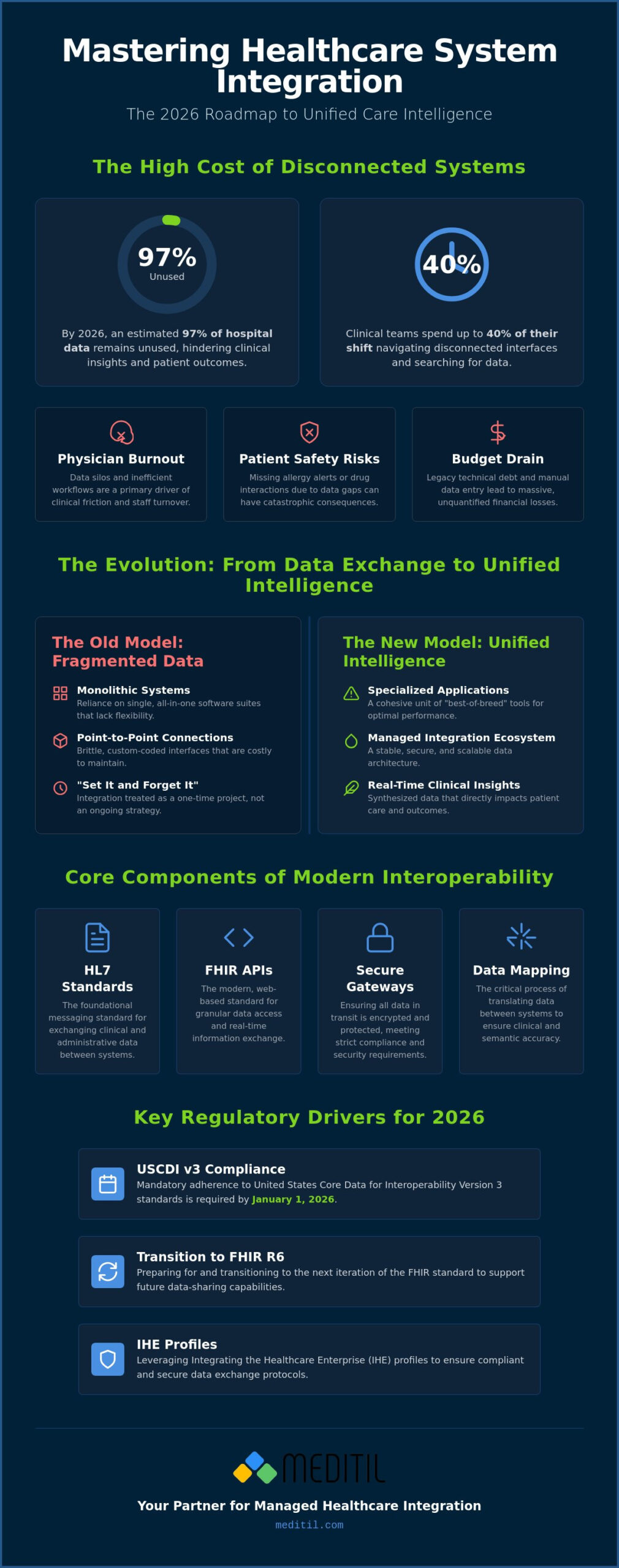
Did you know that in 2026, an estimated 97% of hospital data remains unused despite massive investments in digital infrastructure? It’s frustrating to watch clinical teams struggle with data silos that fuel physician burnout, all while legacy technical debt continues to drain your budget. You likely recognize that achieving true interoperability isn’t just a technical hurdle; it’s a strategic necessity for patient safety and operational survival. This guide provides a definitive roadmap for mastering healthcare system integration services to eliminate those silos and optimize your clinical workflows.
We’ll explore how to navigate the 2026 regulatory landscape, including USCDI Version 3 compliance and the transition to FHIR R6, to build a scalable IT infrastructure that supports long-term growth. From automating billing workflows to securing data in transit, you’ll learn how to transform your disparate platforms into a unified, high-performing ecosystem that protects your organization and your patients. By aligning your technical strategy with clinical needs, you can ensure that every data point serves a purpose in delivering superior care.
Key Takeaways
- Understand the transition from basic data exchange to unified care intelligence, moving beyond the limitations of monolithic software systems.
- Identify the core technical standards, including HL7, FHIR, and secure APIs, that serve as the foundation for modern healthcare system integration services.
- Evaluate the critical differences between high-risk, tactical “band-aid” fixes and the long-term stability of a managed integration ecosystem.
- Learn a phased implementation roadmap that prioritizes thorough application auditing and the specific workflow needs of clinical and billing teams.
- Discover how fractional CIO leadership can align your IT infrastructure with regulatory requirements while ensuring a scalable platform for future growth.
The State of Healthcare System Integration Services in 2026
The healthcare landscape has moved beyond the era of the all-in-one monolithic software suite. Today, excellence is found in specialized applications that must function as a single, cohesive unit. This shift defines modern healthcare system integration services in 2026. It’s no longer enough to simply move data from point A to point B. We’ve entered the age of unified care intelligence. In this model, information is not just exchanged; it’s synthesized to provide real-time clinical insights that directly impact patient outcomes.
The evolution from simple data exchange to unified care intelligence represents a fundamental change in how we view IT. In the past, integration was often a “set it and forget it” project. Now, it’s an ongoing strategic management function. It involves the continuous monitoring of data flows to ensure accuracy and the proactive identification of bottlenecks before they impact the point of care. This transition is essential for any organization looking to thrive in a data-driven environment.
For mid-market healthcare organizations, the shift toward Integration-as-a-Service provides a path to enterprise-level capabilities. You don’t need the massive budget of a multi-state hospital system to achieve seamless connectivity. This managed approach ensures that your infrastructure remains agile, secure, and ready for future growth. It allows your internal teams to focus on clinical excellence while experts handle the complexities of the underlying data architecture.
The High Cost of Technical Debt and Data Silos
Manual data entry and redundant lab work represent a massive, often unquantified, financial drain on mid-market organizations. Disconnected systems create dangerous gaps in patient safety; a missing allergy alert or an overlooked drug interaction due to a data silo can have catastrophic consequences. In the 2026 market, technical debt is the mounting operational cost and security risk incurred by relying on brittle, legacy interfaces that cannot support modern FHIR-based interoperability requirements.
Regulatory Drivers for Interoperability
Compliance has evolved from a regulatory hurdle into a strategic imperative. Federal mandates, such as the required adherence to USCDI Version 3 standards as of January 1, 2026, make data transparency a condition of participation in the modern healthcare economy. Interoperability is also a critical security component, as detailed in our guide on Healthcare Cybersecurity Services: A Strategic Guide for 2026. Standards like Integrating the Healthcare Enterprise (IHE) help facilities maintain compliant and secure data exchange.
Core Components of Modern Interoperability Frameworks
Building a framework for sustainable, patient-centric interoperability requires more than just technical connectivity; it demands a standardized approach to data structure. In 2026, the complexity of the medical landscape means that healthcare system integration services must manage a diverse array of protocols. These frameworks act as the central nervous system of your organization, ensuring that diagnostic data, patient demographics, and billing codes move with precision between disparate platforms. Without these core components, your IT environment remains a collection of isolated tools rather than a unified clinical asset.
Data mapping and modeling represent the most critical phase of this process. It’s the practice of ensuring “System A” speaks the same language as “System B.” For instance, a lab result formatted in an older legacy system must be accurately translated into a format your modern EHR understands without losing clinical nuance. This semantic layer prevents data corruption and ensures that when a physician pulls up a record, they see a complete and accurate history. Achieving this level of precision often starts with a comprehensive IT audit to identify where communication gaps currently exist.
Secure APIs have replaced the clunky, batch-processing methods of the past. These interfaces allow for real-time communication between your EHR and third-party applications, such as telehealth platforms or advanced analytics tools. By utilizing secure APIs, you enable a “plug-and-play” environment where new technologies can be added without disrupting existing workflows. This modularity is essential for maintaining a scalable infrastructure that can adapt as new clinical needs arise.
Standardizing Data Exchange with FHIR and HL7
While HL7 v2 remains the workhorse for approximately 95% of internal hospital interfaces, Fast Healthcare Interoperability Resources (FHIR) has become the gold standard for modern, mobile-friendly data exchange. Managing this hybrid environment is a primary challenge for mid-market providers. You must maintain legacy HL7 feeds for stability while simultaneously adopting FHIR R4 or R5 standards to satisfy federal mandates and improve data granularity. This dual-track approach ensures that specialty clinics and diagnostic labs receive the specific, high-resolution data they need for accurate decision-making.
Cybersecurity and Compliance in the Integration Layer
Data in transit is data at risk. Modern integration frameworks prioritize a cybersecurity-first approach, utilizing AES-256 encryption for data at rest and TLS 1.3 for data in motion. Identity and Access Management (IAM) protocols are equally vital, ensuring that only authorized users and verified applications can interact with sensitive ePHI. Strategic healthcare system integration services must strictly adhere to the HIPAA “Minimum Necessary” standard, filtering data streams to ensure that only the specific information required for a clinical or administrative function is exposed. This disciplined approach to data access reduces your attack surface and protects patient privacy.
Strategic vs. Tactical Integration: Choosing the Right Model
Choosing between a tactical “patch” and a strategic ecosystem is the difference between temporary relief and long-term operational health. Many organizations mistakenly view healthcare system integration services as a one-time project to connect two specific applications. This tactical approach often results in a brittle network of custom connectors that fail whenever a vendor releases a routine software update. In contrast, a strategic model treats integration as a managed ecosystem. It prioritizes stability and scalability, ensuring that your data infrastructure grows alongside your clinical needs rather than becoming a bottleneck that hinders care delivery.
The financial implications of these models are stark. While a “band-aid” fix might seem cost-effective in the short term, the long-term ROI of a unified data strategy is significantly higher. You aren’t just paying for a technical connection; you’re investing in the elimination of manual data entry and the reduction of redundant administrative tasks. A fragmented system requires constant, expensive maintenance across disparate platforms. By centralizing your integration logic, you reduce the total cost of ownership and free up your IT budget for strategic initiatives rather than mere system survival.
A fractional CIO plays a vital role in this transition. This expert provides the strategic roadmap necessary to align your technical capabilities with your multi-year business goals. They act as a steady hand at the wheel, ensuring that every integration project serves a larger purpose within your organization’s infrastructure. This leadership ensures that your technical investments are verified, secure, and capable of supporting the high-stakes environment of modern medicine.
Custom Middleware vs. Native API Connectors
When working with modern platforms like Epic, Cerner, or Athena, leveraging native API connectors is usually the most efficient path. However, legacy medical software often requires custom bridges to maintain data flow. In these cases, we utilize “Facade Architecture” to modernize legacy systems. This approach creates a modern, standardized interface over older code. It allows legacy applications to communicate with FHIR-based environments without requiring a complete, high-risk system replacement, protecting your existing investments while moving toward modern standards.
The Managed Service Advantage for Integration
Internal IT teams are frequently overwhelmed by the sheer complexity of maintaining multi-system connectivity. Integration isn’t a static achievement; it’s a dynamic process that requires ongoing monitoring to prevent “integration breakages” after software updates or server migrations. This is where the managed service model excels. By partnering with a specialist, you gain access to proactive oversight that identifies and resolves issues before they impact patient care. For a deeper look at how this fits into a broader technology plan, see our Managed IT Services for Healthcare: The 2026 Definitive Strategic Guide.
Implementation Roadmap: Overcoming Integration Hurdles
Implementation of healthcare system integration services requires a disciplined, multi-phase approach to ensure both technical stability and clinical utility. Many projects falter because they focus exclusively on the code while ignoring the operational realities of the providers using the system. A successful roadmap moves from high-level strategy to granular execution, ensuring that every stakeholder is aligned before a single line of data is migrated. This methodical progression prevents the “integration breakage” that often plagues less structured attempts at connectivity.
The structured progression of a robust integration project includes five critical phases:
- Phase 1: Discovery and Portfolio Auditing. We begin by identifying every application within your current environment, from legacy diagnostic tools to modern EHR platforms. This phase includes a deep dive into versioning and compatibility to uncover hidden technical debt.
- Phase 2: Workflow-Centric Requirement Definition. We interview clinical and billing teams to understand how data moves through their daily routines. We don’t just ask what data is needed; we ask when and where it’s needed to prevent bottlenecks.
- Phase 3: Data Flow and Security Architecture. This stage involves designing the secure pathways for information exchange, prioritizing encryption and ensuring compliance with USCDI Version 3 standards.
- Phase 4: Testing, Validation, and Staff Training. Before going live, we verify every data map and train your team to ensure high adoption rates. Verification is essential to prevent clinical errors.
- Phase 5: Managed Oversight and Continuous Optimization. Post-launch, we monitor the ecosystem to resolve breakages and fine-tune performance as your organization grows.
Bridging Clinical Data with Billing Automation
A significant hurdle for mid-market healthcare is the gap between clinical documentation and the revenue cycle. When these systems don’t communicate, claim denials rise and manual intervention becomes a costly necessity. By connecting your EHR directly to specialized billing engines, you ensure that documentation automatically triggers the correct coding and submission processes. This real-time exchange is a cornerstone of our Medical Billing Automation Solutions: A Strategic Guide for Healthcare Leaders in 2026. It transforms a reactive administrative task into a proactive, automated workflow that improves cash flow.
Addressing the Human Element: Workflow and Training
Technical integration fails if it isn’t embraced by the people using it. Clinical workflow alignment is the “last mile” of any successful project. We focus on training strategies that demonstrate the immediate value of integrated systems, such as reduced clicks or faster access to patient histories. We also utilize business intelligence tools to measure success, tracking metrics like data latency and user error rates to ensure the system is actually helping your team. If you’re ready to stabilize your clinical environment, you can consult with our strategic integration experts today.
MEDITIL: Your Partner for Managed Healthcare Integration
MEDITIL offers a distinct alternative to standard software vendors by providing comprehensive healthcare system integration services rooted in strategic partnership. We recognize that software alone cannot solve the systemic challenges of interoperability. Our “Infrastructure-First” philosophy ensures that your integration layer is built upon a stable, secure, and HIPAA-compliant foundation. This approach minimizes technical debt and provides the resilience required for high-stakes medical environments where data accuracy is non-negotiable. We don’t just connect your systems; we manage the entire ecosystem to ensure long-term stability.
Our customized managed IT solutions are designed to scale alongside your organization. Whether you’re expanding your clinic network or adopting new telehealth capabilities, our team provides the steady hand at the wheel needed to navigate technical transitions. We focus on proactive monitoring and continuous maintenance, identifying potential points of failure before they disrupt clinical workflows. This disciplined management style reflects our commitment to being a reliable, high-performing specialist for mid-market healthcare providers.
Strategic IT Leadership for Integration Success
A successful integration strategy requires executive-level oversight to ensure technical projects deliver measurable clinical value. Our Virtual CIO Services: Strategic IT Leadership for Healthcare in 2026 bridge the gap between your IT budget and patient care objectives. By providing a multi-year roadmap, we help organizations move from reactive troubleshooting to proactive innovation. Our vCIOs have a proven track record of reducing clinical friction through managed interoperability, allowing providers to focus on patients rather than navigating fragmented data sets.
Comprehensive Support for Clinical Applications
Our commitment to your success extends well beyond the initial implementation phase. MEDITIL provides dedicated help desk support and specialized healthcare application management to assist your staff with daily technical challenges, utilizing centralized communication platforms like Bodo to ensure every inquiry is resolved efficiently. We maintain mission-critical systems with a target of 99.9% uptime, ensuring that clinicians have uninterrupted access to real-time data when it matters most. This level of consistency is vital for maintaining patient safety and administrative efficiency in a 24/7 care environment. We invite you to schedule a professional consultation for a comprehensive systems audit to evaluate your current healthcare system integration services and identify opportunities for optimization.
Securing Your Clinical Future Through Strategic Interoperability
Transitioning from fragmented data silos to a unified care intelligence model is a necessity for modern medicine. We’ve explored how standardized frameworks like FHIR and secure APIs serve as the foundation for this digital evolution. By prioritizing a strategic, managed ecosystem over tactical fixes, your organization can eliminate technical debt while significantly reducing physician burnout. This shift ensures that your technology serves your clinical mission rather than hindering it.
Success in 2026 requires more than just technical connectivity. It demands a steady hand to navigate complex regulatory mandates and evolving security vulnerabilities. MEDITIL provides the fractional CIO strategic oversight and specialized healthcare cybersecurity expertise needed to protect your patient data. Our managed IT support is specifically tailored to ensure your clinical workflows remain stable, scalable, and efficient in a high-stakes environment.
Take the first step toward a seamless and high-performing IT environment. Request a Comprehensive Systems Integration Audit from MEDITIL to identify gaps in your current healthcare system integration services and build a roadmap for long-term growth. We’re ready to help you achieve a more connected and resilient future for your providers and patients alike.
Frequently Asked Questions
What are healthcare system integration services?
These services connect disparate IT systems, such as EHRs, laboratory information systems, and billing platforms, into a unified network. They facilitate the secure and automated exchange of clinical and administrative data across your organization. This process eliminates manual data entry and ensures that providers have access to a single, accurate source of truth at the point of care. It’s about turning isolated tools into a cohesive clinical asset.
How does healthcare interoperability improve patient safety?
Interoperability reduces medical errors by providing clinicians with real-time access to a patient’s complete medical history, including allergies, lab results, and current medications. When systems speak the same language, critical alerts are no longer trapped in data silos. This immediate availability of data prevents adverse drug events and ensures that life-saving information is always accessible during emergencies, directly improving clinical outcomes.
What is the difference between HL7 and FHIR standards?
HL7 v2 is a legacy messaging standard used by approximately 95% of US hospitals for internal system communication. Fast Healthcare Interoperability Resources (FHIR) is a modern, API-based standard designed for easier data exchange across web and mobile applications. While HL7 remains the workhorse for existing infrastructure, FHIR is the current industry benchmark for real-time, granular data access as mandated by federal standards like USCDI Version 3.
How much does it cost to integrate an EHR with a billing system?
The cost of integration depends on several variables, including the complexity of the platforms involved and whether the data flow is read-only or bidirectional. Factors such as data migration requirements and the need for custom middleware also influence the final investment. Because every clinical environment has unique infrastructure needs, a comprehensive audit is necessary to determine the specific resources required for a stable and secure connection.
Can legacy medical software be integrated with modern cloud platforms?
Yes, legacy software can often be integrated using “Facade Architecture” or custom middleware bridges. These solutions create a modern interface over older code, allowing legacy systems to communicate with cloud-based FHIR environments. This approach protects your existing software investments while enabling your organization to adopt modern, scalable infrastructure without the risks associated with a total system replacement.
What is the role of a vCIO in healthcare system integration?
A vCIO provides the strategic leadership necessary to align technical integration projects with long-term clinical and financial goals. They act as a proactive guide, ensuring that every integration serves a broader purpose within the organization’s infrastructure. This role involves roadmapping, budgeting, and ensuring that technical implementations remain verified, secure, and compliant with evolving regulatory standards like the HIPAA Security Rule.
How long does a typical healthcare integration project take?
Project timelines vary based on the scope of the integration and the readiness of the existing infrastructure. A focused API connection might take several weeks, while a comprehensive, multi-system interoperability project can span several months. A phased approach, starting with discovery and moving through testing and validation, ensures that the final implementation is stable and doesn’t disrupt clinical workflows during the transition.
How do you ensure HIPAA compliance during system integration?
Compliance is maintained through rigorous encryption of data at rest and in transit, typically utilizing AES-256 and TLS 1.3 standards. Identity and Access Management protocols are implemented to ensure that only authorized users can access sensitive ePHI. Additionally, healthcare system integration services must adhere to the “Minimum Necessary” standard, ensuring that only the specific data required for a task is shared between systems to protect patient privacy.