
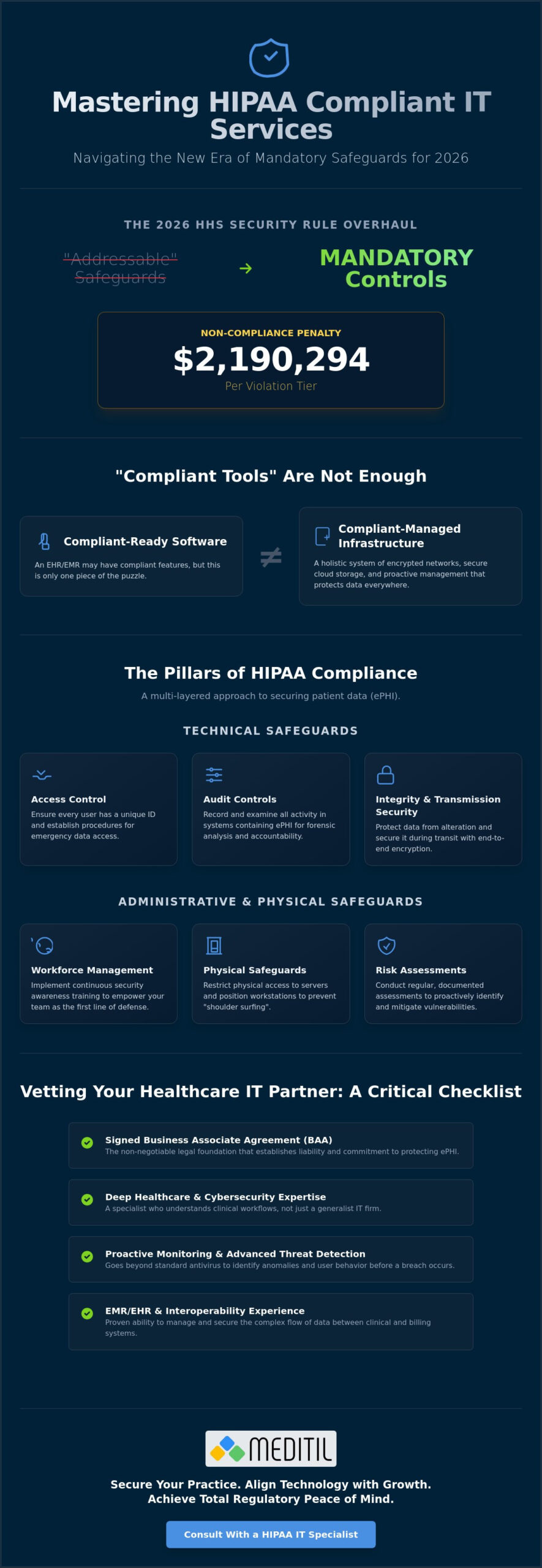
The 2026 HHS Security Rule overhaul has officially eliminated “addressable” safeguards, making once-optional controls mandatory for every healthcare entity. If your provider still treats compliance as a periodic checklist, your practice is exposed to Tier 4 penalties that now reach $2,190,294 per violation. You need HIPAA compliant IT services that function as a continuous operational state rather than a static product. It’s natural to feel the weight of technical debt and the fear of reputational damage when general IT firms fail to grasp the high-stakes nuances of medical workflows.
We understand that your primary goal is to protect patient data while maintaining a high-performing clinical environment. This guide will help you master the critical criteria for selecting a HIPAA-compliant IT partner that secures your infrastructure and optimizes your daily operations. We’ll examine the new mandatory technical standards for 2026, the 15-day patient record access rule, and how strategic IT leadership can turn regulatory requirements into a roadmap for practice growth.
Key Takeaways
- Understand the legal necessity of Business Associate Agreements as the foundation for any partnership involving sensitive patient data.
- Identify the specific criteria for vetting HIPAA compliant IT services to ensure they offer deep expertise in both cybersecurity and clinical workflows.
- Learn why using compliant software is only the first step and how infrastructure management prevents critical data leaks.
- Discover how fractional CIO leadership can align your technology investments with a long-term strategic roadmap for compliance.
- Gain the clarity needed to manage complex systems while maintaining total regulatory peace of mind and operational stability.
What Are HIPAA Compliant IT Services in 2026?
Defining HIPAA compliant IT services in 2026 requires looking beyond simple software patches. It represents a holistic management of electronic protected health information (ePHI) across every network node, mobile device, and cloud environment your practice touches. This framework is governed by the Health Insurance Portability and Accountability Act (HIPAA), which mandates strict technical and administrative standards. The legal bedrock of this partnership is the Business Associate Agreement (BAA). Without a signed BAA, an IT provider cannot legally touch your systems; this document establishes their liability and commitment to protecting your patient data.
Many healthcare leaders confuse “compliant-ready” software with “compliant-managed” infrastructure. An EHR might have the features to be compliant, but if your local network is unencrypted or your cloud storage is misconfigured, the software’s internal settings won’t save you from a breach. True HIPAA compliant IT services bridge this gap by shifting from reactive troubleshooting to proactive, life-critical system protection. In the current regulatory climate, the distinction between “addressable” and “required” safeguards has vanished. Every control is now a mandatory requirement for your digital ecosystem.
The Three Pillars of Technical Safeguards
Technical safeguards focus on the technology that protects ePHI and controls access to it. These aren’t suggestions; they’re the technical barriers between your data and a threat actor.
- Access Control: Every staff member must have a unique user identification to ensure accountability. Systems must also include established procedures for emergency access to data during a clinical crisis.
- Audit Controls: Your hardware and software must record and examine activity in systems containing ePHI. This digital trail is vital for forensic analysis and verifying that data hasn’t been tampered with.
- Integrity and Transmission Security: Data must be protected from unauthorized alteration during storage. It must also be secured against interception during transit through robust, end-to-end encryption protocols.
Administrative and Physical Requirements
Compliance isn’t just a digital concern; it requires managing the human and physical environment with equal precision. Technology alone can’t stop a physical breach or a human error.
- Workforce Management: IT partners must assist in implementing security awareness training. This ensures your team remains the first line of defense against phishing and social engineering.
- Physical Safeguards: Access to server rooms and media storage must be physically restricted. Workstations must be positioned to prevent “shoulder surfing” by unauthorized visitors or patients.
- Risk Assessments: Regular, documented assessments are mandatory to identify vulnerabilities before they are exploited. This proactive stance is a core component of modern healthcare cybersecurity services.
Critical Selection Criteria: Vetting Your Healthcare IT Partner
Selecting a partner for HIPAA compliant IT services isn’t merely a procurement decision; it’s a foundational choice for your clinical operations. A generalist IT firm may understand server uptime, but they often lack the specialized knowledge required to handle protected health information (PHI) within a regulated environment. You need a partner that demonstrates deep expertise in healthcare cybersecurity services to navigate the 2026 regulatory landscape effectively. This expertise should span the entire IT lifecycle, providing everything from rapid help desk support to high-level fractional CIO leadership.
Proactive monitoring is another non-negotiable requirement. In 2026, standard antivirus software is insufficient to stop sophisticated ransomware. Your provider must utilize advanced threat detection that identifies anomalies in medical device traffic and user behavior before a breach occurs. Evaluating their track record with EMR/EHR implementation and interoperability projects is also essential. If they don’t understand how data moves between your clinical and billing systems, they can’t effectively secure those pathways. If you’re concerned about your current infrastructure, it’s wise to consult with a specialist who understands these high-stakes requirements.
Healthcare-Specific Technical Expertise
Medical data operates on unique standards that general IT providers rarely encounter. Your partner must be fluent in HL7 and FHIR to ensure that interoperability doesn’t come at the cost of security. They should also provide 24/7/365 monitoring, as healthcare systems are life-critical and don’t follow a standard nine-to-five schedule. Furthermore, they must be capable of implementing network security best practices that are specifically optimized for medical traffic, ensuring that security protocols don’t slow down urgent clinical workflows.
The BAA and Legal Accountability
The Business Associate Agreement (BAA) is the legal cornerstone of your partnership. You must never share PHI with a provider who refuses to sign a BAA, as this document establishes their legal liability for data protection. However, a signature is just the beginning. You should also review the provider’s internal audit and compliance history. According to HIPAA Security Rule guidance provided by the HHS, it’s vital to understand the division of responsibility in a shared-compliance model. You need to know exactly which safeguards are managed by the provider and which remain under your practice’s direct control to avoid dangerous gaps in coverage.
Beyond the Software: Why “Compliant Tools” Are Not Enough
A common pitfall for healthcare leadership is the belief that purchasing a “HIPAA-compliant” EHR platform satisfies all regulatory obligations. While software vendors provide the tools for data entry and clinical documentation, they don’t manage the environment where that data resides. Effective HIPAA compliant IT services must account for the complex infrastructure surrounding the software. If your office Wi-Fi is poorly secured or your cloud storage ports are left open, the compliance status of your EHR becomes irrelevant. Most data breaches aren’t the result of software failure; they’re caused by misconfigurations in the underlying network. Understanding the full spectrum of cloud security threats in healthcare is essential for any practice relying on hybrid or cloud-based infrastructure.
The HIPAA Security Rule requirements explicitly state that administrative and physical safeguards are just as critical as technical ones. This means your compliance posture is only as strong as your weakest endpoint. Implementing healthcare network segmentation is a vital step in this process. By isolating sensitive patient data from guest Wi-Fi and general administrative traffic, you create a defensive layer that prevents a single compromised device from exposing your entire database. This strategic isolation is a hallmark of a mature security framework.
The Human Element and Misconfiguration Risks
General IT providers often miss the nuances of medical workflows, leading to accidental security gaps. One of the most significant risks is “shadow IT,” where clinicians use unauthorized messaging apps or personal cloud storage to share patient information quickly. Without HIPAA compliant IT services to monitor and restrict these behaviors, your practice remains in a state of constant risk. Managed services solve this by enforcing policy through technical controls, ensuring that the easiest way to do the job is also the most secure way.
Total Practice Security vs. Software Compliance
Securing the “last mile” of your practice requires a focus on local networks and mobile devices. Software compliance won’t protect a tablet left in a public area or an unencrypted backup drive. You need robust disaster recovery plans that allow for system restoration within the 72-hour window mandated by current standards. Relying on managed it services for healthcare ensures that every component of your ecosystem—from the front-desk printer to the remote telehealth station—is overseen by experts. This oversight prevents “compliance drift,” where small configuration changes over time eventually create large, exploitable vulnerabilities. Centralizing your security event data through a dedicated security information event management SIEM platform is one of the most effective ways to detect and respond to these configuration changes before they become critical exposures.
Strategic Compliance: The Role of a Fractional CIO
Strategic leadership is the missing link in many healthcare organizations. While help desk support keeps computers running, it rarely addresses the long-term regulatory trajectory of the practice. HIPAA compliant IT services must be guided by a seasoned expert who understands how to translate complex laws into operational reality. This is where virtual CIO services become indispensable. They provide the high-level oversight necessary to build a strategic IT roadmap, ensuring that compliance is a budgeted, predictable part of your growth rather than a series of emergency expenses.
Beyond simple oversight, a fractional CIO utilizes business intelligence and analytics to track compliance metrics in real time. This data-driven approach allows you to verify that encryption is active across all endpoints and that audit logs are being correctly generated. Instead of guessing your level of risk, you have documented proof of your security posture. This level of precision is what separates a standard service provider from a true strategic partner. A disciplined roadmap ensures your HIPAA compliant IT services evolve alongside changing federal mandates.
Aligning Technology with Clinical Outcomes
A primary challenge for healthcare leaders is managing clinical friction. This occurs when security measures, such as complex login procedures or restricted file sharing, slow down patient care. A fractional CIO evaluates the ROI of specialized healthcare IT by selecting tools that offer both high security and seamless interoperability. They also manage third-party risk assessments, ensuring that every vendor you partner with maintains the same rigorous standards you do. This proactive vendor management reduces the risk of a supply-chain breach affecting your clinical operations.
Audit Readiness and Risk Management
Audit readiness is not a state you achieve once; it’s a continuous process of verification. Your fractional CIO leads the development of a comprehensive Incident Response Plan (IRP) that meets all regulatory requirements. This plan ensures your team knows exactly how to react in the event of a breach, minimizing both data loss and legal liability. By treating compliance as a competitive advantage, you reassure patients that their most sensitive information is being handled with professional discipline. Schedule a strategic advisory session to learn how fractional CIO leadership can stabilize your compliance roadmap.
Why MEDITIL is the Steady Hand for Your HIPAA Compliance
MEDITIL serves as more than a technical vendor; we’re a strategic ally dedicated to the long-term stability of your healthcare infrastructure. Our HIPAA compliant IT services are built on a mission-driven foundation that prioritizes patient safety and operational continuity above all else. We understand that in a clinical environment, a system failure isn’t just an inconvenience; it’s a disruption to care. By providing a steady hand at the wheel, we ensure that your technology serves your medical mission rather than distracting from it.
Flexibility is core to our partnership model. We don’t believe in one-size-fits-all solutions that ignore your existing investments. Whether you require the management of IT teams already in place or need a full augmented IT team to fill critical gaps, our experts integrate seamlessly into your workflow. We specialize in the high-stakes intersection of billing automation and EHR optimization, ensuring that your financial and clinical data remain secure while moving efficiently through your practice ecosystem. This comprehensive oversight eliminates the silos that often lead to compliance vulnerabilities.
Tailored Solutions for Modern Healthcare
Modern medical practices require infrastructure designed for high-volume, high-reliability environments. We deploy customized network services that handle the heavy data demands of telehealth and imaging without compromising on speed. A key component of our strategy involves implementing medical billing automation solutions that reduce administrative overhead while maintaining strict data integrity. By focusing on seamless connectivity and interoperability, we help your clinical platforms communicate securely, allowing your staff to focus on patients instead of troubleshooting software conflicts.
Your Partner in Strategic Growth
Scaling a healthcare practice in a regulated environment requires disciplined leadership. Leveraging our fractional CIO services allows you to navigate complex growth phases without outstepping your security capabilities. We provide proactive cybersecurity that protects your patient data and your professional reputation, ensuring that every new office or service line is compliant from day one. Our approach turns HIPAA compliant IT services into a predictable, manageable asset that supports your long-term vision. Schedule a strategic consultation with MEDITIL today.
Future-Proof Your Clinical Infrastructure
In 2026, healthcare technology requires more than simple maintenance; it demands a continuous state of readiness against evolving regulatory and security threats. Selecting HIPAA compliant IT services is a strategic decision that directly impacts your practice’s legal standing and clinical efficiency. By prioritizing specialized healthcare expertise and strategic leadership, you ensure that your technology supports patient outcomes instead of creating operational friction or technical debt. The transition from addressable to mandatory safeguards makes precision in your IT infrastructure non-negotiable.
MEDITIL provides this stability through a specialized healthcare-only focus and life-critical system monitoring that protects your data around the clock. Our fractional CIO strategic leadership bridges the gap between complex federal mandates and your daily practice operations, providing the expert guidance needed for long-term growth. Secure Your Practice with MEDITIL’s HIPAA Compliant Managed IT. You don’t have to navigate these technical complexities alone. With a disciplined partner, you can achieve total regulatory peace of mind and focus on delivering exceptional patient care.
Frequently Asked Questions
What makes an IT service provider “HIPAA compliant”?
An IT provider achieves compliance by implementing the full spectrum of administrative, physical, and technical safeguards required by the Security Rule. This includes maintaining active encryption, strict access controls, and detailed audit trails. HIPAA compliant IT services also require a signed Business Associate Agreement (BAA) and a documented history of regular risk assessments to verify that security measures evolve with new threats.
Does my IT provider need to sign a Business Associate Agreement (BAA)?
Yes, any IT provider with potential access to protected health information must sign a Business Associate Agreement. This document is a legal mandate that establishes the provider’s accountability for data protection. Without a BAA, your practice is in direct violation of federal law, and the provider cannot legally perform HIPAA compliant IT services on your behalf.
Can a general Managed Service Provider (MSP) handle healthcare IT?
A general MSP can manage basic infrastructure, but they often lack the specialized knowledge required for clinical environments. Healthcare IT requires an understanding of medical data standards and the high-stakes nature of life-critical systems. Generalists may inadvertently overlook healthcare-specific vulnerabilities, such as unencrypted medical device traffic or improper EHR integration settings that lead to data exposure.
How does HIPAA compliance affect my EHR or EMR system?
Compliance governs the entire ecosystem surrounding your EHR or EMR system. While the software itself may be compliant-ready, your IT provider must secure the infrastructure, including local networks, Wi-Fi, and endpoint devices. Misconfigurations at the network or cloud storage level can lead to major data leaks even if the EHR software platform is perfectly secure.
What are the most common HIPAA violations related to IT services?
The most frequent violations involve the failure to perform comprehensive risk analyses and the lack of encryption on portable devices. Other common issues include improper disposal of hardware containing ePHI and failing to implement mandatory multi-factor authentication. These oversights often lead to Tier 4 penalties, which can reach $2,190,294 in 2026 for uncorrected willful neglect.
How often should an IT risk assessment be performed for HIPAA compliance?
You must conduct vulnerability scans at least every six months and perform a full penetration test annually under the 2026 Security Rule updates. Compliance isn’t a one-time event but a continuous cycle of verification. Regular assessments identify emerging security gaps before they can be exploited by threat actors or flagged during an Office for Civil Rights audit. Deploying a healthcare security information and event management SIEM solution can significantly accelerate your ability to detect and document these gaps in real time, strengthening your audit readiness throughout the year.
What is the difference between a vCIO and a standard IT manager for compliance?
A standard IT manager handles tactical duties like software updates and hardware repairs. In contrast, a virtual CIO (vCIO) provides high-level strategic leadership. The vCIO bridges the gap between technology and regulation, developing a long-term roadmap that aligns your IT budget with clinical goals and the evolving 2026 mandatory technical standards.
How much do HIPAA compliant IT services typically cost?
Pricing for specialized healthcare IT support depends on your organization’s staff count, the volume of data managed, and the complexity of your network infrastructure. While specialized services require a dedicated investment, they’re significantly more cost-effective than the multi-million dollar fines associated with data breaches. Most practices find that a managed service model provides the best balance of security and predictable budgeting.
2 Responses