
With an average of 2.3 ransomware attacks striking the healthcare sector every single day in 2026, the question for medical leaders is no longer if an incident will occur, but whether your clinical operations can survive it. This surge in volume, paired with a 14% increase in attack frequency over the last year, makes a robust strategy for healthcare ransomware prevention a clinical necessity rather than a technical luxury. You likely feel the mounting pressure of the 2026 HIPAA Security Rule updates and the constant anxiety that a single digital vulnerability could halt your entire practice during a critical shift. It’s exhausting to balance these sophisticated extortion-only threats against the primary mission of patient care.
We understand that you need a defense strategy that is both invisible to your providers and impenetrable to bad actors. This guide offers a clear roadmap to building a resilient, multi-layered system that ensures clinical continuity and secures patient data against modern threats. You’ll learn how to navigate mandatory annual audits, implement required encryption standards, and verify that your current IT partner is providing the strategic oversight necessary to protect your reputation and your bottom line.
Key Takeaways
- Understand the shift toward extortion-only tactics and why patient records remain the most valuable target for cybercriminals in 2026.
- Implement a multi-layered framework for healthcare ransomware prevention that integrates phishing-resistant authentication and AI-driven behavioral analysis.
- Identify hidden vulnerabilities within your clinical network, including “shadow IT” and unauthorized devices, through a structured risk assessment methodology.
- Establish an operational roadmap for patch management and incident response that protects patient safety without disrupting provider workflows.
- Discover how a Fractional CIO provides the strategic oversight needed to align your cybersecurity budget with long-term clinical and regulatory goals.
The State of Healthcare Ransomware in 2026: Why Medical Practices are Targets
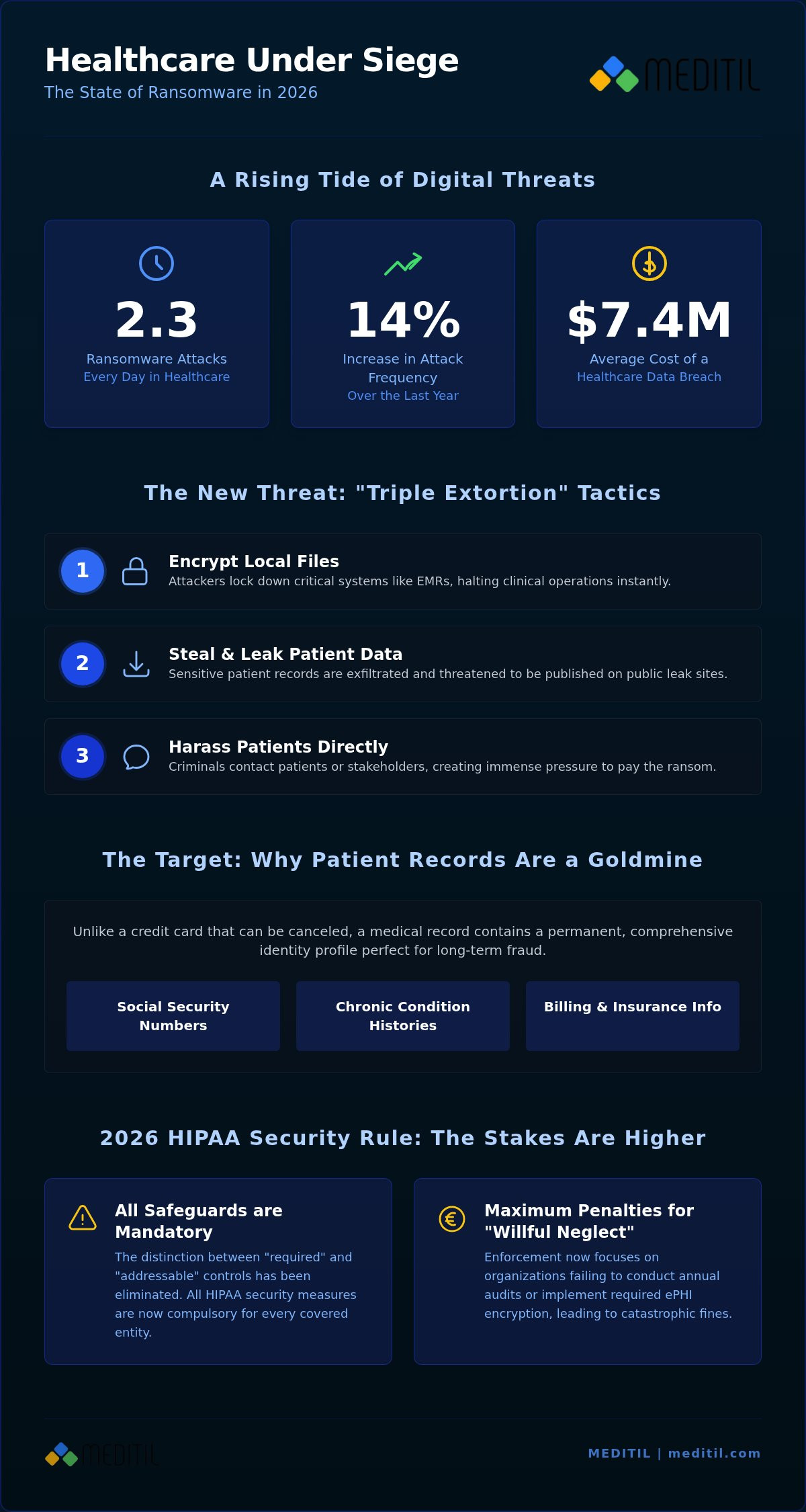
In the first half of 2026, the healthcare sector faced an average of 2.3 ransomware attacks every day. This represents a 14% increase from the previous year, signaling a shift in how cybercriminals view medical infrastructure. No longer satisfied with simple data encryption, modern attackers have moved toward “triple extortion” tactics. In this model, criminals encrypt your local files, steal sensitive patient data for public leak sites, and then harass your patients or stakeholders directly to demand payment. This evolution makes healthcare ransomware prevention a clinical priority rather than just an IT concern.
Patient records command a premium on the dark web in 2026 because they provide a comprehensive identity profile. Unlike a stolen credit card that can be canceled, a medical record contains permanent data: Social Security numbers, chronic condition histories, and billing information. This data allows for long-term insurance fraud and identity theft. When Ransomware strikes, the primary victim isn’t the server; it’s the patient whose care is delayed and whose privacy is permanently compromised. Strategic leaders now focus on “cyber resilience,” a standard that prioritizes the ability to maintain clinical operations even while under active digital assault.
The Cost of Clinical Downtime
An EMR outage in a multi-specialty clinic creates a cascading financial crisis. Beyond the immediate loss of billable hours, you face the high cost of diverted patients and the administrative burden of manual charting. The average cost of a healthcare data breach has climbed to $7.42 million, but the intangible costs are often more damaging. Physician burnout accelerates when teams cannot access critical tools, and patient trust evaporates when appointments are canceled without notice. Implementing robust managed it services for healthcare ensures that these outages are prevented before they can impact your bottom line or provider morale.
Regulatory and HIPAA Implications
The regulatory environment in 2026 has become significantly more stringent. Updates to the HIPAA Security Rule have eliminated the distinction between “required” and “addressable” controls, making all safeguards mandatory for every covered entity. Enforcement trends now focus on “willful neglect,” where organizations that fail to conduct annual audits or implement encryption for ePHI at rest face maximum penalties. Proactive healthcare ransomware prevention is the only reliable way to navigate these mandatory reporting requirements. By documenting your technical and administrative safeguards now, you reduce both your legal liability and the potential for catastrophic financial settlements following an incident.
Assessing Healthcare IT Security Risks: A Step-by-Step Methodology
A proactive approach to healthcare ransomware prevention begins with a granular understanding of your digital environment. In 2026, a standard IT audit is insufficient for medical groups. A healthcare-specific security audit must encompass the entire clinical ecosystem, from EMR databases to the smallest IoT pulse oximeter. This process starts by identifying “shadow IT,” which includes unauthorized personal devices or cloud applications used by clinicians to streamline their work. These unmanaged entry points often bypass traditional security perimeters, creating silent vulnerabilities that attackers exploit to gain a foothold in your network.
Evaluating the security posture of third-party vendors is equally critical. Most modern medical practices rely on a complex web of EMR integrations, billing platforms, and laboratory interfaces. Each connection represents a potential bridge for ransomware to cross. It’s essential to verify that every partner adheres to the same 2026 encryption and auditing standards that your own organization maintains. If you’re unsure where your greatest risks lie, consulting with a strategic IT partner can help clarify your current security gaps before they become liabilities.
Mapping Data Flow and Vulnerabilities
To protect patient data, you must first map exactly how Protected Health Information (PHI) moves through your infrastructure. This includes tracking data from the initial telehealth consultation through to remote monitoring devices and final archival in the EHR. Weak points frequently emerge in telehealth platforms that haven’t been patched to meet 2026 resiliency standards. The Cybersecurity and Infrastructure Security Agency (CISA) provides specialized resources to help healthcare entities identify these high-risk pathways. In a 2026 medical context, vulnerability scanning is the automated, non-disruptive process of identifying security weaknesses in clinical software and hardware to ensure patient data remains uncompromised.
The Human Element: Testing Phishing Resilience
Social engineering remains the primary entry point for ransomware because it targets human psychology rather than technical firewalls. Clinical staff are often targeted during high-stress shifts when their focus is entirely on patient care, making them more likely to click a deceptive link. Effective healthcare ransomware prevention requires conducting non-punitive phishing simulations. These exercises should be educational rather than disciplinary, helping providers recognize the sophisticated, AI-driven phishing attempts common in 2026. Aligning your internal training with professional healthcare cybersecurity services ensures that your team stays ahead of evolving social engineering tactics without adding to their administrative burden.
The 5-Layer Healthcare Ransomware Prevention Framework
Building a resilient defense requires moving beyond basic firewalls toward a defense-in-depth architecture. In 2026, effective healthcare ransomware prevention relies on five distinct layers of protection that work in concert to neutralize threats before they reach the EMR. The first layer focuses on Identity and Access Management (IAM) using phishing-resistant multi-factor authentication. This ensures that even if a clinician’s credentials are compromised, the attacker cannot gain entry without a physical security key or biometric verification. Layer two employs Endpoint Detection and Response (EDR) that utilizes AI-driven behavioral analysis to identify and kill malicious processes in milliseconds, long before they can begin encrypting files.
The third and fourth layers address the internal network and data recovery. Network segmentation prevents the lateral movement of threats, ensuring that an infection in a front-desk workstation cannot migrate to the surgical suite or the billing server. This is followed by the implementation of immutable, air-gapped backups, which serve as your final safety net. The fifth layer is strategic oversight, where continuous compliance monitoring and executive-level IT leadership ensure that these technical controls remain aligned with evolving regulatory standards and clinical needs.
Implementing Zero Trust Architecture in a Clinical Setting
Zero Trust operates on the principle of “never trust, always verify.” For nursing and administrative staff, this means implementing least privilege access, where users only have the specific permissions required for their current shift. Medical devices and IoT equipment are segmented onto their own isolated networks, preventing a vulnerable pulse oximeter from becoming a gateway to the primary EMR. To maintain clinical speed, these high-security protocols are integrated with “Tap-and-Go” technology. This allows providers to maintain a Zero Trust posture with rapid, badge-based logins that don’t sacrifice security for convenience.
Data Protection: Beyond Simple Backups
Standard backups are no longer sufficient because modern ransomware specifically targets and deletes them. Immutable backups are the new standard; they use “write-once-read-many” (WORM) technology that prevents any data from being altered or deleted for a set period. We recommend the 3-2-1-1-0 backup rule: maintain 3 copies of data, on 2 different media, with 1 copy offsite, 1 copy that is immutable or offline, and 0 errors through automated verification. Air-gapping is critical because it creates a physical or logical disconnect between your primary network and your backup storage, ensuring that ransomware cannot traverse the network to encrypt your recovery files. This architecture guarantees that even in a worst-case scenario, your clinical continuity remains intact.
Operationalizing Prevention: Incident Response and Patch Management
Effective healthcare ransomware prevention requires a transition from static defense to active operational maintenance. In 2026, the window between the discovery of a vulnerability and its exploitation has shrunk to mere hours. This reality necessitates a rigorous patch management schedule that operates without disrupting patient care. By scheduling updates during low-volume clinical windows and utilizing automated deployment tools, you ensure that your infrastructure remains hardened against the latest threats. This operational discipline is the only way to maintain the 2026 HIPAA standards for administrative and technical safeguards.
A well-documented Incident Response Plan (IRP) serves as your organization’s playbook during a crisis. This document must define clear roles and establish specific “Return to Operations” (RTO) objectives for critical systems like the EMR and imaging archives. For instance, an RTO of four hours for clinical charting ensures that providers don’t have to rely on paper records for an entire shift. If your internal team is struggling to maintain this level of readiness, partnering with a managed IT specialist can provide the necessary 24/7 monitoring and response capabilities.
Automated Patching and System Hardening
Legacy medical equipment often presents the greatest risk because these devices cannot always be updated with modern operating systems. In these cases, system hardening involves disabling unnecessary ports and services on clinical workstations to reduce the attack surface. Managed IT services play a vital role here by providing proactive monitoring that identifies anomalous behavior before a breach occurs. This level of precision ensures that even older diagnostic tools remain secure within your broader network architecture without requiring immediate, costly hardware replacements.
Testing the Incident Response Plan
A plan that hasn’t been tested is merely a suggestion. Conducting annual tabletop exercises allows your Crisis Management Team to simulate a ransomware event in a controlled environment. This team should include representatives from the following areas:
- IT and Security: To manage technical containment and recovery.
- Clinical Leadership: To oversee patient safety and workflow adjustments.
- Legal Counsel: To ensure compliance with 2026 mandatory reporting requirements.
- Public Relations: To manage patient-facing communication and protect reputational integrity.
During these simulations, you must practice both internal staff updates and external messaging strategies. Refining the plan based on simulation results and 2026 threat intelligence ensures that your response is methodical and composed when a real threat emerges. This process directly addresses the annual audit requirements mandated by the latest regulatory updates.
Strategic Prevention: The Role of the Fractional CIO
While technical defenses like EDR and immutable backups provide the foundation for security, they require a cohesive leadership strategy to remain effective against 2026 threats. Many medical groups struggle with a “leadership gap” where IT decisions are made reactively rather than strategically. A Fractional CIO fills this void by providing executive-level oversight that ensures healthcare ransomware prevention is integrated into the organization’s long-term business goals. This role moves beyond managing tickets to managing risk, ensuring that every dollar spent on cybersecurity directly contributes to clinical stability and regulatory compliance.
Managing a cybersecurity budget in 2026 requires a sophisticated understanding of the protection-to-cost ratio. A Fractional CIO analyzes your current infrastructure to eliminate redundant tools while prioritizing investments in high-impact areas like phishing-resistant MFA and network segmentation. This disciplined approach maximizes your return on investment while maintaining a “steady hand at the wheel.” It also ensures that your practice stays ahead of evolving HIPAA mandates and state-specific privacy regulations, which now require documented evidence of proactive risk management and annual safeguard audits.
Bridging the Gap Between IT and Clinical Leadership
In a resilient medical group, security is a boardroom discussion rather than a back-office technical task. Effective prevention requires a security-first culture where clinical staff understand their role in protecting the network. Utilizing virtual cio services allows your leadership team to drive this culture from the top down. This partnership helps develop a multi-year technology roadmap that prioritizes infrastructure resilience, ensuring that clinical workflows are never compromised by outdated systems or unpatched vulnerabilities. It transforms IT from a cost center into a strategic asset that supports high-quality patient care.
Why a Specialized Healthcare Partner Matters
Generalist Managed Service Providers (MSPs) often lack the industry-specific knowledge required to secure a modern medical environment. They may understand firewalls, but they often don’t grasp the nuances of EMR interoperability or the critical nature of clinical uptime. MEDITIL’s deep expertise in healthcare application support prevents the common implementation gaps that generalists overlook. We ensure that your security layers don’t slow down your providers or disrupt the flow of Protected Health Information. Our focus is on maintaining a seamless connection between robust protection and clinical efficiency. Secure your practice with MEDITIL’s expert healthcare IT leadership and ensure your organization is prepared for the challenges of 2026 and beyond.
Securing the Future of Your Clinical Operations
The complexity of the 2026 threat landscape requires a move away from fragmented security tools toward a unified, strategic architecture. Success in healthcare ransomware prevention depends on your ability to integrate technical layers, such as immutable backups and AI-driven detection, with a culture of clinical readiness. By conducting regular risk assessments and operationalizing your incident response plan, you ensure that patient care remains uninterrupted even during an attempted breach.
Strategic leadership is the final piece of the puzzle. A multi-year technology roadmap allows you to balance your cybersecurity budget with the high-stakes demands of modern medicine. You don’t have to manage these complexities alone. Partner with MEDITIL for proactive healthcare cybersecurity and Fractional CIO leadership to gain access to specialized HIPAA compliance expertise and 24/7 proactive medical network monitoring. Our team provides the strategic IT roadmapping needed for clinical stability and long-term peace of mind. Your focus should remain on the patient; let us provide the steady hand that secures your digital future.
Frequently Asked Questions
What is the first thing a healthcare organization should do after a ransomware attack?
Isolate all affected systems immediately to prevent the lateral movement of the threat across your clinical network. This involves disconnecting infected workstations and servers from the primary network to contain the breach. Once you’ve secured the perimeter, activate your Incident Response Plan and notify your legal, security, and executive leadership teams to initiate forensic analysis and recovery protocols.
How often should a medical practice conduct a security risk assessment?
Healthcare organizations are required to conduct and document a comprehensive audit of their administrative, technical, and physical safeguards at least once every 12 months. This 2026 requirement ensures that your organization remains compliant with the updated HIPAA Security Rule. It’s also best practice to perform targeted assessments whenever you implement new EMR integrations or telehealth platforms.
Is cyber insurance enough to protect my clinic from ransomware?
Cyber insurance is a vital financial recovery tool, but it doesn’t provide healthcare ransomware prevention or restore clinical continuity. While a policy may cover forensic costs or ransom demands, it cannot prevent the catastrophic downtime that halts patient care or the long-term damage to your professional reputation. Insurance should be viewed as a secondary safety net rather than a primary defense strategy.
What are the most common entry points for ransomware in healthcare?
Phishing remains the primary entry point, with attackers using AI-driven social engineering to target clinicians during high-stress shifts. Other common vulnerabilities include unpatched legacy medical devices, unauthorized “shadow IT” applications, and weak points in the healthcare supply chain. Securing these entry points requires a combination of technical controls and continuous employee awareness training.
Can Zero Trust architecture be implemented without slowing down clinicians?
Yes, Zero Trust can be integrated seamlessly into clinical workflows by utilizing “Tap-and-Go” badge-based authentication and biometric verification. These technologies allow for rapid provider access while maintaining the strict “never trust, always verify” standard. When configured correctly, these systems provide high-level security that is virtually invisible to the end-user, ensuring that patient care remains the priority.
How do immutable backups differ from traditional cloud backups?
Immutable backups use “write-once-read-many” technology that prevents data from being altered, encrypted, or deleted for a specified period. Traditional cloud backups are often susceptible to the same ransomware that infects your primary network if they aren’t properly isolated. Immutability provides a guaranteed recovery point that remains untouched even if an attacker gains administrative access to your systems.
What is the role of a Fractional CIO in ransomware prevention?
A Fractional CIO provides the executive-level IT leadership necessary to align your security roadmap with clinical and regulatory goals. They oversee mandatory annual audits, manage the cybersecurity budget, and ensure that your organization adheres to the latest 2026 HIPAA standards. This role provides a steady hand at the wheel, transforming IT from a reactive service into a strategic clinical asset.
How much should a healthcare practice budget for cybersecurity in 2026?
Your budget should focus on meeting the mandatory 2026 regulatory requirements, such as full ePHI encryption and annual security audits. While specific allocations vary based on the complexity of your infrastructure, a strategic budget prioritizes high-ROI defenses like phishing-resistant MFA and immutable storage. A Fractional CIO can help you determine the exact investment needed to maximize your protection without overextending your operational funds.