Imagine an EHR system freezing during a critical patient consultation at 2:00 AM. In the high-stakes environment of 2026, a technical delay isn’t just an administrative nuisance. It’s a direct risk to clinical stability and patient safety. You already know that general IT providers often lack the specialized knowledge required to manage 24/7 IT support for medical clinics effectively. You need a partner who understands that every second of downtime impacts a person’s well-being and views your infrastructure as a life-critical asset rather than a simple set of computers.
This guide explores how specialized 24/7 IT support protects patient data, eliminates clinical downtime, and secures your medical practice around the clock. We’ll provide a clear roadmap for achieving zero-latency access to records and meeting the rigorous regulatory standards of the coming year. You’ll discover how a strategic IT partner acts as a steady hand, ensuring your technology remains a silent, supportive background to your medical expertise. By establishing a proactive defense against cybersecurity threats and system failures, you can return your full attention to what matters most: the health of your patients.
Key Takeaways
- Learn the distinction between proactive monitoring and reactive troubleshooting to prevent technical debt from impacting patient care.
- Discover how specialized 24/7 IT support for medical clinics maintains seamless EHR connectivity across all clinical nodes.
- Recognize why general IT providers often struggle with the unique nuances of healthcare workflows and shifting 2026 regulations.
- Master the art of evaluating SLAs by prioritizing resolution time over simple response metrics during a system crisis.
- Understand how a strategic partner serves as a steady hand for your infrastructure, ensuring total clinical stability around the clock.
The Critical Necessity of 24/7 IT Support in Modern Healthcare
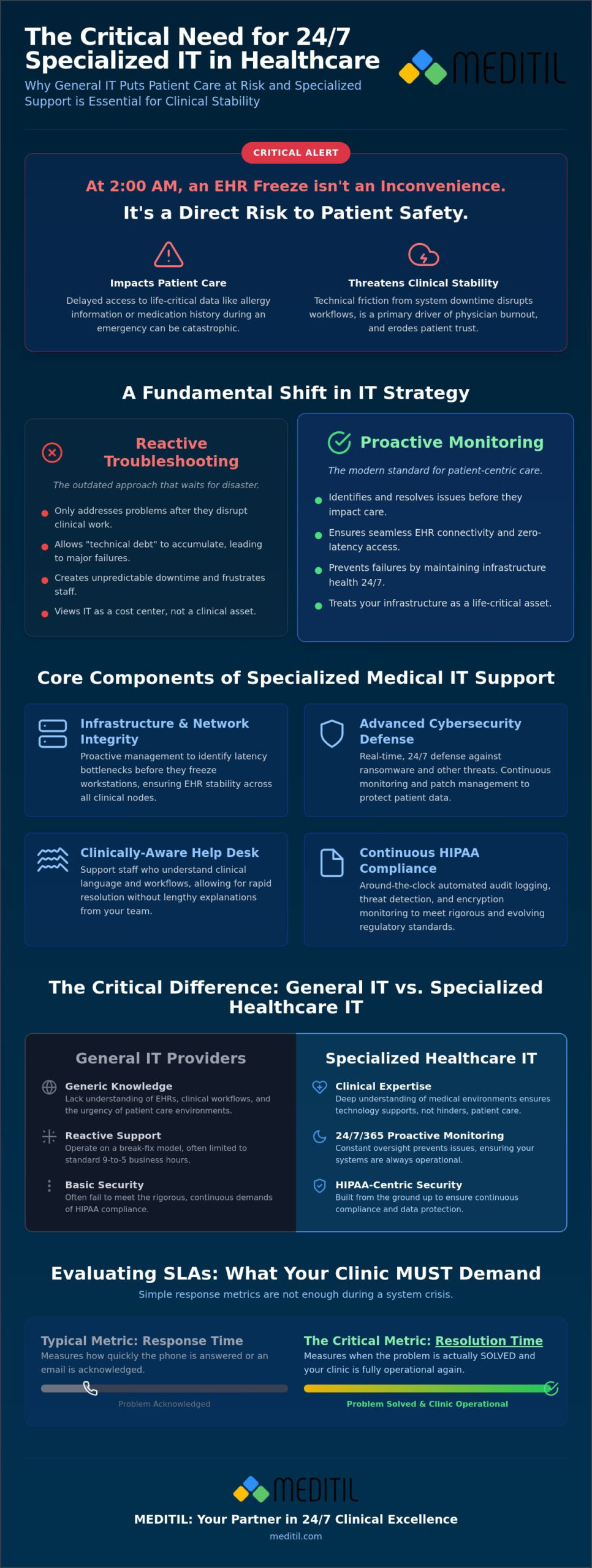
The traditional 9-to-5 business model has no place in a modern clinical environment. Whether it’s a surgeon reviewing charts at midnight or a telehealth provider conducting a remote consultation on a Sunday, the demand for data is constant. Effective 24/7 IT support for medical clinics moves beyond the basic help desk model. It prioritizes proactive monitoring, where technicians identify and resolve system weaknesses before they manifest as failures. Reactive troubleshooting, by contrast, only addresses problems after they’ve already disrupted a physician’s workflow. This shift from defense to offense is what defines a stable practice in 2026.
Technical debt accumulates when clinics rely on outdated infrastructure or patchwork solutions. This debt carries a high interest rate in the form of system downtime. When an EHR goes offline, the financial loss is immediate, but the damage to patient trust and clinical outcomes is harder to quantify. Continuous oversight ensures that Health information technology systems remain operational, preventing the cascading failures that often occur when small errors are left unchecked during off-hours. Establishing a foundation for clinical stability requires constant infrastructure oversight that doesn’t sleep when your staff does.
Patient Safety and the Digital Record
Immediate access to life-critical data is a requirement, not a luxury. During a medical emergency, a delay in retrieving allergy information or medication history can be catastrophic. 24/7 monitoring acts as a safeguard against data corruption within EHR systems, ensuring that every entry is accurately preserved and instantly available. We define clinical friction as any technical obstacle that slows down a provider’s ability to deliver care; it’s a primary driver of physician burnout and low retention rates. By eliminating these hurdles, you protect both your patients and your practitioners.
Compliance as a Constant Requirement
Regulatory bodies don’t pause their requirements when the clinic doors close. HIPAA compliance demands continuous threat detection and the maintenance of detailed audit logs at all hours. Unauthorized data access attempts don’t follow a schedule, making constant vigilance essential. A dedicated partner ensures that your practice meets these shifting standards without requiring your internal team to become security experts. Consider these core compliance functions that must operate around the clock:
- Real-time threat detection: Identifying suspicious login attempts or data exfiltration as they happen.
- Automated audit logging: Maintaining a continuous record of who accessed what data and when.
- Patch management: Deploying critical security updates during low-traffic hours to avoid clinical disruption.
- Encryption monitoring: Verifying that data remains secure during transit and at rest, even during holiday shifts.
By treating compliance as a continuous process rather than a periodic check, you create a resilient environment that can withstand the scrutiny of 2026’s evolving healthcare regulations.
Core Components of Specialized Medical IT Support
Specialized 24/7 IT support for medical clinics is often misunderstood as a simple help desk for forgotten passwords. In reality, it functions as the central nervous system of a modern practice. High-performing clinics require proactive network management that identifies latency bottlenecks before they freeze a physician’s workstation during a patient encounter. This level of oversight ensures that clinical nodes remain connected and that the EHR remains stable across every department. Utilizing effective strategies for implementing health IT allows a practice to transform technology from a potential point of failure into a reliable asset for patient care.
Beyond connectivity, cybersecurity serves as a critical pillar. Real-time defense against ransomware is no longer optional; it’s a requirement for operational survival. A dedicated provider of 24/7 IT support for medical clinics offers an end-user help desk that understands clinical language, allowing staff to resolve technical hurdles without explaining basic medical workflows. This expertise extends to billing automation and interoperability, where the goal is to ensure data flows correctly for revenue cycle management without manual intervention.
Infrastructure and Network Integrity
Reliability in a clinical setting is built on N+1 redundancy. This means every critical component has a backup ready to take over instantly if a primary system fails. Whether your practice utilizes cloud services, on-premise hardware, or a hybrid model, the infrastructure must be resilient. Key focus areas include:
- Redundant Power and Connectivity: Ensuring hardware remains online during local outages.
- Hybrid Cloud Management: Balancing the speed of on-site servers with the flexibility of the cloud.
- Encrypted Data Paths: Securing patient identifiers as they move between clinical nodes.
We focus on optimizing Infrastructure & Network Services to maintain high-speed access to diagnostic imagery and records. This architectural approach prevents the common slowdowns that frustrate clinicians and delay patient care.
Strategic Application Support
A medical practice relies on more than just an EHR. Strategic support includes managing specialized software for labs, imaging, and remote monitoring. Telehealth platforms must remain operational at all hours to support the growing demand for virtual care. By integrating billing software directly with clinical systems, you ensure seamless financial operations. This interoperability reduces administrative friction and allows your team to focus on clinical excellence rather than data entry errors. When these systems work in harmony, the technical burden disappears, leaving a steady hand at the wheel of your clinical technology.
General IT vs. Specialized Healthcare IT: The Difference
Many clinics mistakenly hire general Managed Service Providers (MSPs) that claim to support all industries. While these providers may excel at basic desktop support, they often lack the depth required for 24/7 IT support for medical clinics. A general IT firm views a workstation as a generic tool. A healthcare-focused partner views that same workstation as a critical portal for patient care. This lack of specialization leads to delays when navigating complex electronic record systems or troubleshooting medical-specific hardware. When a system fails at midnight, you don’t need a generalist reading from a script; you need a specialist who understands your specific EMR environment.
Recognizing the nuance of clinical workflows is where the true value of a partner emerges. Nurses and physicians operate in high-pressure environments where every click counts. A general IT provider might suggest a system update during peak morning intake hours, causing administrative gridlock. Specialized support understands the cadence of a medical day, scheduling maintenance and updates during low-volume windows to ensure zero impact on patient throughput. Interoperability is another major hurdle. Generalists often fail to understand the specific protocols required to link disparate systems, which leads to fragmented data silos and errors in the revenue cycle.
Workflow-Aware Support Models
Specialized support models prioritize the reduction of alert fatigue by fine-tuning monitoring systems to only escalate meaningful issues. This ensures that when a technician contacts your staff, the matter is truly urgent and requires immediate attention. For a deeper look at these tailored approaches, see our Managed IT Services for Healthcare guide. By aligning technical support with clinical reality, we minimize disruptions during the most critical hours of patient care and staff intake. We focus on being a steady hand that manages the technical burden so your clinicians can remain focused on their patients.
Regulatory Knowledge and Risk Management
Standard business security protocols are insufficient for protecting Protected Health Information (PHI). Specialized 24/7 IT support for medical clinics implements advanced encryption and access controls that exceed basic commercial standards. This includes navigating the complexities of medical billing automation to ensure financial data remains as secure as clinical data. Incorporating Health IT Strategic Planning into your long-term roadmap ensures that your infrastructure evolves alongside regulatory changes. To learn more about defending your practice against sophisticated threats, explore our Healthcare Cybersecurity Services. Our proactive monitoring is tailored to the unique security requirements of the medical industry, providing verification rather than just assumptions of safety.
Evaluating 24/7 SLAs: What Your Clinic Should Demand
Service Level Agreements (SLAs) are the benchmark for accountability in technical partnerships. However, most generic IT contracts focus on response times, which only measure how quickly a technician acknowledges a problem. In a clinical setting, this metric is insufficient. You need to prioritize resolution time. A prompt response is meaningless if a workstation remains frozen during a critical patient consultation. When evaluating 24/7 IT support for medical clinics, demand a contract that guarantees specific resolution windows for life-critical systems. This ensures that your practitioners aren’t left waiting while a generalist technician learns your EHR architecture on the fly.
After-hours protocols must be clearly defined to maintain stability. If a system crashes at 3:00 AM, your clinic needs a direct line to a specialist who understands medical infrastructure, not a general call center. As your practice expands and patient volume increases, your IT support must scale accordingly. This is where a Virtual CIO becomes essential. They provide the strategic roadmap necessary to align your technology with your long-term growth objectives. This oversight ensures your systems never become a bottleneck for expansion or a source of clinical friction.
Key Performance Indicators (KPIs) for Medical IT
System latency is a vital KPI that directly affects clinical efficiency. It isn’t enough for a system to be “up”; it must be fast enough to support real-time data entry and image retrieval. Tracking ticket resolution rates for life-critical versus non-critical issues allows you to see how your provider prioritizes patient care. For clinics seeking advanced leadership, our Virtual CIO Services offer the strategic oversight needed to manage these metrics effectively. We focus on maintaining a steady hand at the wheel of your technology so you can focus on patient outcomes.
Budgeting for Strategic IT Stability
Reactive “break-fix” IT models are often more expensive than managed 24/7 support when you factor in the cost of downtime. A single hour of EHR unavailability can lead to significant revenue loss and administrative chaos. A fractional CIO helps align your IT spend with clinical outcomes, ensuring that every dollar invested strengthens your infrastructure. You can explore our Strategic IT Budgeting for Medical Practices to better understand how to allocate resources for the coming year. This financial roadmap helps move your clinic away from unpredictable repair costs toward a stable, predictable operational budget. If you’re ready to secure your practice’s future, you can consult with our strategic IT advisors to develop a tailored plan.
MEDITIL: Your Partner in 24/7 Clinical Excellence
Reliability is the cornerstone of modern healthcare. MEDITIL operates as a strategic partner rather than a mere service provider, acting as a steady hand at the wheel of your clinical technology. Our specialized 24/7 IT support for medical clinics ensures that every technical detail is handled with precision, from the back-end server architecture to the front-end user experience. We don’t just react to system failures. We proactively manage your infrastructure and network services to prevent disruptions before they occur. This methodical approach allows your clinicians to remain focused on patient care while we maintain the stability of your digital environment.
Our partnership extends across the full spectrum of healthcare technology. We provide comprehensive cybersecurity and compliance management, offering total peace of mind in an era of increasing digital threats. Whether you’re navigating a complex EMR implementation or optimizing billing automation and system interoperability, MEDITIL provides the technical confidence you need. We understand that clinical excellence requires a seamless flow of data, and our team is dedicated to ensuring that your systems are always connected, verified, and secure.
Fractional CIO and Strategic Advisory
Many practices require executive-level IT leadership but don’t have the budget for a full-time Chief Information Officer. Our Fractional CIO service bridges this gap. We provide high-level strategic advisory that helps you develop a clear 2026 roadmap for technology adoption and practice growth. This includes utilizing customized business intelligence and analytics to drive data-driven decision-making. By aligning your technical investments with your clinical outcomes, we help you achieve long-term stability without the overhead of an executive hire. It’s a disciplined way to ensure your technology supports your strategic advancement.
Getting Started with MEDITIL
The transition to a more stable IT environment begins with a thorough understanding of your current state. Our onboarding process involves a comprehensive audit of your existing infrastructure to identify security gaps and operational bottlenecks. We don’t believe in one-size-fits-all solutions; instead, we offer customized plans that can either augment your existing IT team or provide full management of your systems. This flexibility ensures that you receive the exact level of support your clinic requires to thrive. If you’re ready to eliminate technical friction and secure your practice’s future, it’s time to Partner with MEDITIL for 24/7 medical IT support.
Securing Your Clinical Future in 2026 and Beyond
Maintaining clinical stability requires more than just keeping the lights on; it demands a sophisticated alignment between your medical objectives and your technical infrastructure. We’ve explored how 24/7 IT support for medical clinics serves as a life-critical asset that prevents clinical friction and protects patient safety. By prioritizing resolution times and specialized healthcare expertise over generic help desk models, your practice can navigate the complexities of EHR interoperability and billing automation with total confidence.
MEDITIL provides the comprehensive management of life-critical healthcare infrastructure and the strategic leadership of a fractional CIO to ensure your practice remains compliant and efficient. Our expertise in HIPAA and system interoperability provides a foundation for long-term growth. We act as a steady hand, allowing you to focus entirely on patient care while we handle the technical burden of system performance. You don’t have to navigate these high-stakes challenges alone.
Secure your clinical operations with MEDITIL’s 24/7 specialized IT support. We’re ready to help your clinic achieve a new standard of operational excellence and technical resilience.
Frequently Asked Questions
What is the difference between 24/7 monitoring and 24/7 help desk support?
Monitoring is a proactive process that tracks system health to identify issues before they cause a clinical crash. Help desk support is reactive, providing immediate assistance to staff when they encounter technical hurdles. A complete 24/7 IT support for medical clinics agreement includes both. Monitoring ensures your servers remain stable; the help desk ensures your clinicians can keep working without interruption.
Does my medical clinic really need IT support on weekends and holidays?
Your clinic needs support whenever patient data is accessed or security systems are active. Many clinicians perform after-hours charting or review diagnostic results on weekends. Cyber threats don’t follow a business schedule; hackers often target medical practices during holidays when they expect fewer eyes on the network. Constant oversight provides a steady hand at the wheel, ensuring your infrastructure is always protected.
How does 24/7 IT support help with HIPAA compliance?
HIPAA compliance requires continuous auditing and real-time threat detection to protect patient privacy. 24/7 support ensures that these security protocols never experience a gap in coverage. We maintain detailed audit logs and monitor for unauthorized access attempts at all hours. This level of vigilance is necessary to meet the rigorous regulatory standards of 2026 and protect your practice from costly breaches.
Can MEDITIL support our specific EHR/EMR system after hours?
MEDITIL offers specialized healthcare application support that covers a variety of EMR and EHR platforms. We understand the specific architecture of medical software and how it interacts with your network. Our team can troubleshoot connectivity issues or performance bottlenecks after hours. This ensures that your system is fully optimized and ready for the first patient consultation of the day.
What happens if our network goes down in the middle of the night?
Our proactive monitoring systems identify network failures the moment they occur, often alerting our team before your staff is aware of the problem. We immediately initiate recovery protocols to restore connectivity. By implementing N+1 redundancy and strategic failover systems, we ensure that your critical clinical nodes remain operational. Our goal is to resolve midnight outages before they can impact your morning workflow.
Is 24/7 specialized medical IT support more expensive than general IT services?
Specialized support focuses on the unique requirements of a clinical environment, which general providers often overlook. While general IT services might seem cheaper, they often lead to higher costs through extended downtime and HIPAA non-compliance. Investing in 24/7 IT support for medical clinics reduces financial risk. It provides a more stable foundation for revenue cycle management and patient care delivery.
How does a Fractional CIO work with a 24/7 support team?
The Fractional CIO provides executive-level leadership by analyzing data from the 24/7 support team to guide long-term strategy. While the support team manages daily technical hurdles, the CIO focuses on your practice’s future roadmap and budgeting. This collaboration ensures that your technology isn’t just functional but is also actively supporting your strategic growth and clinical outcomes for the coming year.