
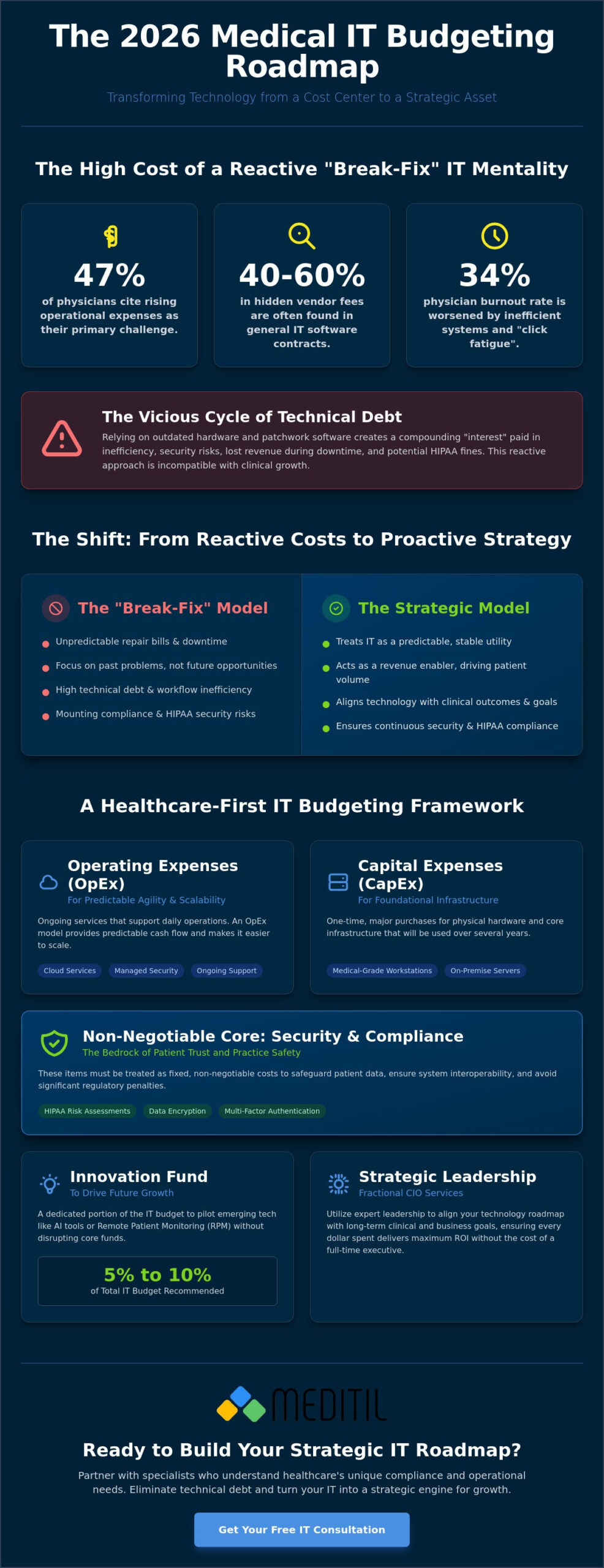
Did you know that 47% of physicians now cite rising operational expenses as their primary challenge for the coming year? For many administrators, the most volatile line item is technology. It’s common to feel trapped in a cycle of unpredictable repair and maintenance bills and mounting clinical friction from outdated hardware and software. Mastering IT budgeting for medical practices is the only way to break this cycle. It requires moving away from reactive spending and toward a structured financial strategy that treats technology as a stable, predictable utility.
You likely recognize that underfunding your security or delaying an EMR transition only leads to higher costs and potential HIPAA fines later. We’ll show you how to audit your current infrastructure, account for the 40% to 60% in hidden vendor fees often found in software contracts, and align your spending with 2026 compliance standards. This guide provides a clear roadmap to eliminate technical debt and ensure your practice remains both profitable and protected in an increasingly complex digital environment. By the end of this roadmap, you’ll have the framework needed to transform IT from a source of anxiety into a strategic engine for growth.
Key Takeaways
- Shift from a reactive “break-fix” mentality to a proactive model that treats technology as a strategic revenue enabler rather than a cost center.
- Identify the hidden costs and compliance risks associated with general IT providers compared to specialized healthcare partners.
- Conduct a rigorous audit of existing technical debt to create a more predictable and stable framework for it budgeting for medical practices.
- Utilize fractional CIO services to align high-level technology investments with long-term clinical and operational goals without the expense of a full-time executive.
- Structure your financial roadmap by categorizing CapEx and OpEx to ensure that security and HIPAA compliance remain well-funded, non-negotiable priorities.
The Strategic Importance of IT Budgeting for Medical Practices in 2026
Medical IT budgeting is no longer just a line item on a spreadsheet. It’s the proactive allocation of financial resources designed to safeguard patient data and optimize the flow of clinical work. In the past, many administrators viewed technology as a cost center; a necessary expense that drained profits. By 2026, this perspective has fundamentally shifted. Modern practices now treat Health Information Technology (HIT) as a revenue enabler that drives patient volume and improves reimbursement accuracy. When systems are integrated and workflows are automated, providers can see more patients without compromising the quality of care.
One of the most overlooked aspects of it budgeting for medical practices is the management of technical debt. This represents the cumulative “interest” paid in the form of inefficiency and security risks when a practice relies on outdated hardware or patchwork software solutions. With the global healthcare IT market projected to reach $231.2 billion this year, staying competitive requires a disciplined financial approach. New frameworks, such as the proposed Healthy Technology Act of 2026, emphasize AI integration and stricter data accuracy. Failing to budget for these mandatory upgrades doesn’t just hinder care; it invites significant regulatory scrutiny and financial penalties.
The Hidden Costs of Reactive IT
Reactive IT is inherently expensive. When an EHR system fails during peak patient hours, the loss isn’t limited to the technician’s repair fee. It includes the thousands of dollars in unbilled time and the immediate erosion of patient trust. Break-fix models are fundamentally incompatible with clinical growth because they force leadership to focus on yesterday’s problems rather than tomorrow’s opportunities. Technical debt is the financial burden of maintaining legacy systems that hinder modern clinical interoperability.
Aligning Technology with Clinical Outcomes
A strategic budget addresses the human element of medicine. By investing in tools that reduce “click fatigue” and administrative bloat, practices can directly combat the 34% burnout rate currently reported by physicians. A 2026 roadmap must also prioritize secure telehealth accessibility. Currently, 40% of practices still rely on general-purpose video tools that may not meet the latest safety standards. Proper it budgeting for medical practices ensures that every dollar spent on infrastructure directly supports a superior patient experience and enhanced data integrity. This alignment is essential for meeting the 2026 standards for patient safety and interoperability.
Categorizing Your IT Spend: A Healthcare-First Framework
Effective it budgeting for medical practices requires a departure from the “static expense” model. Instead of simply reviewing historical data, administrators must categorize investments based on clinical utility and risk mitigation. A structured financial roadmap distinguishes between Capital Expenditures (CapEx) and Operating Expenditures (OpEx). While CapEx covers one-time purchases like medical-grade workstations or local servers, OpEx supports the ongoing agility of the practice through cloud services, managed security, and ongoing support. Shifting toward an OpEx-heavy model often provides better scalability and more predictable monthly cash flow.
Security and compliance must be treated as non-negotiable fixed costs. This category includes mandatory HIPAA risk assessments, encryption protocols, and multi-factor authentication. Beyond basic protection, allocate specific funds for system interoperability. Ensuring that your EMR/EHR can communicate seamlessly with laboratories and imaging centers reduces manual data entry and errors. If you’re looking for precision in your financial planning, specialized IT consulting can provide the clarity needed to avoid over-investment while maintaining high standards of care.
Strategic leaders also establish an Innovation Fund, typically 5% to 10% of the total IT budget. This allows the practice to pilot emerging technologies, such as remote patient monitoring (RPM) or AI-driven patient engagement tools, without disrupting core operational funds. Finally, include professional services like fractional CIO leadership in your operational budget. These experts ensure that your technology roadmap aligns with long-term business goals, preventing the “over-buying” of features that don’t serve your specific patient demographic.
Core Infrastructure and Network Stability
Clinical operations require a zero-downtime environment. Budgeting for N+1 redundancy ensures that if a critical component fails, a secondary system takes over immediately. This stability is vital for high-speed connectivity used in modern medical imaging and telehealth. Medical-grade hardware generally follows a three to five-year lifecycle; planning for proactive replacement is significantly more cost-effective than emergency repairs during patient hours.
Billing Automation and Revenue Cycle Management
Integrating medical billing automation solutions into your budget directly impacts the bottom line by reducing claim denials and accelerating reimbursements. While the initial integration with an EHR requires an investment, the ROI is realized through decreased administrative labor and improved data accuracy. Real-time business intelligence and analytics should also be funded to provide leadership with a clear view of practice performance and financial health.
Comparing IT Delivery Models: General MSP vs. Specialized Healthcare Partner
Selecting an IT delivery model is one of the most consequential decisions in it budgeting for medical practices. While a general Managed Service Provider (MSP) may offer a lower monthly retainer, the long-term cost differences often favor a specialized healthcare partner. General providers frequently lack the specific expertise required to navigate the intricacies of HIPAA regulations and EMR workflows. This knowledge gap creates “hidden costs” in the form of clinical friction, where medical staff must spend valuable consultation minutes explaining healthcare-specific problems to a technician who doesn’t understand the environment. A specialized help desk understands the urgency of a frozen EHR or a failed imaging transfer, resolving issues faster to preserve your practice’s revenue stream.
The financial structure of your IT agreement also dictates your long-term stability. Hourly billing models often create a conflict of interest, as the provider profits from your system failures. In contrast, flat-rate managed services align the provider’s goals with your own. When your IT partner receives a fixed monthly fee, they’re incentivized to implement proactive maintenance that prevents downtime. This shift from reactive to proactive support is a cornerstone of effective it budgeting for medical practices, as it replaces volatile, high-cost emergency repairs with a steady, predictable operational expense.
The ROI of Specialized Healthcare IT
Investing in managed it support for healthcare provides a measurable return by preventing costly HIPAA audit failures. For a small practice with 10 to 50 employees, the first-year cost for HIPAA compliance can range from $5,000 to $25,000, and a single breach can result in penalties that far exceed any initial savings from a general IT provider. Specialized partners also offer superior vendor management. They act as a liaison between your practice and medical software companies, ensuring that updates don’t cause clinical bottlenecks or interoperability failures that disrupt patient care.
Total Cost of Ownership (TCO) in Medical IT
A sophisticated budget looks beyond the monthly invoice to analyze the total cost of ownership over a three to five-year period. Proactive management reduces the frequency and severity of emergency expenditures, which are often 200% to 300% more expensive than planned upgrades. You must also factor in the “catastrophic cost” of regulatory non-compliance. With third-party HIPAA risk assessments typically costing between $2,000 and $10,000, having a partner who integrates these requirements into their standard service prevents the sudden, unbudgeted spikes in spending that derail financial health.
Actionable Steps to Build Your 2026 Medical IT Budget
Building a resilient financial plan requires shifting from guesswork to data driven precision. The first step in it budgeting for medical practices is conducting a comprehensive audit of your existing infrastructure. This process identifies technical debt and security vulnerabilities that often remain hidden until a system failure occurs. By documenting the age of every workstation, the version of every software application, and the status of your network hardware, you create a baseline for necessary upgrades. This audit allows you to move away from the high costs of reactive repairs and toward a more stable, predictable investment strategy.
Reviewing last year’s unplanned IT expenses is equally critical. Analyze every “break-fix” invoice to identify systemic weaknesses. If you spent a significant portion of your budget on emergency server repairs or workstation troubleshooting, it’s a clear signal that your current infrastructure is underperforming. To ensure the new budget meets actual clinical needs, involve your physicians and nursing staff in the process. They can identify workflow pain points, such as slow EMR load times or “click fatigue,” that directly impact patient care. Finally, benchmark your proposed spending against national industry averages. For medical practices, IT spending typically ranges from 4% to 7% of annual revenue.
Budgeting for HIPAA Compliance and Cybersecurity
Compliance is a recurring investment rather than a one-time event. Your budget must allocate specific funds for mandatory annual risk assessments and ongoing employee security training. Effective healthcare cybersecurity services now include proactive 24/7 monitoring and advanced encryption to protect sensitive patient data. When evaluating storage options, conduct a cost-benefit analysis between cloud-based and on-premise solutions. While cloud systems often have higher monthly operational costs, they typically provide superior data redundancy and easier HIPAA compliance management than aging local servers.
Interoperability and Data Management
Modern medicine relies on the seamless exchange of information. You must fund the “bridges” between disparate platforms to ensure your practice maintains a single source of truth for patient records. Implementing medical it solutions that prioritize interoperability reduces administrative labor and prevents dangerous data silos. Don’t forget to budget for the training required to maximize these systems. Even the most advanced technology fails to deliver ROI if your staff isn’t proficient in using it. If you need assistance identifying these gaps, our team can provide a professional audit to secure your Managed IT Services and stabilize your 2026 financial roadmap.
The Role of a Fractional CIO in Optimizing Your IT Budget
Many medical practices reach a point where technical complexity outpaces their internal management capabilities. While the need for high level strategy is evident, the cost of a full time Chief Information Officer is often prohibitive for mid sized groups. A Fractional CIO bridges this gap by providing executive level oversight at a fraction of the traditional expense. This specialized leadership is essential for effective it budgeting for medical practices, as it moves the conversation from “what does this cost” to “what value does this deliver.” By aligning every technology investment with your long term clinical goals, a strategic advisor ensures that your practice isn’t just spending money, but building a scalable foundation for growth.
Strategic leadership is the most effective defense against “over buying.” It’s common for vendors to pitch comprehensive software suites with features that a specific specialty may never use. A CIO evaluates these offerings through a clinical lens, identifying where technology can truly reduce administrative bloat and where it simply adds unnecessary cost. Beyond procurement, these experts manage the complexities of vendor contracts. They negotiate pricing for medical software and ensure that service level agreements (SLAs) actually protect the practice’s interests. This level of scrutiny prevents the “scope creep” that often causes IT budgets to spiral out of control.
Strategic Roadmapping and Vendor Management
Stability in a financial roadmap is achieved through long term planning. Specialized virtual cio services create a structured three year technology roadmap that anticipates hardware refresh cycles and software upgrades. This approach allows administrators to spread costs evenly over several years, avoiding the sudden capital calls that disrupt cash flow. A Fractional CIO transforms IT from an unpredictable expense into a controlled, strategic investment that supports the practice’s financial health. By consolidating vendors and optimizing licensing fees, they reduce the administrative overhead required to manage multiple disparate systems.
Partnering with MEDITIL for Financial and Technical Stability
At MEDITIL, we understand that financial predictability is just as important as technical uptime. Our managed services provide healthcare leaders with a fixed monthly budget, eliminating the volatility of the traditional break fix model. By utilizing an augmented IT team, your practice gains access to a broad spectrum of experts without the burden of increasing internal headcount or benefits costs. This model provides the high performing infrastructure necessary for modern medicine while maintaining strict fiscal discipline. To move beyond reactive spending and secure your clinical operations, schedule a strategic IT budget consultation with MEDITIL to secure your practice’s financial future.
Securing Your Practice’s Financial and Operational Future
The landscape of healthcare technology in 2026 demands a transition from reactive “break-fix” spending to a disciplined, proactive utility model. By categorizing your infrastructure investments and addressing technical debt now, you protect your practice from the volatility of emergency repairs and regulatory penalties. Successful it budgeting for medical practices isn’t just about controlling costs; it’s about ensuring that every dollar spent enhances clinical interoperability and patient safety. This strategic alignment turns technology into a reliable engine for growth rather than a source of financial friction.
Working with a partner that offers Fractional CIO leadership and specialized expertise in healthcare revenue cycle management provides the executive level strategy needed to stabilize your roadmap. This approach ensures proactive HIPAA compliance and risk mitigation while preventing the common pitfall of over investing in unnecessary technology. You don’t have to navigate these complexities alone. To begin standardizing your financial planning, Download our Strategic IT Budgeting Template for Medical Practices. Taking control of your technology investments today ensures a more resilient, profitable, and patient centered practice for years to come.
Frequently Asked Questions
What percentage of revenue should a medical practice spend on IT?
A medical practice should typically allocate between 4% and 7% of its annual revenue to technology and support services. This range ensures sufficient funding for core infrastructure, cybersecurity, and the ongoing maintenance necessary to maintain clinical efficiency. Smaller practices with less than $1 million in revenue often find themselves at the higher end of this percentage to establish baseline compliance and reliable EHR capabilities.
Is it better to lease or buy medical IT hardware for budgeting purposes?
Leasing is often preferable for medical practices because it shifts large capital expenditures to predictable operating expenses. This model allows practices to maintain a consistent three to five year hardware refresh cycle, ensuring clinical staff always have access to high performing, medical grade equipment. While buying may offer lower long term costs, it often leads to technical debt as hardware ages beyond its optimal lifespan and becomes prone to failure.
How does a budget help prevent HIPAA compliance violations?
A structured budget prevents HIPAA violations by ensuring that critical security measures, such as annual risk assessments and employee training, are never skipped due to a lack of immediate funds. By treating compliance as a fixed operational cost rather than an optional project, practices can maintain continuous encryption and proactive monitoring. This disciplined approach to it budgeting for medical practices mitigates the risk of catastrophic fines and patient data breaches.
Can specialized IT support actually reduce my overall practice overhead?
Yes, specialized support reduces overhead by eliminating the hidden costs of clinical downtime and staff inefficiency. General providers often take longer to resolve healthcare specific issues, leading to lost consultation minutes and physician burnout. A partner familiar with medical workflows ensures that EHR systems and imaging tools remain operational, allowing the practice to maximize patient volume and revenue without increasing administrative headcount.
What are the most common hidden costs in medical IT budgeting?
The most common hidden costs include EHR implementation fees, which can range from $20,000 to $65,000, and essential software add ons like e-prescribing or telehealth modules. Many vendors advertise a base price that is significantly lower than the true cost of ownership. Additionally, unplanned “break-fix” repair bills for legacy systems often create significant budget variances that disrupt a practice’s financial stability and cash flow.
How often should a medical practice review its IT budget?
You should conduct a formal review of your IT budget at least once per quarter to track variances and adjust for emerging technical needs. An annual deep dive is also necessary to align technology spending with the next year’s clinical and growth objectives. Regular reviews allow leadership to identify systemic infrastructure weaknesses early, preventing minor technical issues from escalating into expensive, unbudgeted emergency expenditures.
Does my small practice really need a Fractional CIO for budgeting?
Even a small practice benefits from Fractional CIO services because high level strategy prevents expensive mistakes like “over buying” or investing in incompatible systems. A strategic advisor provides the executive oversight needed to negotiate better vendor contracts and build a three year technology roadmap. This ensures that every dollar spent on it budgeting for medical practices supports long term financial health and clinical excellence.
How do we budget for unexpected cybersecurity threats in 2026?
Budgeting for modern cybersecurity requires moving from basic antivirus software to proactive managed security models that include 24/7 monitoring and endpoint protection. Practices should allocate funds for a dedicated incident response plan and advanced encryption protocols to protect sensitive data. By treating cybersecurity as a non-negotiable utility, you ensure that the practice remains resilient against the increasing sophistication of ransomware and other digital threats in the healthcare sector.
23 Responses