A generalist IT provider is no longer just a slow responder; in 2026, they’re a liability to your HIPAA compliance and clinical workflow. You’ve likely felt the friction when a help desk agent doesn’t understand the urgency of a frozen EHR during rounds or the nuances of the latest HIPAA Security Rule updates. It’s frustrating to explain medical terminology to the very people supposed to be fixing your systems. To maintain stability, your organization requires specialized healthcare IT help desk services that speak the language of HL7 and MIPS, not just basic password resets.
This guide will show you how these specialized services evolve beyond simple ticket resolution into strategic partners that drive clinical optimization and ensure bulletproof compliance. We’ll help you navigate the shift toward mandatory safeguards and the new 15-day patient record access deadline. By the end of this comparison, you’ll have a clear roadmap to reduce physician burnout through efficient tech and achieve seamless EHR interoperability for the 2026 performance year. We’re here to ensure your infrastructure is a catalyst for care, not a hurdle for your clinicians.
Key Takeaways
- Transition your operational focus from simple ticket volume to clinical outcome optimization by defining the specific requirements of healthcare-native IT support.
- Evaluate the performance of specialized healthcare IT help desk services through clinical-grade SLAs and deep EHR/EMR application support rather than generic response times.
- Ensure life-critical system stability by implementing N+1 redundancy and modernizing legacy infrastructure to meet 2026 interoperability and security standards.
- Utilize a rigorous procurement framework to vet potential partners based on verified clinical case studies and their technical capacity for complex billing and EHR integrations.
- Leverage strategic leadership models, such as Fractional CIO services or augmented IT teams, to align technical operations with long-term organizational goals.
The 2026 Landscape of Healthcare IT Help Desk Services
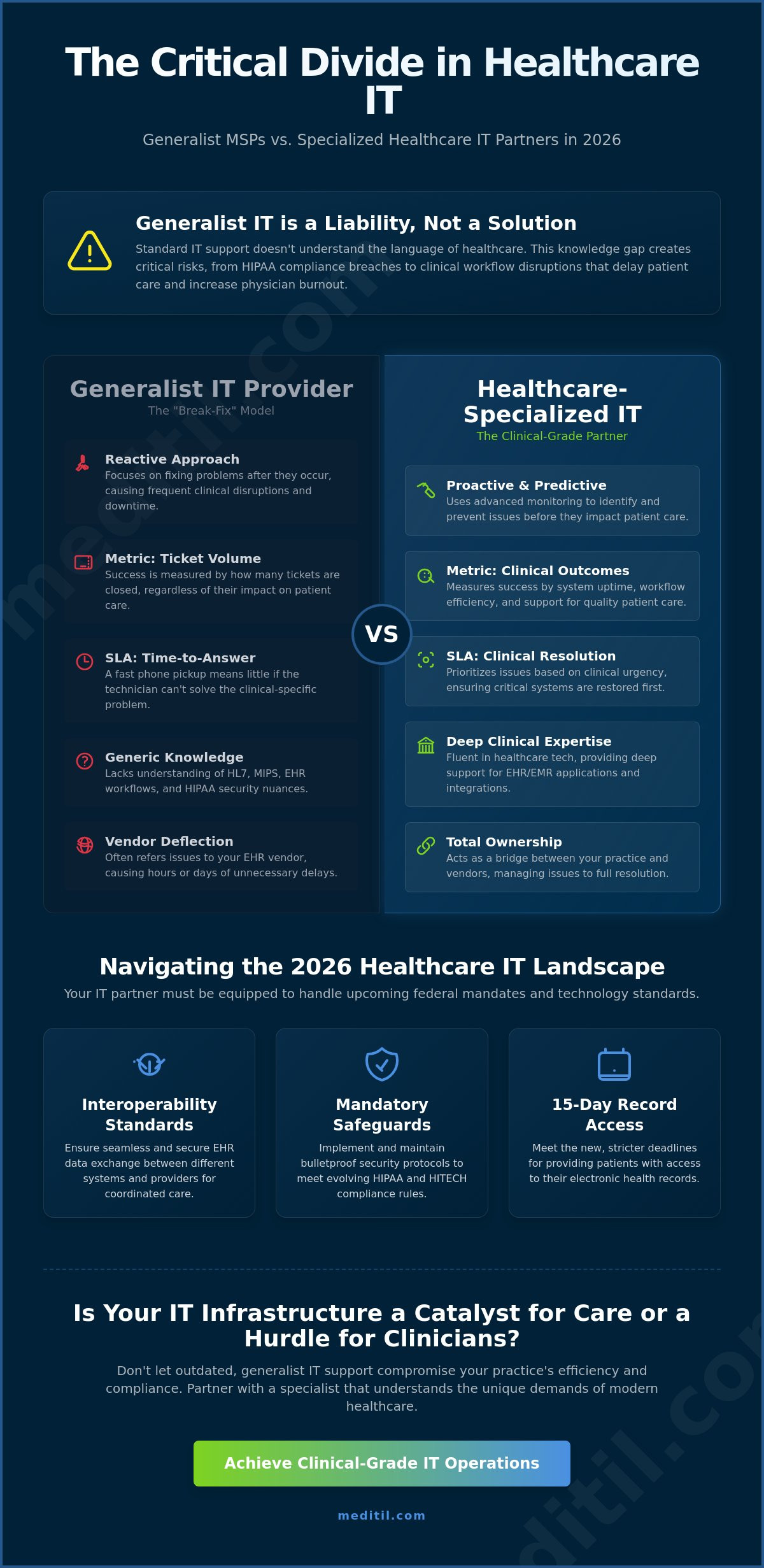
Technical support in a medical environment must transcend traditional boundaries to meet the rigorous demands of 2026. Modern practices can’t afford the disconnect found in generic outsourced help desks. These generalist providers focus on ticket volume and resolution times, metrics that often fail to reflect the reality of a busy clinic. In contrast, specialized healthcare IT help desk services prioritize clinical outcome optimization. This shift ensures that every technical intervention supports the primary mission: providing high-quality patient care without interruption. A healthcare-native approach means the support team understands the pressure of a full waiting room and the critical nature of a functioning clinician portal.
A sophisticated understanding of Health Information Technology (HIT) is now the baseline for any effective support model. It’s not just about keeping the local network running; it’s about maintaining the intricate web of systems that keep patients safe. This includes the critical role of 24/7/365 monitoring. In life-critical environments, a single minute of server lag can delay a diagnosis or treatment plan, making constant vigilance a necessity rather than a luxury. By 2026, the standard for excellence is defined by a support structure that is as resilient and reliable as the medical professionals IT serves.
Why Generalist IT Support Fails Medical Practices
Generalist MSPs often lack the specialized vocabulary required to communicate effectively with medical staff. When a nurse reports an “interface error,” a generic agent might treat it like a standard software glitch. They don’t understand that the error represents a break in the HL7 data stream between the lab and the EHR. This knowledge gap leads to extended downtime and increased clinical friction. These providers also frequently overlook the specific nuances of HIPAA and HITECH compliance, potentially exposing the practice to audits and legal liabilities. The hidden costs of downtime become clear when support teams don’t understand how a failure ripples through specific EHR workflows, causing bottlenecks that frustrate physicians and delay patient care.
The Proactive Paradigm: Preventing Clinical Disruption
The industry is moving away from the reactive “break-fix” model toward predictive infrastructure management. Professional healthcare IT help desk services use advanced monitoring tools to identify potential system failures before they impact a physician’s ability to see patients. By aligning response times with clinical urgency levels, technical teams can prioritize a malfunctioning surgical tablet over a non-essential office printer. This disciplined approach ensures that technical support serves as a stable foundation for patient safety. It’s about creating a reliable environment where clinicians can focus on their patients, confident that the underlying technology will work as intended, even during peak hours or complex procedures.
Generalist MSPs vs. Healthcare-Specialized IT Partners
Choosing a technical partner for your medical practice involves more than comparing monthly fees. Most generalist Managed Service Providers (MSPs) operate on a volume-based model, focusing on Service Level Agreements (SLAs) that prioritize “time to answer” over “time to clinical resolution.” While a 60-second response sounds impressive, it offers little value if the technician cannot navigate an EMR interface or understand why a prescription isn’t transmitting to a pharmacy. Specialized healthcare IT help desk services treat technical issues as clinical events. They recognize that a workstation failure in an exam room carries higher stakes than a printer error in the administrative office.
These specialized partners align their operations with nationwide interoperability efforts, ensuring that data exchange between disparate systems remains fluid. This depth of support extends to the application layer, where technicians possess the training to troubleshoot specific EMR modules and billing integrations. A generalist provider might simply refer you to the software vendor’s support line, causing hours of delay. A healthcare-hardened partner takes ownership of the issue, acting as a bridge between your staff and the software developers to restore functionality quickly.
Key Differentiators in Service Delivery
Effective service delivery in medicine requires workflow-aware troubleshooting. This means the support team understands how diagnostic imaging flows into the patient chart and how that data eventually triggers a billing cycle. Specialized onboarding doesn’t just install software; it maps these complex patient data flows to prevent future bottlenecks. Support agents also prioritize patient portals, recognizing that these tools are vital for modern patient engagement and practice efficiency. If you find your current support lacks this depth, it’s likely time to evaluate a more clinical-grade technical partnership that understands your specific operational needs.
Compliance and Security Accountability
Security is where the gap between generalists and specialists becomes most dangerous. With the 2026 updates to the HIPAA Security Rule and the mandatory compliance for Substance Use Disorder (SUD) records as of February 16, 2026, generalist security measures are insufficient. Specialized partners provide audit-ready documentation and maintain a security posture designed specifically for the healthcare threat landscape. They manage the shortened 15-day patient record access deadline as a core part of their service, not an add-on. While specialized healthcare IT help desk services represent a focused investment, they act as a vital safeguard against the catastrophic financial and reputational costs of a data breach. Verification of industry-specific certifications is a critical step in vetting any prospective partner to ensure they possess the technical discipline your practice demands.
Core Infrastructure: Interoperability, Security, and Stability
Maintaining a stable healthcare environment requires more than reactive fixes; it demands a robust underlying architecture. Many organizations struggle with technical debt, where outdated legacy systems create a ripple effect of inefficiency and risk. Modernizing these frameworks through comprehensive medical IT solutions is essential for long-term stability. This isn’t just about speed. It is about reliability. Implementing N+1 redundancy ensures that if one hardware component fails, another is ready to take its place instantly. For life-critical systems, this level of infrastructure discipline is the only way to guarantee maximum uptime during patient procedures.
Bridging the gaps between siloed EHRs and diagnostic tools remains a significant challenge for modern practices. When data doesn’t flow, clinicians must manually enter information, which increases the risk of error and fatigue. Strategic healthcare IT help desk services focus on these integration points to ensure that imaging, labs, and patient charts exist in a unified ecosystem. This integration also extends to billing automation. By ensuring seamless connectivity between clinical documentation and financial systems, practices can significantly reduce claim denials and accelerate the revenue cycle. Technical stability provides the foundation for financial health.
Interoperability and Data Management
The Office of the National Coordinator for Health IT (ONC) sets the standards for how these systems should communicate across the industry. Adhering to these guidelines allows practices to leverage business intelligence for better clinical decision support. When telehealth data flows directly into the core medical record without manual intervention, physician burnout decreases. Clinicians spend less time fighting with data silos and more time on patient care. Seamless connectivity defines a mature technical operation.
Life-Critical Cybersecurity Measures
Security in 2026 must go beyond simple firewalls. With the proliferation of medical IoT and connected devices, advanced threat detection is mandatory. These devices often represent a vulnerable entry point if not properly managed. Robust identity and access management protocols ensure that only authorized personnel can view sensitive patient records, preventing accidental or malicious exposure. Finally, the necessity of HIPAA-compliant cloud backups cannot be overstated. A comprehensive disaster recovery plan ensures that even in the event of a catastrophic failure, patient data remains protected and accessible. Professional healthcare IT help desk services manage these complex layers so your practice stays secure and operational.
The Procurement Framework: Vetting Healthcare IT Service Providers
Identifying the right partner for healthcare IT help desk services demands a disciplined vetting process. A generic checklist won’t suffice when patient safety and regulatory standing are at stake. Start by auditing healthcare-specific case studies. You need to see evidence of successful EHR implementations and ongoing application support in environments similar to yours. If a provider can’t demonstrate deep experience with your specific technical stack, particularly for billing and EHR integrations, they’ll likely struggle when clinical urgency peaks. Verification of past performance in high-stakes environments is the most reliable predictor of future success.
Strategic leadership is the next pillar of a robust procurement framework. Evaluate their vCIO or Fractional CIO capabilities. A partner should do more than fix broken hardware; they should provide a technical roadmap for 2026 and beyond. Transparency in compliance reporting is equally vital. Your partner must provide audit-ready documentation that proves they meet the latest HIPAA standards. If their reporting is opaque, your practice carries the risk. A professional provider will welcome this scrutiny and offer clear, verifiable data regarding their security protocols and response metrics.
The Clinical Workflow Test
During the selection process, put the prospective help desk to the test. Ask how they handle a “frozen encounter” or a prescription transmission failure. A healthcare-native team will recognize these as high-priority clinical disruptions, not just standard software tickets. Vetting the help desk for medical terminology accuracy is essential. If an agent doesn’t understand what a PACS system or an HL7 feed is, they’ll spend your time learning on the job instead of solving the problem. You want a team that understands physician friction and knows how to alleviate it through technical precision.
Strategic Roadmap and Financial Alignment
Aligning your IT budget with clinical outcomes is the final step in a mature procurement strategy. Hardware refresh cycles are important, but they shouldn’t be the primary focus of your spending. Instead, prioritize investments that reduce technical debt and improve provider satisfaction. A structured approach to it budgeting for medical practices helps you move from a reactive spending model to a strategic one, eliminating the unpredictable repair bills and hidden vendor fees that trap many organizations. Utilizing managed it support for healthcare helps you move from a reactive spending model to a strategic one. Watch for hidden fees in generalist MSP contracts, such as extra charges for “after-hours” clinical support or compliance audits. A true partner provides a clear, all-inclusive structure that supports your financial health. To ensure your selection process is thorough and data-driven, you can schedule a technical infrastructure audit with our team to identify existing gaps in your current support model.
MEDITIL: Strategic Leadership for Clinical-Grade IT Operations
MEDITIL stands as a specialized partner dedicated to the unique rigors of the medical industry. We don’t just provide healthcare IT help desk services; we deliver a comprehensive operational framework designed for stability. Our approach integrates infrastructure management with a mission-driven focus on patient safety. By customizing technical stacks for specialized practices, we ensure that your technology serves as a seamless extension of your clinical team. This connectivity is vital for maintaining the high-performance standards required in modern medicine. We act as a steady hand at the wheel, ensuring every technical detail is handled with precision.
Our service models are designed for flexibility and depth. Whether you need an augmented IT team to support your internal staff or a fully managed technical department, we provide the expertise necessary to maintain clinical-grade operations. We prioritize seamless interoperability, ensuring that your EHR, diagnostic tools, and billing systems function as a unified ecosystem. This focus on integration reduces the technical friction that often leads to staff frustration and operational bottlenecks.
Fractional CIO: Executive Strategy Without the Overhead
Many practices struggle to align their technical investments with long-term clinical goals. Our Fractional CIO model provides executive-level strategy without the overhead of a full-time hire. This role is essential for navigating the complex regulatory shifts arriving in 2026, such as the mandatory compliance for Substance Use Disorder (SUD) records effective February 16. A vCIO ensures your organization isn’t just reacting to these changes but is proactively prepared. We develop long-term roadmaps for telehealth expansion and automation that prioritize clinical outcomes over simple hardware refreshes. It’s about bridging the gap between technical operations and executive clinical strategy.
A Partnership Built on Clinical Stability
Precision management of existing IT operations is the hallmark of our service. We protect life-critical systems through proactive, healthcare-native support that understands the urgency of every clinical encounter. Our commitment to stability means your infrastructure remains resilient, even during peak patient volumes. We offer a level of technical discipline that generalist providers cannot match, focusing on the specific needs of regulated medical environments.
- Implementation of N+1 redundancy for mission-critical server stability and uptime.
- Advanced identity and access management to meet the 2026 HIPAA Security Rule revisions.
- Technical support agents who are fluent in medical terminology and clinical workflows.
- Strategic alignment of IT budgets with patient care objectives to reduce technical debt.
Choosing the right healthcare it help desk services is a strategic decision that impacts the future of your practice. Partner with MEDITIL for Clinical-Grade IT Support and secure a technical foundation that empowers your clinicians to focus on patient care without technical disruption.
Advancing Clinical Excellence Through Strategic Technical Partnership
The transition to 2026 requires more than reactive support; it demands an infrastructure built for seamless interoperability and a security posture that anticipates stricter regulatory mandates. Organizations must move beyond the limitations of generalist providers to find partners who understand the clinical nuances of EHR workflows and patient safety. Selecting the right healthcare IT help desk services is no longer a back-office utility decision; it’s a strategic move toward operational stability and long-term provider satisfaction.
MEDITIL offers the specialized healthcare IT expertise and Fractional CIO strategic leadership required to navigate this evolving landscape. Our comprehensive HIPAA compliance management ensures your practice remains resilient against both technical failures and regulatory audits. We provide the steady hand at the wheel that your clinicians deserve, allowing them to focus on patients while we manage the complexities of your digital environment. Secure Your Clinical Future with MEDITIL Managed IT Services. We’re ready to help you build a technical foundation that supports your mission of care.
Frequently Asked Questions
What is the primary difference between managed IT and traditional IT support in healthcare?
Managed IT services provide a proactive, subscription-based model that prioritizes infrastructure stability and ongoing monitoring. In contrast, traditional IT support often follows a reactive “break-fix” approach where technicians only intervene after a system failure occurs. For medical practices, the managed model is essential because it includes continuous compliance updates and strategic planning that traditional support typically lacks.
How do specialized help desk services ensure HIPAA compliance for my practice?
Specialized healthcare it help desk services ensure compliance by implementing technical safeguards that meet the latest federal standards. They manage mandatory requirements such as end-to-end encryption, multi-factor authentication, and detailed audit logs required by the 2026 HIPAA Security Rule updates. These services provide the documentation necessary to prove your practice is protecting sensitive patient records during every interaction.
Can a healthcare IT help desk assist with EHR implementation and training?
Yes, specialized IT partners often provide EMR/EHR implementation and training as a core service. They assist medical staff in understanding new workflows and ensure that the software integrates correctly with your existing diagnostic and billing tools. This support reduces the initial friction that clinicians often face during a transition, allowing the practice to maintain productivity while adopting new technology.
What is a Fractional CIO and why does my organization need one?
A Fractional CIO is a seasoned executive who provides strategic IT leadership on a part-time or consultative basis. Your organization needs this role to bridge the gap between technical operations and long-term clinical goals. They develop roadmaps for infrastructure modernization and telehealth expansion, ensuring your technical budget is invested in ways that actually improve care delivery and operational efficiency.
How do managed IT services impact patient safety and clinical outcomes?
Managed IT services impact patient safety by ensuring that critical systems are available and accurate at the point of care. When technical bottlenecks are eliminated, clinicians can access patient histories and diagnostic results without delay. This reliability reduces the risk of medical errors caused by missing information and allows physicians to devote their full attention to clinical decision-making.
What should I look for in a healthcare IT service level agreement (SLA)?
You should look for metrics that reflect clinical urgency rather than just technical response times. A healthcare-grade SLA should define specific uptime requirements for your EHR and provide clear escalation paths for issues that directly impact patient treatment. Ensure the agreement covers compliance reporting and includes penalties for failing to meet the security standards required for medical environments.
How does a specialized help desk handle interoperability between different systems?
A specialized help desk handles interoperability by utilizing industry standards like HL7 to connect disparate software platforms. They ensure that data flows seamlessly between your telehealth tools, laboratory systems, and core medical records. By eliminating data silos, the support team ensures that clinicians have a unified view of patient information, which is vital for effective care coordination.
Is it difficult to switch from a generalist MSP to a healthcare-specialized partner?
The process is a structured transition that begins with a comprehensive audit of your technical debt and compliance standing. While moving away from a generalist provider requires careful data migration, a partner offering healthcare IT help desk services will manage this move to prevent clinical disruption. They focus on stabilizing your network first to ensure that daily operations remain unaffected during the transition.
One Response