
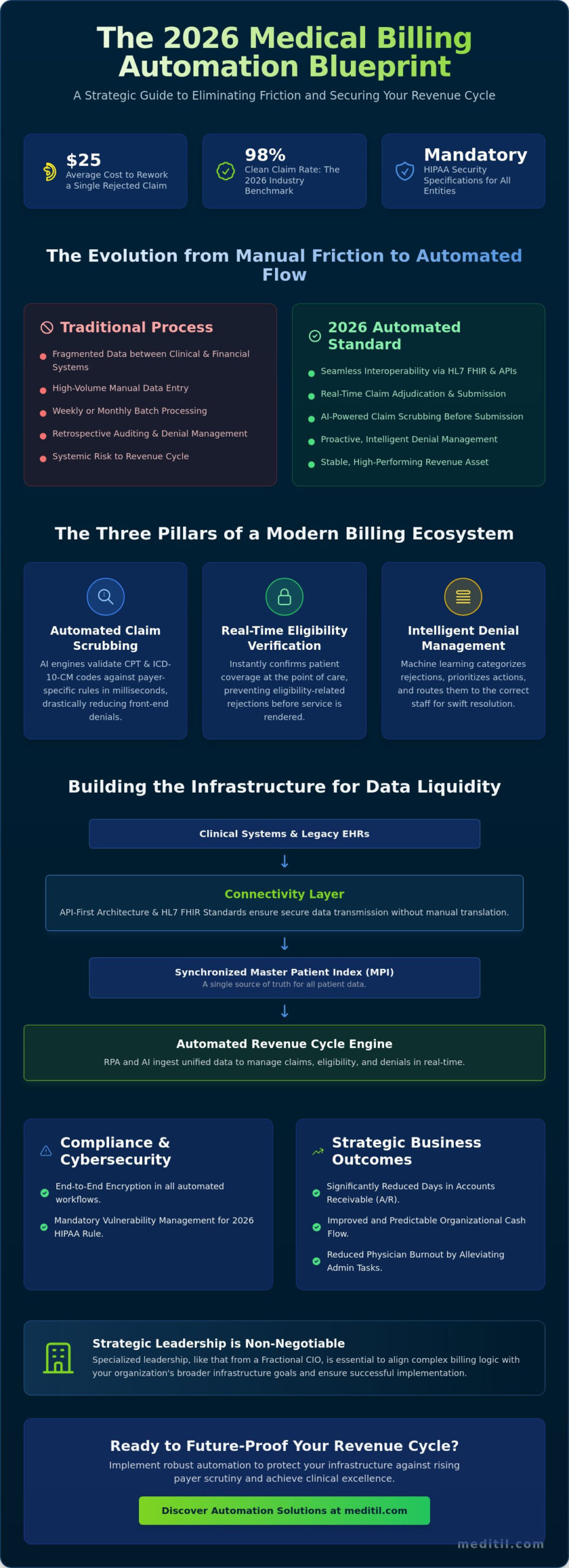
With the average cost to rework a single rejected claim reaching $25, can your organization afford to miss the 2026 industry benchmark of a 98% clean claim rate? As Medicare Part B deductibles rise to $283.00 and HIPAA security specifications become strictly mandatory for all regulated entities, the margin for administrative error has effectively vanished. Many healthcare leaders find that manual entry and fragmented data between clinical and financial systems are no longer just inconveniences. They’re systemic risks to the revenue cycle. Implementing robust medical billing automation solutions isn’t merely a software upgrade; it’s a strategic necessity to protect your infrastructure against rising payer scrutiny and increasingly rigid algorithms.
You likely recognize that your clinical staff is overburdened by administrative tasks that pull them away from patient care. This guide will show you how to leverage automation to eliminate this friction, secure your revenue cycles, and align your technical infrastructure with clinical excellence. We’ll provide a methodical look at integrating these systems to achieve faster reimbursement cycles, reduced overhead, and a unified data view across your entire organization. By the end of this article, you’ll understand how to transform your billing department from a source of friction into a stable, high-performing asset.
Key Takeaways
- Understand why 2026 medical billing automation requires a shift from traditional batch processing to real-time claim adjudication through strategic AI integration.
- Bridge the gap between clinical and financial systems by leveraging HL7 FHIR standards and API-first architectures for seamless data interoperability.
- Navigate the updated 2026 HIPAA Security Rule by implementing end-to-end encryption and mandatory vulnerability management within your automated workflows.
- Create a high-performance revenue cycle by auditing technical debt and identifying manual friction points before deploying new medical billing automation solutions.
- Discover how fractional CIOs provide the specialized leadership necessary to align complex billing logic with your organization’s broader infrastructure goals.
Beyond the Software: Understanding Medical Billing Automation Solutions in 2026
Medical billing automation solutions represent a strategic evolution from simple digitized forms to an integrated architecture of Robotic Process Automation (RPA) and Artificial Intelligence (AI). This transition is vital for maintaining financial stability in an era of increasing payer complexity. While traditional Medical Billing Fundamentals focused on manual data entry and retrospective auditing, the 2026 standard prioritizes real-time claim adjudication. Instead of waiting for weekly batch processing, modern systems evaluate and submit claims as soon as clinical documentation is finalized. This shift reduces the delay between service delivery and reimbursement to nearly zero.
Success in this area requires more than just purchasing a license. Software-only approaches frequently fail because they lack a resilient IT infrastructure foundation. Without stable connectivity and seamless systems integration, automation engines cannot access the clinical data they need to function. Data liquidity, the ability for information to flow securely between clinical touchpoints and the revenue cycle, ensures that every billable event is captured with precision. It’s not enough to have a smart engine; you must have the pipes to feed it.
The Core Components of an Automated Billing Ecosystem
A robust ecosystem relies on three technical pillars that work in concert. First, automated claim scrubbing engines validate codes against payer-specific rules before submission. These engines check for CPT and ICD-10-CM compatibility in milliseconds. Second, real-time eligibility verification occurs at the point of care, preventing front-end denials before the patient even sees the provider. Third, intelligent denial management systems use machine learning to categorize rejections and route them to the appropriate staff for resolution. These medical billing automation solutions create a closed-loop system that minimizes human error and secures the bottom line.
The Business Case for Strategic Automation
Strategic automation directly addresses the financial and operational health of the practice. By accelerating submission workflows, organizations significantly reduce days in accounts receivable (A/R) and improve predictable cash flow. It also alleviates physician burnout. When the system handles non-clinical documentation and coding logic, providers can focus on patient outcomes rather than administrative hurdles. The clean claim rate in 2026 is defined as the percentage of claims processed and accepted for payment on the first submission without any manual correction.
The Technical Pillars: How Modern Solutions Transform Revenue Cycle Management
The architecture of medical billing automation solutions relies on a sophisticated framework of data standards and connectivity protocols. To achieve the real-time adjudication mentioned previously, organizations must move beyond siloed databases. Leveraging HL7 FHIR (Fast Healthcare Interoperability Resources) standards allows for the seamless flow of clinical data into financial workflows. This standard ensures that data points like procedure codes and patient demographics are transmitted without manual translation. A well-defined healthcare API integration strategy further supports this by allowing modern billing engines to communicate with legacy EHR systems that might otherwise lack native automation capabilities.
Data integrity starts with Master Patient Index (MPI) synchronization. When patient records are fragmented across multiple systems, duplicate billing errors and eligibility denials become inevitable. A synchronized MPI acts as a single source of truth, ensuring that the automation engine always associates the correct insurance profile with the right clinical encounter. Addressing this fragmentation at its source requires robust EHR interoperability solutions that unify patient data across the entire continuum of care without requiring a complete overhaul of your existing technology stack. While APIs handle the complex data exchange, Robotic Process Automation (RPA) manages the repetitive, high-volume tasks such as logging into payer portals or downloading remittance advice. These bots function as digital assistants, executing rule-based workflows with a precision that manual entry can’t match.
Interoperability: The Foundation of Billing Success
Effective automation isn’t possible without a robust healthcare data integration strategy. This strategy bridges the gap between disparate EHR and billing platforms, creating a unified environment where clinical documentation triggers financial actions automatically. Semantic interoperability plays a critical role here; it ensures that the meaning of the data is preserved across systems. For example, a diagnosis recorded by a clinician must be interpreted identically by the billing engine to ensure accurate medical coding and claim submission.
Integrating AI and Human Oversight
The 2026 landscape introduces Agentic AI, which refers to autonomous systems capable of executing complex medical claim appeals based on historical payer behavior. To ensure these systems remain accurate, organizations are adopting a scalable machine learning approach to analyze vast datasets for patterns in claim denials. However, high-value exceptions still require human-in-the-loop protocols. This ensures that while the AI handles the bulk of the work, experienced billing specialists oversee complex cases that require nuanced clinical judgment. As these automated engines increase data throughput, your Managed IT infrastructure must scale accordingly to support the higher demand for processing power and network bandwidth.
Navigating Compliance and Cybersecurity in Automated Billing Environments
The implementation of medical billing automation solutions introduces unique security considerations that extend beyond traditional software management. When Protected Health Information (PHI) leaves the clinical environment for third-party scrubbing engines or automated payer portals, the vulnerability layer expands significantly. Protecting this “data-in-transit” is a critical requirement that many organizations overlook. End-to-end encryption, utilizing TLS 1.3 or higher, must be strictly enforced to ensure that data remains unreadable to unauthorized parties as it traverses the automated submission layer. Without these technical safeguards, the efficiency gained through automation is quickly offset by the risk of a high-stakes data breach.
A Zero Trust architecture provides the necessary framework for securing these complex billing networks. This approach operates on the principle that no user or system, whether internal or external, is trusted by default. Every API call, automated bot, and administrative login must be verified and authorized before access is granted. This minimizes the “blast radius” of a potential compromise, ensuring that a vulnerability in one automation layer doesn’t grant lateral access to the entire patient database. Reassuring your stakeholders of this stability requires a methodical approach to infrastructure protection that prioritizes technical enforcement over simple policy statements.
Regulatory compliance also demands a comprehensive audit trail for every automated action. If an AI-driven engine modifies a CPT code or resubmits a rejected claim, the system must log the specific logic used and the identity of the bot that executed the task. These logs are essential for defending against payer audits and demonstrating adherence to CMS standards. Maintaining a transparent record of automated “decisions” ensures that your organization remains accountable even as manual oversight decreases.
HIPAA Compliance for Automated Systems
Ensuring HIPAA compliance in an automated environment requires rigorous administrative and technical controls. All automation vendors must sign Business Associate Agreements (BAAs) that specifically address the handling of PHI within their algorithms. Identity and Access Management (IAM) protocols should be applied to automated bots just as they are to human staff, following the principle of least privilege. For a deeper look at protecting your infrastructure, consult our guide on Healthcare Cybersecurity Services: A Strategic Guide for 2026.
Proactive Risk Management
Maintaining security requires proactive measures like regular penetration testing specifically targeted at billing integration engines. It’s also vital to monitor for “logic drift,” where automated coding engines gradually deviate from standard practices, potentially triggering audits for upcoding or unbundling. In the context of billing automation, compliance is not a checkbox but a dynamic state of technical enforcement and continuous verification. Consistent monitoring ensures that your medical billing automation solutions remain both efficient and legally defensible.
Building an Implementation Roadmap: From Siloed Data to Unified Revenue
Transitioning to medical billing automation solutions requires a methodical assessment of your existing digital environment. A comprehensive technical debt audit of your current EMR and billing systems identifies legacy software that may hinder real-time data flow. This process reveals high-friction manual steps, such as manual code entry or retrospective eligibility checks, that are prime candidates for automation. By pinpointing these bottlenecks, you can prioritize the specific medical billing automation solutions that offer the fastest return on investment. Selecting the right automation partner is equally critical; look for vendors that demonstrate high interoperability standards and provide transparent support models that align with your clinical goals.
A phased rollout is the most effective way to minimize clinical disruption. Rather than a “big bang” implementation, start with a single department or a specific payer group. This approach allows your team to refine automated workflows and resolve integration issues on a smaller scale before a full-scale launch. Success should be measured through clearly defined KPIs, specifically tracking the reduction in claim denial rates and the improvement in staff efficiency as they shift from data entry to exception management.
Infrastructure Readiness Assessment
Your network must be capable of supporting the increased data throughput required for real-time adjudication. Evaluating network stability and latency is essential before deploying high-volume automation engines. Many organizations find that their internal resources are better utilized on clinical support, leading them to seek managed it services for healthcare to manage the underlying infrastructure. Scaling your cloud environment is also a priority to ensure that automated processing loads don’t degrade the performance of clinical applications.
Stakeholder Alignment and Staff Training
Success depends on a cross-functional team of IT and billing leaders who share a unified vision. Establishing clear data governance policies ensures that automated workflows remain compliant and efficient. Staff training should focus on the transition from manual entry to exception management, where employees use their expertise to handle the complex cases that AI flags for review. This shift empowers your team to become strategic overseers of the revenue cycle. If you’re ready to modernize your revenue cycle, consult with our billing integration experts today to design a custom implementation roadmap.
Strategic Leadership: Why Fractional CIOs are Essential for Billing Integration
General IT providers often treat billing software as a standalone utility. This limited perspective overlooks the intricate relationship between clinical coding, payer-specific algorithms, and regulatory mandates. Effective medical billing automation solutions require a leader who understands both the technical stack and the financial nuances of healthcare administration. A generalist might keep your servers running, but they likely lack the specialized expertise to troubleshoot a failing FHIR integration or a misconfigured claim scrubber. Without this high-level oversight, automation can actually amplify errors rather than eliminate them.
This is where virtual cio services become indispensable. A fractional CIO acts as a strategic partner, ensuring that your technology investments directly contribute to the organization’s financial health. They provide the steady hand needed to align IT budgets with long-term revenue cycle objectives. At MEDITIL, we bridge this gap by offering project-based implementation alongside ongoing managed support. We don’t just deploy technology; we consult on how to integrate it into your existing ecosystem for maximum stability and performance.
Executive-Level IT Strategy
Navigating vendor negotiations for complex EMR and billing systems requires an advocate who speaks the language of both technology and administration. A fractional CIO ensures that automation contracts include necessary data liquidity and support standards. They also look ahead, designing a roadmap that supports upcoming initiatives like telehealth and Remote Patient Monitoring (RPM). This foresight prevents the creation of new data silos, ensuring that every patient encounter, regardless of the delivery method, flows seamlessly into your automated managed services. A well-structured approach to it budgeting for medical practices ensures that these technology investments are planned, predictable, and aligned with your long-term financial roadmap.
Partnering for Long-Term Stability
Stability in an automated environment isn’t a one-time achievement. It requires continuous monitoring of integration engines to prevent clinical disruptions. As your organization grows, your IT infrastructure must scale to support increased data throughput without a corresponding spike in overhead costs. Strategic, lifecycle-based management reduces the technical debt mentioned earlier in this guide. By partnering with a specialist like MEDITIL, you gain access to an augmented IT team that prioritizes the protection and performance of your revenue cycle. This disciplined approach ensures that your medical billing automation solutions remain a reliable asset for years to come.
Securing Financial Stability Through Strategic Integration
The transition to automated revenue cycles is no longer a choice but a requirement for healthcare organizations facing the complexities of 2026. By shifting from batch processing to real-time adjudication and enforcing Zero Trust security protocols, your practice can protect its bottom line while reducing administrative burden. Success requires a methodical approach that prioritizes data liquidity and clinical stability. You’ve learned that effective medical billing automation solutions aren’t just software; they’re an integrated infrastructure strategy that aligns your financial health with clinical excellence.
Achieving this level of precision requires a partner who understands the high-stakes nature of healthcare IT. MEDITIL provides the fractional CIO leadership and managed IT services needed to navigate complex integrations for high-volume practices. Our team brings deep expertise in building HIPAA-compliant infrastructure that safeguards your data and your reputation. Secure your revenue cycle with MEDITIL’s strategic medical billing automation solutions. We’re ready to help you build a more stable and efficient future for your organization.
Frequently Asked Questions
What is the difference between medical billing software and medical billing automation?
Medical billing software provides the digital interface for manual data entry and record keeping, while medical billing automation solutions integrate RPA and AI to execute those tasks without human intervention. Software requires a staff member to initiate actions, whereas automation uses APIs to pull clinical data directly into the revenue cycle. This distinction is critical for leaders moving from simple digitization to true operational efficiency and real-time adjudication.
How does automation reduce claim denials in healthcare?
Automation reduces claim denials by enforcing rigid validation rules before a claim is ever submitted to a payer. By utilizing real-time scrubbing engines, the system identifies coding mismatches or missing eligibility data that typically lead to rejections. This proactive approach ensures that claims meet the 98% clean claim rate benchmark required for a healthy revenue cycle in 2026, significantly reducing the $25 average cost to rework a claim.
Is medical billing automation HIPAA compliant?
Automated systems are HIPAA compliant when they incorporate end-to-end encryption and strict identity management for every bot and user. Compliance also requires a Business Associate Agreement (BAA) with the automation vendor to ensure legal accountability for PHI. It’s essential to maintain detailed audit trails that log every automated decision for regulatory transparency and defense against future audits, ensuring that technical enforcement matches your internal security policies.
Can automation work with my existing legacy EHR system?
Most legacy EHR systems can integrate with modern medical billing automation solutions through healthcare API integration strategy frameworks or Robotic Process Automation (RPA). RPA bots can navigate legacy interfaces just as a human would, extracting data and moving it into a more modern billing engine. This allows organizations to leverage advanced automation without the high cost and clinical disruption of a full EHR replacement, preserving your existing clinical workflows.
What is the role of AI in medical billing automation?
AI enhances automation by managing complex tasks like predictive claim adjudication and intelligent denial categorization. While standard automation follows fixed rules, AI uses machine learning to adapt to changing payer behaviors and identify the most successful path for an appeal. This approach allows the system to operate autonomously on high-volume tasks while flagging complex exceptions for human review, ensuring that your staff focuses only on high-value interventions.
How much can a medical practice save by automating their billing?
Practices save significant resources by reducing the manual labor required for data entry and decreasing the frequency of costly claim reworks. Automation also accelerates the reimbursement cycle, which improves cash flow and reduces the “days in A/R” metric. While exact figures vary based on practice volume, the reduction in administrative overhead often allows for the reallocation of staff to higher-value clinical support roles, improving overall practice stability.
Does medical billing automation require a fractional CIO?
While not mandatory, a fractional CIO is essential for ensuring that your automation strategy aligns with long-term infrastructure goals and clinical stability. These leaders manage the complex vendor negotiations and technical integrations that general IT providers often struggle to execute. They provide the executive oversight needed to transition from legacy RCM models to high-performance, automated managed services without the expense of increasing permanent headcount.
What are the security risks of automated medical billing?
The primary security risks involve vulnerabilities during data-in-transit and the potential for “logic drift” within automated coding engines. If a system isn’t properly secured with modern encryption, PHI can be exposed as it moves between clinical and financial layers. Regular penetration testing and a Zero Trust architecture are necessary to mitigate these risks and ensure the long-term integrity of the billing network against evolving cyber threats.
20 Responses