
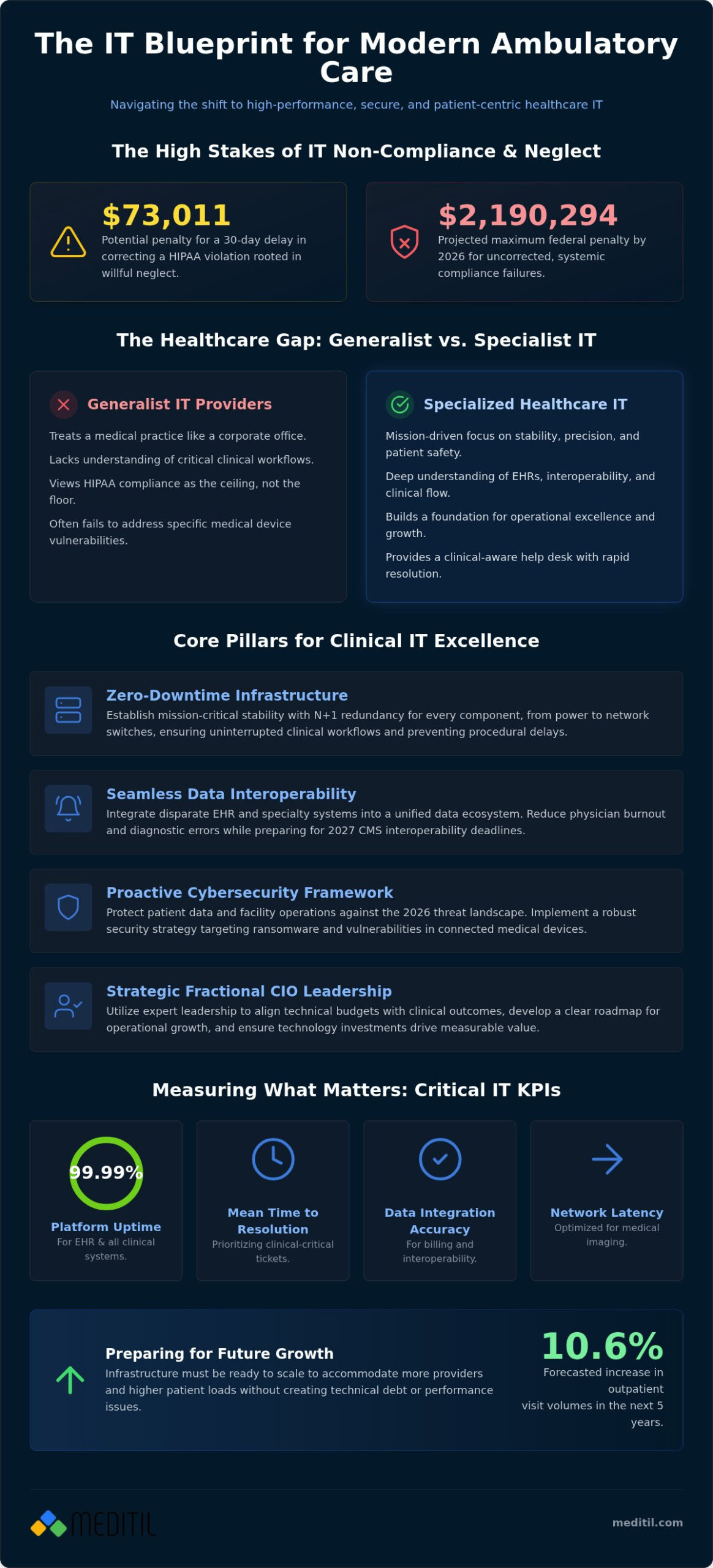
Could a 30-day delay in correcting a HIPAA violation rooted in willful neglect really cost your facility $73,011? With federal penalties reaching as high as $2,190,294 for uncorrected issues in 2026, the stakes for your ambulatory care center IT services have never been higher. You likely recognize that slow EHR systems and security gaps in remote monitoring aren’t just technical nuisances; they’re direct contributors to physician burnout and operational risk. It’s a challenge to maintain a high-volume clinical environment when your technology feels like it’s lagging behind your patient load.
This guide explores how specialized infrastructure and strategic leadership provide the clinical stability needed to drive efficiency and improve patient outcomes. You’ll discover how to achieve seamless data interoperability ahead of the 2027 CMS deadlines and why a structured IT roadmap is the key to predictable budgeting. We’ll provide a clear path for transitioning from reactive troubleshooting to a proactive, secure, and fully integrated IT ecosystem that supports your clinical mission with precision.
Key Takeaways
- Establish zero-downtime environments by implementing N+1 redundancy and high-bandwidth network management for critical clinical workflows.
- Reduce physician burnout and diagnostic errors by integrating disparate EHR systems into a seamless, interoperable data ecosystem.
- Protect your facility against the 2026 threat landscape with a proactive cybersecurity framework targeting ransomware and medical device vulnerabilities.
- Utilize fractional CIO leadership to align technical budgets with clinical outcomes and develop a clear roadmap for operational growth.
- Discover how specialized ambulatory care center IT services drive the shift from volume-based to value-based care through technical precision.
The Evolution of Ambulatory Care Center IT Services in 2026
The healthcare sector is experiencing a profound transformation. As reimbursement models shift from fee-for-service to value-based care, the technical requirements for Ambulatory care facilities have become significantly more complex. Success is no longer measured solely by patient volume. It’s measured by the quality of outcomes and the precision of reported data. This evolution places immense pressure on ambulatory care center IT services to provide more than basic connectivity. IT must now function as a strategic asset that ensures data integrity and supports clinical decision-making at every touchpoint.
Reducing clinical friction is the primary objective for modern healthcare administrators. When an EHR system lags or a network fails during a critical procedure, the result is more than a technical delay. It’s a risk to patient safety and a primary driver of physician burnout. Modern ambulatory IT departments must prioritize specific Key Performance Indicators (KPIs) to maintain operational excellence. These metrics should include:
- Mean Time to Resolution (MTTR): Specifically for clinical-critical tickets that impact patient flow.
- Platform Uptime: Ensuring EHR and specialty systems are available 99.99% of the time.
- Data Integration Accuracy: Measuring the success rate of automated billing and interoperability transfers.
- Network Latency: Monitoring speeds during high-bandwidth tasks like medical imaging or PET scan transfers.
Generalist IT vs. Healthcare-Specific Managed Services
Standard Managed Service Providers often lack the specialized knowledge required to support a high-volume clinical environment. They often treat a medical practice like a standard corporate office, failing to recognize the specific technical nuances of healthcare. This is the “Healthcare Gap.” While a generalist might ensure basic HIPAA compliance, they rarely understand clinical workflows. Compliance is merely the floor, not the ceiling. High-performance IT requires an understanding of how a physician interacts with specialty platforms. It requires technical confidence paired with a mission-driven focus on stability and precision.
The Impact of IT on the Patient Journey
The patient experience begins long before the clinical encounter. Integrated digital platforms for intake reduce administrative burdens and improve data accuracy from the start. If the infrastructure is unstable, patient satisfaction scores typically decline due to perceived disorganization. By integrating billing automation, facilities can reduce overhead and ensure the financial aspect of care is as seamless as the clinical one. This strategic approach allows administrators to focus on patient outcomes while their IT partner manages the technical complexity with a steady hand.
Mission-Critical Infrastructure for High-Volume Clinical Hubs
High-volume clinical hubs require more than standard business connectivity. They require a resilient architecture that supports continuous operations. When designing ambulatory care center IT services, the focus must be on N+1 redundancy. This means every critical component, from power supplies to network switches, has at least one independent backup. If a primary system fails, the secondary unit takes over immediately. This prevents clinical downtime that could otherwise interrupt a surgical procedure or delay the delivery of urgent diagnostic results. It’s about providing a steady hand at the wheel so clinicians never have to worry about the tools they rely on.
Support in this environment must be clinical-aware. A help desk that treats a frozen EHR screen with the same priority as a printer jam is insufficient. Technical teams must understand the urgency of patient care. They need to resolve issues with precision and speed to maintain the flow of the clinic. With outpatient visit volumes forecasted to increase by 10.6% over the next five years, your infrastructure must be ready to scale. This requires a foundation that accommodates more providers and higher patient loads without creating technical debt.
Stable Network Management for Multi-Site ACCs
Optimizing connectivity across satellite clinics is essential for a unified patient experience. SD-WAN technology allows for seamless management of multi-site networks by intelligently routing traffic. It’s critical to prioritize voice and video traffic to ensure telehealth and remote monitoring sessions remain stable. High-bandwidth tasks, like transferring medical imaging or PET scans, shouldn’t degrade the performance of other clinical systems. For a deeper look at these strategies, consult our Managed IT Services for Healthcare: The 2026 Definitive Strategic Guide.
Cloud Infrastructure and Hybrid Hosting Models
The choice between on-premise hardware and cloud services often comes down to data sovereignty and accessibility. A hybrid hosting model allows facilities to keep sensitive data local while leveraging the scalability of a secure healthcare cloud. Disaster recovery planning is non-negotiable. It ensures that medical records remain accessible even during a local outage. Our team provides the Infrastructure & Network Services necessary to build these secure, scalable environments. This approach ensures your facility remains operational and compliant regardless of the technical challenges that arise.
Solving the Interoperability and EMR Integration Challenge
Effective ambulatory care center IT services must bridge the gap between fragmented data systems. By January 1, 2027, federal mandates require impacted payers to maintain Provider Access and Prior Authorization APIs. This regulatory shift emphasizes that interoperability is no longer optional. When disparate EHR systems and specialty platforms fail to communicate, data silos emerge. These silos force clinicians to manually reconcile information from multiple sources. This redundancy contributes significantly to physician burnout and increases the likelihood of diagnostic errors. True integration ensures that patient data flows securely and accurately, providing real-time clinical decision support when it matters most.
Interoperability also serves as the foundation for modern revenue cycle management. When clinical data and billing systems are deeply integrated, the entire administrative workflow becomes more efficient. This connectivity allows for immediate verification of patient information and insurance coverage. It eliminates the manual entry errors that often lead to delayed reimbursements. By treating interoperability as a core clinical asset, facilities can improve both patient outcomes and financial stability. It’s about ensuring a steady hand guides the data from the initial intake to the final claim submission.
EMR/EHR Implementation and Staff Training
Technical implementation often fails because it ignores the nuances of clinical workflow mapping. A system that works in a diagnostic lab might fail in a high-volume surgical center. We prioritize custom interface optimization to reduce “click fatigue,” a primary source of provider frustration. Training strategies must go beyond basic software navigation. They should focus on how providers can leverage the system to increase data accuracy while spending more time with patients. This approach ensures that technical tools support, rather than hinder, the clinical mission.
Billing Automation and Revenue Cycle IT
Revenue health depends on the integrity of data captured at the point of care. Integrated IT solutions automate claim scrubbing and submission, identifying potential errors before they reach the payer. This proactive approach reduces denial rates and accelerates the reimbursement cycle. For administrators looking to modernize these workflows, our guide on Medical Billing Automation Solutions: A Strategic Guide for Healthcare Leaders in 2026 provides a roadmap for aligning financial objectives with technical capabilities. This strategic alignment ensures that every patient encounter is accurately captured and billed without unnecessary administrative overhead.
Cybersecurity and Compliance as a Strategic Clinical Asset
Security in a clinical setting isn’t just about data protection. It’s about patient safety. In 2026, the threat landscape has evolved significantly. Ransomware attacks now target the availability of life-critical systems, not just the confidentiality of records. Medical device vulnerabilities represent a growing perimeter that must be defended with precision. When selecting ambulatory care center IT services, administrators must look for partners who treat security as a continuous clinical operation rather than a periodic checklist. This proactive stance ensures that technology remains a reliable tool for care, not a liability.
Implementing a Security Information and Event Management (SIEM) system is essential for real-time visibility across your practice. It allows for the detection of technical anomalies before they escalate into full-scale breaches. This is especially critical for facilities utilizing telehealth and remote patient monitoring. These services extend the clinical perimeter into the patient’s home, creating new entry points for malicious actors. Protecting this data requires a sophisticated framework that exceeds the basic requirements of HIPAA. It requires a steady hand at the wheel to navigate these complex regulatory and technical challenges.
Proactive Risk Management and Compliance
Standard Security Risk Assessments (SRA) often become static documents that provide little operational value. In a modern ambulatory care environment, these assessments must drive actual technical change. Automating compliance monitoring across all digital platforms ensures that your facility remains audit-ready at all times. This constant verification is vital given that federal penalties for uncorrected willful neglect can reach $2,190,294 in 2026. For a comprehensive strategy, review our Healthcare Cybersecurity Services: A Strategic Guide for 2026. Secure your clinical environment with our Cybersecurity & Compliance expertise.
Protecting Life-Critical Systems
Optimizing Operations with Fractional CIO Leadership
Strategic leadership is the differentiator between a facility that merely survives technical challenges and one that thrives. Many outpatient organizations treat technology as a utility, yet the complexity of modern ambulatory care center IT services demands a more sophisticated approach. A Fractional CIO provides the high-level expertise necessary to align IT budgets with specific clinical outcomes. This role ensures that every dollar spent on infrastructure or cybersecurity contributes to a more efficient, stable environment for both providers and patients. It’s about maintaining a steady hand at the wheel during periods of rapid growth or technical transition.
Effective leadership also involves long-term strategic roadmapping. Planning for the next 3-5 years requires an understanding of emerging healthcare trends and regulatory shifts. Without this foresight, centers often accumulate technical debt by implementing “quick fix” solutions that fail to scale. A proactive guide identifies these risks early, allowing administrators to make informed decisions about their digital future. This disciplined focus on stability and improvement helps centers navigate the high-stakes nature of the healthcare industry with technical confidence.
The vCIO Advantage for Outpatient Centers
A vCIO focuses on converting technical debt into strategic investment. They provide essential vendor management, holding software and hardware providers accountable for their performance and security standards. This oversight ensures that your facility isn’t just buying tools, but building a unified patient-safety system. For a detailed look at how this leadership functions, explore our Virtual CIO Services: Strategic IT Leadership for Healthcare in 2026. This level of partnership is vital for maintaining a reliable, high-performing clinical environment.
Scaling with an Augmented IT Team
Many centers have existing IT departments that are overwhelmed by the increasing volume of outpatient services. An Augmented IT Team fills specific skill gaps without the disruption of full staff turnover. This model provides specialized support for complex clinical mergers and acquisitions, ensuring that new locations are integrated without compromising data integrity. It also offers help desk support that recognizes the urgency of a clinical setting. Whether you are scaling operations or refining your current infrastructure, professional Advising and Consulting ensure your technical team remains a high-performing asset. This collaborative approach allows administrators to focus on patient care while the technical details are handled with precision.
Securing Your Clinical Future in 2026 and Beyond
Navigating the complexities of modern healthcare requires a technical foundation that is both resilient and forward-thinking. As procedures continue to shift toward outpatient settings, the performance of your ambulatory care center IT services will directly determine your facility’s ability to scale without compromising patient safety. Achieving true clinical stability involves more than just resolving daily tickets. It requires a commitment to seamless data interoperability and a proactive approach to defending life-critical medical devices against an evolving threat landscape.
Success in this high-stakes environment depends on having a strategic partner who acts as a steady hand at the wheel. By aligning your technical roadmap with clinical outcomes, you can reduce physician burnout and ensure that your infrastructure supports growth rather than hindering it. MEDITIL provides the specialized healthcare IT expertise and comprehensive cybersecurity focus needed to manage these complex systems with precision. Our fractional CIO leadership ensures your organization remains compliant and efficient as regulatory standards continue to tighten.
Take the first step toward a more stable and secure clinical environment. Schedule a Strategic IT Consultation with MEDITIL to discover how we can help you achieve operational excellence through technical precision. Let’s build a future where your technology empowers your team to focus exclusively on patient care.
Frequently Asked Questions
What are ambulatory care center IT services?
Ambulatory care center IT services encompass the specialized technical infrastructure and support models tailored for outpatient medical facilities. These services go beyond basic computer repair to include managed infrastructure, clinical application support, and interoperability management. By focusing on the unique high-volume needs of surgery centers and diagnostic clinics, these services ensure that technology remains a stable asset for patient care.
How does healthcare-specific IT differ from standard managed services?
Standard managed services often lack the specialized awareness of clinical workflows. Healthcare-specific IT prioritizes the stability of life-critical systems and the nuances of medical data exchange. It requires a technical team that understands the urgency of a frozen EHR screen during a patient encounter. This specialized focus helps reduce clinical friction and supports better patient outcomes through a mission-driven approach to technical stability.
Why is interoperability important for outpatient centers?
Interoperability is essential because it enables the secure exchange of data between disparate EHR systems and specialty platforms. Without it, clinicians are forced into manual data reconciliation, which increases the risk of diagnostic errors and physician burnout. Seamless connectivity ensures that providers have a complete view of a patient’s history in real time, supporting informed clinical decision-making and improving the accuracy of billing automation.
What are the HIPAA requirements for ACC IT infrastructure?
HIPAA mandates administrative, physical, and technical safeguards for protecting electronic protected health information (ePHI). Key requirements include robust encryption for data at rest and in transit, strict access controls, and comprehensive audit logs. Regular Security Risk Assessments are also required to identify and mitigate vulnerabilities within the IT infrastructure. Failing to maintain these standards can lead to significant federal penalties, which have increased as of 2026.
How much do managed IT services for healthcare typically cost?
The cost of managed IT services for healthcare is determined by the specific scale and complexity of the clinical environment. Factors such as the number of providers, the volume of managed medical devices, and the depth of required cybersecurity compliance influence the final investment. Facilities should look for transparent service agreements that align technical costs with long-term clinical and operational goals rather than choosing the lowest bidder.
Can a fractional CIO help with EHR implementation?
A fractional CIO plays a critical role in EHR implementation by providing strategic roadmapping and vendor oversight. They ensure that the software is configured to match existing clinical workflows rather than forcing staff to adapt to a poorly designed system. This leadership helps facilities avoid technical debt and ensures that the implementation stays on schedule. Their presence provides a steady hand at the wheel during complex technical transitions.
What is N+1 redundancy in a clinical setting?
N+1 redundancy refers to a system design where the number of components (N) is supplemented by at least one independent backup (+1). In a clinical hub, this means if a primary network switch or power source fails, a secondary unit is already in place to maintain operations. This architecture is vital for achieving the zero-downtime environments required for modern ambulatory care, especially during surgical procedures or urgent diagnostic imaging.
How do you protect medical devices from cyber threats?
Protecting medical devices requires network segmentation to isolate them from the broader practice network. This prevents lateral movement if a standard office computer is compromised. Additionally, implementing Identity and Access Management (IAM) ensures that only authorized personnel can interact with life-critical systems. Regular vulnerability scanning and proactive monitoring through a SIEM system help identify devices that require urgent security patching before a breach occurs.