
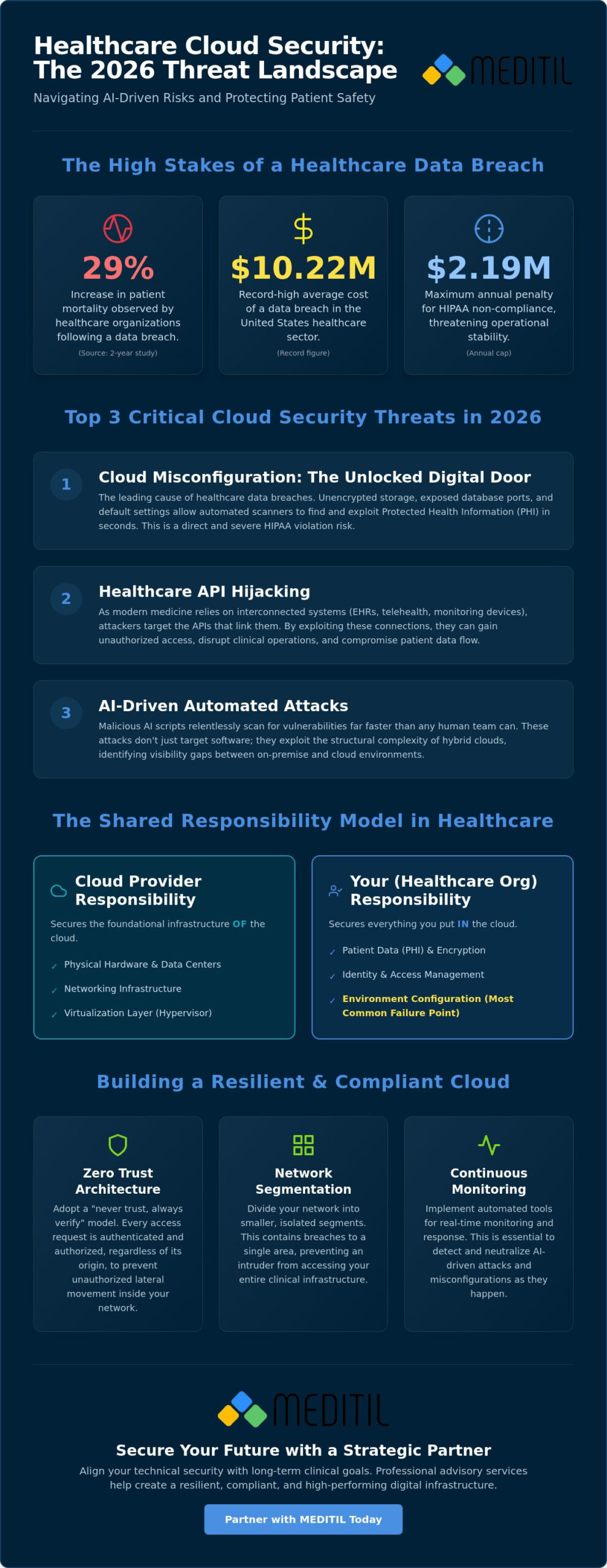
Did you know that 29% of healthcare organizations reporting a data breach or ransomware attack in the last two years also observed a measurable increase in patient mortality? This statistic transforms cybersecurity from a back-office concern into a direct pillar of patient safety. In 2026, cloud security threats have evolved from administrative hurdles into sophisticated, AI-driven risks that can halt clinical operations in an instant. The average cost of a data breach in the United States has reached a record $10.22 million, making the stakes for your infrastructure higher than ever before.
It’s understandable if you feel the weight of managing complex hybrid environments while trying to avoid the maximum $2,190,294 annual penalty for HIPAA non-compliance. You need more than just reactive fixes; you need a steady hand to guide your digital strategy. This article identifies the most critical cloud security threats facing healthcare organizations today and provides the strategic frameworks required to neutralize them. We’ll explore the 2026 regulatory landscape and offer a methodical roadmap to help you achieve a resilient, compliant, and high-performing cloud posture.
Key Takeaways
- Understand the evolving nature of cloud security threats within hybrid healthcare environments and why traditional perimeter defenses are no longer sufficient for 2026.
- Identify the primary technical vulnerabilities facing medical practices, including misconfigured cloud environments and the rising risk of Healthcare API Hijacking.
- Analyze the direct correlation between cloud infrastructure failures and clinical operational disruptions that compromise patient safety and EHR availability.
- Learn how to implement strategic frameworks like Zero Trust Architecture and network segmentation to contain breaches and ensure a continuous compliance posture.
- Discover how professional advisory services can align your technical security initiatives with long-term clinical goals to create a resilient digital infrastructure.
Understanding the 2026 Cloud Security Threat Landscape
In the healthcare sector, cloud security threats encompass any potential occurrence that results in unauthorized access, data loss, or the disruption of cloud-hosted medical services. As organizations migrate from legacy data centers to sophisticated hybrid healthcare clouds, the traditional security perimeter has effectively dissolved. This transition provides clinical agility; however, it also introduces a complex web of interconnected systems that require precise management. By 2026, the primary concern has shifted toward AI-automated attacks that specifically target healthcare APIs, exploiting the very interoperability that modern medicine relies upon. Establishing a foundational knowledge of cloud security fundamentals is the first step in establishing a stable defense against these evolving risks.
Hybrid clouds combine the control of on-premise servers with the scalability of public cloud platforms. While this offers a balanced approach for clinical data storage, it often leads to significant visibility gaps. If your IT team cannot monitor the entire data flow across both environments simultaneously, they cannot protect it effectively. In 2026, we see a marked increase in the use of automated scripts to scan for exposed patient data. These tools can identify a misconfigured database in seconds, far faster than a manual audit can detect the error. This speed necessitates a shift toward automated, real-time monitoring and response capabilities to maintain operational stability.
The Evolution of Cloud Vulnerabilities
The vulnerability landscape is often shaped by the persistence of legacy healthcare software. These older systems, when moved to the cloud, create unique entry points because they weren’t designed for modern web-scale environments. It’s vital to distinguish between a threat, which is the external actor or malicious intent, and a vulnerability, which is the technical weakness within your infrastructure. The rapid adoption of telehealth has significantly expanded this attack surface. Every new remote monitoring device and virtual consultation platform represents a potential gateway if it isn’t properly integrated into a unified security framework. These cloud security threats are no longer just theoretical; they are active risks to clinical continuity.
The Shared Responsibility Model in Healthcare
One of the most dangerous misconceptions in medical administration is the belief that the Cloud Service Provider (CSP) handles all security. Under the Shared Responsibility Model, the CSP is responsible for the security of the cloud, including the physical hardware, networking, and virtualization layers. However, the medical practice remains responsible for the security of the data “in” the cloud. This includes identity management, data encryption, and, most critically, environment configuration. Industry data indicates that the most common point of failure isn’t a breach of the provider’s infrastructure but rather a customer-side misconfiguration. When these vulnerabilities are exploited, the legal and financial liability rests with the healthcare organization, not the service provider.
The Three Most Critical Cloud Security Threats for Medical Practices
As healthcare organizations transition to more complex architectures, the nature of cloud security threats has become increasingly technical and difficult to detect with legacy tools. Traditional antivirus software and perimeter firewalls are often blind to these risks because they occur within authorized cloud sessions or through legitimate, albeit misconfigured, access points. In 2026, the most dangerous threats are those that exploit the structural complexity of your environment rather than just the software itself. Understanding these specific vectors is essential for maintaining clinical continuity and regulatory standing.
Cloud Misconfiguration: The Open Door
Misconfiguration remains the leading cause of healthcare data breaches in 2026. Administrators often leave S3 buckets unencrypted or database ports exposed during the rapid deployment of new clinical tools. Default settings frequently allow Protected Health Information (PHI) to be indexed by public search engines, creating an immediate and severe HIPAA violation risk. Automated scanners used by malicious actors can identify these configuration gaps in seconds. Without continuous, automated auditing of your cloud environment, these silent vulnerabilities can persist for months before being discovered by an attacker.
Insecure APIs and Interoperability Risks
Modern medicine depends on the seamless exchange of data between disparate systems. However, rapid EHR integrations often create “shadow APIs” that exist outside the view of central IT monitoring. These unmanaged interfaces are prone to broken object-level authorization, where an attacker can manipulate a patient portal to view records that do not belong to them. Successfully solving the healthcare interoperability challenge requires securing these pathways with the same rigor as the core database. When APIs are hijacked, they provide a direct, high-speed tunnel for data exfiltration that bypasses traditional traffic filters.
Identity and Access Management (IAM) Failures
Identity has become the new security perimeter in a cloud-first world. Many practices still grant excessive permissions to administrative staff, allowing a single compromised account to access the entire cloud directory. While Multi-Factor Authentication (MFA) is a baseline requirement, it’s not a complete solution against sophisticated session hijacking or credential stuffing attacks targeting clinical staff. Cybercriminals use AI to refine social engineering tactics, making account takeover (ATO) attempts appear indistinguishable from legitimate login requests. Securing these identities remains a vital task for any comprehensive cybersecurity and compliance strategy. Establishing a principle of least privilege ensures that even if an account is compromised, the potential damage is strictly contained.
The Clinical Impact: When Cloud Threats Meet Patient Care
While data privacy remains a critical concern, the most profound danger of cloud security threats in 2026 is their capacity to paralyze clinical workflows. When a cloud-hosted Electronic Health Record (EHR) system is compromised, the impact extends far beyond administrative inconvenience. It becomes a threat to life. Recent data indicates that 72% of healthcare organizations experiencing a cybersecurity incident reported significant disruptions to patient care. Even more concerning, 29% of those organizations reported a measurable increase in patient mortality following a breach. This shift in perspective, moving from “data theft” to “clinical operational disruption,” is essential for modern healthcare leadership.
Many smaller medical practices operate under the misconception that they are too insignificant for hackers to notice. This is a dangerous fallacy. Automated AI scripts do not discriminate based on practice size; they scan the entire internet for known vulnerabilities, such as misconfigured cloud storage or unpatched APIs. Small practices are often viewed as “low-hanging fruit” or entry points into larger, interconnected healthcare networks. In 2026, a single ransomware attack on a cloud environment can lock down clinical systems indefinitely, leaving practitioners unable to access patient histories, medication lists, or diagnostic results.
Operational Paralysis and Patient Safety
Cloud downtime prevents immediate access to life-critical information. In an emergency department or surgical suite, a delay of even minutes in retrieving a patient’s allergy profile or recent imaging can lead to catastrophic outcomes. When cloud security threats manifest as ransomware, the resulting operational paralysis forces clinics to divert patients and postpone essential procedures. This creates an ethical imperative for robust cybersecurity. Protecting your digital infrastructure is no longer just an IT requirement; it’s a fundamental component of your commitment to patient safety and the delivery of high-quality care.
The HIPAA Compliance and Financial Fallout
The financial consequences of a cloud breach have reached unprecedented levels. As of 2026, the average cost of a data breach in the United States has risen to $10.22 million. Beyond the immediate loss of revenue, the Office for Civil Rights (OCR) has intensified its audit landscape, focusing heavily on risk analysis within cloud environments. Tier 4 HIPAA violations, which involve willful neglect that remains uncorrected, now carry an annual penalty cap of $2,190,294. These figures do not include the long-term costs of forensic investigations, legal fees, and the mandatory patient notification process. Securing HIPAA compliant IT services is a strategic necessity to mitigate these risks. The reputational damage following a publicized breach can take years to repair, often leading to a permanent loss of patient trust and a decline in new patient acquisitions.
Strategic Mitigation: Building a Resilient Healthcare Cloud
Neutralizing cloud security threats requires a strategic shift from passive perimeter defense to a proactive, resilient architecture. In 2026, a “set it and forget it” approach to infrastructure is a significant liability. You must implement a layered defense that assumes a breach is possible and focuses on containment and rapid recovery. This begins with robust healthcare network segmentation to isolate guest Wi-Fi, medical devices, and administrative systems from sensitive PHI repositories. By creating these internal barriers, you ensure that a single compromised device cannot provide an attacker with a path to your entire cloud environment.
Visibility is the cornerstone of any effective response plan. Utilizing SIEM (Security Information and Event Management) allows your team to aggregate and analyze telemetry from across your hybrid cloud in real-time. This centralized view is essential for identifying the AI-automated attacks discussed earlier. Regular audits based on network security best practices help identify drifting configurations before they become exploitable vulnerabilities. To ensure your practice meets these rigorous standards, consider a professional cybersecurity and compliance assessment to identify and close existing gaps.
Adopting a Zero Trust Framework
The “never trust, always verify” principle is the gold standard for modern medical IT. Zero Trust Architecture (ZTA) moves away from location-based access, which assumes anyone on the office network is safe. Instead, it relies on identity-based access control. This requires every user and device to be authenticated and authorized for every specific transaction. This granular control prevents the lateral movement of attackers within your systems, effectively trapping them at the point of entry.
The Role of Continuous Compliance Monitoring
Annual risk assessments are no longer sufficient to manage the dynamic nature of cloud environments. Your infrastructure changes daily as new clinical tools are integrated or updated. Automated compliance scanning provides a continuous feedback loop. This alerts your team to any configuration that falls out of HIPAA alignment immediately. Investing in clinical-grade IT infrastructure ensures that your technical controls are built on a foundation of stability and precision, rather than reactive patches.
Securing Your Future with MEDITIL Strategic Partnership
Successfully neutralizing cloud security threats requires more than just software; it demands a partnership built on technical precision and a deep understanding of clinical workflows. MEDITIL positions itself as a strategic partner for organizations managing complex healthcare cloud environments. We provide the steady hand at the wheel that your practice needs to maintain stability in a volatile digital landscape. Our focus extends beyond basic troubleshooting to encompass long-term infrastructure health and regulatory resilience. By integrating our managed IT teams into your organization, you gain access to specialists who are intimately familiar with healthcare-specific regulations like HIPAA and 42 CFR Part 2.
We believe that technology should serve the mission of patient care, not hinder it. This is why our approach is methodical and results-oriented. We don’t just offer services; we offer a disciplined framework for growth. Our teams work to ensure your cloud systems are customized to your specific operational needs while maintaining a posture of constant verification. This proactive stance is essential for preventing the disruptions that can compromise both your reputation and your clinical outcomes. We’re here to help you move from a state of anxiety over potential breaches to a state of confidence in your digital security.
Fractional CIO: Strategic Security Leadership
For many medical practices, the cost of a full-time Chief Information Officer is prohibitive. Our virtual CIO services bridge this gap by providing high-level security roadmaps and executive leadership on a fractional basis. We help you optimize your budget for cybersecurity investments, ensuring that every dollar spent contributes directly to risk reduction and operational efficiency. By aligning your IT security with your clinical goals, we create a unified strategy that supports both your providers and your patients. We act as a consultant invested in your long-term success, helping you navigate the complexities of a highly regulated environment with ease.
Clinical-Grade Cybersecurity Services
Our approach to healthcare cybersecurity services is designed to handle the high-stakes nature of modern medicine. We provide 24/7 monitoring and rapid response capabilities to identify and contain cloud security threats before they can escalate into clinical crises. This “clinical-grade” standard means every detail of your infrastructure is handled with precision and a mission-driven focus on stability. If you’re ready to secure your practice against the evolving risks of 2026, we invite you to contact us for a comprehensive strategic security assessment. Let’s work together to build a resilient foundation for your digital future.
Executing Your 2026 Cloud Security Strategy
The transition to a cloud-first infrastructure is no longer an optional upgrade; it’s the foundation of modern clinical operations. We’ve established that cloud security threats are not merely technical hurdles but direct risks to patient safety and financial stability. By moving beyond traditional perimeter defenses and adopting a Zero Trust framework, your organization can protect its most sensitive data while maintaining the interoperability that 2026 demands. The high stakes of this environment require a disciplined approach to risk management and a commitment to continuous compliance.
You don’t have to navigate these complexities alone. MEDITIL provides a specialized healthcare IT focus and deep expertise in HIPAA and regulatory standards to ensure your systems remain resilient. Our proven Fractional CIO leadership offers the strategic guidance necessary to align your technology with your clinical goals. We invite you to secure your clinical cloud with a MEDITIL Strategic Assessment. Taking this proactive step today builds a stable, high-performing environment for your providers and patients tomorrow. We’re ready to serve as your steady partner in digital advancement.
Frequently Asked Questions
What is the biggest cloud security threat to healthcare in 2026?
Misconfiguration remains the most frequent point of entry for attackers in 2026. This technical failure occurs when cloud settings are left at default or incorrectly adjusted, exposing PHI to the public internet. Additionally, AI-automated attacks targeting healthcare APIs have become a primary concern. These automated scripts can identify and exploit vulnerabilities faster than manual security teams can patch them, making real-time monitoring a necessity for clinical stability.
How does the Shared Responsibility Model apply to my medical practice?
This model dictates that while your cloud provider secures the underlying infrastructure, your medical practice is responsible for the security of the data within that environment. You must manage identity access, encryption, and configuration settings. Failing to understand this distinction is a major cause of preventable breaches. It’s vital to recognize that your service provider isn’t responsible for a breach resulting from your internal administrative errors.
Can cloud security threats lead to HIPAA violations?
Yes, cloud security threats directly lead to HIPAA violations when they result in unauthorized access to Protected Health Information. If a technical vulnerability allows a breach and the OCR determines that your practice failed to perform an adequate risk analysis, you could face Tier 4 penalties. In 2026, these fines can reach $2,190,294 per year. Maintaining a compliant posture requires continuous verification of your cloud environment’s security controls.
What is the difference between a cloud threat and a cloud vulnerability?
A cloud threat is an external actor or event with the potential to cause harm, such as a ransomware group or a malicious script. In contrast, a vulnerability is a specific weakness within your infrastructure that a threat can exploit. For example, an unpatched API is a vulnerability, whereas a hacker attempting to access it is the threat. Effective risk management involves identifying vulnerabilities before they can be leveraged by active threats.
How does Zero Trust help mitigate cloud security threats in clinics?
Zero Trust Architecture mitigates cloud security threats by removing the assumption of trust for any user or device, regardless of their location. It requires continuous authentication and authorization for every access request to clinical data. This strategy is particularly effective because it prevents lateral movement. If an attacker compromises a single endpoint, the Zero Trust framework ensures they cannot navigate further into your cloud environment to access sensitive patient records.
Is my EHR provider responsible for all my cloud security?
Your EHR provider is only responsible for the security of their specific application and the infrastructure they manage. They don’t oversee your local network, the devices your staff use, or how you manage user permissions. Security is a collaborative effort. You must ensure that your team’s access points and internal data handling practices are as secure as the EHR platform itself to prevent end-to-end vulnerabilities.
How often should a medical practice perform a cloud security audit?
While the HIPAA Security Rule requires periodic assessments, the dynamic nature of 2026 cloud environments necessitates continuous monitoring. Formal, comprehensive cloud security audits should be performed at least annually or whenever significant changes are made to your infrastructure. Automated scanning tools can provide daily reports on configuration drift. This proactive approach ensures that your practice remains compliant and resilient against evolving digital risks without waiting for a yearly review.
What should we do immediately if we suspect a cloud security breach?
You should immediately activate your formal incident response plan and isolate the affected systems to prevent further data exfiltration. Do not attempt to fix the issue yourself, as you may inadvertently destroy forensic evidence needed for the investigation. Contact your managed IT partner or cybersecurity experts to begin a professional containment and remediation process. Prompt action is critical for minimizing clinical disruption and meeting the mandatory HIPAA breach notification requirements.
One Response