
What if your current technology partner is the primary bottleneck in your patient care pipeline? In 2026, the gap between generalist support and specialized healthcare IT service providers has become a critical risk factor for clinical operations. Most healthcare leaders already feel the friction caused by systems that lag during peak hours or the underlying anxiety of a looming HIPAA audit. You deserve a partnership built on technical precision and a deep understanding of the unique pressures found within a regulated medical environment.
This guide provides a rigorous framework for vetting IT partners on clinical alignment, regulatory compliance, and strategic scalability. We move beyond basic uptime to examine how your infrastructure can support seamless interoperability and long-term business growth. By following this 2026 evaluation checklist, you’ll learn how to secure zero downtime during clinical hours and build a strategic roadmap that aligns your technology with your mission of delivering superior patient care.
Key Takeaways
- Learn why generalist IT fails in clinical settings and how specialized healthcare IT service providers eliminate technical debt through industry-specific expertise.
- Identify the essential infrastructure requirements for life-critical systems, including network redundancy and verified EHR implementation frameworks.
- Establish security benchmarks that exceed basic HIPAA compliance by implementing proactive monitoring and sophisticated regulatory mastery.
- Understand the value of a Fractional CIO in transforming your IT from a reactive cost center into a strategic driver of clinical alignment.
- Master the selection process by evaluating provider transition methodologies and the responsiveness of specialized clinical help desks.
Why Generalist IT Fails: Defining Specialized Healthcare IT Service Providers
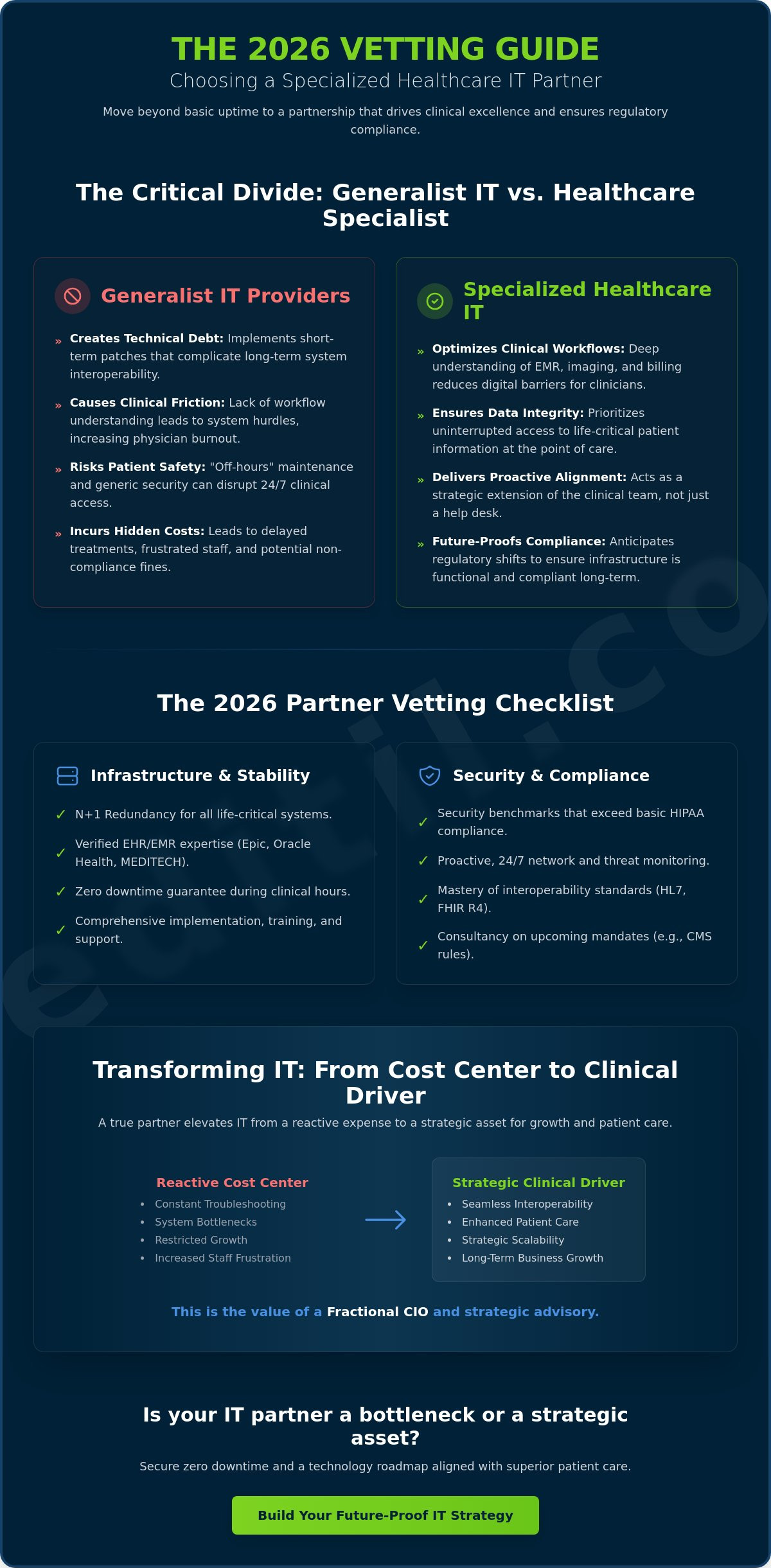
A healthcare-specific Managed Service Provider (MSP) acts as a strategic extension of your clinical team rather than just a remote help desk. While generalist firms focus on hardware lifecycles and generic uptime, healthcare IT service providers prioritize the integrity of patient data and the fluidity of medical workflows. For these specialists, the objective isn’t merely keeping a server active; it involves ensuring that the clinician at the point of care has immediate, uninterrupted access to life-critical information. This requires a deep understanding of how specialized healthcare IT lives within a regulated, high-stakes environment.
The “one-size-fits-all” approach typical of general IT often creates significant technical debt within clinical settings. When a provider doesn’t understand how an EMR interacts with imaging software or billing modules, they often implement patches that solve immediate glitches but complicate long-term interoperability. This lack of specialized knowledge leads to clinical friction. Physicians spend more time navigating system hurdles than treating patients. True specialization bridges the gap between technical support and clinical workflow optimization. By eliminating these digital barriers, specialized providers directly reduce physician burnout. This allows staff to focus on care delivery rather than troubleshooting software.
The High Cost of Generalist IT in Healthcare
Downtime during clinical hours is more than a loss of productivity; it’s a risk to patient safety. Generalist providers often schedule maintenance during “off-hours” that don’t account for the unique schedules of 24-hour facilities or urgent care centers. Additionally, generic security protocols can be overly restrictive. They might inadvertently block access to vital patient records during emergencies because the provider doesn’t understand the urgency of clinical access. You can explore these specific risks in our guide on Why General Managed IT Fails the Healthcare Sector. These hidden costs manifest as delayed treatments, frustrated staff, and potential regulatory non-compliance.
The 2026 Healthcare IT Landscape
The role of healthcare it service providers has evolved from reactive troubleshooting to proactive clinical alignment. In 2026, a 24/7 help desk is a baseline requirement, not a differentiator. Strategic partners must now demonstrate mastery of interoperability standards like HL7 and FHIR R4 to ensure data moves securely across the continuum of care. As regulatory requirements like the CMS Prior Authorization Rule take effect, your IT partner must act as a consultant. They need to anticipate shifts in the landscape, ensuring your infrastructure is functional and future-proofed against new compliance mandates.
The Infrastructure Checklist: Vetting for Stability and Interoperability
Reliability in healthcare IT is measured by the absence of failure. When vetting healthcare IT service providers, you must look beyond basic uptime percentages. True stability requires N+1 architecture. This is a design philosophy where every critical component has at least one independent backup. In a clinical environment, this means if a primary server or network switch fails, a redundant system immediately assumes the load without disrupting patient care. Ask prospective partners to document their redundancy protocols for life-critical systems. This level of preparation ensures that your staff never faces a system down scenario during an emergency procedure or a high-volume clinic day.
EHR and EMR implementation remains one of the most significant technical hurdles for any practice. A provider shouldn’t just install software; they must offer comprehensive training and ongoing application support. Vetting for this expertise involves checking their track record with specific platforms like Epic, Oracle Health, or MEDITECH. Effective implementation includes optimizing the interface to match your specific clinical workflows. If you’re unsure if your current setup meets these standards, you might consider an infrastructure and network assessment to identify potential bottlenecks before they impact patient care.
Network and Cloud Infrastructure Requirements
High-volume clinics require more than standard broadband. You need to verify if the provider offers managed redundant network paths. This ensures that if one ISP fails, your clinic stays online. Cloud migration is another critical area. Any move to the cloud must strictly adhere to federal regulations regarding HIPAA, privacy, and security. Infrastructure for Telehealth and remote monitoring must be prioritized to handle high-bandwidth video traffic without latency. This is essential for maintaining the integrity of remote diagnostics and patient consultations.
Interoperability and Billing Automation
Interoperability is the linchpin of modern healthcare administration. Top-tier healthcare IT service providers specialize in managing data exchange between disparate systems. This might involve connecting a specialized lab platform with your central EHR. Billing automation is equally vital. Vetting for this involves ensuring the provider can automate the flow of data from clinical notes to the billing module. This reduces manual entry errors and accelerates the revenue cycle. Seamless connectivity between patient portals and EHRs is no longer optional. It’s a requirement for patient engagement and compliance with the 2026 CMS Prior Authorization Rule.
The Security and Compliance Checklist: Beyond HIPAA Checkboxes
Compliance is not a static state; it’s a continuous commitment to data integrity and patient safety. Effective healthcare IT service providers must move beyond the “checkbox” mentality of basic HIPAA requirements. In an environment where ransomware attacks on medical facilities are increasingly sophisticated, your partner needs to implement Security Information and Event Management (SIEM). This technology provides real time monitoring of your network, allowing for the immediate detection of unauthorized access or anomalous behavior. The clinical significance of HIT lies in its ability to protect patient outcomes through data integrity. When data is compromised or inaccessible, the quality of care suffers immediately.
Ransomware protection requires a multi layered defense strategy. It’s not enough to have a standard firewall. You need immutable backups and a verified disaster recovery plan that guarantees a specific Return to Operation (RTO) time. Your IT partner should also conduct regular phishing simulations and staff training. Human error remains a primary vector for security breaches. By educating your clinical and administrative staff, you create a human firewall that complements your technical defenses. Professional healthcare IT service providers will provide detailed reports on these training sessions to demonstrate proactive risk management and a culture of security awareness. With the average cost of a breach now exceeding $7 million, a comprehensive approach to healthcare data breach prevention is an essential investment rather than an optional safeguard.
Compliance Mastery and Audit Readiness
Audit readiness is a core requirement for 2026. With the HIPAA Security Rule update finalized this year, many previously “addressable” standards are now mandatory. Organizations must also implement updated Notice of Privacy Practices (NPP) by February 16, 2026. Your provider should offer ongoing compliance gap assessments to identify vulnerabilities before they become liabilities. Documentation is vital. Ensure your partner maintains a comprehensive audit trail of all security protocols. This is essential for defending against federal inquiries and avoiding Tier 4 penalties, which can reach an annual cap of $2,190,294.
Data Protection and Risk Management
Mobile clinical devices and Telehealth platforms introduce unique security challenges that generalist IT often overlooks. You must vet for robust endpoint management that allows for remote wiping of devices if they’re lost or stolen. Secure remote access protocols, such as multi factor authentication and encrypted tunnels, are mandatory for telehealth providers. For data backup, we recommend N+1 redundancy. This ensures that even if your primary backup fails, a secondary, independent copy remains available. This level of redundancy is the standard for organizations that view data protection as a mission critical function.
Strategic Vetting: Evaluating Fractional CIO and Advisory Services
Healthcare leadership often falls into the trap of viewing technology as a series of isolated repairs. While technical proficiency is essential, the most effective healthcare IT service providers offer more than just troubleshooting. They provide strategic leadership through Fractional CIO services. A technician ensures your network is active; a Fractional CIO ensures your technology investments actually improve patient outcomes and operational efficiency. This level of advisory service is critical for developing a long-term IT roadmap that anticipates clinical needs rather than reacting to them. Vetting for this capability requires assessing whether a provider can translate technical metrics into business value.
A strategic partner must also demonstrate the ability to manage and augment existing IT teams. Many health systems maintain dedicated on-site staff but lack the high-level expertise needed for complex systems integration or advanced business intelligence projects. Your chosen partner should seamlessly integrate with your current department, providing the specialized knowledge required to drive clinical decision-making through data. This collaborative approach ensures that your internal team isn’t replaced, but rather empowered with the tools and oversight necessary to execute high-level strategic objectives.
The Role of the Virtual CIO in 2026
In 2026, the vCIO serves as the bridge between the boardroom and the server room. Their primary responsibility is to align IT budgets with clinical goals. This involves rigorous technology lifecycle planning to ensure that equipment and software are updated before they become liabilities. You can learn more about how this leadership role functions in our guide on Virtual CIO Services: Strategic IT Leadership for Healthcare. A vCIO doesn’t just manage hardware. They manage the strategic advancement of your entire organization, ensuring you’re prepared for upcoming platform upgrades like the Epic Spring 2026 release.
Clinical Alignment and Business Intelligence
True clinical alignment requires a partner who understands your specific medical specialty workflows. A pediatrician’s data needs differ significantly from those of an orthopedic surgeon. Leading healthcare IT service providers use business intelligence and analytics to provide actionable insights into patient experiences and clinic throughput. This data-driven approach allows you to identify bottlenecks in care delivery and optimize resource allocation. If your organization is ready to move beyond basic support, we invite you to explore our project-based IT consulting to begin building a more resilient, data-informed practice.
Final Selection: Transitioning to a Managed Healthcare IT Partner
The transition phase is the most critical period in establishing a successful partnership. Moving from a generalist MSP to specialized healthcare IT service providers requires a structured methodology that preserves clinical continuity while addressing legacy technical debt. This process begins with a comprehensive discovery phase, where every endpoint, network node, and software integration is documented. A successful transition doesn’t just transfer responsibility; it improves the baseline security and performance of your entire environment. You should expect a clear project timeline that outlines how the provider will assume management of your systems without disrupting patient care or administrative workflows.
Service Level Agreements (SLAs) must be tailored to your specific clinical hours rather than standard business hours. If your clinic begins seeing patients at 7:00 AM, your IT support must be fully operational well before the first appointment. Vetting for responsiveness involves examining the provider’s help desk metrics, specifically their average time to resolution for clinical applications. A partner who understands the urgency of a frozen EHR screen during a patient encounter is far more valuable than one who treats it as a standard support ticket. Establishing a framework for quarterly performance reviews ensures that the partnership remains focused on long-term stability and strategic growth.
Onboarding and Augmented IT Teams
For larger medical groups with existing internal staff, the “Augmented IT Team” model provides a seamless path to modernization. In this arrangement, the specialist provider manages and supports your internal technicians, providing them with advanced cybersecurity tools and strategic oversight. This model prevents the loss of institutional knowledge while injecting high-level expertise into your operations. During onboarding, the provider should prioritize training your staff on new EHR/EMR integrations and updated security protocols. This ensures that every member of your team is prepared for the 2026 regulatory updates, including the mandatory HIPAA Security Rule changes.
The MEDITIL Approach to Strategic Partnership
We believe that technology should be an invisible enabler of care, not a source of clinical friction. By leveraging managed IT services for healthcare, organizations can transition from reactive troubleshooting to a state of proactive stability. Our approach focuses on building a clinical outcome-driven IT infrastructure that scales with your practice. We serve as a steady hand at the wheel, ensuring that your systems are secure, compliant, and fully optimized for the demands of modern medicine. If you are ready to align your technology with your clinical mission, schedule a consultation with a MEDITIL Healthcare IT expert to begin developing your 2026 strategic roadmap.
Securing Your Clinical Future Through Strategic IT Alignment
Transitioning to a specialized IT model is no longer optional in a landscape defined by complex interoperability and rising cyber threats. You’ve seen how generalist providers often fail to account for clinical workflows, leading to technical debt and physician burnout. By prioritizing N+1 infrastructure redundancy and proactive SIEM monitoring, you ensure that your practice remains resilient against both system failures and evolving regulatory audits. The focus must shift from basic technical support to a comprehensive strategy that prioritizes patient outcomes and operational stability.
Selecting the right healthcare IT service provider is about more than just maintaining uptime; it’s about securing a partner who understands the clinical significance of every digital interaction. MEDITIL has specialized in the healthcare sector for over a decade. We provide the Fractional CIO leadership necessary for true clinical alignment and comprehensive HIPAA and SOC2 compliance mastery. Ready to eliminate clinical friction? Contact MEDITIL for a strategic IT assessment today. Your mission is patient care, and we’re here to ensure your technology supports that mission with absolute precision.
Frequently Asked Questions
What is the difference between a general MSP and a healthcare IT service provider?
General MSPs focus on standard uptime and hardware lifecycles across various industries. In contrast, specialized healthcare IT service providers prioritize clinical workflow optimization and patient data integrity. They possess a deep understanding of how technology interacts with EMR systems and medical regulations. This specialization ensures that technical support is aligned with the high-stakes demands of a patient care environment rather than just basic office productivity.
How do healthcare IT service providers ensure HIPAA compliance?
Compliance is maintained through continuous monitoring, immutable backups, and regular gap assessments. Providers implement advanced encryption and multi factor authentication to protect sensitive data. They also manage critical updates, such as the February 16, 2026, deadline for modified Notice of Privacy Practices. This proactive approach ensures your organization meets the mandatory requirements of the updated HIPAA Security Rule and avoids significant civil monetary penalties.
What should be included in a healthcare IT Service Level Agreement (SLA)?
A healthcare-specific SLA must prioritize clinical hours and critical system availability over standard business hours. It should define specific response times for EMR outages, imaging failures, and prescription system glitches. These agreements often feature “zero downtime” targets during peak patient hours. This ensures that technical issues don’t disrupt the provider-patient relationship or lead to administrative bottlenecks during high-volume clinic days.
How does a Fractional CIO help a medical practice grow?
A Fractional CIO provides the strategic leadership necessary to align technology investments with business expansion. They develop long-term IT roadmaps, manage complex budgets, and evaluate new clinical tools for scalability. This leadership ensures your infrastructure grows seamlessly as you add more providers or locations. By acting as a consultant rather than just a technician, they transform IT into a driver of organizational growth.
Can a healthcare IT provider help with EMR implementation and training?
Yes, specialized providers offer comprehensive EMR implementation and ongoing staff training. They optimize the software interface to match your specific clinical workflows, which reduces manual entry errors and physician burnout. This support includes managing platform updates, such as the May 2026 Epic upgrade. Their expertise ensures that your staff remains proficient and that the system continues to support efficient care delivery.
What are the most common cybersecurity threats for healthcare organizations in 2026?
In 2026, the primary threats include sophisticated ransomware and targeted phishing attacks aimed at clinical staff. Healthcare organizations also face significant risks from insecure mobile devices and vulnerabilities within telehealth platforms. Leading healthcare IT service providers mitigate these threats using SIEM monitoring and robust endpoint management. These layers of defense are essential for protecting patient records and maintaining the integrity of remote monitoring systems.
How do I transition from my current IT provider to a specialized healthcare partner?
The transition begins with a structured onboarding methodology and a comprehensive audit of your existing infrastructure. Your new partner documents all network nodes, software integrations, and legacy technical debt before assuming management. This methodical approach ensures a seamless handover without disrupting patient care. A successful transition results in improved system performance and a more secure, compliant environment for your clinical and administrative teams.
Why is interoperability so important when choosing an IT service provider?
Interoperability allows disparate systems, such as billing modules and patient portals, to communicate effectively. Without it, clinical data becomes siloed, leading to manual entry errors and delayed treatments. Choosing a provider experienced in HL7 and FHIR R4 standards is essential for maintaining a unified digital environment. This connectivity is vital for meeting the 2026 CMS Prior Authorization Rule and ensuring a smooth flow of information across the care continuum.