
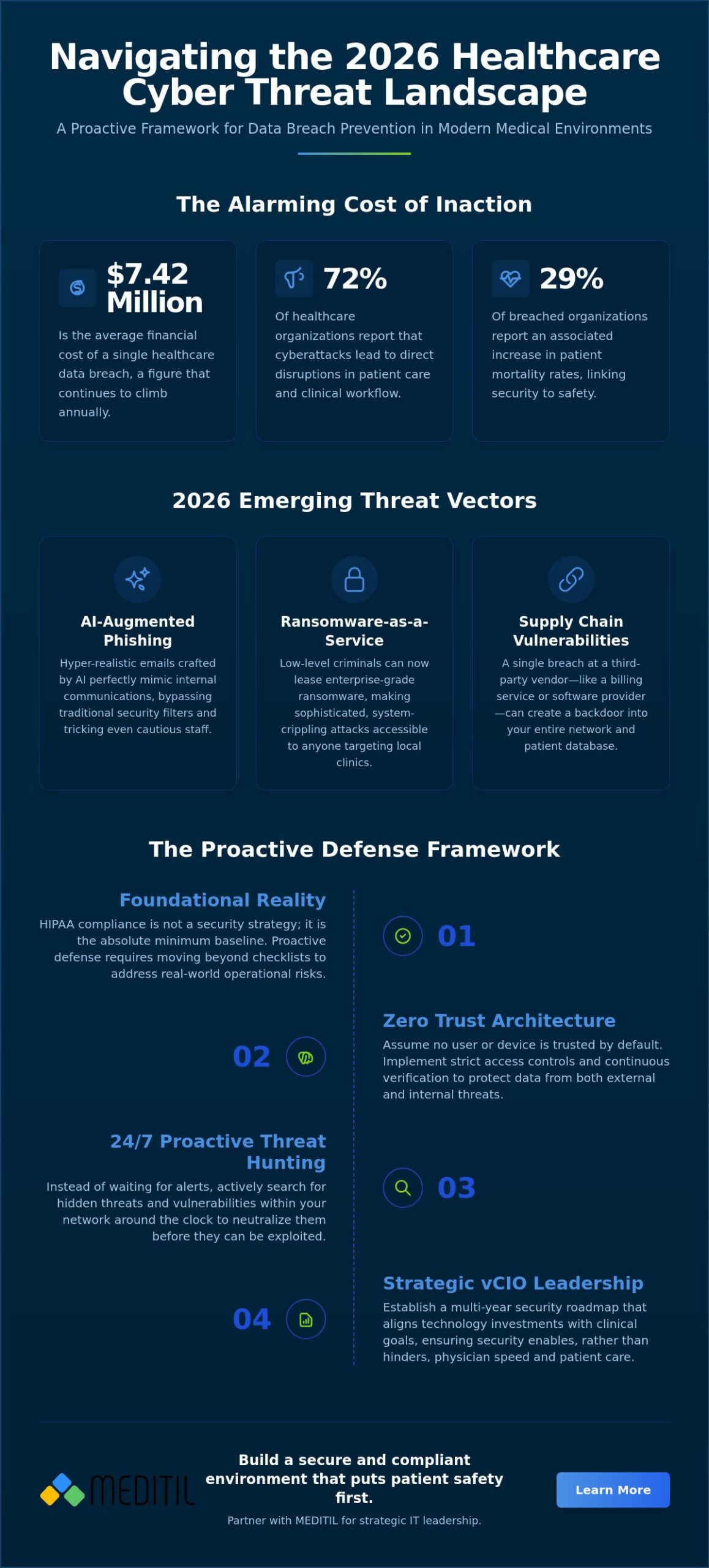
With the average cost of a healthcare data breach reaching $7.42 million and 72% of organizations reporting direct disruptions to patient care, the stakes for clinical security have never been higher. You likely face the constant pressure of mounting OCR fines and the growing complexity of securing a hybrid workforce. It’s a difficult balance to maintain when reactive IT measures create bottlenecks for physicians who must move quickly. Effective healthcare data breach prevention requires more than just checking boxes; it demands a sophisticated alignment of infrastructure, clinical workflow, and expert leadership.
This article details the emerging threat vectors of 2026 and the proactive infrastructure strategies required to protect patient data while maintaining clinical stability. We’ll explore how to achieve full regulatory compliance and foster strategic IT leadership that anticipates threats before they impact your operations. Our objective is to provide a methodical roadmap for building a secure, high-performing environment that supports your mission and removes the stress of potential audits.
Key Takeaways
- Understand why healthcare remains the primary target for cybercriminals in 2026 and how to transition from a reactive posture to a proactive defense strategy.
- Identify sophisticated threat vectors such as AI-augmented phishing and Ransomware-as-a-Service that bypass traditional security filters in modern medical environments.
- Learn why HIPAA compliance is merely a baseline and how to implement a continuous healthcare data breach prevention framework that addresses operational risks.
- Discover the technical requirements of Zero Trust Architecture and the necessity of 24/7 proactive threat hunting to maintain clinical stability and patient safety.
- Leverage strategic IT leadership and vCIO guidance to establish a multi-year security roadmap that protects sensitive data without hindering physician speed.
The 2026 Healthcare Data Breach Landscape: Why Risks Are Peaking
Effective healthcare data breach prevention in 2026 centers on a multi-layered defense strategy that anticipates failure points before they occur. It’s no longer enough to react to alerts. Modern prevention requires a proactive alignment of infrastructure, clinical staff training, and real-time monitoring. This approach treats security as a living part of the clinical workflow rather than a technical hurdle that slows down care delivery.
The modern medical data breach landscape shows that healthcare remains the primary target for cybercriminals. This isn’t just because patient records fetch a premium on the dark web. It’s because medical facilities are perceived as high-pressure environments where downtime isn’t an option. Attackers recognize that the urgency of patient care makes healthcare organizations more likely to pay ransoms to restore system access quickly.
This targeting has shifted from simple data exfiltration to the disruption of life-critical systems. Ransomware attacks now frequently target imaging equipment, telemetry monitors, and pharmacy systems. When these systems fail, the result isn’t just a loss of data; it’s a direct threat to patient safety. Clinical friction also plays a role. When security measures are too cumbersome, staff often find workarounds that inadvertently create new vulnerabilities. Addressing this technical debt is a core requirement for any 2026 healthcare data breach prevention strategy.
The Cost of Inaction in 2026
The average cost of a healthcare breach reached $7.42 million in 2025, and the financial burden continues to climb as systems become more interconnected. Financial loss is only the beginning. The long-term reputational damage can lead to a sustained loss of patient trust that takes years to recover. According to research from the Ponemon Institute, 29% of healthcare organizations that experienced a cyberattack reported an increase in patient mortality rates. This makes a stable foundation of medical it essential for protecting both the organization’s viability and the lives of those it serves.
Regulatory Evolution and Compliance Pressure
Regulatory bodies have moved away from passive audits toward active, risk-based enforcement. As of January 2026, inflation-adjusted HIPAA penalties have reached new heights. Tier 4 violations, which involve willful neglect that isn’t corrected within 30 days, now carry an annual cap of $2,190,294. State-level privacy laws have also become more stringent, creating a complex patchwork of requirements that medical practices must navigate. Simply checking the boxes on a compliance list is no longer a valid legal defense. Regulators now look for evidence of continuous risk management and strategic leadership that anticipates modern threats.
Emerging Threat Vectors in Modern Medical Environments
Cybersecurity is no longer just a battle against simple malware; it’s a fight against sophisticated automation. Attackers now use generative artificial intelligence to craft hyper-realistic phishing emails that mirror the specific tone of hospital leadership. These AI-augmented messages bypass traditional filters because they lack the grammatical errors and awkward phrasing that once signaled a threat. When an employee clicks a link that appears to be a legitimate internal memo, the organization’s healthcare data breach prevention efforts are put to the ultimate test.
Smaller medical practices face unique risks from Ransomware-as-a-Service (RaaS) models. These platforms allow low-level cybercriminals to lease high-end encryption tools, bringing enterprise-grade threats to local clinics. Additionally, supply chain vulnerabilities have become a primary backdoor. A breach at a third-party billing company or a clinical vendor with network access can compromise your entire database. Cybercriminals are increasingly exploiting emerging threat vectors that target the intersection of technology and human behavior. If your current infrastructure feels reactive, seeking professional Managed IT Services can help stabilize your defense layers.
Securing the Telehealth and Remote Monitoring Perimeter
Telehealth has expanded the clinical perimeter into the homes of staff and patients. This shift introduces unmanaged personal devices and unsecured Wi-Fi networks into the professional environment. Accidental disclosures are often the result of “Insider Threats” where employees utilize unauthorized cloud storage or personal email to handle patient files. It’s vital to implement a strategy to secure healthcare it solutions that specifically address remote access. Proper endpoint management ensures that every device, whether in the clinic or a home office, adheres to strict security protocols.
The Vulnerability of Interoperability
While seamless data sharing is essential for clinical speed, the APIs that connect EHRs create new entry points for attackers. Interoperability requires a delicate balance between open communication and robust verification. “Shadow IT” remains a persistent challenge; specialty clinics often adopt niche software without IT oversight, creating unmonitored silos of patient data. Effective healthcare data breach prevention requires a centralized view of all integrations to ensure that no connection becomes a weak link in your clinical infrastructure.
The Critical Gap: Why HIPAA Compliance Alone Isn’t Prevention
Many organizations mistake a clean audit for a secure infrastructure. Compliance acts as a static snapshot of a specific point in time, documenting that certain controls were in place during the review. In contrast, healthcare data breach prevention must be an ongoing operational process that evolves alongside new threats. An “audit-ready” mindset focuses primarily on documentation and historical data to satisfy a checklist. A “breach-resistant” mindset focuses on real-time resilience, active threat hunting, and the ability to maintain clinical operations under duress.
General managed IT providers often lack the deep expertise required to navigate the complexities of healthcare-specific risks. They might secure a network but fail to understand how PHI moves through specialized interoperable systems or telehealth platforms. Professional managed services for healthcare must go beyond generic IT support by aligning technical safeguards with the unique operational and regulatory demands of a clinical environment. This specialized focus ensures that security measures don’t just exist on paper but actually protect patient data during every physician interaction.
Technical Gaps in Standard Compliance Frameworks
Many legacy systems still in use throughout 2026 meet the basic requirements of HIPAA but remain highly vulnerable to modern exploits. These systems often lack the capacity for real-time monitoring or encrypted logging, which are critical components of healthcare data breach prevention. When compliance is the only metric for success, technical debt accumulates rapidly. This debt represents the growing gap between what is legally required and what is technically necessary to stop a sophisticated attack. Relying on traditional compliance models leaves blind spots that hackers are eager to exploit through automated vulnerability scanning.
The Human Element: Training vs. Culture
Annual compliance training is a necessary requirement, yet it rarely prevents a successful social engineering attack. Hackers in 2026 use personalized data and AI to create convincing scenarios that bypass the basic red flags taught in standard modules. A truly secure environment requires shifting from periodic training to a “Security First” culture. This culture is modeled by leadership and adopted by every clinical and administrative staff member. When data stewardship becomes a shared value rather than a chore, the organization’s defensive posture strengthens significantly. Strategic leadership must prioritize this cultural shift to ensure that staff members are empowered to recognize and report suspicious activity without hesitation.
A Proactive Framework for Securing Patient Data
In 2026, a robust healthcare data breach prevention strategy relies on the implementation of Zero Trust Architecture. This framework operates on the principle of “Never Trust, Always Verify,” requiring strict identity verification for every person and device attempting to access resources on the network. By removing the concept of a “trusted” internal perimeter, you significantly reduce the risk of lateral movement by attackers who have gained an initial foothold. This methodical approach ensures that sensitive clinical data remains segmented and protected by multiple layers of authentication.
Proactive threat hunting is the next evolution in clinical security. Utilizing 24/7 Security Information and Event Management (SIEM) allows for the continuous analysis of log data across your entire infrastructure. This visibility enables IT teams to identify anomalous patterns that suggest a breach is in progress before data exfiltration occurs. Regular, non-disruptive penetration testing and risk assessments further strengthen this posture by identifying vulnerabilities in a controlled environment. These simulations allow you to patch weaknesses without impacting the daily operations of your medical staff.
Endpoint protection must extend beyond standard workstations to include every tablet and connected medical device (IoMT) within your facility. These devices often serve as the weakest entry points for sophisticated malware. Ensuring that every piece of hardware is monitored and encrypted creates a comprehensive shield around your clinical environment. If you want to verify your current defensive layers, scheduling a comprehensive Cybersecurity & Compliance audit can provide the clarity needed to close existing gaps.
Clinical Alignment: Security Without Friction
Security protocols only work if they don’t hinder the speed of care. Integrating Single Sign-On (SSO) with Multi-Factor Authentication (MFA) allows physicians to move between workstations seamlessly without repeatedly entering complex credentials. This balance of speed and security requires healthcare it service providers who possess a deep understanding of medical workflows. When technical safeguards align with the natural rhythm of a clinic, staff are more likely to adhere to protocols, which inherently strengthens your healthcare data breach prevention efforts.
Disaster Recovery and Business Continuity
Resilience is measured by how quickly you can return to operations after a disruption. Immutable backups are essential in 2026; these are data copies that cannot be altered or deleted, even by an attacker with administrative privileges. Implementing an “N+1” redundancy model ensures that critical clinical infrastructure has an immediate failover option. We recommend testing your “Return to Operations” (RTO) metrics quarterly to minimize patient care disruption. A steady hand at the wheel ensures that even in the event of a technical failure, your clinical data remains available and your practice stays operational.
Strategic Prevention through Managed IT and vCIO Leadership
Effective healthcare data breach prevention requires more than just technical implementation; it demands high-level governance and a long-term vision. Relying on a reactive IT model often leaves organizations vulnerable to the sophisticated, AI-driven threats of 2026. Professional managed it services for healthcare provide the “steady hand” necessary to navigate this complex environment. These services offer a disciplined approach to infrastructure management, ensuring that every update, patch, and configuration change is handled with precision and a mission-driven focus on stability.
Strategic leadership is the missing link in many clinical security programs. A Virtual CIO (vCIO) provides this expertise by setting a comprehensive three-year security roadmap that anticipates emerging risks. This proactive guidance helps internal teams move beyond daily troubleshooting toward a mature defensive posture. By augmenting your existing staff with specialized cybersecurity expertise, you gain access to a broader range of technical nomenclature and industry-specific insights. MEDITIL positions itself as a strategic partner, offering the focused, results-oriented support required to maintain a secure and high-performing clinical environment.
The Fractional CIO: Strategy Without the Overhead
A virtual cio services expert ensures that your IT budget aligns directly with your security outcomes. This role is critical for bridging the gap between clinical needs and technical requirements; it ensures that physicians have the speed they need while the organization maintains the protection it requires. vCIOs navigate complex vendor management and oversee security audits, providing a methodical approach to risk-based decision-making. This level of strategic oversight allows healthcare leaders to focus on patient care, confident that their infrastructure is being managed by a seasoned expert invested in their long-term success.
Moving Toward a Breach-Resistant Future
The transition from reactive firefighting to proactive management is a fundamental requirement for healthcare data breach prevention in 2026. Ongoing managed services are the most cost-effective prevention tool available because they identify and resolve vulnerabilities before they can be exploited. This methodical rhythm of communication and operational improvement reinforces your organization’s image as a stable, reliable entity. It’s time to move away from the stress of potential audits and toward a future of seamless connectivity and robust protection. Taking the next step to secure your practice ensures that your patient data and clinical reputation remain protected against the evolving threats of the modern landscape.
Securing the Future of Clinical Infrastructure
The transition toward a breach-resistant environment requires a fundamental shift from static compliance to a dynamic, multi-layered defense strategy. As we’ve explored, healthcare data breach prevention in 2026 demands the integration of Zero Trust Architecture and proactive threat hunting to protect sensitive patient records. These technical safeguards must align with clinical workflows to ensure that security never comes at the cost of physician speed or patient safety.
Strategic leadership remains the most critical component of a resilient infrastructure. By leveraging Fractional CIO advisory and specialized expertise in HIPAA compliance and clinical interoperability, your organization can move from reactive firefighting to intentional, long-term stability. MEDITIL provides the steady hand at the wheel that your mission deserves. Take the first step toward a more secure operational model and Secure your clinical future with MEDITIL’s Managed IT and Cybersecurity Services. Building a fortified foundation today ensures that your practice remains a reliable sanctuary for patient care for years to come.
Frequently Asked Questions
What is the most common cause of healthcare data breaches in 2026?
Hacking and IT incidents remain the primary cause of breaches, specifically those targeting third-party vendors and supply chain partners. As of June 2026, these incidents account for the vast majority of records compromised in the healthcare sector. Social engineering and AI-augmented phishing also serve as frequent entry points by exploiting human vulnerabilities to gain initial network access.
How does HIPAA compliance differ from actual data breach prevention?
HIPAA compliance is a regulatory baseline that focuses on meeting specific legal standards and maintaining historical documentation for audits. In contrast, healthcare data breach prevention is an active operational process that involves real-time threat hunting and infrastructure resilience. While compliance tells you what should be in place, prevention ensures those systems actually stop a sophisticated live attack.
Can a small medical practice afford advanced cybersecurity services?
Small practices can access enterprise-grade protection through scalable managed IT models that provide sophisticated security without the cost of an internal department. These services allow smaller organizations to pool resources and benefit from advanced monitoring and vCIO leadership. Proactive defense is always more cost-effective than the multi-million dollar recovery expenses and OCR fines associated with a successful breach.
What should be the first step if we suspect a data breach has occurred?
Your first action must be to activate your incident response plan to isolate affected systems and contain the threat immediately. Rapid containment is essential to prevent attackers from moving laterally through your network to access more sensitive clinical data. Once you’ve stabilized the environment, you should notify your technical partners and legal counsel to begin a formal forensic investigation.
How often should a healthcare organization conduct a security risk assessment?
Organizations should conduct a comprehensive security risk assessment at least annually or whenever significant changes are made to their clinical infrastructure. Regular assessments are a core component of healthcare data breach prevention, helping to identify new vulnerabilities before they can be exploited. Supplementing these annual reviews with quarterly vulnerability scans ensures your defensive posture remains current against evolving threats.
Is cloud-based EHR storage safer than on-premise servers?
Cloud-based storage is typically more secure because major providers utilize advanced physical and digital safeguards that are difficult for individual practices to maintain. These platforms offer superior data redundancy and automated updates that protect against the latest malware strains. However, the security of the cloud still depends on strict access controls and the proper configuration of your internal clinical endpoints.
What is the role of a vCIO in preventing healthcare data breaches?
A Virtual CIO provides the strategic leadership necessary to align your IT investments with long-term security outcomes and clinical stability. They act as a steady hand at the wheel, setting a multi-year roadmap that moves your organization from a reactive posture to a proactive one. This guidance ensures that your security measures grow alongside your practice and the changing regulatory landscape.
How can we prevent phishing attacks from reaching our clinical staff?
Effective prevention requires a multi-layered approach that combines AI-driven email filtering with continuous security awareness training. Advanced filters identify and quarantine sophisticated messages that lack the traditional red flags of older phishing attempts. Coupling this technology with a security-first culture ensures that your staff can recognize and report the subtle signs of social engineering that bypass technical barriers.
One Response