What if your technology infrastructure was treated with the same clinical rigor as a surgical suite? For many healthcare leaders, the reality is often less precise. You’ve likely experienced the frustration of an EHR system that refuses to communicate or the anxiety that comes with system downtime when patients are waiting. These aren’t just technical glitches; they’re direct risks to patient safety and operational stability. In 2026, the stakes for medical it have never been higher. With the Healthcare Cybersecurity and Resiliency Act and new mandatory HIPAA technical safeguards now in effect, a general IT approach is no longer sufficient for regulatory survival.
We understand that managing complex networks while ensuring 72-hour data restoration and multi-factor authentication across all systems feels overwhelming. This guide bridges the gap between technical requirements and clinical excellence. You’ll discover how a specialized infrastructure transforms your operations, ensures total compliance with current standards, and directly improves patient outcomes. We will break down the essential components of a modern healthcare environment, from advanced cybersecurity frameworks like HITRUST CSF v11.2 to the seamless integration of interoperable data systems that finally talk to one another.
Key Takeaways
- Define the clinical technology ecosystem by distinguishing specialized healthcare systems from general administrative IT functions.
- Identify the critical pillars of robust medical it infrastructure, focusing on high-volume data connectivity and specialized cloud environments.
- Understand the impact of 2026 regulatory updates, including mandatory technical safeguards and the Healthcare Cybersecurity and Resiliency Act.
- Resolve interoperability challenges by leveraging modern data standards like FHIR and HL7 to connect disparate clinical systems.
- Prepare for the future of clinical operations through strategic IT leadership and the integration of AI for diagnostics and documentation.
What is Medical IT? Defining the Clinical Technology Ecosystem
Medical IT represents the sophisticated convergence of information systems, clinical operations, and rigid regulatory frameworks. It is not merely the maintenance of computers and servers; it is the strategic management of the digital environment where patient care occurs. Unlike general office technology, Health information technology is built to handle life-critical data with absolute precision. This discipline requires a deep understanding of how technical stability influences clinical outcomes and legal standing.
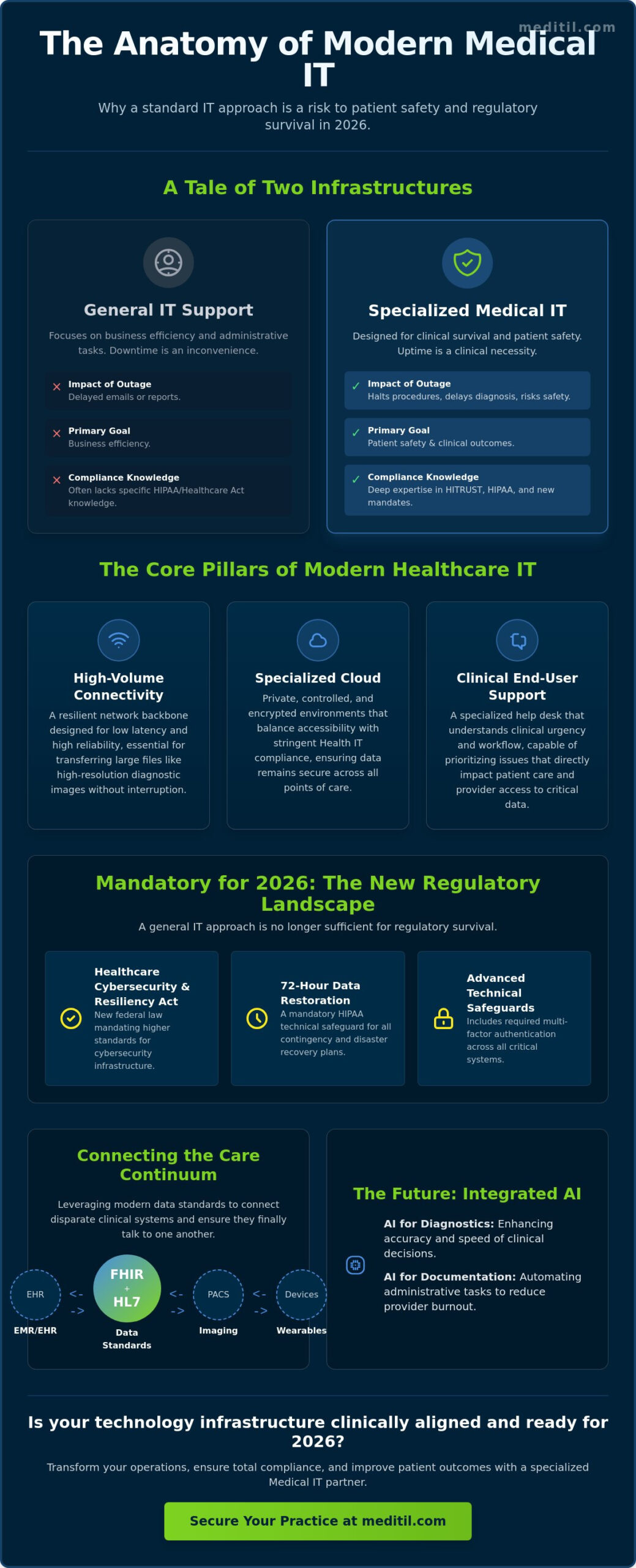
The distinction between general office support and medical it is often the difference between business efficiency and clinical survival. In a traditional business environment, a server outage might delay an email or a report. Within a healthcare facility, a failure in the infrastructure can halt a surgical procedure, delay a life-saving diagnosis, or prevent access to critical allergy records. This high-stakes reality demands a philosophy of clinical alignment, where technology is designed to support the physician’s workflow rather than create administrative friction. Understanding why general managed services for healthcare fall short of clinical demands is the first step toward building a truly resilient medical IT environment.
The Scope of Medical IT in 2026
Modern healthcare environments operate through a complex divide of administrative and clinical systems. Administrative systems handle the business of medicine, including scheduling, patient registration, and sophisticated billing automation. Clinical systems, however, are the tools of the trade. These include Electronic Medical Records (EMR), Picture Archiving and Communication Systems (PACS), and telehealth platforms. By 2026, this scope has expanded significantly to include remote patient monitoring and the secure management of data from wearable medical devices. Effective data management now requires seamless connectivity between the clinic and the patient’s home, ensuring that real-time health metrics are integrated directly into the provider’s decision-making process.
Why Specialization Matters
Relying on generalist IT providers introduces significant risk to a medical practice. Generalists often lack the specialized knowledge required to manage the unique uptime requirements of life-critical systems or the nuances of medical-grade hardware. A standard IT approach might overlook the specific technical safeguards mandated by the latest HIPAA updates, such as the 72-hour data restoration requirement now essential for contingency plans. Specialized providers understand that in healthcare, “uptime” isn’t a goal; it’s a clinical necessity. They prioritize the stability of the network backbone to ensure that high-volume medical data, such as high-resolution imaging, moves without latency or interruption. When evaluating your options, using a rigorous framework to assess healthcare it service providers on clinical alignment and regulatory expertise can help you avoid costly gaps in your infrastructure.
Medical IT is the disciplined integration of information systems and clinical workflows designed to prioritize patient safety and maintain absolute regulatory integrity.
The Core Pillars of Modern Healthcare IT Infrastructure
A reliable medical it strategy rests on a foundation of specialized infrastructure. It isn’t just about having a fast internet connection; it’s about building a resilient ecosystem where data flows securely and without interruption. This requires a transition from basic technical support to a strategic architecture that prioritizes clinical availability.
Networking and connectivity serve as the primary backbone of this environment. High-volume medical data transfer, such as transmitting high-resolution diagnostic images, requires more than standard consumer-grade bandwidth. It demands a network designed for low latency and high reliability. Similarly, cloud services must balance the need for accessibility with the stringent requirements of a private cloud. This ensures that while providers can access data from various points of care, the information remains within a controlled, encrypted environment that meets the standards for Health IT and regulatory compliance. In 2026, these cloud solutions must also support the mandatory 72-hour data restoration requirement as part of a comprehensive contingency plan.
End-user support is another critical pillar. Specialized medical help desks are essential because they understand clinical urgency. When a physician cannot access a patient’s chart, every minute of delay impacts care quality. General IT support often lacks the context to prioritize these clinical issues effectively. Managing hardware and peripherals also requires a unique approach. Clinical environments demand hardware that is:
- Durable and Sanitizable: Designed to withstand medical-grade cleaning agents.
- Seamlessly Integrated: Tablets and scanners must sync instantly with the central database.
- Reliable: Medical-grade workstations must offer consistent performance under high-stress conditions.
Ensuring these devices are correctly managed within the medical it ecosystem prevents them from becoming points of failure.
Network Management and Stability
In clinical hubs, network downtime is unacceptable. Implementing N+1 redundancy is a necessary standard to ensure that if one component fails, a secondary system takes over immediately. This level of stability is vital for maintaining real-time telehealth sessions and the rapid transfer of massive imaging files. Optimizing your bandwidth prevents the “spinning wheel” that frustrates clinicians and patients alike. For a deeper look at these technical requirements, consider reviewing our Managed IT Services for Healthcare: The 2026 Definitive Strategic Guide.
EMR and EHR Implementation
Successful EMR and EHR deployment goes beyond choosing the right software. IT specialization plays a vital role in EHR optimization, ensuring the system aligns with the actual clinical workflow. Infrastructure readiness is a prerequisite. If the underlying network cannot support the data load, even the best software will fail. Training your staff is the final step, reducing clinical friction and ensuring that technology acts as a tool for better outcomes rather than an administrative burden. If your current systems feel disjointed, our team can provide Infrastructure & Network Services tailored to your specific clinical needs.
Navigating Cybersecurity and Regulatory Compliance in Medicine
Healthcare remains the primary target for ransomware and sophisticated cyberattacks in 2026. The high value of protected health information (PHI) on the black market, combined with the extreme urgency of clinical operations, makes medical facilities uniquely vulnerable. For a modern practice, medical it security is no longer just a technical requirement; it’s a fundamental component of patient safety. A breach doesn’t just compromise privacy; it can paralyze the delivery of care, leading to delayed treatments and diagnostic errors.
Regulatory standards have evolved to meet these heightened threats. As of 2026, the HIPAA Security Rule has transitioned previously “addressable” safeguards into mandatory requirements for all covered entities. This shift means that technical controls like multi-factor authentication (MFA) and data encryption are now non-negotiable standards of care. Effective compliance requires proactive monitoring through Security Information and Event Management (SIEM) systems. These tools provide real-time visibility into the network, allowing for the immediate detection and neutralization of unauthorized access before it escalates into a full-scale breach. Many practices remain unaware of how deeply the gaps in general managed services for healthcare expose them to these escalating regulatory and security risks.
Disaster recovery protocols must also reflect clinical realities. While a 4-hour recovery window was once considered acceptable for standard business operations, it’s often too slow for modern medicine. In a surgical or emergency setting, even an hour of system unavailability can have dire consequences. Current medical it standards now emphasize a 72-hour data restoration mandate for entire systems, ensuring that clinical workflows can resume with minimal disruption to the clinical applications of health IT that providers rely on every day.
Technical Safeguards for Patient Data
Securing patient data requires a multi-layered technical approach. Modern clinical workflows must integrate encryption protocols for data both at rest and in transit. Multi-factor authentication is now required across all applications to prevent unauthorized entry through compromised credentials. Managing access controls is equally vital; the principle of least privilege ensures that staff members only have access to the specific data necessary for their roles. Regular, automated risk assessments and biannual vulnerability scanning are essential to identify and remediate gaps in the infrastructure before they are exploited.
The Human Element of Medical Cybersecurity
Technology alone cannot secure a practice. Staff members are the frontline defense against social engineering and phishing attempts. Continuous training ensures that every employee understands their role in maintaining the security perimeter. This preparation should culminate in a robust incident response plan tailored specifically to medical operations. This plan outlines exact steps for containment and communication during a crisis, ensuring the team remains composed and effective. For organizations seeking to integrate these protections into their daily operations, our Strategic Healthcare IT Services: A Framework for Clinical Alignment in 2026 provides a comprehensive roadmap for balancing security with clinical efficiency.
Interoperability and Data Management: Connecting the Care Continuum
Data silos remain a persistent obstacle in clinical environments. When information is trapped within isolated software modules, the care continuum suffers and patient safety is compromised. Effective medical it strategy in 2026 focuses on dismantling these barriers through standardized data exchange and strategic systems integration. Without this connectivity, clinicians are forced into manual data entry, which increases the likelihood of medical errors and administrative delays. Moving beyond fragmented systems requires a deliberate shift toward a unified digital ecosystem.
Achieving true interoperability requires strict adherence to modern standards. As of 2026, Fast Healthcare Interoperability Resources (FHIR) R4 is the foundational standard for health data exchange in the United States, mandated by the ONC Cures Act Final Rule. Understanding the transition toward FHIR R6 and the integration of United States Core Data for Interoperability (USCDI) Version 3 is essential for maintaining a compliant infrastructure. These protocols ensure that clinical notes, demographics, and high-resolution DICOM images move securely between disparate systems, providing a complete clinical picture at the point of care.
Bridging the gap between the EMR, billing automation, and pharmacy modules is a core function of professional systems integration. When these components are synchronized, the practice gains a unified view of the patient journey. This integration powers advanced business intelligence and analytics. By turning raw data into actionable insights, practices can identify clinical trends and optimize financial performance with precision. If your systems remain fragmented and your data is difficult to access, our Systems Integration & Interoperability services can create the seamless connectivity your practice requires.
Achieving Seamless Connectivity
Ongoing healthcare application support is vital for maintaining these connections as software updates and regulatory changes occur. Billing automation and integration further reduce the administrative burden by eliminating redundant data entry and lowering error rates. Seamless interoperability reduces physician burnout by providing immediate access to comprehensive patient records without the need for manual searching or phone calls to outside facilities. This efficiency allows providers to focus on clinical decision-making rather than administrative troubleshooting.
Telehealth and Remote Monitoring
The expansion of the Internet of Medical Things (IoMT) has made remote patient monitoring a standard of care. Integrating data from wearable devices directly into the primary patient record ensures that clinical decisions are based on continuous, real-time metrics rather than sporadic office visits. Scalable telehealth programs require robust medical it infrastructure that supports secure, high-quality video links and encrypted data transmission. This ensures that virtual consultations provide the same level of care and security as in-person visits while maintaining compliance with 2026 HIPAA standards.
The Future of Medical IT: Strategic Management and AI Integration
The future of medical it depends on a transition from reactive technical support to proactive clinical leadership. Many practices still operate under a break-fix model, where IT is only addressed when systems fail. This approach is increasingly dangerous in a landscape defined by the Healthcare Cybersecurity and Resiliency Act of 2026. A proactive, augmented IT team model ensures that your infrastructure is continuously monitored and optimized before issues affect patient care. This shift allows your practice to move beyond basic maintenance and toward strategic advancement. Selecting the right partner for this transition requires a thorough vetting process; a structured checklist for evaluating healthcare it service providers on clinical alignment, regulatory compliance, and strategic scalability can be an invaluable tool for making that decision with confidence.
Artificial Intelligence is no longer a peripheral concept; it’s an indispensable tool for diagnostics and operational efficiency. Between 2026 and 2033, the AI and machine learning segment in healthcare is projected to grow at a CAGR of 17.5%. This growth is driven by tools that offer predictive diagnostics and automated clinical documentation, which significantly reduce the cognitive load on providers. However, implementing these technologies safely requires a human leadership element to oversee data integrity and ethical applications. Scalability is achieved by building a roadmap that anticipates these technological shifts rather than reacting to them.
Strategic leadership serves as the final bridge between clinical objectives and technical capabilities. While Managed IT services provide the necessary day-to-day stability, high-level consulting ensures that your technology investments align with your long-term growth. This involves moving from a utility-based view of technology to a partnership-based model. By 2026, the most successful clinics will be those that treat their technical infrastructure as a strategic asset.
The Fractional CIO Advantage
A Fractional CIO provides the high-level expertise necessary to bridge the gap between clinical workflows and administrative strategy. This role is essential for aligning IT budgets with both patient outcome goals and financial objectives. Instead of simply managing hardware, this strategic partner helps you navigate complex regulatory changes and select technologies that offer a genuine return on investment. For more information on this approach, explore our Virtual CIO Services: Strategic IT Leadership for Healthcare in 2026.
Preparing for AI and Automation
Infrastructure readiness is the primary prerequisite for AI adoption. These advanced tools require significant computational power and a high degree of data hygiene. If your patient data is inconsistent or poorly structured, machine learning algorithms cannot provide accurate insights. Partnering with a specialized medical it firm ensures your data environment is verified and secure. This collaboration is the logical final step for any practice aiming to maintain a competitive and compliant clinical environment in the years ahead.
Achieving Operational Excellence Through Strategic Infrastructure
The landscape of healthcare technology in 2026 requires more than just technical support; it demands a disciplined approach to clinical alignment. We’ve explored how specialized infrastructure provides the stability needed for high-stakes medical environments and why mandatory HIPAA safeguards are now essential for regulatory survival. By moving from a reactive “break-fix” mindset to a proactive model, your practice can leverage the full potential of interoperable systems and AI integration.
True success lies in bridging the gap between technical complexity and clinical efficiency. This is achieved through expert guidance in HIPAA and healthcare compliance, strategic Fractional CIO leadership, and a proactive cybersecurity posture tailored to medical data protection. Specialized medical it is no longer a utility; it’s the foundation of patient safety and business growth. Secure your clinical operations with MEDITIL’s specialized Medical IT services. Your practice deserves a technology partner that understands the precision required in modern medicine. We’re ready to help you navigate this evolving environment with confidence.
Frequently Asked Questions
What is the difference between Health IT and Medical IT?
Health IT is a broad category encompassing all digital health technologies, while medical it specifically focuses on the specialized infrastructure and technical management required for clinical operations. This includes the hardware, networks, and integration points that directly support patient care and regulatory adherence. It is the practical application of technology within a medical facility to ensure clinical stability.
How does Medical IT improve patient safety in a clinical setting?
Stable infrastructure enhances patient safety by ensuring that critical clinical data is accurate and available at the point of care without interruption. Reliable networks prevent delays in accessing allergy records or diagnostic images, while interoperable systems reduce the risk of manual data entry errors. This technical reliability ensures that clinicians make informed decisions based on real-time, verified information.
Is HIPAA compliance handled by the software or the IT infrastructure?
HIPAA compliance is a shared responsibility between your software applications and your underlying IT infrastructure. While an EMR provides privacy features, the infrastructure must provide the mandatory technical safeguards, such as multi-factor authentication and encryption for data in transit. In 2026, the updated HIPAA Security Rule specifically mandates these infrastructure-level controls to ensure total data protection regardless of the software used.
Why do medical practices need specialized managed IT services instead of general IT?
Specialized providers understand the high-stakes nature of clinical workflows where system downtime is a direct risk to patient care rather than a mere administrative inconvenience. General IT providers often lack the specific expertise required to manage medical-grade hardware or navigate the complex regulatory environment of healthcare. Specialized medical it ensures that your systems are optimized for the unique demands of a regulated medical practice.
What is a fractional CIO, and does my medical practice need one?
A fractional CIO is a strategic leader who provides executive-level IT guidance on a part-time or project basis. Your practice needs one if you are navigating complex digital transformations, scaling your operations, or struggling to align your technology budget with long-term clinical goals. This role ensures that your technical strategy supports your business objectives without the expense of a full-time executive hire.
How can Medical IT help reduce physician and staff burnout?
Technology reduces burnout by automating repetitive administrative tasks and streamlining clinical workflows. When systems are fully integrated, staff members spend less time on manual data entry and more time on patient interaction. Reliable technical support also eliminates the constant frustration of system glitches, allowing physicians to focus on medicine rather than troubleshooting their workstations.
What are the biggest cybersecurity threats facing medical practices in 2026?
The primary threats in 2026 include sophisticated ransomware attacks and vulnerabilities within the growing network of Internet of Medical Things (IoMT) devices. Social engineering remains a significant risk, targeting staff members to gain unauthorized access to protected health information. These threats are addressed through the Healthcare Cybersecurity and Resiliency Act, which emphasizes the need for robust, proactive defense layers and mandatory technical safeguards.
Can Medical IT help with billing automation and revenue cycle management?
Strategic infrastructure directly supports revenue cycle management by integrating billing automation into the clinical workflow. This connectivity ensures that encounter data flows seamlessly from the patient record to the billing system, which reduces coding errors and accelerates the reimbursement process. Proper systems integration ensures these data points remain secure and functional, protecting the financial health of the practice.
2 Responses