
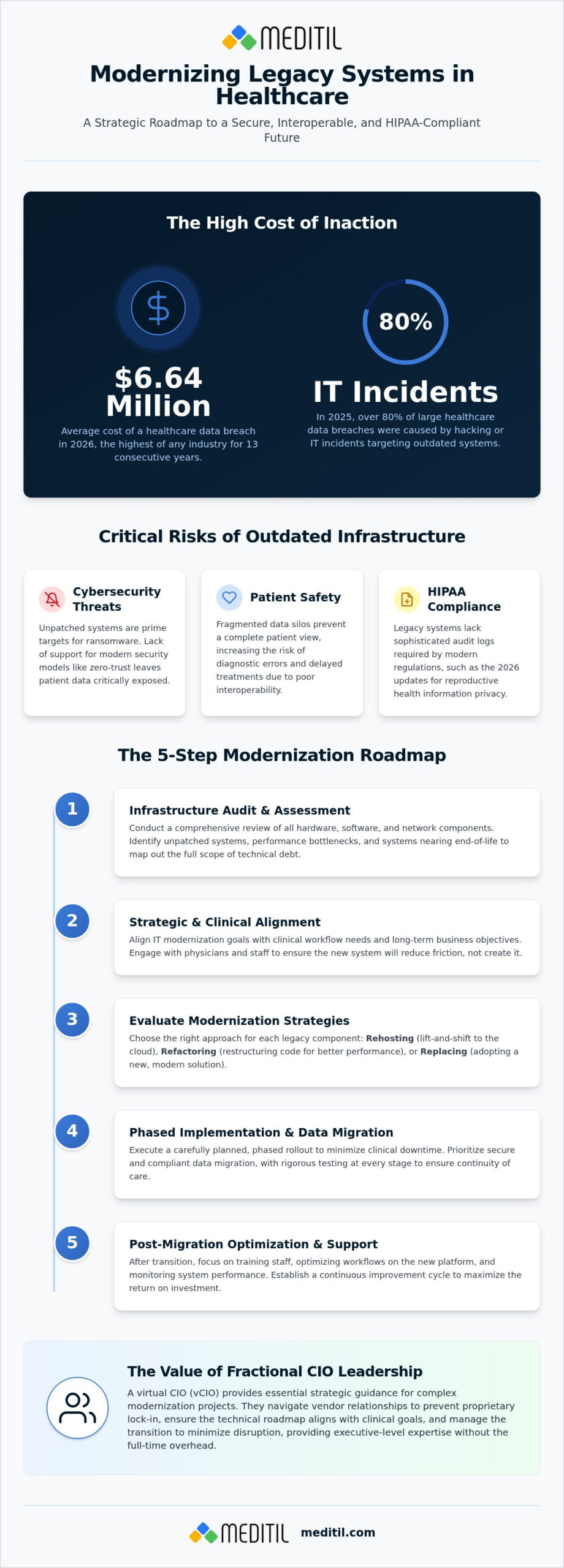
In 2026, the average cost of a healthcare data breach has climbed to $6.64 million, marking the thirteenth consecutive year that this sector leads all others in financial risk. Most administrators recognize that the high cost of maintaining technical debt is no longer just a budgetary nuisance; it’s a critical threat to organizational stability. You’re likely struggling with the persistent lack of interoperability between EHR and billing systems, which creates clinical friction and increases the risk of HIPAA violations due to unpatched, aging hardware.
This guide provides a structured roadmap for upgrading legacy systems in healthcare, focusing on a transition from fragmented infrastructure to modern, interoperable environments. We’ll show you how to achieve a secure, HIPAA-compliant foundation that enhances patient safety and provides long-term scalability. We’ll examine how to address the 2026 regulatory environment, implement zero-trust security models, and utilize fractional CIO leadership to ensure a seamless transition without disrupting patient care. By the end of this article, you’ll understand how to manage this complex evolution with precision and technical confidence.
Key Takeaways
- Define technical debt as a compounding operational burden rather than a simple maintenance expense to better justify modernization budgets.
- Identify critical security vulnerabilities in unpatched hardware that increase the risk of ransomware and 2026 HIPAA compliance failures.
- Evaluate the strategic benefits of rehosting versus refactoring when upgrading legacy systems in healthcare to ensure the best fit for your clinical workflow.
- Follow a methodical five-step roadmap that prioritizes infrastructure audits and strategic alignment to reduce clinical friction for providers.
- Utilize fractional CIO leadership to manage complex vendor relationships and prevent the long-term risks of proprietary software lock-in.
What is a Legacy System in Healthcare and the Cost of Technical Debt?
A legacy system in a medical environment is any software or hardware that remains critical to daily operations but lacks modern support, security updates, or integration capabilities. These platforms often run on sunsetted operating systems or use proprietary code that cannot communicate with contemporary standards like FHIR. Organizations often maintain this aging infrastructure due to a combination of factors. The fear of clinical downtime during a transition is a major deterrent. Many administrators also worry about the perceived high cost of replacement and the complex regulatory hurdles involved in data migration. While keeping the status quo feels safer, it creates a mounting burden on the entire practice.
Choosing temporary fixes over comprehensive modernization results in technical debt. This isn’t merely a financial metaphor; it represents a real structural deficit in your IT environment. Every manual workaround and unpatched server adds to this burden. Technical debt in healthcare is the hidden operational tax paid for maintaining fragmented infrastructure. Eventually, the cost of managing these inefficiencies makes upgrading legacy systems in healthcare a financial necessity. The interest on this debt is paid through decreased productivity and increased risk every single day.
Identifying the Signs of System Obsolescence
Clinical staff usually recognize the symptoms of an aging system through daily frustrations. Frequent downtime or sluggish performance during patient check-ins are clear indicators that hardware is reaching its limit. If your current platform can’t integrate with modern diagnostic tools or telehealth services, it’s a clear sign of obsolescence. Perhaps the most dangerous signal is the lack of security patches from original equipment manufacturers (OEMs). When vendors stop issuing updates, upgrading legacy systems in healthcare becomes a requirement for basic cybersecurity survival rather than an optional project.
The Human Cost: Clinical Friction and Physician Burnout
The impact of outdated technology is felt most acutely by the providers. Slow, unintuitive interfaces and the need for manual data entry contribute heavily to physician burnout. When clinical data remains trapped in fragmented silos, providers must spend more time on administrative tasks than on patient care. This friction isn’t just an inconvenience; it’s a risk factor for medical errors. In 2026, streamlining these workflows is a central goal for modernization projects. Eliminating these barriers allows providers to focus on clinical outcomes rather than fighting with their tools. Modernizing the environment is a direct investment in your team’s professional satisfaction and performance.
The Critical Risks of Maintaining Outdated Healthcare Infrastructure
Maintaining outdated infrastructure isn’t just an operational hurdle; it’s a significant liability. Cybercriminals view unpatched, aging systems as low-hanging fruit for ransomware attacks. In 2025, hacking or IT incidents caused over 80% of large healthcare data breaches, highlighting the danger of using hardware that no longer receives security updates. These legacy platforms often lack the processing power or architectural design required for zero-trust security models. Beyond the threat of an external attack, operational fragility poses a constant risk. Without modern, redundant backup protocols, a single hardware failure can lead to catastrophic data loss with no clear recovery path for the organization.
The gap in interoperability also creates profound risks for patient safety. When clinical data is trapped in fragmented silos, providers cannot access a complete patient history in real time. This lack of connectivity prevents the seamless exchange of information between EHRs and diagnostic tools, which can lead to delayed treatments or diagnostic errors. The process of upgrading legacy systems in healthcare is the only viable method to bridge these gaps and ensure that your infrastructure supports the high-speed data exchange required in 2026.
Regulatory Risks and HIPAA Compliance Gaps
Compliance standards are becoming increasingly stringent as data privacy concerns grow. By February 16, 2026, all HIPAA-covered entities are required to update their Notice of Privacy Practices to reflect new protections for reproductive health information. Systems developed decades ago often lack the sophisticated audit logs and access controls needed to demonstrate compliance during a federal investigation. This regulatory pressure is a primary driver behind large-scale initiatives like the Health IT Modernization Program. Failing to modernize can lead to willful neglect penalties, which can reach $2,190,294 per year. You can find more detail on these requirements in our guide to Healthcare Cybersecurity Services: A Strategic Guide for 2026.
Revenue Cycle Disruption and Billing Inefficiencies
The financial impact of outdated systems is most visible in the revenue cycle. Legacy silos often lack the necessary APIs to integrate with medical billing automation solutions. This forces administrative staff to rely on manual data entry, which significantly increases the likelihood of human error. These mistakes lead to higher claim denial rates and unpredictable cash flow, which can destabilize a practice’s finances. Upgrading legacy systems in healthcare allows for the synchronization of clinical and financial data, reducing friction and ensuring that billing is as precise as the care provided. Engaging a professional for Project-Based IT Consulting can help you identify these hidden financial leaks and develop a strategy to plug them through modernization.
Modernization Strategies: Rehosting, Refactoring, or Replacing?
Modernizing your infrastructure requires a calculated choice between several technical paths. Each strategy offers a unique balance of speed, cost, and clinical impact. When upgrading legacy systems in healthcare, the decision usually falls into one of four categories based on the health of the existing code and the long-term goals of the practice.
- Rehosting (Lift and Shift): This involves moving legacy applications to a cloud environment with minimal changes. It’s a rapid way to reduce on-premise hardware costs, though it doesn’t always resolve underlying software inefficiencies.
- Refactoring: This strategy focuses on optimizing existing code to run more efficiently on modern infrastructure. It allows for better scalability and performance without the disruption of a total system overhaul.
- Replacing: Many organizations find that upgrading legacy systems in healthcare eventually necessitates a transition to a completely new, cloud-native EHR or Practice Management System. This path offers the highest long-term value but requires significant data migration and staff training.
- Encapsulating: This approach uses APIs to connect legacy data to modern interfaces. It’s an effective way to improve interoperability and user experience without a full rip-and-replace of the core system.
The ROI Framework for System Upgrades
Financial decisions must balance upfront capital expenditure (CapEx) against the ongoing benefits of operational savings (OpEx). A critical part of this analysis is calculating the “Cost of Doing Nothing” (CODN) over a three-year period. This includes the rising costs of emergency repairs, lost productivity, and potential HIPAA penalties. Modernization often leads to predictable IT budgeting and reduced clinical friction. For a detailed breakdown of these metrics, review our guide on Strategic IT Budgeting for Medical Practices.
Choosing the Right Path for Your Practice Type
The ideal strategy often depends on the scale of your operations. Specialty clinics frequently find success with a phased rollout to maintain patient volume. In contrast, large-scale clinical hubs might require a more aggressive implementation to ensure all departments move in sync across the enterprise. Managing these hybrid environments requires a steady hand to maintain stability during the transition. Many organizations rely on managed IT services for healthcare to provide the technical precision needed for such a strategic realignment.
A 5-Step Roadmap for Modernizing Your Clinical Environment
Modernization isn’t a singular event. It’s a methodical progression requiring technical precision and clinical insight. Successfully upgrading legacy systems in healthcare depends on a structured approach that prioritizes stability and data integrity. This five-step roadmap provides a clear path for organizations looking to move from fragmented infrastructure to a unified, modern environment.
- Step 1: Comprehensive Infrastructure Audit. We begin by identifying every component of your current environment, including hidden data silos, network bottlenecks, and security vulnerabilities. This assessment ensures we understand the full scope of your technical debt before any changes occur.
- Step 2: Strategic Alignment. We define clear clinical outcomes and Key Performance Indicators (KPIs). These might include targets for reduced provider friction, improved billing accuracy, or faster patient throughput.
- Step 3: Data Migration and Interoperability Planning. This stage involves the heavy lifting of mapping legacy data to modern standards. We focus on HL7 and FHIR compliance to ensure your records are portable and accessible across the care continuum.
- Step 4: Phased Implementation and Testing. To minimize downtime in life-critical systems, we deploy updates in controlled phases. Rigorous testing in a sandbox environment precedes any live rollout to ensure patient safety isn’t compromised.
- Step 5: Post-Launch Managed Support and Training. True success is measured by staff adoption. We provide ongoing help desk support and tailored training to ensure your team feels confident using the new tools.
The Importance of Data Mapping and Interoperability
Ensuring patient records remain accurate during the transition is a non-negotiable requirement. By implementing FHIR standards, we bridge the gap between legacy data and modern applications, creating a foundation for future telehealth and remote monitoring integrations. This connectivity ensures that clinical insights aren’t lost during the process of upgrading legacy systems in healthcare. A well-mapped data environment allows for seamless information exchange, which is essential for meeting 2026 regulatory standards and improving patient outcomes.
Staff Training and Change Management
Clinician resistance is often the biggest hurdle to successful modernization. We address this by involving providers early in the design process, ensuring the new workflows mimic familiar clinical patterns rather than disrupting them. Intuitive interfaces help reduce post-migration anxiety and prevent the burnout often associated with poorly implemented technology. If you’re ready to build a more resilient clinical environment, our team provides the expert IT consulting necessary to guide you through every phase of this transition.
Strategic IT Leadership: How a vCIO Navigates System Upgrades
A successful transition requires more than just technical expertise; it demands strategic foresight. While a standard technician focuses on resolving immediate hardware failures, a virtual cio services provider operates as a high-level consultant. This leadership is essential when upgrading legacy systems in healthcare, as these projects involve high stakes for patient safety and clinical continuity. A vCIO manages complex vendor relationships to prevent software lock-in, ensuring that your new infrastructure remains flexible and interoperable. They align every technical decision with your practice’s long-term growth objectives, acting as the steady hand that guides augmented IT teams through the complexities of a system overhaul.
Bridging the Gap Between Administration and IT
One of the most significant challenges in modernization is communication. A vCIO serves as a vital link between technical staff and the healthcare board, translating complex technical risks into clear business impacts. Instead of discussing server latency, they present evidence-based ROI projections that highlight how modernization reduces clinical friction and protects revenue. This approach helps secure budget approval by demonstrating how the IT roadmap supports regulatory compliance and future-proofing. By framing technical debt as a strategic liability, leadership can make informed decisions that prioritize both financial stability and patient care.
MEDITIL: Your Partner in Strategic Healthcare Modernization
We position ourselves as a proactive guide for organizations navigating these high-stakes transitions. Our approach to upgrading legacy systems in healthcare respects the unique demands of clinical workflows, ensuring that technology serves the providers rather than hindering them. We specialize in the expert management of interoperability and billing automation integrations, creating the seamless connectivity that legacy environments lack. Our commitment focuses on stability, security, and the performance of life-critical systems. Whether you need fractional leadership to manage an internal team or a comprehensive infrastructure overhaul, we provide the seasoned expertise required for a disciplined, results-oriented modernization journey. Does your current IT strategy align with your 2026 clinical goals? We’re ready to help you build a more resilient foundation.
Securing Your Clinical Future Through Strategic Modernization
Modernizing aging infrastructure is a critical step toward ensuring patient safety and operational resilience in 2026. By addressing technical debt and eliminating fragmented data silos, organizations can significantly reduce clinical friction for their providers. Success in upgrading legacy systems in healthcare requires a methodical approach that balances immediate security needs with long-term scalability. This transition isn’t just about replacing software; it’s about building a foundation that supports interoperability and streamlined clinical workflows.
A disciplined roadmap, supported by professional leadership, ensures that your transition is both seamless and secure. We specialize in providing the technical precision needed to navigate these complexities. Our approach leverages specialized healthcare vCIO expertise and proven interoperability frameworks to deliver comprehensive HIPAA-compliant managed services. If you’re ready to stabilize your environment and prepare for future growth, our team is prepared to act as your steady hand at the wheel. Schedule a Strategic IT Assessment with MEDITIL today to begin your modernization journey with confidence.
Frequently Asked Questions
What are the main challenges of upgrading legacy systems in healthcare?
The primary obstacles include the complexity of migrating unstructured data and the high risk of clinical downtime during the transition. Administrators often face resistance from providers who fear disruptions to their established workflows. Additionally, ensuring that new infrastructure maintains strict HIPAA compliance while integrating with aging hardware requires deep technical expertise. Successfully upgrading legacy systems in healthcare demands a disciplined strategy that addresses these technical and human factors simultaneously to ensure a stable outcome.
How much does it cost to modernize an outdated EHR system?
Total investment for modernization varies significantly based on the size of the clinical environment and the depth of the data migration required. Costs typically encompass infrastructure audits, software licensing, and specialized project-based IT consulting. Organizations must also account for staff training and post-launch managed support. While upfront capital expenditure is necessary, a well-executed upgrade reduces long-term operational costs and prevents expensive emergency repairs or regulatory penalties associated with technical debt.
Is it possible to upgrade healthcare systems without patient care downtime?
Yes, a zero-downtime transition is achievable through a phased rollout and the use of sandbox environments for rigorous testing. By deploying updates in stages or during low-volume hours, IT teams can maintain clinical continuity. Strategic infrastructure management allows for the synchronization of data in the background while the existing system remains active. This methodical approach ensures that life-critical functions remain operational throughout the entire modernization process, protecting patient safety and provider productivity.
What is the difference between rehosting and refactoring in medical IT?
Rehosting, often called “lift and shift,” involves moving existing applications to a cloud environment with minimal changes to the underlying code. This is a faster, less expensive path but doesn’t resolve inherent software inefficiencies. Refactoring is a more intensive process that involves optimizing the code to leverage modern cloud capabilities. While refactoring requires more time and technical precision, it offers superior scalability, better performance, and enhanced security for long-term clinical growth.
How does a vCIO help with legacy system modernization?
A virtual CIO provides the strategic leadership required to align technical upgrades with clinical and business goals. They manage complex vendor relationships to prevent proprietary lock-in and oversee the technical roadmap to ensure every investment supports long-term stability. By translating technical risks into business impacts, a vCIO helps boards make informed decisions about infrastructure. Their involvement is critical for upgrading legacy systems in healthcare without making expensive, short-sighted implementation mistakes.
What are the HIPAA risks associated with legacy software?
Legacy platforms often lack the ability to receive security patches, leaving them vulnerable to ransomware and data breaches. Many older systems also fail to maintain the sophisticated audit logs or encryption standards required by modern HIPAA regulations. As of 2026, the maximum penalty for a single violation can reach $2,190,294 for uncorrected willful neglect. Using outdated hardware makes it nearly impossible to demonstrate the proactive security posture required during a federal compliance audit.
How long does a typical healthcare system upgrade take?
The timeline for a system upgrade depends on the complexity of the data silos and the scale of the organization. A focused infrastructure modernization project might take three to six months, while a full enterprise-wide EHR replacement can extend over a year. Each phase, from the initial audit to post-launch training, must be handled with precision. A structured roadmap helps manage expectations and ensures that every milestone is met without compromising clinical stability.
Can legacy systems be integrated with modern telehealth platforms?
Integration is often possible through encapsulation or the use of modern APIs that bridge legacy data with new interfaces. By implementing FHIR standards, organizations can create a secure pathway for data to flow between aging databases and contemporary telehealth tools. This approach improves the patient experience without requiring a full system replacement. However, these integrations must be carefully managed to ensure that security protocols remain robust and that data remains synchronized across all clinical platforms.