
Can a hospital truly deliver elite patient care when its digital infrastructure is managed by an understaffed, revolving door of IT generalists? With the average healthcare data breach now costing $12.6 million, the internal approach to technology management is often more of a liability than an asset. You likely feel the daily strain of talent shortages and the persistent threat of sophisticated ransomware targeting your patient records. It’s a heavy burden to carry while trying to maintain seamless clinical workflows and meet rigorous regulatory standards.
This guide demonstrates how the benefits of outsourcing hospital IT provide a direct path to clinical resilience and long-term stability. You’ll learn how a strategic partnership resolves clinical friction, secures sensitive data, and transforms your technology into a high-performing competitive advantage. We’ll explore the transition to predictable OpEx spending models, the value of fractional CIO leadership, and the specific protocols required to achieve a zero-downtime environment in 2026.
Key Takeaways
- Identify how to bridge the specialized talent gap by accessing a dedicated team of cybersecurity and cloud architects without the overhead of internal recruitment.
- Realize the financial benefits of outsourcing hospital IT by converting unpredictable hardware spikes into a stable, predictable operational expense model.
- Discover strategies to reduce clinical friction and physician burnout through optimized system interoperability and enhanced life-safety protection.
- Learn how fractional CIO services provide high-level strategic leadership and a multi-year technology roadmap without the cost of a full-time executive.
- Follow a structured implementation framework that begins with a comprehensive security audit and prioritizes clinical uptime through precise service level agreements.
Hospital IT Crisis: Why In-House Models Fracture in 2026
Healthcare IT outsourcing is a strategic partnership where a hospital engages specialized providers to manage its complex medical technology infrastructure. This model has shifted from an optional cost-saving measure to a critical survival strategy. As clinical environments become more digital, the traditional in-house IT department often finds itself overwhelmed by the sheer scale of modern requirements. For a broader context on how these partnerships have evolved across the industry, this Medical Outsourcing Overview provides a foundational perspective on the integration of external expertise into healthcare operations.
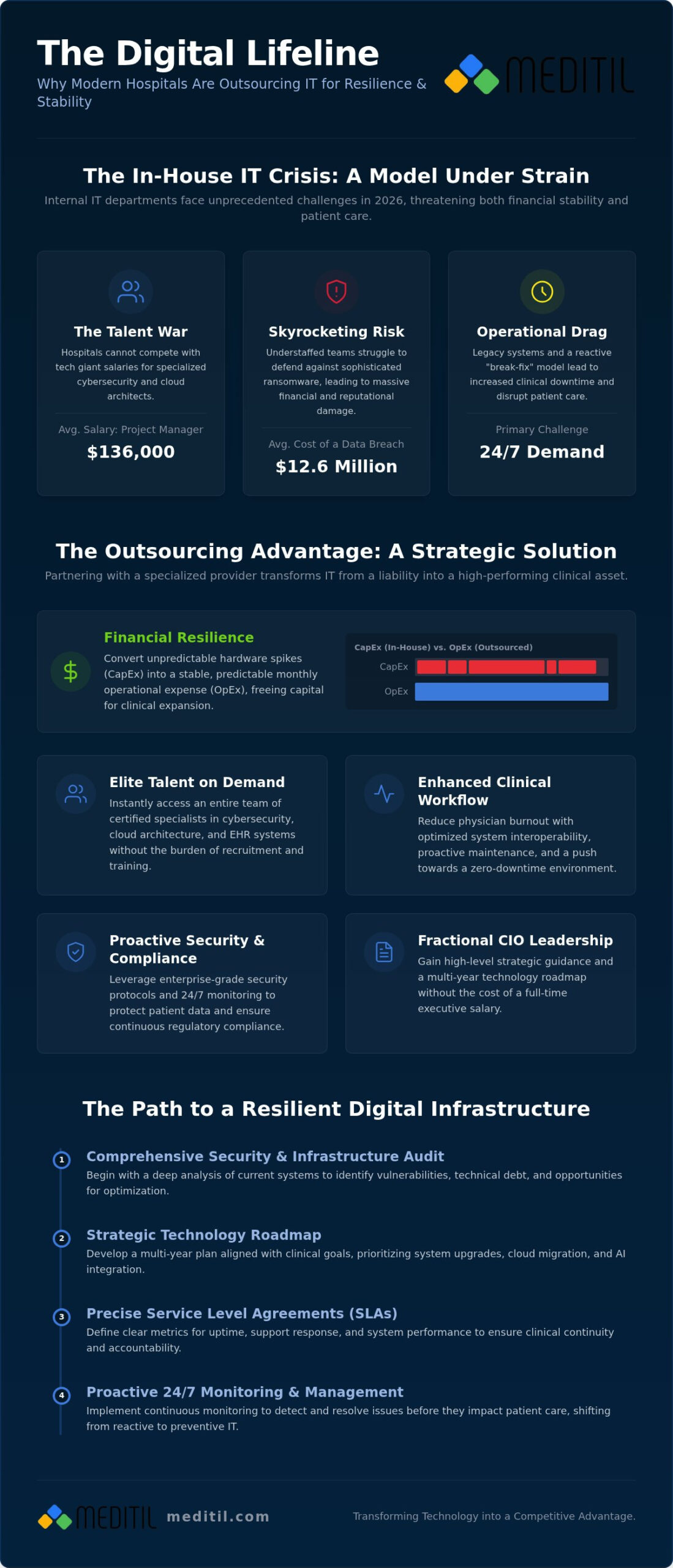
The 2026 talent war has created a significant barrier for hospitals attempting to maintain internal teams. Healthcare facilities simply cannot compete with the aggressive compensation packages and remote-work flexibility offered by global tech giants for specialized cybersecurity and cloud architects. With the average salary for a healthcare IT project manager reaching $136,000, and specialized system administrators commanding $123,000, the financial burden of recruitment is staggering. This scarcity of talent leads to a dangerous reliance on generalists who may lack the deep expertise required to defend against sophisticated ransomware attacks.
Technical debt also weighs heavily on modern hospitals. Legacy systems that were implemented years ago often require disproportionate resources to maintain, leading to increased clinical downtime and rising operational costs. One of the primary benefits of outsourcing hospital IT is the ability to break this cycle. Instead of functioning in a reactive “break-fix” mode, leadership can transition to proactive managed it services for healthcare. This shift ensures that infrastructure is monitored and updated before failures occur, rather than after they disrupt patient care.
The Impossible Demand for 24/7 Clinical Support
Modern healthcare operates without pause. The expansion of telehealth and remote monitoring means that technical support must be available every hour of every day. Internal teams often struggle to meet these requirements, leading to high turnover and exhaustion. Augmented IT teams offer the necessary “n+1” redundancy. This ensures that life-critical systems are always supported by a fresh, alert team of experts, regardless of the time or day.
Infrastructure Complexity in the Era of AI and Cloud
The integration of AI-driven diagnostics with existing EHR systems presents a level of complexity that generalist IT providers aren’t equipped to handle. Medical data management requires a specific understanding of interoperability and regulatory compliance that goes beyond standard IT knowledge. The benefits of outsourcing hospital IT include access to specialists who understand the nuances of digital transformation within a regulated clinical environment, ensuring that new technologies actually improve workflows rather than adding to clinical friction.
Quantifying the Financial Resilience of Outsourced Hospital IT
Managing a hospital budget in 2026 requires a departure from the volatile cycles of hardware depreciation and emergency repairs. By shifting from a Capital Expenditure (CapEx) model to an Operational Expenditure (OpEx) framework, leadership can convert unpredictable infrastructure spikes into a consistent monthly investment. This transition is a cornerstone of the benefits of outsourcing hospital IT, allowing administrators to allocate capital toward clinical expansion rather than aging server rooms. Understanding the Strategic Benefits of IT Outsourcing helps leadership recognize that these financial shifts are not just about saving money, but about building long-term resilience.
The true cost of an internal team extends far beyond base salaries. When you factor in recruitment fees, comprehensive benefits packages, and the mandatory ongoing training required to keep pace with evolving threats, the financial burden is substantial. A specialized healthcare IT partner provides immediate access to an entire department’s worth of expertise for a fraction of the cost of building that same capability in-house. This economy of scale ensures that even mid-sized facilities can leverage enterprise-grade technology and security protocols without the enterprise-grade price tag.
Aligning technology spend with clinical outcomes requires a disciplined approach to strategic it budgeting for medical practices. It’s about moving away from reactive spending and toward a three-to-five-year financial roadmap that supports hospital growth objectives. This foresight prevents the sudden, massive capital requests that often stall critical upgrades.
Predictable Budgeting with Managed Service Agreements
Emergency-only support models carry high financial risks, as a single day of downtime can cost a hospital millions in lost revenue and potential legal liability. Fixed-fee managed service agreements eliminate these variables by prioritizing proactive maintenance and 24/7 monitoring. MEDITIL’s ongoing managed services stabilize hospital financial roadmaps by providing a predictable cost structure that covers everything from daily support to major system migrations.
Reducing Operational Waste Through Billing Automation
Revenue cycle management is often hindered by fragmented systems that fail to communicate effectively. Implementing medical billing automation solutions through an outsourced partner allows hospitals to leverage advanced data analytics to identify and resolve bottlenecks. This integration significantly reduces claim denials and accelerates the reimbursement cycle. If you’re looking to optimize your financial performance, consider how specialized IT consulting can bridge the gap between your clinical data and your bottom line.
Enhancing Patient Safety and Clinical Workflow Efficiency
Clinical excellence is inseparable from technical reliability. When medical systems lag or fail to communicate, the result isn’t just an administrative headache; it’s a direct threat to patient safety. One of the primary benefits of outsourcing hospital IT is the immediate and measurable reduction in clinical friction. By optimizing infrastructure, hospitals can effectively mitigate physician burnout and the “alert fatigue” caused by poorly configured EHR systems. This ensures that clinicians spend their time making critical decisions rather than troubleshooting software interfaces.
Achieving 99.999% uptime for critical medical applications requires a level of professional network management that most internal departments struggle to maintain. Specialized healthcare partners utilize redundant systems and proactive monitoring to ensure that life-saving tools are available the moment they’re needed. These partners are also uniquely equipped for HIPAA-compliant cloud security, providing a level of data protection and accessibility that generalist providers cannot replicate. This high-availability environment is essential for modern hospitals that rely on real-time data for patient monitoring and emergency response.
Solving the Interoperability Challenge
Fragmented data remains a significant source of medical errors. Outsourcing facilitates seamless data exchange between EHRs, laboratories, and pharmacies by providing access to engineers who specialize in HL7 and FHIR standards. These technical protocols are complex and require constant maintenance to ensure data remains accurate across different platforms. True data interoperability is a critical clinical safety feature that protects patients by providing providers with a comprehensive, real-time view of medical history. When information flows without barriers, the risk of medication errors and diagnostic delays decreases significantly.
Proactive Cybersecurity and Regulatory Compliance
In 2026, ransomware is a patient safety issue as much as a security threat. Specialized healthcare cybersecurity services implement zero-trust architectures that secure every endpoint without slowing down the clinicians who use them. This approach replaces the “perimeter” mindset with a model of continuous verification, ensuring that sensitive patient records are protected from evolving threats. Leadership teams often discover that the benefits of outsourcing hospital IT include a “steady hand” at the wheel of compliance. Rather than relying on periodic internal audits, an outsourced partner provides continuous monitoring to maintain HIPAA and SOC2 standards, ensuring the hospital remains audit-ready at all times.
The Fractional CIO: Strategic Leadership Without the Executive Salary
Many hospital executives view technical partnerships as a tactical labor fix. While augmenting your staff is valuable, the most significant benefits of outsourcing hospital IT often emerge at the leadership level. Access to virtual cio services provides your organization with a seasoned expert who bridges the gap between clinical requirements and technical execution. This role isn’t merely advisory; it’s a proactive partnership designed to align every technology investment with the hospital’s long-term growth objectives.
A fractional CIO develops a comprehensive 3-5 year technology roadmap that anticipates shifts in the healthcare environment. This foresight prevents the common pitfall of investing in fragmented solutions that don’t scale. Whether you’re implementing complex telehealth platforms or integrating disparate systems after an acquisition, having executive-level IT leadership ensures your infrastructure supports your mission. It provides the strategic “steady hand” necessary for organizations that require high-level guidance but don’t need a full-time, high-salary executive on the payroll.
Aligning IT Strategy with Hospital Business Intelligence
Navigating High-Stakes Digital Transformation
Large-scale system migrations, such as moving a legacy EHR to a cloud environment, carry immense operational risk. A fractional CIO manages these transitions with a disciplined methodology, identifying potential bottlenecks before they disrupt patient care. This level of expertise is especially critical for hospitals undergoing mergers or acquisitions, where integrating different IT cultures and infrastructures is a primary challenge. By avoiding technical dead-ends and ensuring long-term sustainability, a vCIO protects the hospital’s digital future. If your organization requires expert guidance to navigate these complexities, explore our fractional CIO advisory services to secure your strategic roadmap.
Transitioning to an Outsourced Model: A Strategic Implementation Roadmap
The shift to an external partnership is a methodical process that requires precision to ensure clinical continuity. Moving away from a fractured in-house model involves more than just a contract; it requires a disciplined execution of a strategic roadmap. This journey begins with a comprehensive audit of your current IT infrastructure and security posture. This initial discovery phase identifies hidden technical debt and security vulnerabilities that could compromise patient care if left unaddressed. By establishing a clear baseline, leadership can make informed decisions about which systems require immediate modernization and which can be migrated over time.
Once the audit is complete, the next critical step is defining service level agreements (SLAs) that prioritize clinical uptime and response times. These agreements shouldn’t be generic; they must reflect the high-stakes reality of a 24/7 hospital environment. Realizing the full benefits of outsourcing hospital IT depends on selecting a partner with proven healthcare-specific credentials and a mission-driven culture. The implementation follows a phased transition plan, allowing for the gradual integration of services to ensure zero disruption to patient care. Finally, establishing a governance model for ongoing strategic review ensures the partnership remains aligned with your hospital’s evolving growth objectives.
Evaluating Healthcare-Specific IT Expertise
Generalist managed service providers often fail to grasp the nuances of a regulated medical environment. Leadership should avoid providers that serve multiple industries and instead seek partners that focus exclusively on healthcare. Ask potential partners about their direct experience with EMR implementation and their specific protocols for maintaining HIPAA compliance during system migrations. Cultural alignment is just as vital as technical skill. An IT partner must understand the pressure clinicians face, ensuring that every technical solution is designed to support, rather than hinder, the delivery of care.
Managing the Human Element of IT Outsourcing
A successful transition addresses the concerns of the people using the systems every day. Integrating an outsourced partner with your remaining internal IT staff requires clear role definitions and open communication to prevent operational friction. Leadership should proactively communicate the benefits of outsourcing hospital IT to physicians and nursing leadership, highlighting how the change will reduce clinical friction and improve system reliability. Providing a seamless help-desk experience from day one is essential. When clinicians see that their technical issues are resolved faster and more effectively, trust in the new model builds quickly, ensuring long-term success for the organization.
Securing Your Institution’s Digital Future
The transition toward a specialized IT model is no longer a matter of simple cost reduction; it’s a fundamental requirement for clinical resilience. By integrating fractional CIO advisory and robust cybersecurity, your hospital can move beyond the cycle of technical debt and staffing shortages. You’ve seen how the benefits of outsourcing hospital IT extend from the balance sheet to the bedside, ensuring that clinicians focus on patient care without the distraction of system failures. Professional interoperability and HIPAA compliance become standard operating procedures rather than constant sources of anxiety.
A stable, high-performing technology environment is within reach for organizations that choose a partner with deep healthcare expertise. This strategic alignment reduces clinical friction and provides a clear roadmap for long-term growth. It’s time to transform your technology from a liability into a competitive asset that supports your mission of excellence.
Secure your hospital’s future with MEDITIL’s Strategic Managed IT Services. With a steady hand at the wheel, your institution is well-positioned to thrive in an increasingly complex digital landscape.
Frequently Asked Questions
What are the primary benefits of outsourcing hospital IT?
The primary benefits of outsourcing hospital IT include access to elite cybersecurity talent, predictable operational costs, and a significant reduction in clinical friction. By partnering with specialists, hospitals bridge the gap created by the national IT talent shortage. This allows internal leadership to focus on patient outcomes while external experts manage the complexities of cloud infrastructure and system interoperability.
Is outsourcing IT safer than keeping it in-house for a hospital?
Outsourcing is often safer because specialized providers offer 24/7 proactive monitoring and zero-trust security architectures that are difficult to maintain in-house. With healthcare data breaches costing an average of $12.6 million in 2026, the advanced protection provided by an expert partner is a critical safeguard. These teams utilize sophisticated threat detection tools to identify and neutralize ransomware before it disrupts clinical operations.
How much can a hospital save by outsourcing its IT services?
Hospitals save money by converting unpredictable capital expenditures into stable monthly operational expenses and eliminating the high costs of recruitment and benefits. The average salary for specialized roles like healthcare IT project managers has reached $136,000, making internal hiring increasingly prohibitive. Outsourcing leverages economies of scale, providing enterprise-grade infrastructure and support without the massive overhead of an entire in-house department.
Will outsourcing my hospital IT lead to a loss of control over our data?
A strategic partnership enhances your data control by providing better visibility through advanced analytics and centralized governance. You retain full ownership of your patient records and clinical data while the provider ensures it remains secure and accessible. A properly structured service level agreement defines clear data access protocols, ensuring that your leadership team always has the final word on technical strategy.
What is the difference between an MSP and a Fractional CIO for healthcare?
An MSP focuses on the daily operational management of your infrastructure, while a Fractional CIO provides high-level strategic leadership and long-term roadmapping. While an MSP ensures your systems are running and secure, a vCIO aligns your technology investments with hospital growth and clinical objectives. Most successful hospitals utilize both to ensure they have both the technical labor and the executive guidance required for digital transformation.
How does IT outsourcing help with HIPAA compliance?
Outsourcing helps with HIPAA compliance by implementing continuous monitoring and automated auditing processes that far exceed periodic internal reviews. Specialized partners stay current with evolving regulations, such as the 2026 CIRCIA reporting requirements, ensuring your hospital remains audit-ready at all times. They provide the steady hand needed to manage complex data protection standards across cloud environments and mobile devices.
Can an outsourced IT provider manage our specific EHR or EMR system?
Specialized healthcare IT providers are equipped to manage and optimize major EHR and EMR systems through dedicated application support. They focus on improving interoperability between your EHR and other clinical tools, such as laboratory and billing systems. This expertise reduces the administrative burden on physicians by streamlining workflows and ensuring that data flows seamlessly across the entire care continuum.
What happens to our current IT staff if we decide to outsource?
Transitioning to an outsourced model often involves augmenting your existing team rather than replacing it entirely. Current IT staff are frequently redirected toward high-value, clinical-facing projects while the partner handles routine maintenance and cybersecurity. This approach reduces internal burnout and allows your team to focus on initiatives that directly improve the patient and provider experience within the facility.