
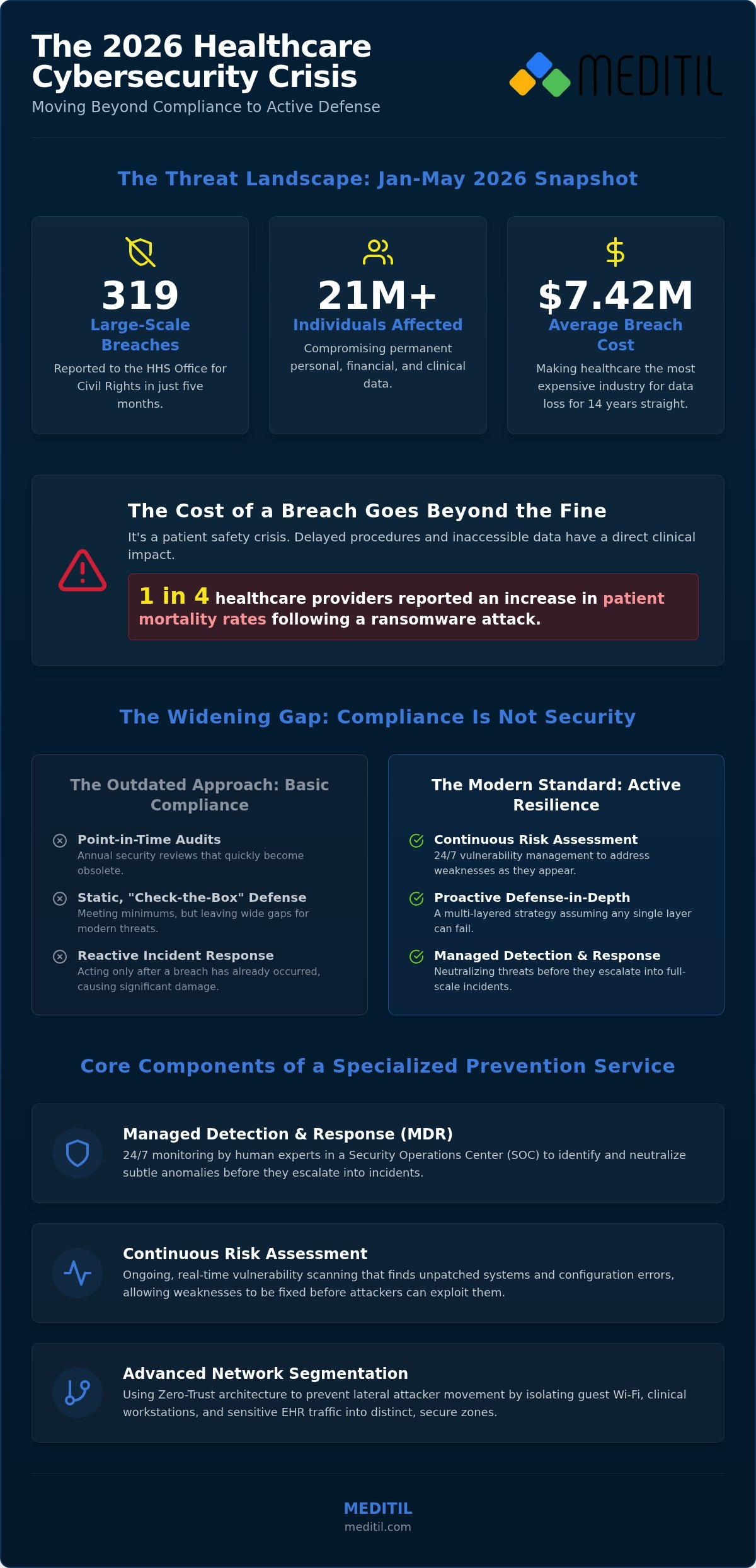
Between January and May 2026, 319 large-scale healthcare data breaches have already compromised the records of more than 21 million individuals. For many clinical leaders, the average breach cost of $7.42 million represents a catastrophic risk that threatens both financial stability and patient safety. You likely recognize that simply checking the boxes for HIPAA compliance doesn’t provide true immunity against sophisticated ransomware or nation-state actors. The gap between regulatory minimums and actual network resilience is widening. Specialized healthcare data breach prevention services are now a fundamental requirement for any organization that intends to maintain clinical continuity and patient trust.
It’s understandable to feel overwhelmed by the convergence of AI-driven threats and limited internal IT capacity. This article provides a strategic 2026 security roadmap to bridge that gap. You’ll discover how managed infrastructure and fractional CIO leadership can transform your security from a source of anxiety into a steady, invisible foundation for care. We’ll examine the shift from basic compliance to proactive defense, ensuring your network remains secure without adding to your administrative burden.
Key Takeaways
- Understand why modern healthcare data breach prevention services require a proactive, multi-layered managed strategy to protect high-value patient records from evolving 2026 threats.
- Learn how specialized managed infrastructure and continuous risk assessments prevent lateral attacker movement and replace outdated annual audit cycles.
- Identify the critical technical gaps between standard HIPAA compliance and true network resilience against sophisticated ransomware.
- Discover a phased roadmap for identifying shadow IT and hardening clinical networks through strategic segmentation and redundant backups.
- Explore how fractional CIO leadership provides the necessary expertise to manage complex IT environments and ensure long-term operational stability.
The 2026 Healthcare Threat Landscape: Why Static Prevention Fails
Effective healthcare data breach prevention services represent more than a collection of firewalls and antivirus software. It’s a proactive, multi-layered managed strategy designed to neutralize threats before they penetrate the clinical environment. In the current environment, a static defense is essentially no defense at all. Cybercriminals target healthcare organizations because patient records contain a permanent, unchangeable combination of personal, financial, and clinical data that commands a high price on the black market. This medical data breach overview illustrates how these exposures occur and the regulatory fallout that typically follows for unprepared entities.
The 2026 threat landscape is defined by the convergence of nation-state espionage and automated ransomware. Between January and May 2026 alone, 319 large healthcare breaches were reported to the HHS Office for Civil Rights, affecting over 21 million individuals. Adversaries now use AI-driven social engineering to craft perfect phishing lures and automated vulnerability scanning to find unpatched medical devices in seconds. We move beyond “check-the-box” compliance. Our “Defense-in-Depth” philosophy assumes that any single layer can fail, so we build redundant protections around your most critical assets.
The Cost of a Breach Beyond the Fine
When a system goes dark, it’s not just an IT issue. It’s a patient safety crisis. Procedures are delayed, and critical data becomes inaccessible, which can lead to life-threatening errors. Nearly one in four healthcare providers reported an increase in patient mortality rates after a ransomware attack. Beyond the immediate clinical impact, organizations face long-term reputational damage and significant patient churn as trust erodes. The average cost of a healthcare data breach reached $7.42 million in 2025, and healthcare remains the most expensive industry for data loss for the 14th consecutive year.
Why General IT Providers Miss Healthcare Nuances
General IT providers often struggle with the intricacies of medical environments. They don’t always understand the fragility of legacy EHR systems or the specific security requirements of medical IoT devices like infusion pumps. Implementing standard security protocols without clinical context creates friction that slows down providers and impacts care delivery. This is why specialized healthcare cybersecurity services are necessary. We balance rigorous protection with operational efficiency, ensuring that security measures support clinical workflows rather than hindering them.
Core Components of Specialized Breach Prevention Services
Specialized healthcare data breach prevention services operate as an ongoing lifecycle rather than a static checklist. While many organizations still rely on annual security reviews, the 2026 threat environment demands real-time posture management. This shift is supported by NIH research on data breaches, which highlights how evolving attack vectors necessitate more sophisticated, continuous defense mechanisms. A robust strategy integrates managed detection and response (MDR) where human experts in a Security Operations Center (SOC) monitor your network 24/7. This ensures that even the most subtle anomalies are identified and neutralized before they escalate into full-scale incidents.
Moving away from point-in-time audits is essential for clinical stability. Continuous risk assessment involves 24/7 vulnerability management that scans for unpatched systems and configuration errors as they happen. This proactive stance allows your augmented IT team to address weaknesses before attackers can exploit them. It’s about maintaining a steady hand at the wheel of your infrastructure, ensuring that every connected device is verified and secure.
Advanced Network Segmentation for Medical Hubs
Effective infrastructure must prevent lateral movement by attackers. If a single guest device is compromised, it shouldn’t provide a pathway to your patient records or medical IoT. We utilize zero-trust architecture to isolate guest Wi-Fi, clinical workstations, and sensitive EHR traffic into distinct, secure zones. Our deep expertise in infrastructure and network services ensures that these segments are configured correctly to maintain both high-level security and seamless clinical performance.
Identity and Access Management (IAM)
Controlling who has access to specific data is a cornerstone of breach prevention. Role-Based Access Control (RBAC) ensures that clinicians and administrative staff only interact with the information necessary for their specific duties. We implement Multi-Factor Authentication (MFA) protocols that are rigorous yet optimized for clinical workflows, preventing the friction that often leads to staff workarounds. Additionally, managing third-party vendor access is critical to mitigating supply chain risks. If you’re concerned about your current vulnerabilities, exploring a strategic security partnership can help clarify your risk profile.
Technology alone cannot solve the security puzzle. Advanced training for your staff must go beyond generic phishing simulations. We focus on teaching your team to recognize sophisticated, AI-enhanced social engineering tactics. This creates a human firewall that complements your technical infrastructure, ensuring that your employees are assets to your security posture rather than liabilities.
Compliance vs. Security: Bridging the HIPAA Gap
Many organizations mistake regulatory compliance for a comprehensive security strategy. HIPAA serves as a baseline for administrative and physical safeguards; it is not a ceiling for technical resilience. An in-depth analysis of healthcare data breaches reveals that entities with passing audit scores frequently fall victim to sophisticated ransomware. This discrepancy exists because standard regulatory audits often focus on policy documentation rather than the real-time effectiveness of technical controls. Being “HIPAA compliant” does not mean your network is immune to a zero-day exploit or an AI-driven social engineering campaign.
Adopting a “Security First” mindset ensures that protection is the primary objective. When you design an infrastructure with mandatory encryption, multi-factor authentication, and strict network segmentation, compliance becomes a natural byproduct of your operational excellence. Comprehensive managed it services for healthcare facilitate this by automating the collection of technical evidence. Instead of a manual scramble during an audit, your systems provide a continuous, verifiable stream of compliance data. This transition allows your clinical staff to focus on patient outcomes while the technology maintains a silent, secure perimeter.
The Strategic Role of the Fractional CIO
Strategic leadership is the essential bridge between clinical requirements and technical security. A virtual CIO provides the seasoned expertise needed to align security budgets with patient care priorities. This role is particularly vital as we navigate 2026 regulatory shifts, including the proposed HIPAA Security Rule updates targeted for 2027. By developing a long-term roadmap, fractional leaders prevent the accumulation of technical debt. This proactive planning eliminates the outdated systems and unmanaged “shadow IT” that frequently serve as entry points for attackers.
Managing the Regulatory Burden
Modern healthcare data breach prevention services must simplify the administrative weight of regulation. Preparing for the 2026 audit cycle requires proactive documentation and automated reporting. We focus on:
- Automated Audit Trails: Centralizing logs to ensure every access point is tracked and timestamped.
- Third-Party Risk Management: Formalizing Business Associate Agreements (BAAs) to ensure vendors meet your security standards.
- Contingency Verification: Documenting regular testing of system restoration procedures to meet the 72-hour recovery proposals.
This disciplined approach ensures that your organization remains ready for scrutiny without diverting resources from clinical operations.
Building a Strategic Prevention Roadmap
A resilient defense requires a structured progression rather than a fragmented response to individual threats. Comprehensive healthcare data breach prevention services rely on a logical roadmap that treats infrastructure as the primary security layer. This phased approach ensures that every vulnerability is identified, addressed, and monitored with precision. It moves your organization from a state of reactive anxiety to one of disciplined, proactive protection. By following a documented roadmap, you eliminate the guesswork that often leads to security gaps and technical debt.
The roadmap begins with Phase 1: a baseline assessment. This discovery process identifies “shadow IT,” which includes unauthorized applications or devices that exist outside the view of traditional administration. Phase 2 focuses on infrastructure hardening. Building on the segmentation strategies discussed previously, we implement redundant, immutable backups that reside outside the primary network. Phase 3 involves operational integration, where we deploy Identity and Access Management (IAM) and conduct staff training tailored to specific clinical workflows. Finally, Phase 4 establishes continuous governance. This involves ongoing monitoring and quarterly vCIO strategic reviews to ensure your defense evolves alongside the 2026 threat landscape.
Modernizing Healthcare Infrastructure
Security is often limited by the hardware that supports it. Outdated servers or network switches that cannot handle modern encryption standards create inherent blind spots. Transitioning to hybrid cloud environments allows for more granular security controls while maintaining the performance required for medical imaging and EHR access. We also emphasize the integration of secure systems, such as billing automation integration, which reduces clinical friction by ensuring that administrative data flows through encrypted, verified channels. This ensures that efficiency never comes at the expense of patient privacy.
Incident Response and Business Continuity
Technical protection must be paired with a clear plan for when the unexpected occurs. An incident response plan isn’t a document on a shelf; it’s a living protocol that ensures “always-on” patient care. Immutable backups are the final line of defense against ransomware, as they cannot be encrypted or deleted by attackers. We facilitate regular table-top exercises for both clinical and IT staff to simulate breach scenarios. These tests ensure that every team member knows their role in maintaining clinical continuity, even during a network disruption. If you’re ready to move from a reactive posture to a structured defense, you can discuss your security roadmap with an expert to begin your baseline assessment.
The MEDITIL Advantage: Comprehensive Healthcare IT Partnership
Choosing a partner for your infrastructure is a decision that impacts every facet of your clinical operations. Many organizations offer software-centric tools that automate risk, yet these often lead to alert fatigue without providing the necessary context for medical workflows. MEDITIL serves as the single point of accountability for your technology, ensuring that healthcare data breach prevention services are integrated into the daily rhythm of your practice. We don’t just provide a platform; we provide a disciplined, mission-driven team focused on stability and patient safety.
We specialize in managing entire IT departments or providing an augmented IT team to support your existing staff. This approach ensures that security isn’t treated as a secondary project; it’s baked into every administrative and clinical operation. Our experts understand the nuances of interoperability and the high stakes of clinical downtime. By implementing professional healthcare data breach prevention services as part of your core infrastructure, we help you maintain a steady hand at the wheel. This allows your providers to focus on care delivery while we handle the complexities of the 2026 threat landscape.
Why Fractional CIO Leadership is the Missing Link
Strategic success requires more than technical proficiency. It demands executive-level vision that aligns your technology with your clinical goals. Our fractional CIO services provide this leadership without the overhead of a full-time C-suite salary. We act as the essential bridge between technical IT teams and healthcare administration, translating complex security requirements into actionable business plans. This includes the development of a strategic IT budget that prioritizes breach prevention and infrastructure resilience, ensuring your financial resources are allocated where they offer the greatest protection.
Next Steps: Securing Your Practice for 2026
The transition to a secure, resilient infrastructure shouldn’t be a source of friction for your team. Our implementation process is designed to be seamless, prioritizing clinical continuity at every stage. We recommend beginning with a comprehensive security posture review to identify immediate vulnerabilities and long-term strategic needs. This assessment serves as the foundation for your 2026 roadmap, providing the clarity required to move forward with confidence. Are you ready to strengthen your clinical environment against emerging threats? You can schedule a consultation for healthcare-specific cybersecurity to begin the process of hardening your network.
Securing the Future of Clinical Operations
The 2026 threat landscape requires a shift from static checklists toward a managed lifecycle of protection. By prioritizing hardened infrastructure and zero-trust architecture, you ensure that patient safety remains uncompromised by evolving cyber threats. You’ve seen how specialized healthcare data breach prevention services transform security from a regulatory burden into a silent, stable foundation for care. This transition is most effective when guided by a strategic roadmap that aligns technical controls with clinical workflows.
MEDITIL brings deep expertise in HIPAA-compliant infrastructure and clinical workflow optimization to help you navigate these complexities. We offer proven Fractional CIO leadership for strategic security roadmapping and provide comprehensive management of IT teams for national healthcare organizations. It’s time to replace reactive anxiety with a disciplined, proactive posture. Partner with MEDITIL for tailored healthcare IT and breach prevention services. Your organization deserves a secure environment where technology supports, rather than hinders, the mission of patient care.
Frequently Asked Questions
What are healthcare data breach prevention services?
Healthcare data breach prevention services are comprehensive managed strategies that combine technical infrastructure, continuous monitoring, and staff training to protect sensitive medical records. Unlike basic software tools, these services provide a proactive defense-in-depth approach that includes managed detection and response (MDR) and network hardening. This ensures that clinical operations remain stable while patient data is shielded from sophisticated 2026-era threats like AI-driven social engineering and automated vulnerability exploitation.
How much do healthcare cybersecurity services cost in 2026?
The cost of healthcare cybersecurity services varies significantly based on the size of the organization, the complexity of the network, and the specific level of managed support required. Rather than viewing these as a fixed expense, many clinical leaders treat them as a strategic investment in risk mitigation. You should consult with a specialized provider to receive a customized assessment that aligns with your specific infrastructure needs and clinical goals for the 2026 fiscal year.
Does HIPAA compliance guarantee my medical data is safe?
HIPAA compliance does not guarantee that your medical data is safe from a targeted attack. Compliance represents a set of regulatory minimums for administrative and physical safeguards, but it often lags behind the technical reality of modern cybercrime. A practice can be fully compliant yet remain vulnerable to zero-day exploits. True safety requires moving beyond a checklist mentality to implement advanced healthcare data breach prevention services that prioritize technical resilience and real-time monitoring.
What is the role of a Fractional CIO in breach prevention?
A Fractional CIO provides executive-level strategic leadership to align your security budget with clinical objectives. This role is essential for navigating complex regulatory changes and developing long-term security roadmaps that prevent the accumulation of technical debt. By acting as a steady hand at the wheel, a Fractional CIO ensures that your organization implements the right technologies and protocols to mitigate risk effectively without the overhead of a full-time executive salary.
Can managed IT services prevent ransomware attacks in clinics?
Managed IT services play a critical role in preventing ransomware by implementing a multi-layered defense strategy. This includes automated patching of vulnerabilities, 24/7 monitoring for anomalous behavior, and the deployment of immutable backups that cannot be encrypted by attackers. While no service can claim 100% prevention, a proactive managed approach significantly reduces the attack surface and ensures that clinical continuity is maintained even if a security incident occurs on the network.
How does network segmentation protect patient health information (PHI)?
Network segmentation protects PHI by dividing your network into isolated zones, which prevents an attacker from moving laterally if a single device is compromised. For example, isolating guest Wi-Fi and medical IoT devices from the primary server containing your EHR ensures that a breach in one area does not lead to a total system exposure. This structure is a cornerstone of zero-trust architecture, providing a secure perimeter around your most sensitive clinical data.
What should I look for in a healthcare IT service provider?
You should prioritize providers with deep expertise in clinical workflows and a proven track record of managing HIPAA-compliant infrastructure. A qualified provider offers more than just help desk support; they should provide Fractional CIO leadership, a dedicated Security Operations Center (SOC), and a mission-driven focus on patient safety. Look for a partner that acts as a single point of accountability, managing your entire IT environment to ensure that security is baked into every daily operation.
How often should a medical practice conduct a security risk analysis?
While HIPAA requires periodic reviews, the 2026 threat landscape makes annual security risk analyses the necessary minimum for most medical practices. Additionally, an analysis should be conducted whenever significant changes occur in your environment, such as implementing a new EHR system or moving to a hybrid cloud infrastructure. Continuous vulnerability management is now considered a best practice, allowing your team to identify and remediate weaknesses in real-time rather than waiting for a yearly audit.