
What if your IT infrastructure wasn’t just a cost center that fixed broken printers, but a strategic engine that directly improved patient outcomes? Many healthcare executives find themselves trapped in a cycle of reactive troubleshooting, where EMR downtime disrupts care and the fear of a ransomware attack remains a constant, quiet hum in the background. It’s frustrating to manage high turnover rates for specialized technical talent while trying to maintain strict HIPAA compliance. You deserve a stable environment where technology supports, rather than hinders, your clinical mission.
A fully outsourced healthcare it department offers a path toward this stability by providing the security, compliance, and strategic leadership necessary to optimize clinical outcomes and reduce operational overhead. In this 2026 strategic guide, we’ll examine how to eliminate technical debt and align your digital infrastructure with your long-term organizational goals. We’ll explore the shift from basic support to a comprehensive partnership that ensures your network remains high-performing, your costs stay predictable, and your focus stays where it belongs: on the patient.
Key Takeaways
- Learn why shifting from reactive vendors to a strategic partnership is essential for maintaining stability in high-stakes clinical environments.
- Understand how modern network architecture and secure cloud services prioritize data accessibility while maintaining rigorous regulatory standards.
- Discover how an outsourced healthcare it department provides fractional CIO leadership to align technical investments with long-term clinical objectives.
- Identify the critical steps for a successful transition, including comprehensive infrastructure audits and the definition of clinical-grade performance metrics.
- Explore how specialized systems integration and billing automation reduce operational overhead while eliminating the surprise of technical debt.
What is an Outsourced Healthcare IT Department?
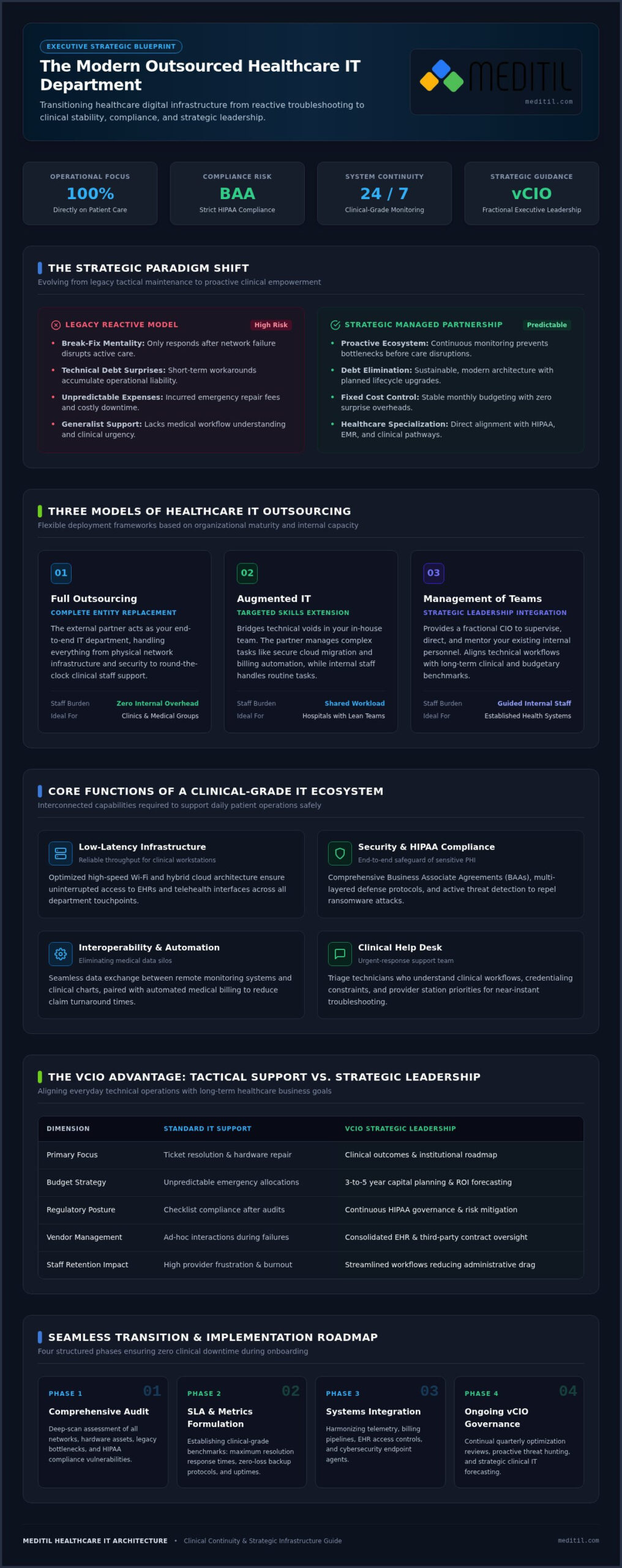
An outsourced healthcare it department is a comprehensive service model where an external partner assumes responsibility for all technical operations, data security, and long-term strategic planning. This isn’t merely a contract for remote support. It’s a deep integration where the partner manages your entire digital ecosystem to ensure clinical continuity. By 2026, the industry has moved decisively away from reactive ‘break-fix’ vendors. Modern healthcare leaders now prioritize Managed Service Partners (MSPs) who offer a proactive, steady hand at the wheel rather than just responding to emergencies.
The core components of this model include robust infrastructure management, a specialized help desk, advanced cybersecurity, and executive-level leadership. Generalist IT firms often struggle within this sector because they lack deep expertise in health information technology and the specific nuances of clinical interoperability. Without a partner who understands the high-stakes nature of patient data, organizations risk significant compliance gaps and operational friction.
Three Models of Healthcare IT Outsourcing
Choosing the right structure depends on your current internal capacity and long-term objectives. Most organizations adopt one of these three primary frameworks:
- Full Outsourcing: The partner functions as your entire IT entity. They handle everything from server maintenance and compliance audits to end-user support for your clinical staff.
- Augmented IT: This model bridges the gap for internal teams. The partner provides specialized skills, such as billing automation or cloud migration, that your current staff may not possess. It allows your team to focus on daily tasks while experts handle complex projects.
- Management of IT Teams: In this high-level model, the partner provides a Fractional CIO to lead and mentor your internal technical staff. This ensures that their daily activities are strategically aligned with the organization’s clinical and financial goals.
The True Cost of In-House Technical Debt
Maintaining an internal department carries significant hidden costs that go beyond simple salaries. Recruitment, benefits, and the constant need for specialized training for IT talent create a heavy financial burden. When these resources aren’t managed correctly, technical debt begins to accumulate. Technical debt in a clinical context is the cumulative financial and operational liability incurred when short-term technical workarounds or obsolete systems compromise patient care and regulatory compliance.
The financial impact of clinical downtime is often more severe than the cost of the technology itself. Interruptions in care lead to physician burnout and patient dissatisfaction, which are difficult to quantify but impossible to ignore. A strategic partner helps eliminate these ‘technical debt’ surprises by maintaining a predictable, high-performing infrastructure.
Core Functions of a Modern Healthcare IT Ecosystem
A high-performing outsourced healthcare it department serves as the backbone of clinical operations. It manages the complex interplay between network stability and data integrity. In high-volume clinical hubs, infrastructure must be designed to handle massive data throughput without latency. This includes everything from wireless connectivity for mobile workstations to secure cloud environments that prioritize both accessibility and protection. When these systems work in harmony, providers can focus entirely on the patient encounter. To ensure your facility’s physical infrastructure is built to these professional standards, check out UTD Technology Corp for expert technology systems integration.
Security is not an optional layer; it’s built into every protocol. When engaging an external partner, you must ensure they strictly adhere to HIPAA business associate requirements. This formalizes their responsibility in protecting sensitive patient information and mitigating risk. Beyond security, end-user support must reflect the urgency of the medical environment. A clinician in an exam room cannot wait hours for a login reset. Support teams must understand specific clinical workflows to resolve issues before they impact care delivery.
Interoperability remains one of the most significant hurdles in modern medicine. An outsourced department acts as a bridge, ensuring that data flows seamlessly between telehealth platforms, remote monitoring devices, and primary EHR systems. By eliminating these silos, providers gain a holistic view of patient health without manual data entry. Implementing medical billing automation solutions further reduces administrative friction by syncing clinical data directly with financial systems, ensuring accuracy and faster reimbursement cycles.
N+1 Redundancy and Clinical Stability
Patient safety relies on system availability. High-availability architecture, often utilizing N+1 redundancy, ensures that if one component fails, a backup is ready to take over immediately. This architecture prevents the “single point of failure” that often leads to catastrophic downtime in critical care environments. Proactive monitoring tools identify hardware degradation or network bottlenecks before they result in a system crash, allowing for maintenance during non-clinical hours.
Business intelligence tools play a critical role here by tracking system performance over time. This data-driven approach allows for precise adjustments to infrastructure, ensuring long-term stability and scalability. If you’re looking to stabilize your current environment, exploring comprehensive infrastructure management can provide the steady hand your organization needs to thrive in a digital-first landscape.
Tactical Support vs. Strategic Leadership: The vCIO Advantage
Many organizations mistake an outsourced healthcare it department for a simple help desk. While resolving tickets is necessary for daily operations, it doesn’t address the underlying infrastructure decay that often leads to clinical downtime. True value lies in the transition from tactical fixes to strategic leadership. A virtual Chief Information Officer (vCIO) provides a steady hand at the wheel, ensuring that every technical decision supports the broader mission of the practice. They don’t just fix what’s broken; they build systems that prevent breakage from occurring in the first place.
This executive-level guidance comes without the overhead of a full-time executive salary. A vCIO manages the complex lifecycle of medical applications and hardware, preventing the sudden financial shocks associated with obsolete equipment. By aligning technology investments with specific clinical outcomes and revenue targets, they transform IT from a necessary expense into a strategic engine for growth. This ensures that your technical roadmap is always in sync with your administrative and medical goals.
Building a Strategic IT Roadmap
A roadmap isn’t just a wishlist. It’s a structured three-year plan that forecasts technical needs to prevent emergency budget requests. By utilizing virtual CIO services, leaders can evaluate emerging technologies like AI-driven diagnostics or remote patient monitoring for their actual clinical fit. This methodical approach ensures that your infrastructure remains scalable and resilient as healthcare delivery models evolve. It allows you to invest with confidence rather than reacting to industry trends.
Compliance as a Strategic Asset
Compliance shouldn’t be a reactive exercise performed once a year. Instead, a vCIO treats it as a proactive risk management strategy. This involves implementing the latest healthcare cybersecurity guidance to protect against sophisticated ransomware and data breaches. By integrating healthcare cybersecurity services into the daily workflow, the organization becomes naturally prepared for regulatory audits and meets the rigorous requirements of cybersecurity insurance providers. This level of preparation provides a deep sense of security for both staff and patients, ensuring that data protection is a core part of the organizational culture.
Evaluating and Transitioning to an Outsourced Partner
Transitioning to an outsourced healthcare it department is a high-stakes evolution that requires a meticulous, phase-based approach. It isn’t a simple hand-off; it’s a strategic partnership designed to eliminate technical friction. The process begins with a comprehensive audit of your current infrastructure and security posture. This discovery phase identifies hidden vulnerabilities that could lead to regulatory violations or system failures. Mapping clinical workflows is equally critical. You must understand exactly where technology slows down a physician or nurse during a patient encounter.
Service Level Agreements (SLAs) must be tailored to clinical hours, not standard business hours. If your facility operates on weekends or extended evenings, your IT partner must be present. Cultural fit is another non-negotiable factor. Your technical team should understand the high-pressure nature of the medical environment and communicate with empathy and precision. They need to act as a steady hand at the wheel, providing reassurance during complex transitions.
The 5-Step Transition Framework
A structured framework ensures that nothing is overlooked during the integration process. This methodology moves from immediate stabilization to long-term optimization:
- Step 1: Discovery and Documentation. A deep dive into all hardware, software, and network configurations to create a single source of truth for the environment.
- Step 2: Immediate Remediation. Addressing critical security and stability gaps identified during the audit to protect patient data immediately.
- Step 3: Strategic Alignment. Developing a 3-year roadmap with leadership to align technology investments with clinical and financial goals.
- Step 4: Proactive Monitoring Integration. Launching real-time system tracking and help desk services to catch failures before they impact patient care.
- Step 5: Continuous Optimization. Regular reviews of system performance and security protocols to stay ahead of emerging threats and regulatory updates.
Key Metrics for Outsourcing Success
Success should be measured through data rather than anecdotes. Tracking Mean Time to Resolution (MTTR) for critical clinical issues is essential. If a provider can’t access an EHR, every minute lost impacts patient safety and practice revenue. System uptime should also be correlated to patient throughput. A stable network allows for a more efficient clinic and better patient experiences. Finally, evaluating user satisfaction among your medical staff provides qualitative insight into the partner’s effectiveness and cultural integration.
If you’re ready to move away from reactive troubleshooting, consider partnering with a specialist who understands the complexities of the modern medical environment.
Why MEDITIL is the Strategic Partner for Healthcare IT
In a landscape where technical failure can directly impact patient safety, a generalist approach is no longer sufficient. MEDITIL functions as a deeply specialized outsourced healthcare it department that understands the unique pressures of the medical sector. We speak the language of providers and administrators alike. Our team focuses on reducing clinical friction by ensuring that your digital tools enhance, rather than hinder, the delivery of care. We prioritize interoperability and seamless data flow to eliminate the silos that often complicate modern medicine.
Our service range is designed to be comprehensive. We provide everything from immediate end-user support for your nursing staff to high-level Fractional CIO leadership for your executive board. This allows for a unified technical strategy where every help desk ticket is viewed through the lens of your long-term organizational goals. Whether you require a full team replacement or an augmented model to support your existing staff, our proven methodology ensures a smooth transition and immediate stabilization of your infrastructure.
A Steady Hand at the Technical Wheel
Stability is the foundation of clinical excellence. MEDITIL provides the “steady hand at the wheel” required to navigate complex regulatory environments and evolving cybersecurity threats. We’ve moved beyond the traditional break-fix model to embrace a philosophy of proactive improvement. By identifying hardware degradation and network bottlenecks before they cause downtime, we maintain a high-performing environment for your staff. Our commitment to excellence is detailed in our guide to managed it services for healthcare, which outlines our approach to infrastructure resilience.
Next Steps: Your Clinical Technology Assessment
The path to a more stable environment begins with a thorough Clinical Technology Assessment. During this consultation, we conduct a deep dive into your current infrastructure to identify hidden risks and performance gaps. We examine your security protocols, backup redundancies, and clinical workflows to determine where technical debt may be accumulating. This audit provides a clear roadmap for remediation and growth, giving you the data needed to make informed investment decisions. Empower your practice with professional IT leadership and ensure your technology is a strategic asset. Contact us today to schedule your assessment and secure the future of your outsourced healthcare it department.
Securing Your Clinical Future Through Strategic IT Partnership
Establishing a high-performing technical environment requires more than reactive troubleshooting. It demands a specialized partner who understands the high-stakes nature of clinical operations and the nuances of regulatory compliance. By prioritizing fractional CIO leadership and deep expertise in EMR interoperability, your organization can effectively eliminate the technical debt that often hinders patient care. A modern outsourced healthcare it department acts as a steady hand at the wheel, providing the stability and strategic foresight necessary to navigate the digital complexities of 2026.
You don’t have to manage these technical burdens in isolation. MEDITIL provides a specialized, healthcare-only focus that is designed to protect your data and optimize your clinical workflows from day one. Schedule your strategic IT assessment with MEDITIL today to identify hidden vulnerabilities in your infrastructure and build a more resilient foundation for your practice. Taking this proactive step ensures your technology remains a reliable, silent partner in your mission to deliver exceptional clinical outcomes for every patient you serve.
Frequently Asked Questions
What is included in an outsourced healthcare IT department?
This model encompasses managed IT operations, network infrastructure, cybersecurity, help desk support, and healthcare application management. It also includes strategic advising through fractional CIO leadership and management of existing IT teams. These components work together to provide a stable, high-performing environment that supports clinical goals while ensuring all systems remain compliant with current healthcare regulations and interoperability standards.
Is an outsourced IT department more secure than an in-house team?
An outsourced healthcare it department often provides superior security through deep specialization and proactive risk management. These partners maintain dedicated cybersecurity and compliance teams that utilize advanced threat mitigation frameworks. While internal staff may be stretched across multiple operational duties, an outsourced partner focuses on continuous monitoring and cyber hygiene to protect sensitive patient data against sophisticated ransomware and breaches.
How does outsourcing IT help with HIPAA compliance?
Outsourced partners provide specialized security solutions that ensure regulatory compliance across all digital platforms. They manage mandatory risk assessments and handle the technical documentation required for HIPAA business associate requirements. By implementing proactive monitoring and disciplined access controls, they move beyond basic compliance to create a secure environment that is naturally prepared for regulatory audits and cybersecurity insurance requirements.
Can an outsourced IT firm manage my specific EMR/EHR system?
Yes, specialized firms provide EMR/EHR implementation, training, and ongoing application support. They don’t sell the software itself but focus on optimizing its performance through billing automation and system interoperability. This ensures that clinical data flows seamlessly between telehealth platforms and electronic records, reducing the manual entry that often leads to errors and administrative friction within the medical practice.
What are the typical response times for outsourced medical IT support?
What are the typical response times for outsourced medical IT support?
Response times are defined in Service Level Agreements (SLAs) that prioritize the urgency of patient-facing environments. High-performing partners aim for rapid Mean Time to Resolution (MTTR) for critical clinical issues. By using proactive monitoring, they often identify and resolve hardware degradation or network bottlenecks before they disrupt care, ensuring that technical support is available during all active clinical hours. To ensure your clinic has this level of reliable coverage, check out Gradius IT Solutions for professional on-site IT support.
Outsourcing typically replaces variable recruitment, training, and benefit costs with a predictable monthly fee. This model eliminates the financial risk of technical debt and emergency equipment failures. By leveraging a partner’s existing infrastructure and specialized talent, organizations often achieve a higher level of performance and security without the substantial overhead associated with maintaining a full-time, specialized internal IT staff.
What is the role of a Fractional CIO in an outsourced model?
A Fractional CIO provides executive-level leadership and strategic roadmapping for your organization. They align technology investments with clinical outcomes and revenue goals, ensuring every technical decision supports the long-term mission. This role manages the complex lifecycle of medical applications and hardware, providing the steady hand at the wheel needed to navigate a regulated environment without the cost of a full-time executive.
How does outsourcing IT reduce physician and staff burnout?
An outsourced healthcare it department reduces clinical friction by ensuring technology works reliably and intuitively. When a practice has a stable network and seamless interoperability between systems, physicians spend less time on administrative troubleshooting. Proactive management of the technical environment ensures that EMRs remain responsive and support is available when needed, allowing clinical staff to focus on patient care rather than technical failures.