
The true cost of outsourced IT for a medical practice isn’t measured in basic hardware maintenance; it directly reflects clinical risk management. When an unpredicted network outage stalls patient check-in or sudden break-fix invoices arrive after a server failure, reactive support transforms from a standard operational expense into a substantial clinical disruption.
You already know the frustration of fluctuating technical fees, the rising overhead tied to recruiting specialized internal personnel, and the looming worry of HIPAA security oversights. In a clinical setting where system downtime immediately reduces throughput and burdens staff, a dependable digital infrastructure is essential to maintaining daily stability.
This guide equips your leadership team to budget with complete confidence. You’ll discover the core pricing models used across the healthcare sector, uncover the hidden operational drivers that distort IT budgets, and secure a structured evaluation framework for selecting a technology partner. We’ll outline how strategic technical collaboration eliminates costly clinical interruptions while establishing predictable, transparent monthly expenditures for your practice.
Key Takeaways
- Explore how structured managed service models eliminate the unpredictability of reactive billing while protecting patient throughput.
- Understand the total operational investment of dedicated internal engineering versus outsourced technical teams to accurately project staffing overhead.
- Identify the core infrastructure, user, and compliance variables that shape the overall cost of outsourced IT for a medical practice.
- Learn how to audit Service Level Agreements to prevent unexpected charges and confirm response times for critical clinical workstations.
- Apply a structured evaluation framework to select a specialized healthcare technology partner capable of supporting complex EHR and compliance demands.
Healthcare Managed IT Pricing Models: How Providers Structure Engagements
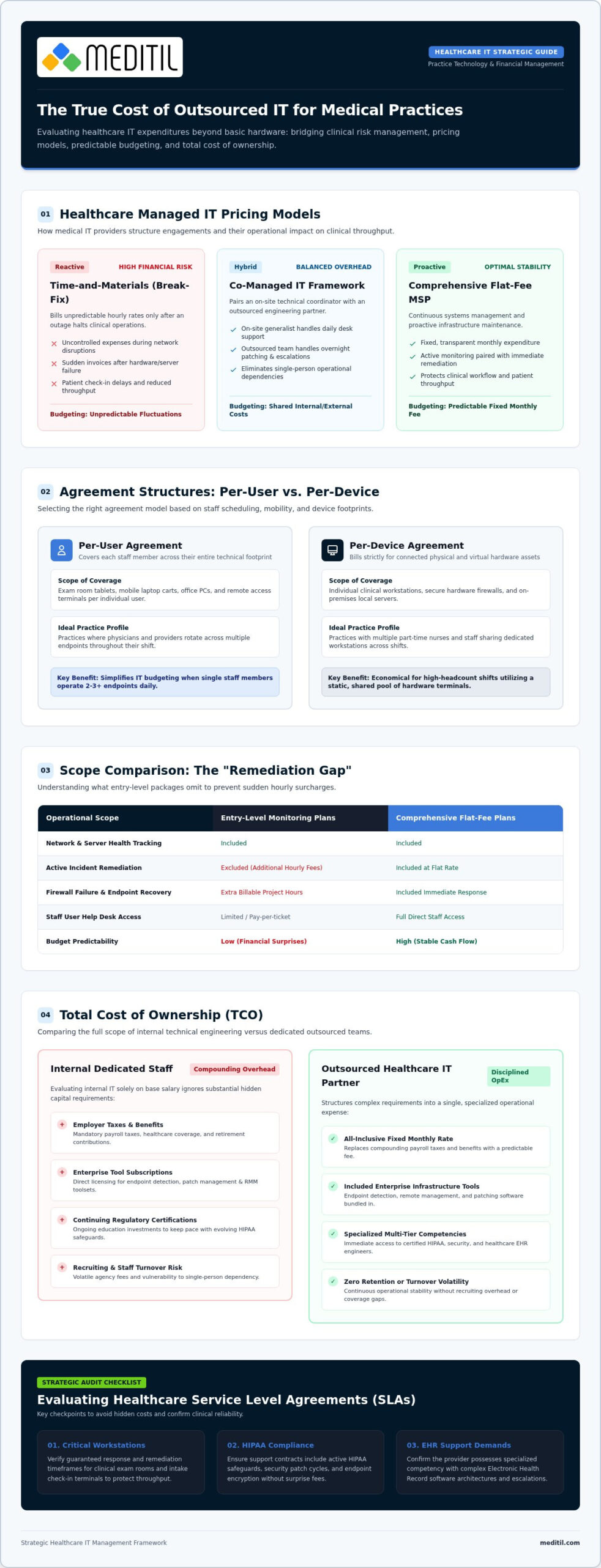
Medical billing agencies often blur the line between revenue cycle collections and technical technology oversight, leaving practices unprepared for actual network maintenance. Flat-fee support provides proactive infrastructure maintenance for a predictable monthly fee, whereas time-and-materials arrangements bill unpredictable hourly rates only after an outage halts clinical operations. Relying on reactive break-fix billing forces practices to absorb uncontrolled expenses during network disruptions. In contrast, modern medical groups partner with a specialized Managed Service Provider (MSP) to establish operational continuity through continuous systems management.
For practices with an existing technical coordinator, hybrid co-managed IT frameworks offer a practical middle ground. This structure pairs your on-site generalist with an outsourced team that handles specialized infrastructure engineering, overnight patching, and escalations, eliminating single-person dependencies without expanding internal headcount.
Per-User and Per-Device Managed Service Agreements
Service providers primarily structure ongoing support through either per-user or per-device models. A per-user agreement covers each staff member across their entire technology footprint, including exam room tablets, mobile laptop carts, and administrative desktops. This model simplifies budgeting when employees use multiple endpoints throughout their shifts.
Per-device contracts bill strictly for connected hardware assets, such as clinical workstations, secure firewalls, and on-premises servers. Practice managers should evaluate their personnel schedules carefully before choosing a structure. When multiple part-time nurses share a single workstation across rotating shifts, per-device pricing often proves more economical. Conversely, practices where physicians frequently rotate between mobile tablets, office laptops, and remote terminals benefit from the simplicity of per-user agreements.
Tiered Support Packages vs. Comprehensive Flat-Fee Plans
Not every managed agreement delivers the same operational scope. Entry-level monitoring packages track network connectivity and server health, yet they frequently omit hands-on remediation. If a firewall fails or an endpoint is compromised, your practice must pay additional hourly fees to fix the issue. This gap introduces sudden financial risk into your technology budget.
Investing in comprehensive managed it services for healthcare pairs active monitoring with immediate remediation, user help desk access, and preventative network management. Securing an all-inclusive plan ensures the total cost of outsourced IT for a medical practice remains stable, predictable, and directly aligned with clinical productivity.
Total Cost of Ownership: Outsourced IT vs. Internal Technical Staff
Evaluating an internal technical hire based solely on base salary produces an incomplete financial picture. When calculating total cost of ownership, healthcare administrators must weigh the full scope of employer taxes, benefits packages, ongoing regulatory certifications, and the enterprise management tools required to oversee clinical systems. In their strategic assessment of the pros and cons of IT outsourcing, healthcare leaders consistently point to specialized competencies and predictable overhead as primary catalysts for partnering with managed teams.
Factoring in recruiting fees and staff turnover makes in-house retention even more volatile. By structuring these requirements into specialized operational expenses, practices establish disciplined it budgeting for medical practices that protects cash flow while maintaining high technical standards.
Direct Payroll Expenses vs. Predictable Operational Fees
Employing an internal IT engineer demands substantial capital beyond base payroll. Medical groups must fund:
- Mandatory employer benefits, healthcare coverage, and payroll taxes.
- Enterprise software subscriptions for endpoint detection, patch management, and remote monitoring.
- Continuous continuing education to keep pace with changing HIPAA safeguards.
Managed service agreements replace these unpredictable, compounding personnel investments with a scalable operational expenditure that expands or contracts seamlessly alongside your clinical headcount.
Addressing the Coverage Gap in Clinical Environments
A solo in-house technician represents a dangerous single point of failure. If your engineer falls ill, takes vacation, or faces an unexpected resignation, clinical workflows stall without immediate recourse. Healthcare operations cannot pause when charting systems or digital imaging networks disconnect.
Outsourcing delivers access to a multi-tiered department of engineers, security analysts, and systems architects. For organizations with an existing technical employee, a co-managed approach offloads after-hours alerting and administrative routine tasks. This prevents staff burnout while preserving business continuity across every clinical shift.
Strategic Guidance: Fractional Executive Leadership
Small to mid-sized practices rarely need a full-time, six-figure executive technologist, yet they still require high-level governance. Retaining virtual cio services gives your leadership team access to executive-level guidance without executive overhead. This strategic resource manages hardware lifecycle planning, evaluates clinical integrations, and ensures your infrastructure budget actively advances practice expansion. If your practice seeks to stabilize technical spending while upgrading technical oversight, exploring structured healthcare IT solutions helps balance daily operational support with forward-looking leadership.
When evaluated comprehensively, the cost of outsourced IT for a medical practice delivers broad institutional depth that an isolated internal hire cannot match.
Core Variables That Determine Your Practice IT Investment
Technology expenditures in healthcare cannot be calculated through simple claims volume or raw software licenses. While generic commercial providers apply uniform pricing templates, the true cost of outsourced IT for a medical practice scales directly with the regulatory obligations and architecture required to keep protected health information secure. In healthcare technology, infrastructure complexity, rather than simple employee counts, ultimately determines your long-term service investment. A practice operating across several clinic locations with complex integrations requires substantially more network governance than a single-site general office.
Every operational variable alters technical overhead, from on-premises local network redundancy to strict data retention rules across hybrid cloud repositories. Understanding these drivers enables leadership to plan accurately rather than reacting to unexpected maintenance surcharges.
Practice Scale, Facilities, and Endpoint Distribution
Expanding across satellite clinics multiplies technical oversight requirements. Medical groups must maintain secure site-to-site connections, synchronized firewall policies, and uniform Wi-Fi networks capable of isolating medical hardware from public traffic. Beyond standard physical expansion, integrating remote patient monitoring hubs and dedicated telehealth platforms increases bandwidth demands and requires proactive quality-of-service routing. Diagnostic imaging systems also require specialized support tiers far beyond standard front-desk workstations, demanding dedicated local caching and verified backup pipelines.
EHR Ecosystem Complexity and Third-Party Interfaces
Clinical software rarely operates in isolation. Electronic health records depend on continuous interfaces connecting:
- Practice management modules and automated digital billing engines.
- Laboratory information systems transmitting diagnostic panels.
- Digital prescription gateways and patient engagement portals.
Each interface represents an operational point that demands routine testing, active troubleshooting, and external vendor coordination. Managing multiple third-party software publishers consumes significant engineering hours, directly shaping your overall support agreement.
Regulatory Compliance and Advanced Threat Protection
Healthcare facilities operate under intense regulatory scrutiny. Generic IT packages often omit the mandatory controls required by the HIPAA Security Rule, exposing clinics to massive non-compliance penalties. Securing patient records requires dedicated healthcare cybersecurity services, including multi-factor authentication enforcement, managed endpoint threat detection, and immutable cloud data backups designed for rapid disaster recovery. Prioritizing proactive defense ensures that the total cost of outsourced IT for a medical practice delivers resilient operations that shield clinical workflows from devastating ransomware events.
Evaluating Healthcare Service Level Agreements: Avoiding Hidden Costs
A master services agreement often looks straightforward until unexpected invoices start arriving for routine clinical changes. What appears to be an attractive initial rate can quickly escalate if the underlying Service Level Agreement (SLA) categorizes common administrative requests as billable out-of-scope work. Evaluating a proposal requires examining not just the base operational rate, but the precise contractual language defining incident response, onboarding limits, and compliance duties.
Every healthcare technical agreement must also center on a fully delineated Business Associate Agreement (BAA). A commercial provider unwilling to sign a clear BAA or define specific data breach containment timelines leaves your medical practice exposed to severe regulatory liability under HIPAA enforcement rules.
Scrutinizing Contract Scope: Included vs. Billable Services
Scope exclusions represent the most common source of budget volatility. When reviewing service agreements, administrators should clarify whether routine tasks trigger supplemental hourly billing:
- Onboarding new clinical providers or administrative staff.
- Configuring replacement exam room tablets and barcode scanners.
- Executing operating system patches outside regular clinic hours.
- Assisting with physical office expansions or server room relocations.
Clarifying these boundaries before signing keeps the net cost of outsourced IT for a medical practice predictable, preventing billing surprises when your team expands.
Guaranteed Response Times and Clinical Escalation Pathways
Never confuse initial response acknowledgment with actual resolution. Automated ticketing portals often issue an instant confirmation receipt within minutes, yet clinical workstations may remain completely unusable for hours while providers wait for an active engineer. A clinical SLA must define true time-to-remediation benchmarks tied directly to operational impact.
Ensure your contract establishes clear priority severity tiers. Issues halting patient check-in or severing digital prescription gateways require immediate high-priority escalation pathways, paired with defined contractual remedies or service credits if standards are missed. To ensure your agreements truly protect clinical continuity without hidden fees, consult with MEDITIL’s advisory team to evaluate comprehensive, transparent healthcare managed service frameworks.
Auditing these service details safeguards your budget and guarantees that your technical investment protects uninterrupted patient care.
Selecting a Healthcare IT Partner: Calculating Return on Investment
Generic customer reviews and general technology badges tell medical administrators very little about clinical reliability. While standard business providers manage basic office networks, healthcare facilities operate under demanding clinical throughput schedules and stringent patient privacy regulations. Evaluating the true return on investment means looking past surface pricing to determine how effectively a technology partner protects billable provider hours and operational stability.
A well-structured technical partnership directly increases clinic revenue capacity. When clinical workstations run smoothly and charting systems load without hesitation, physicians complete encounters on schedule, directly improving daily patient throughput. Framing the cost of outsourced IT for a medical practice around these clinical dividends shifts the discussion from an overhead liability to an operational driver.
Five Steps to Vetting a Healthcare Managed IT Provider
Administrators should apply a structured five-step framework during partner evaluations:
- Verify direct clinical software experience: Require documented proficiency with your specific electronic health records and practice management systems.
- Audit regulatory readiness: Demand executed Business Associate Agreements and inspect their standard HIPAA security controls, including immutable cloud backups.
- Examine incident response tiers: Validate priority escalation paths specifically designed around exam room disruptions and clinical intake interruptions.
- Assess strategic depth: Review capabilities across network architecture, infrastructure engineering, and fractional executive leadership to support long-term planning.
- Evaluate interoperability capabilities: Confirm practical experience connecting digital billing engines, diagnostic imaging, and third-party laboratory portals.
Measuring Business Value Beyond Upfront Service Fees
Quantifying technical return on investment requires analyzing clinical risk reduction. Implementing institutional-grade safeguards often helps practices satisfy strict cyber insurance underwriting terms, which can reduce premium overhead or prevent costly coverage denials. Minimizing workstation latency also prevents administrative fatigue, allowing clinical teams to focus entirely on patient care rather than troubleshooting freeze-ups.
Ultimately, a reliable digital foundation protects patient trust, ensures continuous billing operations, and keeps providers focused on patient care. The overall cost of outsourced IT for a medical practice is quickly offset when unexpected system disruptions disappear entirely. To build an infrastructure that supports your practice goals, Partner with MEDITIL for specialized healthcare technology leadership and reliable operational support.
Building a Predictable Foundation for Practice Growth
Transitioning away from volatile break-fix billing structures and single-engineer staffing models gives healthcare leadership lasting financial stability. When clinical administrators account for network complexity, data redundancy, and mandatory HIPAA safeguards, the cost of outsourced IT for a medical practice transforms into a transparent, high-yield operational investment rather than an unpredictable overhead expense.
True technical value lies in eliminating clinical disruptions before they hinder patient throughput. By unifying comprehensive managed infrastructure with deep EHR and billing workflow integration, your organization secures the rigorous compliance frameworks needed to protect sensitive patient records continuously.
A dependable technology architecture frees your providers and administrative staff to concentrate on exceptional patient outcomes with complete peace of mind. Strengthen your clinical operations with MEDITIL to establish stable, healthcare-dedicated IT leadership tailored to your practice’s long-term success.
Frequently Asked Questions
How is the cost of outsourced IT for a medical practice typically billed?
Providers generally structure their agreements around flat monthly operational fees using either per-user or per-device pricing models. Per-user agreements cover all endpoints assigned to a specific staff member, whereas per-device structures charge per physical workstation, mobile cart, or server. This subscription approach replaces unpredictable break-fix hourly invoices with steady, planned technical spending.
Why do healthcare-specific managed IT services cost more than generic commercial IT?
Healthcare networks require specialized clinical systems engineering, stringent regulatory controls, and deep interoperability management that generic IT vendors don’t provide. Supporting digital billing pipelines, diagnostic equipment, and complex EHR software demands specialized technical competencies. The cost of outsourced IT for a medical practice also incorporates mandatory HIPAA Security Rule safeguards, such as encrypted offsite backups and continuous access audits.
What technical services are typically excluded from standard medical IT contracts?
Major infrastructure overhauls, comprehensive platform migrations, and physical clinic relocations are usually classified as separate project-based consulting rather than routine support. Routine contracts also frequently exclude cabling installations, specialized software licensing purchases, and custom database development. Administrative leaders should inspect their master service agreement to clarify whether new employee onboarding triggers supplemental invoices.
Can a small clinic utilize co-managed IT to reduce overall support costs?
Yes, co-managed IT allows a small practice to support an on-site coordinator without bearing the expense of hiring an entire internal IT department. The outsourced partner handles complex network architecture, overnight patching, and advanced cybersecurity monitoring, while your internal staff member manages daily user requests. This hybrid model prevents single-engineer burnout and avoids gaps in clinical coverage.
How does a medical practice calculate the ROI of outsourcing its technology infrastructure?
Calculating return on investment requires measuring recovered provider hours alongside operational risk reduction. Practices quantify ROI by tracking decreases in charting downtime, steady hourly throughput across exam rooms, and lowered cyber insurance premiums resulting from enterprise security protocols. Preventing an extended network outage or clinical shutdown quickly offsets the monthly investment in proactive infrastructure management.
Does an outsourced IT provider assume liability for HIPAA security compliance?
A specialized provider shares regulatory responsibility by executing a formal Business Associate Agreement, but they don’t absolve the medical practice of covered entity obligations. The partner enforces technical safeguards, manages access controls, and monitors security logs to maintain compliance. However, internal leadership remains legally responsible for overall workforce adherence and clinic privacy policies.
What hidden fees should a medical practice watch out for in an MSP contract?
Administrators should look closely for after-hours emergency surcharges, onboarding fees for newly hired staff, and additional billing for routine patch management. Some service providers also charge extra for generating regulatory audit reports, remediating alerts detected by monitoring software, or coordinating with third-party EHR vendors. Clarifying these operational boundaries before contract execution ensures complete billing transparency.