
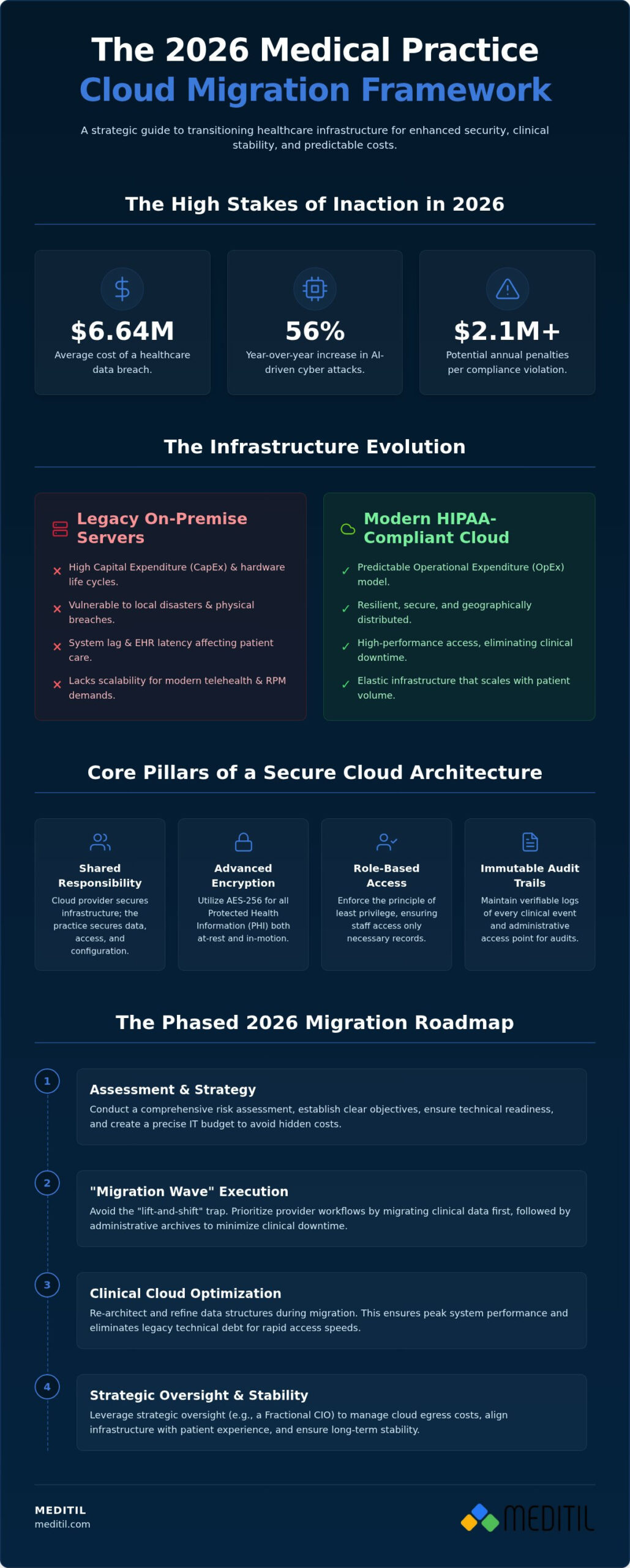
With the average healthcare data breach cost reaching $6.64 million in 2026, the migration to the cloud is no longer a simple IT upgrade; it’s a high-stakes clinical necessity. Medical practices searching for hipaa compliant cloud storage for medical records often realize that the move involves much more than selecting a provider. It’s about protecting your patients and your reputation in an era where AI-driven attacks have increased by 56% year-over-year.
You likely recognize that any disruption to your EHR or a single compliance gap can halt patient care and invite tiered penalties reaching over $2.1 million per year. Maintaining stability while modernizing infrastructure is a delicate balance. This guide provides a strategic framework to ensure your transition is seamless, secure, and financially predictable. We’ll examine how to eliminate clinical downtime, manage hidden egress costs, and build a resilient infrastructure that supports the long-term growth of your telehealth services.
Key Takeaways
- Identify why transitioning from on-premise infrastructure is critical for maintaining clinical stability and mitigating modern patient safety liabilities.
- Establish a secure architecture for hipaa compliant cloud storage for medical records by applying the shared responsibility model and robust encryption protocols.
- Minimize clinical downtime through a “Migration Wave” strategy that prioritizes provider workflows and separates clinical data from administrative archives.
- Execute a phased 2026 roadmap starting with a comprehensive risk assessment to ensure technical readiness and precise IT budgeting.
- Leverage strategic oversight from a Fractional CIO to manage cloud egress costs and align infrastructure with patient experience objectives.
The Strategic Necessity of Medical Practice Cloud Migration in 2026
By 2026, medical practice cloud migration has evolved from a technical option into a fundamental requirement for clinical stability. The healthcare industry has reached a critical tipping point where legacy on-premise servers represent a significant liability for patient safety. Physical hardware is inherently susceptible to local disasters, hardware degradation, and physical security breaches that can compromise the integrity of storing Protected Health Information. Transitioning to hipaa compliant cloud storage for medical records allows practices to move away from the heavy burden of capital expenditure (CapEx) toward a more sustainable operational expenditure (OpEx) model. This shift ensures that IT spending remains predictable and scales directly with patient volume rather than hardware life cycles.
The cloud is the only infrastructure capable of meeting the 2026 mandates for Remote Patient Monitoring (RPM) and telehealth scalability. As practices integrate vast amounts of patient-generated data, the demand for high-performance, elastic storage increases. On-site servers frequently lack the necessary bandwidth to handle these real-time data streams, which can lead to system latency or total failure during peak hours. A cloud-native approach provides the agility required to maintain high standards of care regardless of patient location.
Overcoming the “Lift-and-Shift” Trap
Many organizations fall into the trap of moving fragmented data structures directly into the cloud without optimization. This “lift-and-shift” method often leads to performance bottlenecks and carries legacy technical debt into a more complex environment. When you migrate inefficient processes, you’re simply paying a premium to host those inefficiencies elsewhere. Clinical Cloud Optimization represents the 2026 gold standard for re-architecting healthcare data to ensure peak system performance and total regulatory compliance. By refining data structures during the migration process, practices can achieve the rapid access speeds needed for modern clinical environments.
Identifying Your Practice’s Migration Drivers
System lag and aging hardware are the primary catalysts for a cloud transition. When EHR latency occurs, it directly contributes to physician burnout and reduces overall patient throughput. If your providers spend more time waiting for patient records to load than they do delivering care, your current infrastructure is failing your mission. Modern hipaa compliant cloud storage for medical records addresses these issues by providing superior interoperability. This seamless connectivity ensures that data moves securely between specialists, diagnostic labs, and pharmacies without the friction or downtime associated with legacy on-site systems.
Architecting a HIPAA-Compliant Cloud Environment
Establishing a framework for hipaa compliant cloud storage for medical records requires a clear understanding of the shared responsibility model. While major cloud providers secure the physical infrastructure, the medical practice remains responsible for configuring security controls, managing user permissions, and protecting data integrity. Following the official HHS guidance on cloud computing is essential to ensure that your Business Associate Agreements (BAAs) accurately reflect these divided duties. Precision in this phase prevents the misconfigurations that lead to the majority of cloud-based data breaches.
Data protection must be multilayered. Advanced encryption protocols, such as AES-256, should be applied to Protected Health Information (PHI) both at rest and while in motion across the network. Complementing this, Role-Based Access Control (RBAC) ensures that clinical and administrative staff only access the specific records necessary for their duties. This principle of least privilege is a cornerstone of identity management. The system must also maintain immutable audit trails. These logs provide a verifiable history of every clinical event and administrative access point, which is critical for both internal oversight and regulatory audits.
Security Beyond the Perimeter
Cybersecurity in the cloud extends far beyond basic firewalls. Integrating specialized healthcare cybersecurity services into the cloud fabric allows for real-time monitoring and proactive threat detection. Utilizing Security Information and Event Management (SIEM) systems helps identify anomalous patterns before they escalate into breaches. This proactive stance is vital for maintaining SOC 2 and HITRUST alignment. It provides a documented assurance that your practice meets the highest security benchmarks while keeping patient data safe from evolving AI-driven attacks.
Interoperability by Design
Cloud architecture should facilitate, not hinder, the flow of information. By leveraging FHIR-native APIs, practices can achieve seamless data exchange between disparate EHR systems and billing platforms. This connectivity reduces data silos and ensures that clinicians have a comprehensive view of the patient’s history. Strategic network management allows these systems to communicate securely within the cloud, improving operational efficiency and patient outcomes. If you’re unsure how to align these complex systems, reaching out for expert cloud consulting can help secure your infrastructure from the ground up.
Clinical-First Migration Strategies: Prioritizing Patient Care
Technical uptime is a baseline requirement, but clinical continuity is the true metric of a successful transition. A clinical-first strategy recognizes that moving to hipaa compliant cloud storage for medical records is a transformation of the provider’s daily environment rather than a simple back-end change. We utilize a “Migration Wave” approach to manage this complexity. This method segments active clinical datasets from archival administrative backups, ensuring that the high-priority information required for immediate patient care is available first. By staggering the transfer, we maintain system responsiveness and prevent the bandwidth congestion that often plagues rushed, all-at-once migrations.
Preparation begins with shadowing providers to map actual EHR workflows before a single byte of data moves. Understanding how a clinician navigates a chart or signs an order allows for the creation of specialty-specific templates. These templates ensure that the cloud-native environment feels intuitive and performs at peak speed from the first login. Minimizing clinical friction during this period is essential for maintaining patient safety and preventing the operational lag that can lead to provider frustration and reduced throughput.
Workflow Mapping and Optimization
Documenting existing clinical bottlenecks is a prerequisite for cloud success. If a practice has inefficient legacy processes, moving to the cloud will only accelerate those inefficiencies. We focus on configuring macros and order sets specifically for cloud-native performance, which significantly reduces the number of clicks required for routine tasks. During the critical go-live phase, an augmented IT team provides on-site floor support. This immediate, human-led assistance ensures that any minor technical hurdles are resolved instantly, allowing clinicians to remain focused on their patients rather than their screens.
Data Integrity and Validation
Maintaining the absolute precision of medical data is non-negotiable. After the transfer, we reconcile legacy records using mathematical integrity checks to verify that every data point remains unchanged. This is particularly vital when managing high-resolution medical imaging, such as PACS, where any quality loss can impact diagnostic accuracy. Our protocols ensure zero data loss during high-volume record transfers between environments. By implementing these rigorous validation steps, we provide the “steady hand at the wheel” necessary to protect your practice from the tiered HIPAA penalties associated with data corruption or loss, which can reach $72,596 per violation in cases of willful neglect.
The 2026 Medical Cloud Migration Roadmap
A successful transition requires a methodical, five-phase roadmap that prioritizes clinical safety and financial predictability. We begin with Phase 1: a comprehensive risk and readiness assessment. This involves auditing your current infrastructure to identify legacy vulnerabilities and technical debt. Once the baseline is established, we move to Phase 2, which focuses on developing a strategic roadmap and IT Budgeting. This ensures that all migration costs are transparent and aligned with your practice’s long-term growth objectives.
Phase 3 involves the actual cloud environment build-out and security hardening. Selecting and configuring hipaa compliant cloud storage for medical records happens here, ensuring that all encryption and access controls meet 2026 regulatory standards. Before a full transition, Phase 4 initiates a pilot migration. This smaller-scale move allows us to perform clinical workflow validation, ensuring that EHR performance meets provider expectations. Finally, Phase 5 marks the full-scale execution, supported by ongoing managed services to maintain system integrity and performance.
Integrating Billing and RCM Automation
Migrating to the cloud provides a unique opportunity to modernize your financial operations. Cloud-native environments are the ideal foundation for medical billing automation solutions. By connecting your revenue cycle management (RCM) software directly with cloud-hosted EHRs, you enable real-time data validation. This connectivity significantly reduces manual entry errors and claim denials. Improved data accuracy in the cloud ensures that your billing cycle remains as efficient as your clinical care, protecting your practice’s bottom line during and after the transition.
Staff Training and Change Management
The human element is often the most significant variable in a migration. We’ve found that 1-on-1 provider training is far superior to generic group sessions, as it addresses the specific workflow needs of different specialties. A clear communication plan keeps all clinical stakeholders informed, reducing anxiety and resistance to change. During the go-live period, we establish a “Command Center” for the immediate resolution of any post-migration issues. This dedicated support structure ensures that any technical friction is addressed instantly, keeping your focus on patient care. If you’re ready to secure your practice’s future, our team offers expert cloud services to lead your migration with precision.
Sustaining Stability: The Role of the Fractional CIO
Successful execution of a migration is only the first step toward long-term operational resilience. Clinical stability in a post-migration environment depends on continuous strategic oversight rather than passive maintenance. Without a dedicated strategist, practices often face “bill shock” as unmonitored data egress and unoptimized storage tiers cause monthly expenses to fluctuate unpredictably. Maintaining hipaa compliant cloud storage for medical records is not a one-time configuration but a perpetual commitment to security and performance. Leveraging virtual CIO services provides the high-level expertise needed to align these technical infrastructures with your clinical outcomes and patient experience goals.
Managing vendor relationships and interoperability updates on a national scale requires a sophisticated understanding of the healthcare ecosystem. As software vendors release patches and new API standards emerge, your cloud environment must adapt without disrupting provider workflows. A fractional CIO acts as the steady hand at the wheel, ensuring that your IT roadmap supports your practice’s mission rather than becoming a hurdle to care delivery. This proactive leadership ensures that your technology stack remains a competitive advantage rather than a source of technical debt.
Managing Technical Debt and Cloud Sprawl
Cloud sprawl occurs when resources are provisioned without a clear decommissioning plan, leading to unnecessary expenditures and expanded attack surfaces. Regular monitoring of resource utilization is essential to ensure that your practice only pays for the capacity it actually uses. This includes conducting regular security posture reviews and compliance updates to meet the rigorous 2026 standards. A vCIO prevents the ‘set-it-and-forget-it’ mentality in healthcare IT by ensuring that systems evolve alongside changing regulatory requirements and clinical needs. This disciplined approach keeps your hipaa compliant cloud storage for medical records lean, secure, and performant.
Partnering with a Managed Healthcare IT Expert
Building a foundation for future innovations, such as AI-driven diagnostics or enhanced remote monitoring, requires a reliable technical partner. Selecting a managed IT services for healthcare partner ensures that your practice benefits from 24/7 support for life-critical clinical systems. This partnership goes beyond simple help desk assistance; it provides a comprehensive support structure that manages the complexities of cybersecurity, interoperability, and system integration. By securing this expert guidance, your practice can focus on delivering high-quality patient care while your infrastructure remains stable, scalable, and fully compliant.
Securing Your Clinical Future Through Strategic Migration
Transitioning to the cloud is a pivotal move for any practice aiming for operational resilience. By prioritizing clinical workflows and adopting a methodical roadmap, you ensure that patient care remains uninterrupted while your infrastructure modernizes. The implementation of hipaa compliant cloud storage for medical records serves as the secure foundation for this transformation. It provides the necessary scalability for telehealth and remote monitoring while protecting your practice from the financial risks of data breaches.
Maintaining this stability requires a partner who understands the intersection of regulatory standards and clinical outcomes. MEDITIL offers a steady hand through specialized healthcare vCIO leadership and proven EHR interoperability success. Our approach centers on HIPAA-first infrastructure design to protect your practice from evolving threats and unpredictable costs. We’re ready to help you navigate these complexities with precision.
Schedule a Strategic Cloud Readiness Assessment with MEDITIL to begin your journey toward a more secure and efficient clinical environment. Your path to long-term stability starts with a single, strategic step forward.
Frequently Asked Questions
How long does a typical medical practice cloud migration take in 2026?
A typical medical practice cloud migration in 2026 takes between 3 and 9 months to complete. This timeline depends on the volume of clinical data and the complexity of your existing system integrations. Smaller practices often move faster, while larger organizations with extensive medical imaging archives require more time for rigorous data validation and clinical workflow testing.
Is cloud storage really HIPAA compliant for sensitive patient data?
Cloud storage is HIPAA compliant only when the practice signs a Business Associate Agreement (BAA) with the provider and configures the environment correctly. Utilizing hipaa compliant cloud storage for medical records requires a shared responsibility model. The provider secures the physical infrastructure, but the practice must manage access controls, encryption, and audit trails to meet 2026 regulatory standards.
What is the biggest risk to a medical practice during cloud migration?
The most significant risk during migration is clinical downtime that disrupts patient care. If workflows aren’t mapped accurately or data is moved without optimization, clinicians may experience record latency or system failures during patient encounters. This can lead to safety concerns and lost revenue, making a phased migration strategy essential for maintaining operational stability throughout the transition.
Can we migrate our existing EHR software to the cloud without changing vendors?
You can migrate most existing EHR software to a cloud environment without switching vendors. Many legacy applications are compatible with cloud hosting through virtualization or specific vendor-supported cloud versions. This allows your clinical staff to keep their familiar workflows while your practice gains the benefits of improved data mobility, better security, and more predictable IT costs.
How does cloud migration impact our practice’s internet bandwidth requirements?
Cloud migration significantly increases your internet bandwidth requirements because your EHR and patient records are no longer hosted on a local server. Your practice will likely need a high-speed fiber connection with a redundant backup line to ensure seamless access. Without sufficient bandwidth, providers will experience frustrating system lag that can reduce patient throughput and increase administrative burden.
What happens to our legacy on-premise data after the migration is complete?
Legacy on-premise data is typically moved to a secure, read-only cloud archive or decommissioned after a validation period. It’s critical to note that 2026 standards require audit logs for ePHI to be retained for at least six years. Proper archiving within hipaa compliant cloud storage for medical records ensures this data remains accessible for legal or audit purposes without slowing down active clinical systems.
How much does a medical cloud migration cost on average in 2026?
The cost of a medical cloud migration in 2026 varies based on data volume, the number of users, and system complexity. While there are initial costs for assessment and environment build-out, the transition to an operational expenditure model helps stabilize monthly IT spend. Practices should conduct a comprehensive readiness assessment to determine a precise budget that aligns with their specific clinical and financial goals.
Do we need to hire more IT staff to manage a cloud environment?
You don’t necessarily need to hire more internal IT staff to manage a cloud environment. Many practices find it more effective to partner with a managed IT provider or a fractional CIO who specializes in healthcare cloud architecture. This provides your practice with expert-level security and compliance oversight without the high salary and benefit costs associated with adding full-time, in-house technical personnel.