
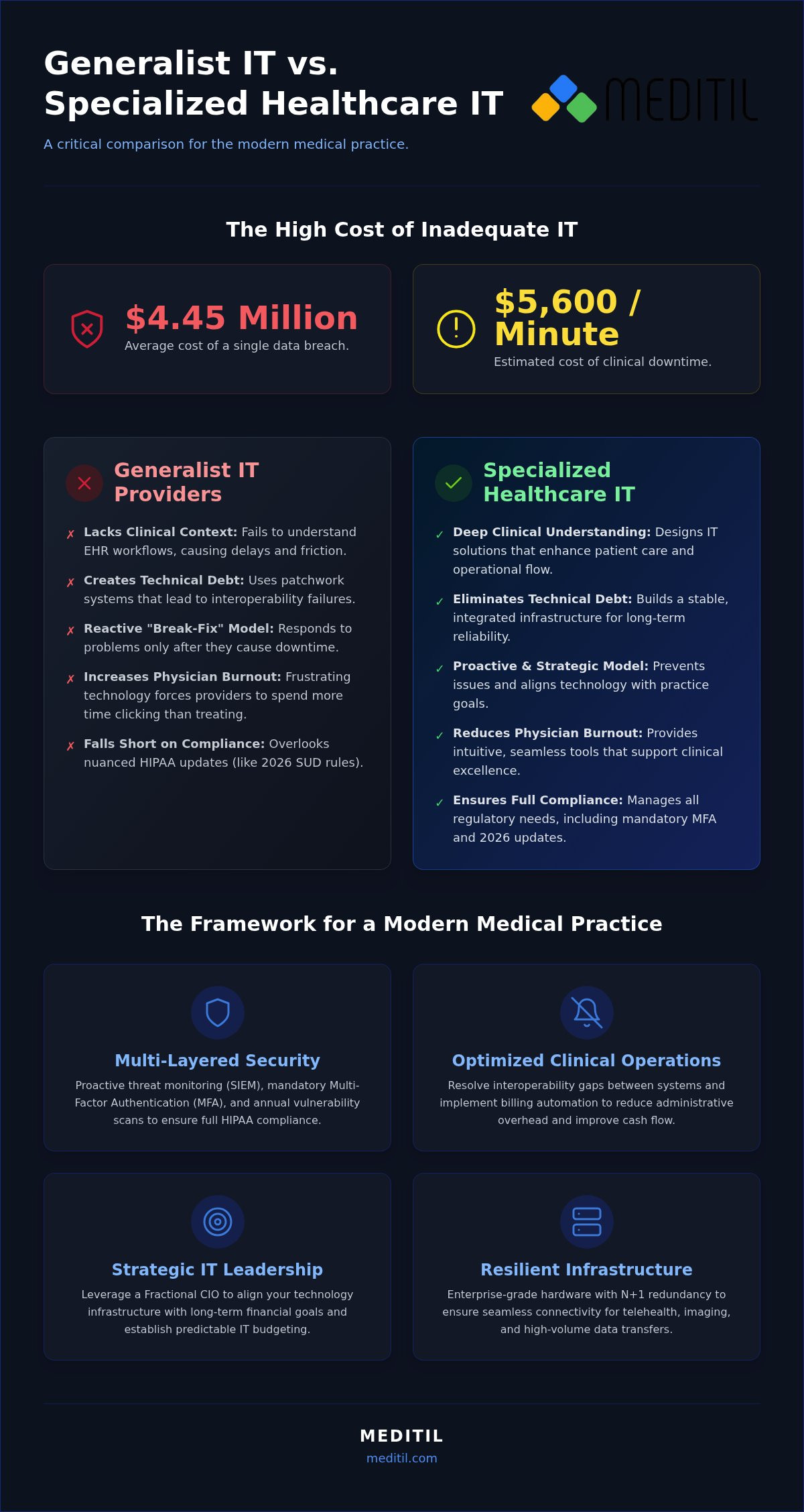
With the average cost of a data breach reaching $4.45 million and clinical downtime costing roughly $5,600 per minute, can your practice afford an IT provider that is still learning the nuances of medical interoperability? You likely entered medicine to care for patients, not to troubleshoot clunky EHR workflows or lose sleep over the February 16, 2026, HIPAA updates regarding substance use disorder records. It’s exhausting when technology feels like a friction point that contributes to physician burnout rather than a tool for clinical excellence. Specialized managed IT services for private medical practices solve these complex challenges by aligning your digital infrastructure with your specific operational goals.
This 2026 guide provides a comprehensive roadmap for transforming your technology into a reliable, strategic asset. You will discover how to implement mandatory multi-factor authentication and enhanced encryption protocols without disrupting the patient experience. We also examine how to achieve predictable budgeting while eliminating the hidden costs often found in generalist IT contracts. By the end of this article, you will understand how a proactive, healthcare-specific partnership ensures full regulatory compliance and seamless clinical operations through a steady, expert hand at the wheel.
Key Takeaways
- General IT providers often lack the clinical context required for complex medical environments; learn how specialized managed IT services for private medical practices eliminate technical debt and reduce physician burnout.
- Navigate the 2026 regulatory landscape with a multi-layered security framework that incorporates mandatory multi-factor authentication and proactive threat monitoring.
- Leverage the strategic foresight of a Fractional CIO to align your technology infrastructure with long-term financial goals and establish predictable IT budgeting.
- Optimize clinical operations by resolving interoperability gaps between disparate systems and implementing billing automation to reduce administrative overhead.
- Master the transition process by evaluating potential partners based on rigorous clinical uptime standards and healthcare-specific implementation expertise.
Why General Managed IT Services Fail Private Medical Practices
Many generalist providers claim they can support any business regardless of the industry. This assumption is dangerous for a medical practice. While a generalist might understand servers and email, they often lack the specialized knowledge required to manage modern healthcare IT infrastructure. Managed IT services for private medical practices require a deep understanding of clinical workflows. In these environments, a thirty-second delay in pulling up a chart isn’t just a nuisance; it’s a barrier to care. General providers often focus on basic uptime, but they miss the nuances of medical billing automation and EHR interoperability that keep a practice profitable.
Patchwork systems and legacy hardware create “technical debt” that compounds over time. In a retail environment, a slow terminal might delay a sale. In a private practice, technical debt leads to interoperability failures where patient data cannot move securely between specialists. This friction directly contributes to physician burnout. When technology fails to be intuitive, providers spend more time clicking than treating patients. A strategic partner understands that every piece of hardware must serve the clinical mission, not just the technical requirements.
The Regulatory Gap: HIPAA Compliance is Not Optional
Standard business security protocols often fall short of the rigorous standards required by the Department of Health and Human Services. As of February 16, 2026, HIPAA-covered entities must comply with updated requirements regarding Substance Use Disorder (SUD) records. Generalist providers often overlook these granular updates. They might secure your network, but they don’t perform the specialized risk assessments needed to protect patient data across diverse digital platforms. 2026 standards also demand mandatory multi-factor authentication and annual vulnerability scanning. These tasks require a steady, expert hand to implement without disrupting daily operations or patient access.
Clinical Friction and Its Impact on Patient Care
Slow networks and clunky login processes do more than frustrate staff. They delay treatment and reduce the number of patients a provider can see in a day. With the average cost of downtime for a mid-size practice reaching $5,600 per minute, the financial stakes are high. General providers typically operate on a reactive model, responding only after a system fails. A healthcare-specific partner focuses on proactive clinical support to ensure high-volume clinics maintain seamless connectivity. This approach transforms IT from a source of anxiety into a strategic asset that supports the patient journey. To find out more about the benefits of a proactive managed IT model, exploring comprehensive support options is recommended.
Core Components of Modern Healthcare IT Infrastructure
Modern clinical environments require a foundation that balances extreme accessibility with uncompromising security. The Core Components of Modern Healthcare IT focus on creating a resilient ecosystem where data flows without interruption. For a private practice, this means moving away from residential-grade hardware toward enterprise-level solutions that can handle the high-volume data transfer required by imaging and real-time EHR updates. Comprehensive managed IT services for private medical practices provide the steady hand at the wheel needed to manage these complex systems with precision.
Network Management and Connectivity
Telehealth and remote patient monitoring are now standard pillars of care. If your connection drops, patient care stops. We recommend implementing N+1 redundancy in critical clinical hubs. This configuration ensures that if one network component fails, a backup is already active to maintain the load. Effective stable network management allows your staff to focus on the patient instead of waiting for screens to load or sessions to buffer. This proactive approach to connectivity ensures that high-volume data transfers don’t bottleneck your daily operations.
Cybersecurity and Data Protection
Security in 2026 is a proactive discipline rather than a reactive one. It’s no longer enough to have a standard firewall. You need a multi-layered defense that includes SIEM (Security Information and Event Management) to monitor for anomalies in real-time. This level of oversight is essential for maintaining data integrity and meeting the rigorous standards expected from managed IT services for private medical practices. If you’re concerned about your current posture, exploring specialized healthcare cybersecurity services can provide the necessary verification that your patient records are truly protected. Mandatory multi-factor authentication and annual vulnerability scanning are now the baseline for any practice serious about compliance.
Finally, disaster recovery and business continuity are non-negotiable for life-critical systems. These systems must remain operational even during a local hardware failure or ISP outage. Cloud services tailored for medical record accessibility allow your team to work securely from any location while keeping data encrypted and compliant. Partnering with a specialist for Infrastructure & Network Services ensures your practice remains both efficient and secure, allowing you to focus on clinical outcomes rather than technical troubleshooting.
Strategic IT Leadership: The Power of a Fractional CIO
Many practices view IT as a support function, similar to plumbing or electricity. This tactical approach is insufficient for the complexities of modern healthcare. Strategic leadership transforms technology into a driver for clinical efficiency. By integrating managed IT services for private medical practices with high-level consulting, you move beyond “break-fix” cycles. A Fractional CIO acts as a proactive guide, ensuring that every hardware purchase or software update serves a long-term clinical objective. This oversight provides the stability needed to scale operations without technical bottlenecks. To understand how these strategic frameworks are applied in the field, you can learn more about CX IT Services and their managed support options.
Building a Multi-Year Strategic IT Roadmap
Infrastructure upgrades should never be reactive. A multi-year roadmap allows you to identify aging hardware and prioritize replacements before they fail. This foresight eliminates the sudden, large expenses that disrupt cash flow. By focusing on strategic IT budgeting for medical practices, you can manage technical debt systematically. This methodical approach ensures that your network remains capable of supporting emerging technologies, such as advanced billing automation or remote patient monitoring, without requiring emergency overhauls. It’s about building a foundation that supports growth rather than hindering it.
Fractional CIO vs. In-House Leadership
Most private practices don’t require a full-time Chief Information Officer, yet they still need executive-level oversight for compliance and security. Utilizing virtual CIO services provides access to seasoned expertise without the burden of a full-time executive salary. This model is particularly effective for managing existing IT teams or augmented departments. A strategic partner provides the “steady hand at the wheel,” navigating complex vendor relationships and ensuring that service level agreements align with clinical uptime requirements. This ensures that your practice receives the highest standard of technical governance.
Strategic leadership also bridges the gap between administrative goals and clinical reality. When a practice aligns its technology investments with its mission, the results are measurable. You see improved interoperability, reduced administrative friction, and a clear path toward future scalability. This level of oversight ensures that your managed IT services for private medical practices aren’t just keeping the lights on. They’re actively securing your practice’s financial and operational future through disciplined, results-oriented planning.
Optimizing Clinical Workflows: EHR, Interoperability, and Billing
Clinical efficiency depends on the seamless movement of data. When systems don’t communicate, providers are forced into repetitive manual tasks that lead to fatigue and administrative errors. Efficient managed IT services for private medical practices prioritize the physician experience by refining these digital interactions. Research indicates that 58% of patients are willing to switch providers for a better payment experience. This shift in patient consumerism makes workflow optimization a financial necessity rather than just an operational preference. Technology should empower the provider, not act as a barrier to care.
The Interoperability Challenge in Private Practice
The “silo” problem remains a significant hurdle for high-volume clinics. Valuable patient data often becomes trapped within imaging software, lab portals, or specific EMR modules. These fragments prevent a holistic view of the patient journey. Standardizing data exchange protocols ensures that care coordination happens in real-time. By bridging these gaps, your practice can reduce manual data entry and mitigate the human error associated with re-keying information across platforms. This connectivity allows for a fluid clinical environment where information is available exactly when the physician needs it, reducing the time spent on administrative navigation.
Billing Automation and Revenue Cycle Stability
Revenue cycle stability is often compromised by administrative bottlenecks that go undetected. Integrating billing software directly with your existing EHR systems allows for faster claims processing and reduced denial rates. We recommend exploring medical billing automation solutions to identify these friction points before they impact your cash flow. Technology should serve as a diagnostic tool for your business health, highlighting where delays occur and providing the data needed to resolve them. This proactive oversight ensures that your financial infrastructure is as resilient as your clinical systems.
A neutral consulting approach is essential when optimizing these workflows. Unlike providers who push specific software sales, a strategic partner evaluates your current stack to find the most efficient path forward. This results in a cohesive system where billing, clinical documentation, and patient scheduling work in unison. If your current workflow feels fragmented or contributes to staff burnout, it’s time to evaluate your systems integration strategy with an expert who understands the technical nuances of medical administration. This disciplined approach ensures your practice remains results-oriented and financially secure.
Selecting the Right Healthcare IT Partner: A Transition Roadmap
Choosing a provider for managed IT services for private medical practices is a high-stakes decision that dictates your operational stability for years to come. Technical proficiency is only the baseline; true partnership requires a deep alignment with clinical objectives and regulatory demands. A generalist might resolve a workstation issue, but they often lack the expertise to navigate the complex interoperability requirements of a high-volume clinic. Your selection process must prioritize a partner that provides a steady hand at the wheel, balancing immediate support with executive-level strategy.
The 5-Step Evaluation Checklist
A structured vetting process prevents the common pitfalls of inadequate support and hidden contractual costs. We recommend a methodical approach to verification:
- Step 1: Audit for HIPAA and regulatory track record. Ensure the provider is prepared for the February 16, 2026, updates regarding substance use disorder records and mandatory multi-factor authentication.
- Step 2: Verify experience with your specific EHR and specialty. Technical debt often accumulates when providers don’t understand the nuances of specific healthcare application support.
- Step 3: Assess strategic capabilities. Confirm the availability of Fractional CIO services to guide your multi-year technology roadmap and budgeting.
- Step 4: Evaluate Service Level Agreements (SLAs) for clinical uptime. With downtime costs averaging $5,600 per minute, your partner must commit to rapid response times that respect clinical urgency.
- Step 5: Review the transition methodology. A professional partner provides a clear, documented plan to migrate services without disrupting patient care or compromising data integrity.
The MEDITIL Approach: Your Strategic Healthcare IT Partner
MEDITIL functions as a dedicated strategic partner rather than a mere service vendor. We specialize in managing entire IT operations or providing augmented IT team models for practices with existing departments. Our focus remains on reducing clinical friction through sophisticated systems integration and billing automation. We maintain a neutral consulting stance, meaning we optimize your existing software stack to improve performance without pushing specific product sales. This disciplined, results-oriented methodology ensures your infrastructure becomes a reliable asset that supports growth.
The transition to a specialized provider doesn’t have to be a source of anxiety. Our methodical onboarding process is designed to identify and resolve vulnerabilities while maintaining seamless connectivity for your staff and patients. If your current technology environment feels fragmented or lacks a clear strategic direction, it’s time to elevate your standards. We invite you to schedule a strategic consultation to evaluate your practice’s roadmap and discover how professional managed IT services for private medical practices can secure your financial and clinical future.
Securing Your Practice’s Digital Future in 2026
The evolution of digital healthcare requires more than just functional hardware; it demands a strategic alignment of technology with clinical outcomes. By addressing technical debt and prioritizing interoperability, your practice can eliminate the friction that contributes to physician burnout. Professional managed IT services for private medical practices ensure that your infrastructure remains a resilient foundation for growth rather than an administrative burden. This methodical approach to infrastructure management allows you to focus on patient care while every technical detail is handled with precision.
MEDITIL offers the specialized healthcare IT expertise and national support infrastructure needed to navigate these complexities with confidence. Through our Fractional CIO leadership, we provide the steady hand at the wheel required to manage multi-year roadmaps and rigorous compliance standards. We invite you to Schedule a Strategic Consultation with MEDITIL to evaluate your current systems and secure your practice’s long-term operational success. Your digital transformation is a vital investment in both your staff’s productivity and your patients’ care.
Frequently Asked Questions
What is the difference between managed IT and healthcare-specific managed IT?
General managed IT focuses on standard business uptime and generic security. Healthcare-specific managed IT addresses the unique interoperability needs of medical environments. This includes managing complex data exchanges between imaging, labs, and EHRs while ensuring adherence to the February 16, 2026, HIPAA updates regarding substance use disorder records. Specialist providers understand that clinical workflows require a higher standard of connectivity and precision than standard office environments.
How do managed IT services help with HIPAA compliance for small practices?
Specialized managed IT services for private medical practices provide the technical framework necessary for continuous compliance. We implement mandatory multi-factor authentication, annual vulnerability scanning, and enhanced encryption protocols that align with 2026 standards. By performing specialized risk assessments, we identify vulnerabilities before they lead to breaches. This proactive oversight removes the administrative burden from your staff, ensuring your practice meets all regulatory requirements without disrupting patient care.
Will switching IT providers cause downtime for my clinic’s EHR?
A methodical transition plan is designed to prevent clinical downtime. Professional providers use a structured onboarding process that runs parallel to your current systems before the final migration. This approach allows for thorough verification of your EHR and network stability. By identifying potential friction points during the audit phase, we ensure that the switch is seamless, maintaining patient access and staff productivity throughout the entire transition period.
What exactly does a Fractional CIO do for a private medical practice?
A Fractional CIO provides executive-level technical leadership on a part-time basis. This role focuses on building multi-year strategic roadmaps and establishing predictable IT budgets. They act as a steady hand at the wheel, managing vendor relationships and ensuring that technology investments align with your long-term clinical goals. For a private practice, this means gaining the expertise of a seasoned executive to oversee technical governance without the cost of a full-time hire.
Can managed IT services help reduce physician and staff burnout?
Technology should be a tool for clinical enablement, not a source of frustration. Managed IT services for private medical practices reduce burnout by optimizing EHR workflows and eliminating clunky login processes. By resolving interoperability gaps and reducing manual data entry, we allow physicians to spend more time with patients and less time navigating fragmented systems. Streamlined operations create a more disciplined, results-oriented environment where staff can work efficiently.
How do you handle cybersecurity for remote staff and telehealth services?
We secure telehealth and remote staff through a multi-layered defense strategy. This includes deploying SIEM (Security Information and Event Management) to monitor for anomalies in real-time across all endpoints. We also implement secure remote monitoring and end-to-end encryption to protect patient data outside the clinic walls. This ensures that remote access remains as secure as your internal network, satisfying the rigorous data protection standards required by current healthcare regulations.
Do you sell EHR or billing software directly?
No, we do not sell EHR or billing software. We function as a neutral strategic partner, which allows us to focus entirely on optimizing your existing software stack. Our role is to provide healthcare application support and implementation expertise without the bias of software sales. This approach ensures that we recommend the most efficient path forward for your specific clinical needs, acting as a consultant invested in your long-term operational stability.
How does managed IT help with medical billing automation?
Managed IT facilitates billing automation by integrating your existing EHR with specialized billing platforms. We identify and resolve technical bottlenecks that cause claim denials or payment delays. By ensuring seamless data flow between clinical documentation and financial systems, we reduce the administrative overhead associated with manual billing processes. This results in revenue cycle stability and a better payment experience for your patients, which is increasingly vital in a consumer-driven healthcare market.