
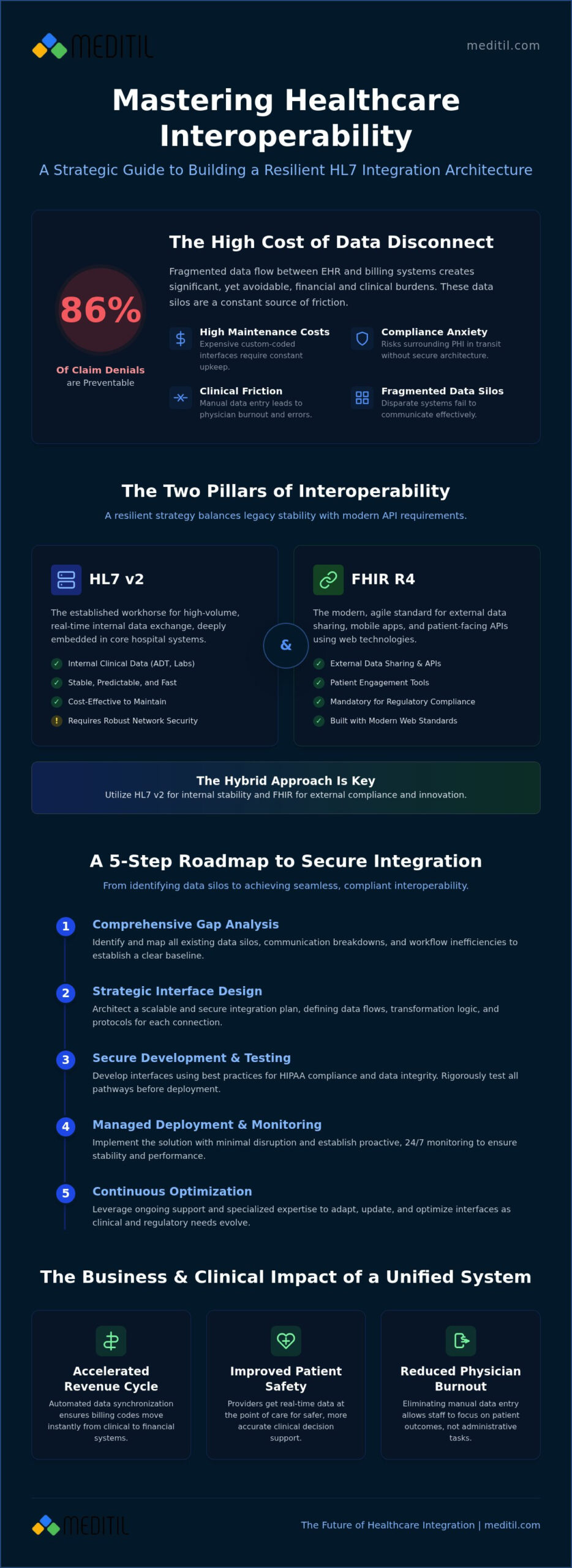
86% of healthcare claim denials are considered preventable with the right upstream checks, yet many organizations continue to struggle with fragmented data flow between their EHR and billing systems. You likely feel the weight of these data silos every day. Whether it’s the high cost of maintaining custom-coded interfaces or the compliance anxiety surrounding PHI in transit, the technical friction is a constant burden. It’s difficult to maintain clinical stability when your infrastructure feels like a collection of isolated parts rather than a unified system.
We understand that building a resilient hl7 integration strategy is about more than just moving data; it’s about creating a reliable nervous system for your entire clinical operation. This guide will help you master the complexities of interoperability to eliminate manual data entry and reduce clinical friction. We will examine a structured approach to balancing legacy HL7 v2 stability with modern FHIR R4 requirements. By the end, you’ll have the roadmap needed to build a scalable, HIPAA-compliant architecture that ensures your disparate medical systems finally work in perfect synchronization.
Key Takeaways
- Navigate the transition between legacy HL7 v2 messaging and modern FHIR API standards to ensure alignment with current regulatory requirements.
- Build a high-performing hl7 integration strategy that eliminates technical debt by moving away from isolated, one-off coding projects toward managed interface services.
- Implement a five-step roadmap for secure interface development, beginning with a comprehensive gap analysis to identify and resolve existing data silos.
- Reduce clinical friction and physician burnout by automating data transfers between EHR, billing, and ancillary medical systems.
- Leverage proactive monitoring and specialized healthcare expertise to maintain a stable, HIPAA-compliant environment for sensitive patient data in transit.
Understanding the Strategic Role of HL7 in Modern Healthcare
Health Level Seven (HL7) serves as the primary framework for exchanging, integrating, and sharing electronic health information. It’s the universal language that enables different software applications to communicate across diverse clinical settings. However, simply adopting a standard doesn’t guarantee connectivity. Most healthcare organizations operate within non-standardized EHR environments where out-of-the-box solutions fail to meet specific operational needs. This reality makes a robust hl7 integration strategy essential for any leader aiming to eliminate technical friction and data silos.
Custom interface development is often the only way to bridge the gap between proprietary systems. Without tailored coding, critical data remains trapped, forcing clinicians to hunt for information across multiple screens. Central to this architecture is the interface engine, such as Mirth Connect. This technology acts as a sophisticated router, translating and filtering messages to ensure they reach the correct destination in a readable format. When these systems function properly, they provide real-time clinical decision support that directly improves patient safety by ensuring providers have the most current data at the point of care.
The Business Case for Seamless Interoperability
Common Use Cases for HL7 Services
Effective implementation of an hl7 integration strategy typically targets high-impact areas where data silos cause the most delay. Consider these frequent integration points:
- Connecting Laboratory Information Systems (LIS) to the primary EHR to ensure results are immediately available for review.
- Integrating Radiology systems (PACS/RIS) with clinical workflows to provide faster imaging results and better diagnostic coordination.
- Bridging the gap between patient portals and internal scheduling tools to improve the patient experience and reduce no-show rates.
By treating these connections as strategic assets rather than isolated IT projects, organizations can build a more resilient and responsive clinical environment.
Evaluating Interoperability Standards: HL7 v2 vs. FHIR in 2026
In 2026, the decision between HL7 v2 and FHIR isn’t an either-or proposition. It’s a strategic alignment of technology with operational goals. HL7 v2 remains the dominant workhorse for internal clinical data, such as ADT (Admission, Discharge, Transfer) messages and laboratory results. Conversely, FHIR (Fast Healthcare Interoperability Resources) has become the mandatory standard for external data sharing and patient-facing APIs. While HL7 v3 was designed to be a more complex, model-driven successor, its high implementation costs and steep learning curve have left it as a niche standard, largely overshadowed by the agility of FHIR R4.
Most existing hospital infrastructure relies on v2 for high-volume, real-time messaging. It’s stable, predictable, and deeply embedded in billing and pharmacy systems. Replacing these legacy interfaces often yields a low return on investment if the current system meets operational needs. A successful hl7 integration strategy recognizes that maintaining v2 interfaces is often more cost-effective than a total modernization project. However, security is a critical factor. Because legacy HL7 messages weren’t built with modern encryption in mind, they require robust network protection and secure VPNs to remain compliant in a high-threat environment.
The Shift to FHIR and Modern APIs
FHIR R4 is the current production standard, enabling the seamless connectivity required for telehealth and remote patient monitoring. The CMS Interoperability and Prior Authorization Final Rule (CMS-0057-F) saw key provisions take effect on January 1, 2026, with full API implementation deadlines beginning January 1, 2027. This regulatory push makes an API-first roadmap essential for future-proofing your IT environment. FHIR’s use of JSON and RESTful architecture allows for easier integration with cloud-native applications and AI tools. If you’re looking to refine your technical roadmap, our systems integration consulting can help bridge the gap between these standards.
Preparing for this shift requires a thorough assessment of your current infrastructure. Organizations must determine which systems can be upgraded to support FHIR APIs and which should remain on v2 to avoid unnecessary technical debt. This methodical approach ensures that your interoperability efforts support long-term clinical and financial objectives without compromising system performance.
Custom Coding vs. Managed Interface Services: Managing Technical Debt
Many healthcare leaders fall into the “Project Trap” by treating interface development as a one-off capital expense. This approach often creates significant technical debt. Once the initial code is written and the developer moves on, the interface remains a static piece of infrastructure in a dynamic environment. A sustainable hl7 integration strategy requires moving beyond one-off coding toward a model of continuous oversight. This shift ensures that your systems remain synchronized as software versions change and regulatory requirements evolve. Organizations often find that integrating these interfaces into their broader Managed IT Services for Healthcare provides a more predictable cost structure and higher system uptime.
The Hidden Costs of Unmanaged Interfaces
Unmanaged interfaces are prone to “silent failures.” These occur when data packets are lost or misrouted without triggering an immediate system alert. In a clinical setting, this might mean a critical lab result never reaches the patient’s record, directly impacting safety and decision-making. Maintaining compliance updates on custom-coded middleware is another significant burden. General IT providers often lack the specialized knowledge required to secure medical data interfaces effectively, leaving the organization vulnerable to HIPAA violations. Proactive patching and real-time monitoring are essential to prevent these lapses and ensure data integrity across the network.
VCIO Oversight in Integration Projects
Strategic leadership is necessary to ensure technical specifications align with clinical outcomes. A fractional CIO acts as a steady hand, ensuring that your hl7 integration strategy supports actual physician workflows rather than complicating them. They manage complex relationships with EHR, lab, and billing vendors to ensure project accountability and prevent vendor finger-pointing when issues arise. This level of Virtual CIO Services ensures that every integration project is a calculated step toward long-term operational stability rather than a reactive fix. By focusing on the logical connection between technical challenges and clinical resolutions, leaders can build a high-performing environment that stands up to the rigors of modern healthcare.
A 5-Step Roadmap for Secure HL7 Interface Development
Executing a successful hl7 integration strategy requires a methodical progression from high-level clinical objectives to granular technical specifications. A structured roadmap prevents the technical debt discussed previously and ensures that every interface remains a stable component of your infrastructure. This five-step process serves as a blueprint for leaders seeking to build a high-performing interoperable environment.
- Step 1: Gap Analysis and Workflow Mapping. We begin by identifying exactly where data is lost or siloed. This involves mapping the journey of a patient record from intake through clinical documentation to final billing to ensure no critical data packets are dropped.
- Step 2: Architecture Design. During this phase, we select the appropriate interface engine and determine the optimal messaging standards. This is where the decision to utilize HL7 v2 for internal stability or FHIR for modern API connectivity is finalized.
- Step 3: Secure Development. Our specialists implement the necessary code while prioritizing the protection of PHI. This includes enforcing strict encryption standards for data both in transit and at rest.
- Step 4: Rigorous Testing. Before any interface goes live, it must undergo thorough validation in a sandbox environment. This prevents clinical disruption by ensuring the new interface handles edge cases and high-volume traffic without error.
- Step 5: Managed Support. Once in production, we implement 24/7 monitoring. This proactive oversight allows for immediate error handling and prevents the silent failures that can compromise patient safety.
Securing PHI During Transmission
Protecting sensitive data requires more than just standard software configurations. We implement secure HL7 messaging tunnels using VPNs and Transport Layer Security (TLS) to ensure that data remains encrypted as it moves between disparate systems. HIPAA regulations also mandate comprehensive audit logging for all interface activities. These logs provide a verifiable trail of who accessed what data and when, which is foundational for maintaining a secure healthcare cybersecurity posture in 2026.
Optimizing Billing Through Integration
A primary benefit of a refined hl7 integration strategy is the direct impact on the revenue cycle. By automating the flow of charges from the EHR to the billing engine, organizations can eliminate the lag and errors associated with manual entry. Research indicates that 86% of claim denials are preventable with better upstream data checks. Ensuring data integrity at the primary source through seamless medical billing automation significantly reduces denial rates and improves cash flow. If you are ready to stabilize your clinical data flow, our team provides the expert systems integration and interoperability services needed for long-term success.
Partnering for Seamless Interoperability: The MEDITIL Approach
Successful interoperability is more than a technical achievement; it’s a foundational operational standard. At MEDITIL, we recognize that a high-performing hl7 integration strategy must account for high-volume, life-critical data that cannot afford latency or transmission errors. Unlike generalist IT firms that treat healthcare as just another vertical, we focus exclusively on the medical environment. This specialization allows us to anticipate the specific technical friction points that occur between EHRs, laboratory systems, and billing engines. We don’t just provide software developers; we provide a partnership that prioritizes clinical stability and data integrity.
Our methodology combines technical execution with proactive oversight. We understand that your infrastructure must support high-volume data flows reliably, 24 hours a day. By integrating interface management into a broader Managed IT framework, we ensure that your systems remain synchronized even as your practice scales or regulatory requirements shift. This dual focus on infrastructure and strategy ensures that every data exchange is precise, secure, and fully aligned with your long-term business objectives.
The “Steady Hand” Approach to Medical IT
We prioritize operational stability over the pursuit of innovative software for its own sake. Our “steady hand” approach means we manage the entire IT lifecycle to prevent the interoperability bottlenecks that often lead to physician burnout. We ensure that your hl7 integration strategy includes rigorous verification and proactive monitoring to catch silent failures before they impact patient care. Our commitment to regulatory compliance and network security is absolute. We build every interface with a foundational focus on HIPAA standards, ensuring that PHI is protected throughout its journey across your network.
Your Next Steps Toward a Connected Practice
Moving toward a truly interoperable environment requires a methodical plan. We recommend beginning with a comprehensive interoperability audit of your current IT infrastructure. This assessment identifies existing data silos and technical debt that may be hindering your clinical efficiency. From there, we design a scalable roadmap for your next integration or modernization project, whether you’re transitioning to FHIR R4 or optimizing legacy v2 interfaces.
If you’re ready to eliminate manual data entry and build a more resilient clinical workflow, it’s time for a strategic conversation. You can contact MEDITIL for a consultation to discuss how our systems integration and interoperability services can stabilize your operations. We’re here to provide the expert leadership and technical precision required to ensure your medical systems work in perfect synchronization.
Stabilizing Your Interoperability Framework
Successful interoperability requires a shift from reactive troubleshooting to proactive management. A hybrid approach allows you to maintain the stability of HL7 v2 while embracing the modern API requirements of FHIR. By moving away from isolated, custom-coded projects and toward managed interface services, you eliminate the technical debt that often leads to silent failures and clinical friction. A successful hl7 integration strategy is ultimately about creating a seamless, secure environment where data flows reliably between every medical system in your practice.
Achieving this level of precision demands a partner who understands the high-stakes nature of life-critical systems. At MEDITIL, we combine HIPAA-compliant managed IT with fractional CIO expertise to ensure your infrastructure supports your clinical and financial goals. We’re ready to help you address the technical challenges of modern healthcare with a steady, experienced hand.
Schedule a Strategic Consultation with MEDITIL to begin optimizing your data environment today. We look forward to helping you build a high-performing, connected practice.
Frequently Asked Questions
What is the difference between an HL7 interface and an API?
HL7 v2 interfaces utilize a push/pull messaging model to transmit data packets between systems, whereas APIs like FHIR use modern RESTful web protocols to request specific data resources. An HL7 interface acts like a continuous stream of information triggered by clinical events. APIs allow for more flexible, targeted data access, which is essential for mobile applications and cloud-native services. A comprehensive hl7 integration strategy often incorporates both methods to ensure internal stability and external connectivity.
How much do HL7 interface development services typically cost?
Industry data indicates that the initial build of a single HL7 v2 interface typically requires an investment between $12,000 and $24,000. Larger, enterprise-wide integration projects involving multiple disparate systems can range from $50,000 to over $750,000 depending on complexity. These figures represent standard industry benchmarks for development. Organizations should also account for ongoing maintenance and monitoring costs to prevent technical debt and ensure the long-term integrity of their clinical data exchange.
Do I need an interface engine like Mirth Connect for my integration?
While not strictly mandatory for every single connection, an interface engine like Mirth Connect is highly recommended for any scalable hl7 integration strategy. These engines act as a centralized hub for routing, filtering, and translating messages between different systems. Without an engine, you are forced to manage a spaghetti network of point-to-point connections. This becomes difficult to monitor and expensive to maintain as your healthcare organization adds new clinical or administrative applications.
How long does it take to develop a custom HL7 interface between an EHR and a Lab?
The timeline for developing a custom HL7 v2 interface between an EHR and a Laboratory Information System typically ranges from 6 to 12 months. This duration accounts for workflow mapping, gap analysis, secure coding, and rigorous sandbox testing. Modern FHIR-based integrations can sometimes be deployed faster, often within 2 to 6 months, due to the use of standardized web technologies. However, the specific complexity of your non-standardized EHR environment will ultimately dictate the final delivery schedule.
Is HL7 v2 still compliant with modern healthcare regulations in 2026?
HL7 v2 remains the most widely used standard for internal hospital workflows in 2026 and is fully compliant for those purposes. However, the 21st Century Cures Act and CMS rules now mandate the use of FHIR-based APIs for external patient data sharing. To remain compliant, most organizations adopt a hybrid model. This approach keeps v2 for high-volume internal messaging, such as admissions and lab results, while utilizing FHIR to meet regulatory requirements for external interoperability.
Can HL7 interfaces help with medical billing automation?
HL7 interfaces are essential for effective medical billing automation. By synchronizing clinical documentation directly with the billing engine, you eliminate the delays and errors associated with manual data entry. This real-time data flow ensures that charges are captured accurately at the point of care. Because 86% of claim denials are considered preventable with better upstream checks, integrating these systems is a critical step in accelerating your revenue cycle and improving overall cash flow.
What are the most common reasons for HL7 interface failures?
Interface failures often stem from silent failures where data packets are lost without triggering an immediate alert. Other common causes include:
- Version mismatches between the sending and receiving systems.
- Inaccurate data mapping during the initial development phase.
- Network connectivity issues or expired security certificates.
- Unmanaged technical debt resulting from one-off coding projects.
Proactive monitoring and regular patching are necessary to identify and resolve these issues before they impact clinical operations.
Does MEDITIL provide ongoing support for existing HL7 interfaces?
Yes, MEDITIL provides comprehensive support for existing HL7 interfaces through our Managed IT and Healthcare Application Support services. We offer 24/7 monitoring and proactive error handling to ensure your life-critical systems remain stable. Our team specializes in infrastructure oversight and fractional CIO advisory, helping you manage the entire IT lifecycle. We focus on maintaining the precision and security of your data exchange, allowing your clinical staff to focus entirely on patient outcomes.